Qian Zhan Wang

Search documents
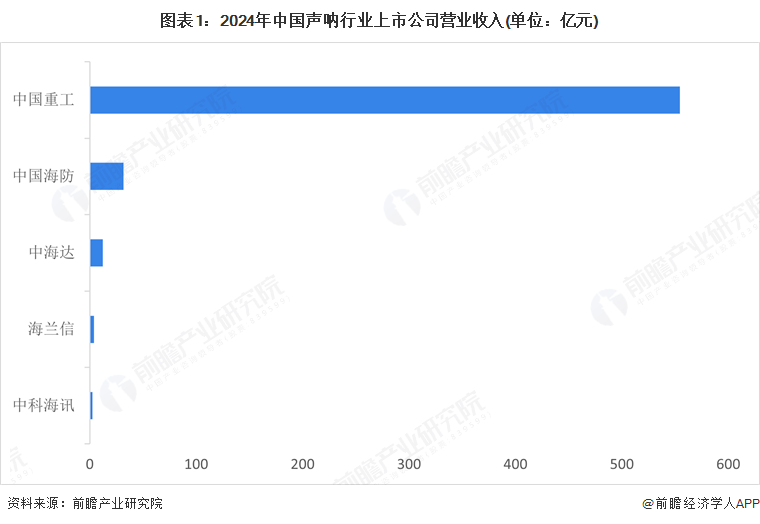
2025年中国声呐行业上市公司经营情况分析:龙头国企营业收入领先
Qian Zhan Wang· 2025-07-24 07:18
Revenue Situation - In 2024, China Shipbuilding Industry Corporation (CSIC) reported the highest revenue in the sonar industry, reaching 55.4 billion yuan. CSIC is a leading ship design and manufacturing enterprise in China, delivering 62 internationally advanced vessels, solidifying its global market position [1] - China Haifang ranked second with a revenue of 3.173 billion yuan [1] Net Profit Situation - CSIC also led in net profit for 2024, achieving 1.33 billion yuan. In contrast, China Haida reported a net loss of 40 million yuan, primarily due to macroeconomic downturns and reduced infrastructure investment impacting its traditional surveying equipment business [4] R&D Capability Analysis R&D Investment - CSIC had the highest R&D investment in 2024, amounting to 2.16 billion yuan, followed by China Haifang with 350 million yuan. The lowest R&D investment was from Zhongke Haixun at 30 million yuan [5] R&D Intensity - R&D intensity, defined as the ratio of R&D investment to revenue, showed that Hailanxin had the highest intensity at 22.51%. Zhongke Haixun followed with an intensity of 12.02%. CSIC had the lowest R&D intensity [8] R&D Personnel - CSIC employed the most R&D personnel, totaling 5,533, but this only accounted for approximately 20% of its total workforce. Zhongke Haixun had the highest proportion of R&D personnel relative to its total workforce at 60.5% [11]


2025年中国连接器行业招投标分析 招投标事件呈波动趋势【组图】
Qian Zhan Wang· 2025-07-24 06:39
Core Insights - The Chinese connector industry has seen a total of 16,600 bidding events from 2019 to June 2025, with a budget amounting to approximately 16.085 billion yuan [1][3] - The number of bidding projects in the connector industry showed a fluctuating trend, peaking at 6,139 projects in 2024, with 2,204 projects recorded in the first half of 2025 [3] - Projects with a bid amount of less than 200,000 yuan account for over 80% of the total projects in the connector industry [5] - The primary bidding entities in the connector industry are state-owned enterprises, which constitute 24% of the total bidding entities, while public institutions account for 31% [6] - The majority of connector bidding projects are concentrated in regions such as Guizhou and Hunan from 2021 to June 2025 [9]



一文读懂北京市人工智能特色产业发展现状与投资机会(附特色产业现状、空间布局、重点项目、产业投融资情况、投资机会分析等)
Qian Zhan Wang· 2025-07-24 04:12
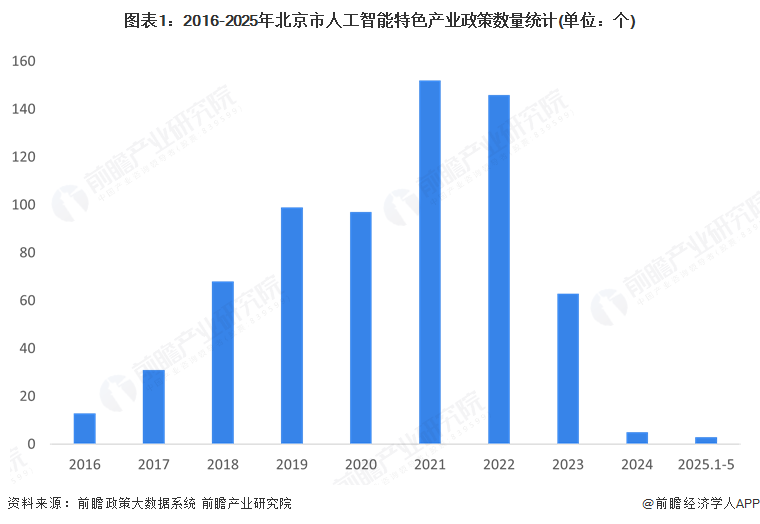
转自:前瞻产业研究院 行业主要上市公司:寒武纪(688256.SH);京北方(002987.SZ);中科金财(002657.SZ);格灵深瞳(688207.SH) 本文核心数据:人工智能产量;产业规模;产业政策;产业投融资情况 1、北京市人工智能特色产业政策环境 ——北京市人工智能特色产业政策数统计 截至2025年5月20日,北京市人工智能产业政策共有380条。2016-2024年,北京市人工智能特色产业政策数 量呈现迅猛增长后回落的趋势,2021年为北京市人工智能特色产业政策数量的峰值,高达152个。2024年北 京市人工智能特色产业政策数量为5个,2025年1-5月,北京市人工智能特色产业政策数量为0个。 | 时间 | 政策名称 | 内容解读 | 政策类型 | | --- | --- | --- | --- | | | | 到 2025年,基本形成要素齐全、技术领先、生态完备、可有力支撑 数字经济高质量发展的通用人工智能产业发展格局。上下游产业链布 | | | | 《北京市通用人 | 局持续优化,优质算力、高质量数据供给支撑能力大幅提升,大模型 | | | 2023.05 | 工智能产业创新 | 创新应用 ...
近亿元!优必选中标全球人形机器人单笔金额最大采购订单【附人形机器人行业发展趋势】
Qian Zhan Wang· 2025-07-23 10:59
Group 1 - UBTECH Technology successfully won a procurement project for robotic equipment from Miyi (Shanghai) Automotive Technology Co., amounting to 90.51 million yuan, marking the largest single procurement order in the humanoid robot field globally [2] - The product involved in this procurement is the self-developed industrial humanoid robot by UBTECH, which was announced just a day before the bid win [2] - UBTECH plans to deliver 500 units of industrial humanoid robots to the smart manufacturing industry by 2025 [2] Group 2 - UBTECH, founded on March 31, 2012, has a registered capital of 419.56 million yuan and is recognized as a global leader in artificial intelligence and humanoid robotics [6] - The company possesses a comprehensive technical capability in humanoid robotics, covering the entire R&D chain from hardware control technologies to AI algorithms and application frameworks [6] - UBTECH has over 2,450 patents related to robotics and AI, with more than 450 overseas patents, and holds the highest number of effective patents in humanoid robotics globally [9] Group 3 - The humanoid robot Walker S series has been implemented in over 30 leading industry production lines, achieving a failure rate of less than 0.3% and an efficiency rate 1.8 times that of human workers [9] - Shenzhen has rapidly emerged as a "pioneer city" in the global humanoid robotics industry, supported by unique policy backing, industrial chain advantages, and technological innovation capabilities [9][11] - As of March 2025, Shenzhen has gathered over 1,600 actuator companies, 2,600 sensor manufacturers, and 1,000 AI companies, forming a closed-loop ecosystem in the humanoid robotics industry [11] Group 4 - The Ministry of Industry and Information Technology's guidance document indicates that by 2027, the humanoid robotics industry is expected to achieve accelerated scale development, with products deeply integrated into the real economy [12] - Industry experts believe that a revolutionary transformation in humanoid robotics will require an additional 3-4 years, with significant advancements in AI capabilities needed [14] - The focus should be on areas where robots can take over repetitive and hazardous tasks, allowing humans to concentrate on creative and emotional activities, which is seen as a true advancement in technological civilization [14]


2025年中国土壤修复行业项目情况及发展趋势 土壤修复行业发展将更系统化【组图】
Qian Zhan Wang· 2025-07-23 08:29
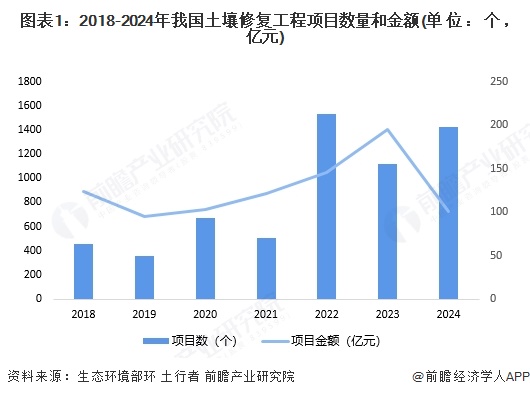
Group 1 - The core viewpoint of the article highlights the significant fluctuations in the scale of soil remediation projects in China, with a notable decrease in investment for 2024 [1][2] - The total investment scale for soil remediation engineering projects in 2024 is approximately 10.1 billion yuan, representing a 48% year-on-year decline [1] - The number of soil remediation engineering projects initiated in 2024 is 1,426, an increase of 309 projects compared to the previous year [1] Group 2 - The scale of soil remediation consulting projects has been increasing year by year, with 4,699 projects expected in 2024 and a total bid amount of 4.718 billion yuan [2] - Consulting service projects account for the largest number of projects, making up 72% of the total project count in 2024 [4] - The highest investment amount is in risk control and remediation projects, which account for 42.7% of the total project investment [4][5] Group 3 - The soil remediation industry is expected to develop in a more systematic manner, with a focus on regulatory frameworks and environmentally friendly development trends [9] - The growth in project numbers is primarily driven by the increase in consulting projects, which include various technical services [9] - Future development in the soil remediation sector is anticipated to be stable and regionally tailored, reflecting a cautious and phased approach to demand release [9]


【全网最全】2025年中国医疗美容行业上市公司全方位对比(附业务布局汇总、业绩对比、业务规划等)
Qian Zhan Wang· 2025-07-23 06:10
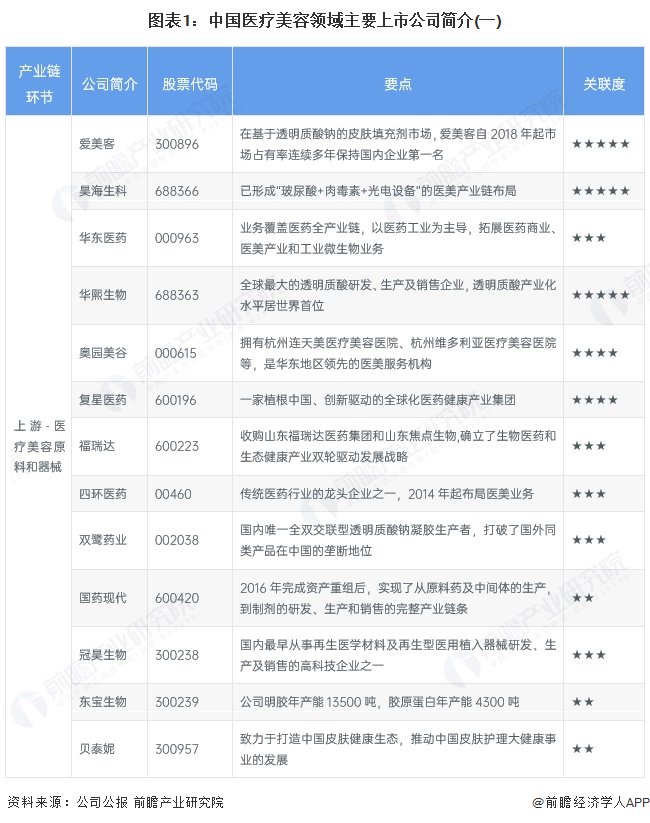
Group 1 - The article provides an overview of the Chinese medical beauty industry, highlighting key listed companies and their performance metrics [1][5][9] - Major players in the industry include Aimeike, Huaxi Biological, and Haohai Biological, with Aimeike maintaining the highest market share in the sodium hyaluronate filler market since 2018 [3][5] - The industry is characterized by a diverse supply chain, with upstream raw material manufacturers, midstream medical institutions, and downstream consumers [1][7] Group 2 - In 2024, Aimeike reported a revenue of 30.26 billion, while Huaxi Biological achieved 53.71 billion, indicating strong performance among leading companies [5][10] - The article notes that Aimeike has a gross profit margin exceeding 90%, outperforming other companies in the sector [9][10] - Companies are focusing on R&D innovation and brand building to enhance market competitiveness and meet evolving consumer demands [11][13] Group 3 - The geographical distribution of companies shows a concentration in coastal regions, particularly in major cities like Beijing, Shanghai, and Guangzhou, which host top research institutions and production companies [7] - Companies like Huadong Pharmaceutical and Huaxi Biological primarily focus on domestic sales, while others like Langzi and Huakan have diversified regional strategies [9][10] - Future plans for companies include enhancing R&D capabilities, expanding production projects, and improving customer service to create a win-win ecosystem [11][13]





2025年中国水下机器人行业上市公司经营情况分析: 研发强度有待提高
Qian Zhan Wang· 2025-07-23 04:11
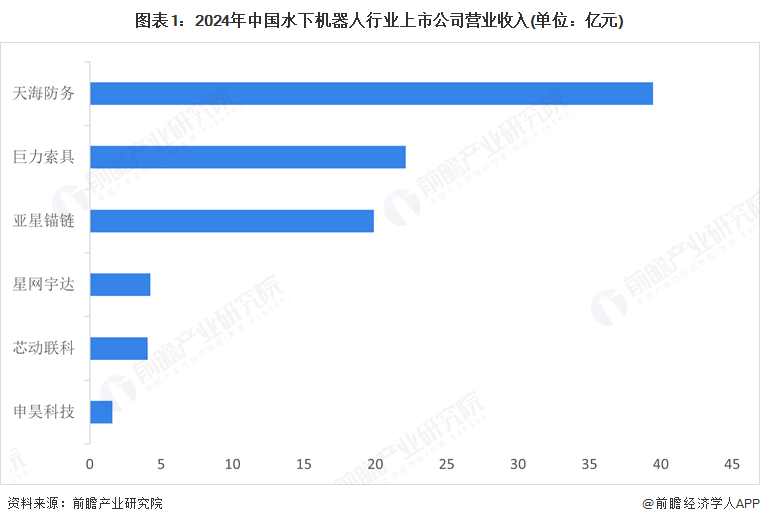
Revenue Situation - In 2024, Tianhai Defense reported the highest revenue in the underwater robotics industry, reaching 3.945 billion yuan, demonstrating strong technical research and market application capabilities [1] - Giant Lifting ranked second with a revenue of 2.214 billion yuan [1] Net Profit Situation - Astar Anchor Chain achieved the highest net profit in 2024, amounting to 335 million yuan [2] - StarNet Yuda reported the lowest net profit, with a loss of 278 million yuan, primarily due to restrictions on military material engineering service procurement qualifications, leading to a significant decrease in order volume and revenue [2] R&D Investment Situation - In 2024, Giant Lifting had the highest R&D investment at 119 million yuan, followed closely by Astar Anchor Chain with 113 million yuan [5] - Tianhai Defense had the lowest R&D investment, totaling 56 million yuan [5] R&D Intensity Situation - Shenhao Technology exhibited the highest R&D intensity, with R&D investment accounting for 67.24% of its revenue [7] - Chip Motion Technology followed with an R&D intensity of 27.07% [7] - Tianhai Defense had the lowest R&D intensity [7] R&D Personnel Situation - Astar Anchor Chain employed the highest number of R&D personnel, totaling 291, which represents 17.80% of the company's total workforce [9] - StarNet Yuda had the highest proportion of R&D personnel relative to its total workforce, at 31.94% [9]

英伟达黄仁勋:中国自动驾驶发展全球最快,遍地都是自动驾驶汽车【附自动驾驶行业市场分析】
Qian Zhan Wang· 2025-07-22 14:11
Core Insights - The rapid development of autonomous driving technology in China is highlighted as a global standout, with significant advancements made by companies like XPeng, Li Auto, NIO, Xiaomi, and BYD [2] - The Chinese autonomous driving industry is transitioning from technology validation to large-scale application, with a notable increase in the sales of smart connected vehicles equipped with driver assistance systems [2][4] - The integration of a complete technology ecosystem in China, encompassing multi-modal sensor fusion, deep learning algorithms, and real-time V2X interactions, has established a comprehensive "perception-decision-control" technology stack [2][4] Industry Overview - China's autonomous driving market is characterized by a competitive landscape where leading companies dominate while smaller firms engage in differentiated competition [4] - The supply chain's completeness and the size of the market contribute to the industry's growth, with significant advancements in chip production, algorithm development, and vehicle manufacturing [4] - The vertical integration of "chip-algorithm-vehicle" capabilities has positioned China favorably in the L2+ level driver assistance sector [4] Market Trends - The global shift towards higher-level autonomous driving technologies is accelerating, with L1/L2 functionalities now covering over 50% of new vehicle sales [4] - By 2030, L2+ systems are expected to become standard in new vehicles, with L3 and above accounting for 50% of the market [4] - Chinese manufacturers are leading the way in this transition, with products like XPeng's XNGP and Huawei's ADS 3.0 already implementing advanced navigation assistance features [4] Future Projections - The cost of high-level autonomous driving features is anticipated to decrease significantly, making them essential for vehicles priced above 200,000 yuan starting in 2025 [5] - The emergence of large model training-driven autonomous driving solutions is expected to further lower costs and enhance accessibility [5] - Industry experts predict that China could implement the world's most advanced and largest-scale fully autonomous driving systems within five years [5]


全球半导体格局或将重塑!日本Rapidus成功试产2nm芯片,计划2027实现量产【附全球半导体行业市场分析】
Qian Zhan Wang· 2025-07-22 10:10
Core Insights - Rapidus, a Japanese semiconductor manufacturer, has announced the initiation of 2nm wafer test production, aiming for mass production by 2027 in Chitose, Hokkaido, which could disrupt the current dominance of TSMC, Samsung, and Intel in the global chip industry [2][3] - The 2nm trial production utilizes Gate-All-Around (GAA) transistor technology, which enhances transistor density and energy efficiency compared to traditional FinFET technology [2] - The IIM-1 facility has made significant progress since its construction began in September 2023, with a cleanroom expected to be completed by 2024 and over 200 advanced equipment sets connected by June 2025 [2][3] Industry Context - Japan's semiconductor strategy, initiated in 2021, aims to restore global competitiveness through subsidies and tax incentives, with Rapidus receiving 590 billion yen (approximately $3.8 billion) in government funding [3] - Japan's semiconductor industry, once a leader in the 1980s, has faced decline due to technological lag and industry shifts, but the push for 2nm technology represents a strategic effort to regain influence in high-end chip manufacturing [3] - The global semiconductor market is currently dominated by TSMC, which holds over 50% of the foundry market share with 7nm and below processes, while Samsung and Intel also maintain significant positions in memory and processor markets, respectively [3] Competitive Landscape - TSMC plans to mass-produce 2nm chips by 2025, with Samsung following closely, presenting a significant challenge for Rapidus to catch up within a two-year timeframe [5] - The semiconductor industry is characterized by high investment and long development cycles, with the IIM-1 facility's construction costs exceeding 5 trillion yen (approximately $32 billion) [5] - Despite the fierce competition in advanced processes, there remains a substantial demand for mature process technologies, with the global semiconductor market reaching $428.4 billion in 2023, where integrated circuits account for 81% [6] Market Opportunities - Japan's traditional strengths in materials science and precision manufacturing could create new market opportunities by integrating advanced 2nm processes with mature technologies, particularly in sectors like automotive electronics [10]



打破欧美国家垄断!我国研制出系列牛用基因芯片,能让奶牛生产出优质牛奶【附基因测序技术分析】
Qian Zhan Wang· 2025-07-22 09:27
Core Viewpoint - The successful development of genome-based embryo genetic evaluation chips and high-performance genomic prediction chips by the National Dairy Technology Innovation Center marks a significant advancement in China's dairy breeding industry, transitioning from a follower to a leader in this field [2] Group 1: Technological Advancements - The newly developed genomic chips fill a gap in China's genetic evaluation technology for dairy cattle, which was previously dominated by developed countries [2] - The new chips enhance detection efficiency by over four times compared to traditional whole-genome sequencing, while reducing costs to one-fifth of previous methods [2] - The chips utilize machine learning and algorithm models, leveraging data from 96 large-scale farms and over 600,000 dairy cows to analyze genetic fingerprints [2] Group 2: Market Context - The Chinese gene sequencing market has seen rapid growth, with the market size increasing from less than 10 billion yuan to over 24 billion yuan from 2016 to 2022, reflecting a compound annual growth rate of over 20% [4] - The high technical barriers in gene sequencing mean that only a few companies, such as Illumina, Thermo Fisher, and BGI, have mass production capabilities [5] Group 3: Future Developments - The National Dairy Technology Innovation Center plans to develop a series of functional genetic testing chips focusing on local dairy cattle breeds, addressing breeding, milk production, and health indicators, while also exploring genetic traits for low carbon emissions and heat stress resistance [9]