Jing Ji Wang

Search documents
凌度智能:用机器人书写高空清洁行业的“中国方案”
Jing Ji Wang· 2025-08-15 09:10
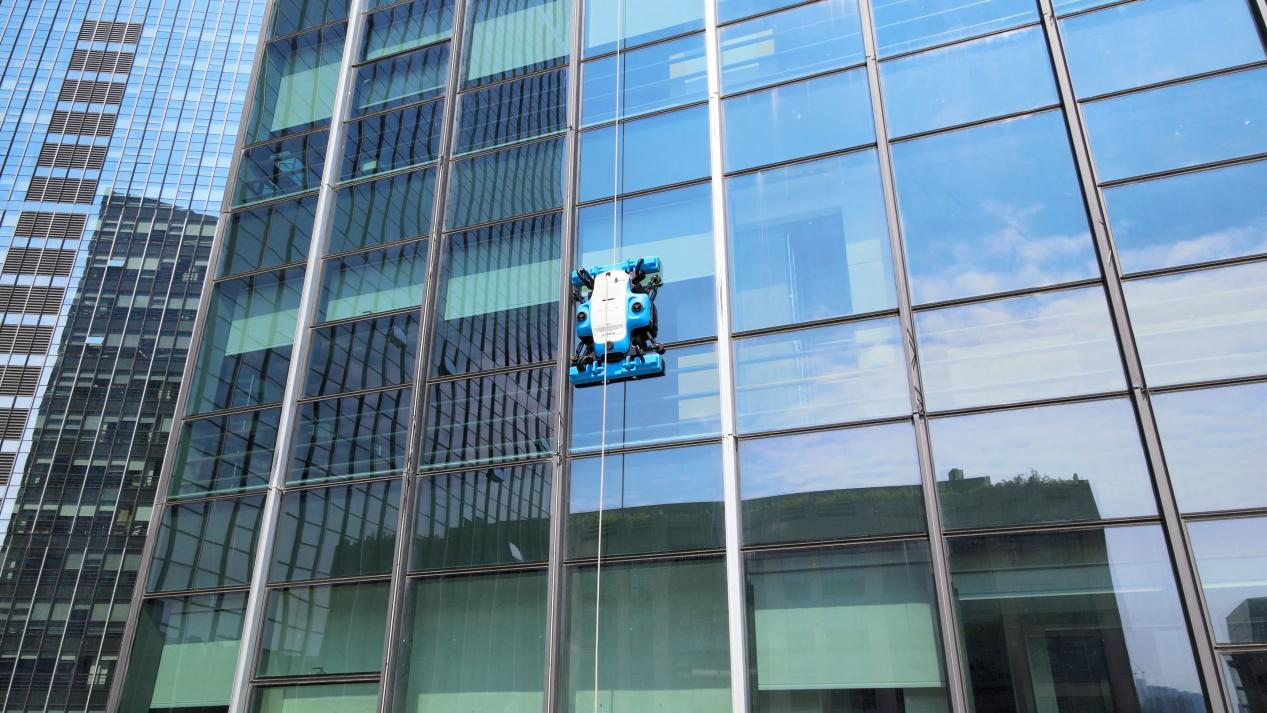
在广州黄埔区京广协同创新中心内,一台外形酷似"钢铁蜘蛛"的机器人正吸附在玻璃幕墙上灵活移动,喷水、刷洗、刮干一气呵成——这是凌度智能最新研 发的第三代高空幕墙清洗机器人"凌空K3"。 在这个4000平方米的现代化研发生产基地里,类似的创新场景每天都在上演。从2016年厦门初创时的几人团队,到如今产品远销全球21个国家和地区,广东 凌度智能科技发展有限公司(简称:凌度智能)用不到十年时间,完成了从行业开拓者到全球领跑者的蜕变。 凌度智能以用智能机器人替代高危、高压、高强度人工作业为出发点,专注智能化机器人领域。服务领域从高空幕墙到光伏面板,以智能化、数字化、高效 化为核心,解决传统人工作业高风险、低效率、用工难、不环保等问题。如今,凌度智能全面布局开发多种应用场景的机器人,为产业的智慧升级打造专业 化、智能化的整体解决方案。 创业动力:这是一个很伟大的事业 "有人说这么多年来是什么支撑你们不放弃的?一般搞个两三年就想放弃的。"凌度智能创始人兼董事长张志忠的一句话,道出了特种机器人创业的艰辛。 高空清洁行业被称为"蜘蛛人"的战场,每年因绳索断裂、天气突变等意外造成的伤亡事故触目惊心。每年高空作业事故不少见,其中幕 ...


中国石油绘就“油气开发与自然共生”画卷
Jing Ji Wang· 2025-08-15 08:57
Core Viewpoint - The company is actively promoting green transformation and biodiversity protection, aligning with the "green mountains and clear waters are gold and silver mountains" philosophy, and has made significant progress in ecological conservation and low-carbon development [1][2]. Group 1: Green Transformation Initiatives - The company is transitioning from primarily oil and gas production to a comprehensive energy supply model that includes oil, gas, heat, and hydrogen [2]. - Key environmental indicators, such as chemical oxygen demand and VOC emissions from refining enterprises, are expected to see a comprehensive decline by 2024 [2]. - The company has been recognized in Fortune magazine's "2024 Most Admired Chinese Companies" list for its outstanding performance in biodiversity protection [2]. Group 2: Biodiversity Protection Efforts - The company has established multiple biodiversity protection sites, including the Guo Wu Lake and Lao Hu Mountain, which host various protected species and contribute to ecological restoration [6][8]. - The Guo Wu Lake protection area covers 1.98 million square meters and is home to 114 plant species and 55 bird species, including two national first-class protected birds [6]. - The Lao Hu Mountain protection area spans approximately 2.17 million square meters, featuring 118 plant species and 32 bird species, including national first-class protected species [8]. Group 3: Specific Biodiversity Sites - The Alshan East Lake Wetland, covering about 15,000 square meters, serves as a habitat for numerous protected bird species and plays a crucial role in water conservation [9]. - The Yan Ge Lake, located in the Longqing Oilfield, has become a vital stopover for migratory birds, with the population of red-billed gulls increasing from dozens to over a thousand [10]. - The Tarim Desert Highway Protection Forest, recognized as the world's first "desert green corridor," spans 436 kilometers and supports over 20 million plants, providing a habitat for various bird species [15]. Group 4: Innovative Ecological Projects - The Tarim Oilfield's desert botanical garden is the first of its kind in a large moving desert, featuring nearly 200 plant species and contributing to ecological research and restoration [16]. - The Keke Ya Ecological Park has planted over 18,000 trees and serves as a biodiversity reservoir, with designated areas left undisturbed for wildlife [17]. - The Hainan Wenfeng Egret Habitat, covering 125,000 square meters, is a critical migratory corridor for various bird species and integrates ecological protection with community education [18].


最新经济数据公布!主要指标增长
Jing Ji Wang· 2025-08-15 08:49
Economic Overview - The national economy shows a steady and progressive development trend, with continuous growth in production and demand, stable employment and prices, and significant achievements in high-quality development [1] Industrial Performance - The industrial added value for July increased by 5.7% year-on-year and 0.38% month-on-month [2] - The equipment manufacturing sector saw an 8.4% year-on-year increase, while high-tech manufacturing grew by 9.3%, outperforming the overall industrial growth by 2.7 and 3.6 percentage points respectively [2] - Specific products such as 3D printing equipment, industrial robots, and new energy vehicles experienced production increases of 24.2%, 24.0%, and 17.1% year-on-year [3] Service Sector - The service production index rose by 5.8% year-on-year in July [4] - The business activity index for the service sector was at 50.0%, with a business activity expectation index of 56.6%, indicating positive sentiment in sectors like railway transport, air transport, and cultural entertainment [4] Consumer Market - The total retail sales of consumer goods reached 38,780 billion yuan in July, marking a 3.7% year-on-year increase, although it saw a slight month-on-month decline of 0.14% [5] - Sales of essential and some upgraded consumer goods showed strong growth, with categories like food, daily necessities, and sports goods retailing up by 8.6%, 8.2%, and 13.7% respectively [5] - Online retail sales for the first seven months totaled 86,835 billion yuan, growing by 9.2%, with physical goods online retailing at 70,790 billion yuan, a 6.3% increase [5] Investment Trends - Fixed asset investment (excluding rural households) for the first seven months was 288,229 billion yuan, reflecting a 1.6% year-on-year growth, with a 5.3% increase when excluding real estate development [7] - Infrastructure investment grew by 3.2%, while manufacturing investment rose by 6.2%, contrasting with a 12.0% decline in real estate development investment [8] Trade Performance - In July, the total value of goods imports and exports reached 39,102 billion yuan, a 6.7% year-on-year increase, with exports at 23,077 billion yuan (up 8.0%) and imports at 16,026 billion yuan (up 4.8%) [10] - For the first seven months, the total trade value was 256,969 billion yuan, with exports growing by 7.3% and imports declining by 1.6% [10] Employment and Prices - The urban surveyed unemployment rate averaged 5.2% from January to July, with July's rate also at 5.2%, showing a 0.2 percentage point increase from the previous month [12] - The Consumer Price Index (CPI) remained flat year-on-year in July, with a month-on-month increase of 0.4% [13] - Core CPI, excluding food and energy prices, rose by 0.8%, with the increase slightly widening by 0.1 percentage points from the previous month [14]
超740亿元!三巨头分红方案披露
Jing Ji Wang· 2025-08-15 08:49
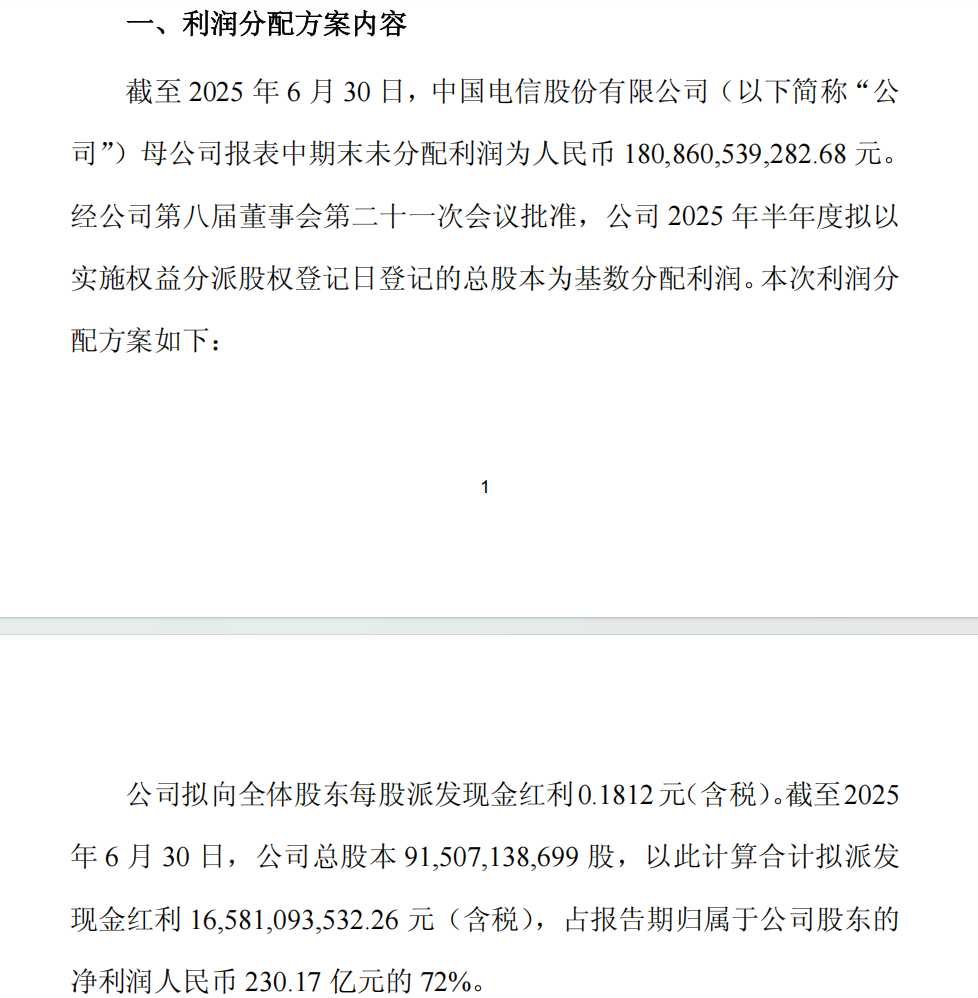
Core Viewpoint - The three major telecom operators in China reported positive growth in net profit for the first half of 2025, while revenue growth showed divergence among them [1][2]. Group 1: Financial Performance - China Telecom achieved operating revenue of 2694.22 billion yuan, a year-on-year increase of 1.3%, and a net profit attributable to shareholders of 230.17 billion yuan, up 5.5% [2]. - China Mobile reported operating revenue of 5437.69 billion yuan, a decline of 0.5%, but a net profit of 842.35 billion yuan, reflecting a growth of 5% [2]. - China Unicom's operating revenue reached 2002.02 billion yuan, growing by 1.5%, with a net profit of 63.49 billion yuan, an increase of 5.1% [2]. Group 2: Dividend Distribution - The three telecom operators plan a total interim dividend exceeding 740 billion yuan [3]. - China Telecom's interim profit distribution plan includes a cash dividend of 0.1812 yuan per share, totaling approximately 165.81 billion yuan, which is 72% of its net profit [3][5]. - China Mobile intends to distribute an interim dividend of 2.75 Hong Kong dollars per share, which is a 5.8% increase year-on-year, amounting to about 540 billion yuan [5]. - China Unicom plans to distribute a cash dividend of 1.112 yuan per 10 shares, totaling around 34.77 billion yuan [7].



核心零售和新业务协同助推用户活跃度飙升,京东集团二季度营收增速创近三年新高
Jing Ji Wang· 2025-08-15 08:49
Group 1 - JD Group reported Q2 2025 revenue of 356.7 billion yuan, a year-on-year increase of 22.4%, marking the highest growth rate in nearly three years [1] - Core retail business showed strong performance with a 20.6% year-on-year growth and an operating profit margin of 4.5%, the highest in promotional quarters [1] - New business revenue surged by 199%, primarily driven by JD's food delivery services [1] Group 2 - User traffic, active user count, and purchase frequency all saw significant growth, with active user count increasing by over 40% year-on-year for seven consecutive quarters [1] - During the "618" shopping festival, JD's overall order volume exceeded 2.2 billion, with daily active users reaching a historical high [1] - JD Supermarket launched new products and enhanced user experience through supply chain innovations, including the introduction of "JD label" products [2] Group 3 - JD's food delivery service achieved over 25 million daily orders, covering 350 cities with over 1.5 million quality restaurant partners [2] - The company has invested over 150 billion yuan in R&D since 2017, with supply chain infrastructure assets nearing 170 billion yuan [2] - JD plans to recruit 35,000 positions in 2026 and has invested 7 billion yuan in youth apartments in Beijing [3] Group 4 - JD has employed over 4,000 disabled individuals and supports their employment through training and operational guidance [3] - The company aims to introduce 1,000 overseas brands within three years, targeting a cumulative sales growth of 10 billion yuan [2]

广发银行绿色信贷余额突破2100亿元
Jing Ji Wang· 2025-08-15 08:49
Core Viewpoint - The "Two Mountains" concept emphasizes the relationship between economic development and ecological protection, serving as a significant development philosophy and a major principle for modern construction [1] Group 1: Green Finance Initiatives - China Life Insurance has actively implemented the "Two Mountains" concept by expanding green finance products and services, contributing to high-quality development and the construction of a beautiful China [1] - In Anji County, the birthplace of the "Two Mountains" concept, China Life's subsidiary, Guangfa Bank, provided a syndicated loan of 200 million yuan for bamboo industry upgrades and carbon sink projects, enhancing insurance services for forestry [2] - Guangfa Bank's green credit balance exceeded 210 billion yuan by June 2025, supporting over 50 carbon reduction projects nationwide [2] - China Life Property Insurance launched marine carbon sink index insurance in Weihai, Shandong, to mitigate risks from environmental changes, promoting a shift from "relying on the sea" to "nurturing the sea" [2] Group 2: Innovative Green Insurance Products - China Life Property Insurance's green insurance offerings provided risk coverage of approximately 8.64 trillion yuan in the first half of 2025, reflecting the growth of green insurance scale [3] - In Shenzhen, China Life's investment in Shenzhen Energy Environmental Co. amounted to 1.5 billion yuan, supporting the transformation of waste incineration plants into energy ecological parks [4] Group 3: Clean Energy Investments - China Life has leveraged its large-scale insurance capital to support investments in clean energy sectors, including hydropower, wind, solar, and nuclear energy [5] - The establishment of the "China Life-Lancang No. 1 Green Equity Investment Plan" and "China Life-Lancang No. 2 Green Equity Investment Plan" involved a strategic investment of 5 billion yuan to enhance hydropower capacity and clean energy investments, potentially reducing carbon emissions by approximately 37 million tons annually [5] Group 4: Financial Support for Transition - Guangfa Bank provided a specialized green finance service plan for a leading glass company in Guangdong, introducing a mechanism linking emission reduction targets with financing costs, thus incentivizing green transformation [6] Group 5: Promoting Green Lifestyle Choices - In Qinghai, China Life Property Insurance introduced a combination of "green car insurance" and "green home insurance," linking car insurance pricing to low-carbon repair commitments [8] - Guangfa Bank launched a comprehensive automotive financial service plan, focusing on new energy vehicle consumption, with auto consumption loans growing over 26% in the first half of 2025 [8] Group 6: Digital Transformation in Green Finance - China Life is integrating digital finance into carbon reduction practices, enhancing customer service through various online platforms, with significant improvements in claims processing efficiency [9]

泽立美通过医保目录初步形式审查
Jing Ji Wang· 2025-08-15 07:46
据介绍,泽立美是我国首个针对2岁以上儿童特应性皮炎的非激素类AhR靶点创新药物,2024年11月通 过国家药品监督管理局儿童药优先审评审批程序获批上市。其作用机制、安全性以及技术特点为全球儿 童湿疹治疗做出贡献。临床研究数据表明,该药有效避免了传统激素类药物可能导致的皮肤萎缩等不良 反应,为儿童湿疹的长期、安全治疗提供了选择。 对此,上海泽德曼医药科技有限公司相关负责人表示:"泽立美通过医保初审,是对公司长期专注创新 研发的积极肯定。我们将全力配合国家医保政策落地,加速药品可及性,降低用药负担,让这一创新成 果更快、更广地惠及全国患儿家庭。" 8月12日,《关于公示通过2025年国家基本医疗保险、生育保险和工伤保险药品目录及商保创新药目录 调整初步形式审查的药品及相关信息的公告》正式发布,上海泽德曼医药科技有限公司研发的儿童湿疹 治疗创新药——泽立美(本维莫德乳膏)通过医保目录初步形式审查。这标志着该药有望被纳入新版国 家医保目录,为特应性皮炎患儿带去更多治疗希望。 ...
房价涨了跌了?数据公布!
Jing Ji Wang· 2025-08-15 03:29
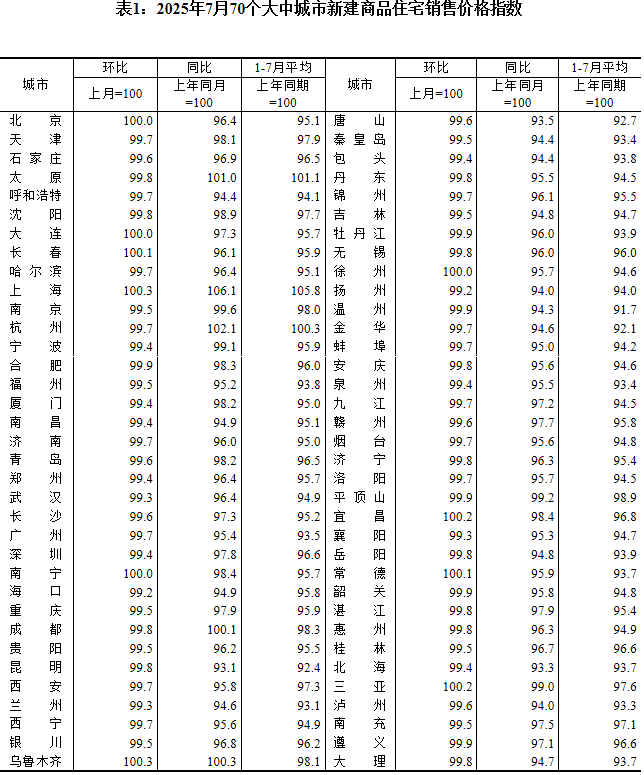
Core Insights - The core viewpoint of the article indicates that in July 2025, the sales prices of commercial residential properties in 70 large and medium-sized cities in China experienced a month-on-month decline, but the year-on-year decline has narrowed overall [1]. Price Changes Overview - In July 2025, the sales prices of new commercial residential properties in first-tier cities decreased by 0.2% month-on-month, with the decline narrowing by 0.1 percentage points compared to the previous month [6]. - The sales prices of new commercial residential properties in second-tier cities fell by 0.4% month-on-month, with the decline expanding by 0.2 percentage points [6]. - The sales prices of new commercial residential properties in third-tier cities decreased by 0.3% month-on-month, with the decline remaining the same as the previous month [6]. Year-on-Year Price Changes - In July 2025, the year-on-year sales prices of new commercial residential properties in first-tier cities dropped by 1.1%, with the decline narrowing by 0.3 percentage points compared to the previous month [7]. - The year-on-year sales prices in second-tier and third-tier cities decreased by 2.8% and 4.2%, respectively, with declines narrowing by 0.2 and 0.4 percentage points [7]. - Among the 70 large and medium-sized cities, five cities saw year-on-year increases in new commercial residential property prices, an increase of two cities compared to the previous month [7]. Second-Hand Residential Prices - In July 2025, the month-on-month sales prices of second-hand residential properties in first-tier cities fell by 1.0%, with the decline expanding by 0.3 percentage points compared to the previous month [6]. - The year-on-year sales prices of second-hand residential properties in first-tier cities decreased by 3.4%, with the decline expanding by 0.4 percentage points [7]. - The year-on-year sales prices in second-tier and third-tier cities for second-hand residential properties fell by 5.6% and 6.4%, respectively, with declines narrowing by 0.2 and 0.3 percentage points [7].
利好来了!央行宣布:5000亿元
Jing Ji Wang· 2025-08-15 03:27
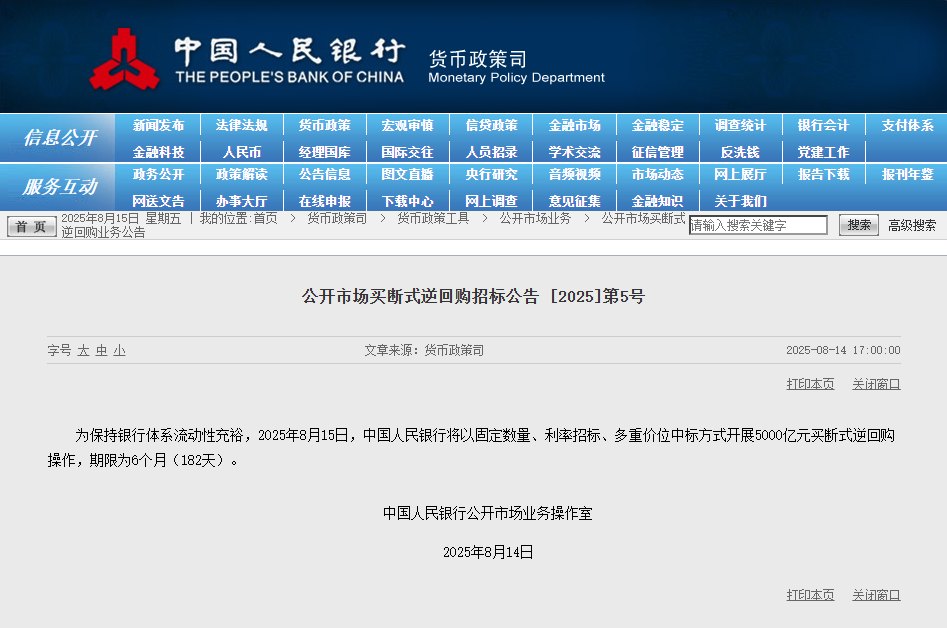
Core Points - The People's Bank of China (PBOC) announced a buyout reverse repurchase operation of 500 billion yuan to maintain ample liquidity in the banking system [1][2] - The operation will be conducted on August 15, 2025, with a term of 6 months (182 days) [1][2] - The auction will utilize a fixed quantity, interest rate bidding, and multiple price level bidding methods [1][2]
股价一个多月涨10倍!
Jing Ji Wang· 2025-08-15 03:13
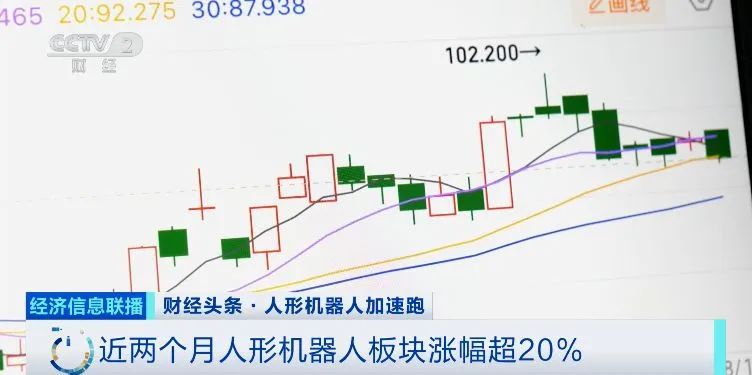
Group 1 - The 2025 World Humanoid Robot Games opened on August 14, highlighting the rapid development of China's humanoid robot industry, with significant advancements in research, manufacturing, and sales [1] - From the beginning of the year to date, there have been 96 investment and financing events related to humanoid robots in China, amounting to 26.549 billion yuan [1] - The humanoid robot sector has seen a stock market increase of over 20% in the past two months, with individual stocks like Changsheng Bearing rising approximately 670% since September last year [3] Group 2 - The only robot-themed ETF in the market, with a scale exceeding 10 billion yuan, has seen a nearly 13% increase since early June [5] - Government support and continuous R&D investments from companies have driven the rise in the humanoid robot sector, with various local policies providing industry and consumer subsidies [7] - Recent financing activities in the humanoid robot sector include a significant 1.1 billion yuan B-round financing by Galaxy General in June, marking the largest single financing in the field this year [9] Group 3 - The humanoid robot sector is gaining attention due to its integration of advanced technologies from artificial intelligence, mechanical engineering, and electronics, with expectations for rapid growth in demand across various applications [11] - The overall outlook for the humanoid robot industry remains positive, supported by the increasing market demand and continuous capital influx [9][11]