Mei Ri Shang Bao

Search documents
最高收益突破30% 首批个人养老金基金三年考卷出炉
Mei Ri Shang Bao· 2025-11-28 00:31
Core Insights - The first batch of personal pension funds has shown impressive performance over three years, with over 90% achieving positive returns, the highest return exceeding 30%, and more than 10 products yielding over 15% [1][2][3] Fund Performance - As of November 25, 2025, 120 out of 129 personal pension funds have achieved positive returns, representing a 93% success rate, with an average return of 9.14% [3] - The top-performing funds include Guotai Min'an Pension 2040 Mixed (FOF) Y and Penghua Pension 2045 Mixed Initiated (FOF) Y, with returns of 32.39% and 25.6% respectively [1][3] - A total of 311 personal pension funds have an average return of 13.33%, with several passive index funds showing exceptional growth rates exceeding 40% since their inception [4] Product Expansion - The range of personal pension products has expanded significantly, now including various types such as passive index funds and enhanced index funds, alongside the original target date FOFs [6] - The inclusion of electronic savings bonds into the personal pension product range is set to provide investors with safer and more stable investment options starting June 2026 [6] Market Growth - As of the third quarter, the total management scale of Y shares reached 15.111 billion, a 65% increase from the end of 2024, with the number of holders rising to 1.6624 million, a significant increase from 387,600 at the end of 2022 [7] - The demographic distribution of Y share holders shows that the majority are aged between 30-50, with males making up nearly 70% of account holders [7] Future Outlook - The personal pension system is gradually shifting residents' perception from "savings for retirement" to "investment for retirement," although further education on the system is needed [8] - Future enhancements may include optimizing tax policies, expanding the range of investable financial products, and increasing the annual contribution limits to encourage more participation [8]
一朵菇的“双城记” 稠州银行“贷”动产业跨域新生
Mei Ri Shang Bao· 2025-11-28 00:17
Core Insights - The article highlights the successful collaboration between Zhejiang Chouzhou Commercial Bank and mushroom farmers from Qingyuan, showcasing how financial support can facilitate industry transfer and empower local economies [1][2][3] Group 1: Industry Transfer and Financial Support - Qingyuan is recognized as the origin of cultivated mushrooms, with a significant cultural and economic impact, while Pingquan has developed a robust mushroom cultivation industry, producing over 700 million mushroom sticks annually [2] - The bank has established a specialized service team to address the financial needs of Qingyuan farmers in Pingquan, providing tailored financial solutions such as the "Anxin Loan," which is unsecured and based on credit [2][3] Group 2: Financial Services and Impact - Chouzhou Bank has created a comprehensive service system that supports the entire mushroom production chain, from procurement to market sales, ensuring financial backing at every stage [3] - The bank has provided over 50 million yuan in financial support to Qingyuan farmers in Pingquan, benefiting 120 clients within the industry chain [3]
驰援香港 互联网公司纷纷出手
Mei Ri Shang Bao· 2025-11-27 23:31
Group 1 - Major fire incident occurred in Hong Kong's Tai Po district, leading to significant casualties and damages, prompting various internet companies to provide assistance [1] - Alibaba Group initiated a donation of 20 million HKD, while Ant Group and AlipayHK contributed 10 million HKD to support fire rescue and subsequent relief efforts [1] - Didi announced a donation of 10 million HKD for emergency rescue and humanitarian aid, and will continue to provide support based on the progress of disaster relief [1] Group 2 - Tencent Charity Foundation launched an initial donation of 10 million HKD for urgent relief, transitional housing, and emotional support for affected residents [2] - Pinduoduo also initiated a donation of 10 million HKD for emergency relief and community recovery efforts [2] - Meituan's Keeta platform donated 5 million HKD and provided free mobile charging stations to support rescue efforts and community recovery [2]





A股主要股指冲高回落 沪指微涨0.29%
Mei Ri Shang Bao· 2025-11-27 23:31
Market Overview - A-shares experienced a strong upward movement during the day but retreated in the afternoon, with the Shanghai Composite Index closing up 0.29%, while the Shenzhen Component Index and ChiNext Index fell by 0.25% and 0.44% respectively [1] - The total trading volume in the Shanghai and Shenzhen markets was 1.72 trillion yuan, a decrease of 740 billion yuan compared to the previous trading day [1] - Over 2,700 stocks rose across the market, indicating a rapid rotation of market hotspots [1] Sector Performance - The lithium battery electrolyte concept saw a rebound, with stocks like Shida Shenghua hitting the daily limit [1][6] - The computing power chip sector was active, with Saiwei Electronics rising over 15% [1] - The consumer electronics sector remained strong throughout the day, with Yunzuka Technology hitting the daily limit [1] - The paper sector showed significant gains, with an overall increase of over 2%, driven by price hikes in various paper products [4] - Other sectors such as forestry, daily chemicals, chemical products, and chemical fibers also performed well [5] Specific Company Developments - Xi'an Catering's stock surged, reaching the daily limit after the announcement of 16 measures by the Shaanxi provincial government to deepen capital market reforms [2] - The company focuses on a dual-driven strategy of "catering main business + food industry," emphasizing regional specialty cuisine and food production [3] - Major paper companies have announced price increases for various paper types, benefiting from improved demand and supply-side adjustments [4][6] - Leading electrolyte companies are experiencing a surge in orders, with some contracts extending to 2028, indicating strong future demand [7]


大厂Q3财报陆续出炉 各家有喜有忧
Mei Ri Shang Bao· 2025-11-27 23:09
Core Insights - Alibaba's Q2 FY2026 financial report shows revenue growth but a significant decline in profit, primarily due to increased marketing investments in instant retail and technology [2][3] - The company's revenue reached 247.8 billion RMB, a 5% year-on-year increase, while operating profit plummeted by 85% to 5.4 billion RMB [2] - Alibaba's cloud business emerged as a key growth driver, with revenue of 39.8 billion RMB, reflecting a 34% year-on-year increase, supported by strong AI product sales [3] Alibaba's Financial Performance - Revenue for Q2 FY2026 was reported at 247.8 billion RMB, marking a 5% increase compared to the previous year [2] - Operating profit decreased to 5.4 billion RMB, down 85% year-on-year, attributed to reduced adjusted EBITA [2] - Adjusted EBITA fell by 78% to 9.1 billion RMB, influenced by investments in instant retail and user experience [2] Marketing and Investment Strategy - Alibaba's marketing and sales expenses surged to 66.5 billion RMB, more than doubling from the previous year [2] - The CEO indicated that the company is in an investment phase to build AI technology and infrastructure, aiming for long-term strategic value [2] - The high investment in flash sales during July and August was a significant factor in the financial losses reported [2] Cloud Business Highlights - The cloud segment reported revenue of 39.8 billion RMB, with a 34% year-on-year growth [3] - AI-related product revenue has seen triple-digit year-on-year growth for nine consecutive quarters, becoming a crucial driver for cloud business growth [3] - The proportion of AI revenue in external commercial income from the cloud business is increasing [3] Competitors' Performance - JD.com also reported revenue growth but a decline in profit, with Q3 revenue at 299.1 billion RMB, a 14.9% increase, while net profit fell by 54.7% to 5.3 billion RMB [4] - Didi's Q3 performance showed a 13.8% increase in order volume, reaching 4.685 billion orders, with a GTV growth of 14.8% to 115.8 billion RMB [5] - Pinduoduo's Q3 revenue was 108.3 billion RMB, a 9% increase, with adjusted net profit rising by 14% to 31.4 billion RMB [5]
长三角高铁全新旅游计次票产品来了
Mei Ri Shang Bao· 2025-11-27 22:22
Core Viewpoint - The introduction of three new travel products by the Shanghai Railway Bureau aims to enhance travel flexibility and affordability for the public in the Yangtze River Delta region, starting from November 27 [1]. Group 1: New Travel Products - Three travel products are launched: "Charming Shanghai-Nanjing-Hangzhou," "Famous Mountains and Waters Tour," and "Water Town Scroll Tour," covering five high-speed rail lines and 26 stations [1]. - "Charming Shanghai-Nanjing-Hangzhou" connects major cities like Shanghai, Hangzhou, and Nanjing, showcasing the unique charm of the Yangtze River Delta [1]. - "Famous Mountains and Waters Tour" focuses on 5A scenic spots such as West Lake and Huangshan, creating a visual feast of mountains and waters [1]. - "Water Town Scroll Tour" integrates cultural attractions like Nanzhu Ancient Town and Hengdian Film City, presenting the flowing charm of Jiangnan [1]. Group 2: Ticketing and Pricing - The products allow passengers to travel on any train within a specified range, with flexible pricing and the option to choose between 2 to 10 segments of travel [2]. - The ticket price for the "Charming Shanghai-Nanjing-Hangzhou" product is significantly lower than purchasing individual tickets, offering better value [2]. - If travel plans change, customers can enjoy convenient services such as fee waivers for cancellations, and unused tickets within 30 days will be fully refunded [2]. Group 3: Purchase and Usage - Tickets can be purchased through various channels, including the 12306 website, mobile app, and self-service machines [3]. - Passengers must make advance reservations for their travel segments and present valid identification for quick access on the day of travel [3].
打造百年企业 需要长期主义
Mei Ri Shang Bao· 2025-11-27 12:12
Core Insights - Wan Shili Group celebrated its 50th anniversary, marking it as a successful enterprise that has navigated through significant historical changes in China [1][2]. Group 1: Company Longevity and Achievements - The average lifespan of global SMEs is about 7 years, while top 1000 companies last around 30 years, and top 500 companies about 40 years; only 2% of companies exceed 50 years [1]. - Wan Shili is recognized as a "Hangzhou Old Brand," meeting the criteria of being established for over 40 years, with only 238 such brands recognized since 2009 [1]. - The company has evolved from a small township enterprise to a publicly listed company, contributing nearly 50,000 jobs to society over its 50-year history [1]. Group 2: Key Development Strategies - The company emphasizes talent development, having introduced university graduates for overseas training as early as the 1990s, recognizing the long-term value of human resources [2]. - The founder, Shen Aiqin, invested nearly a decade in preparing her daughter for succession, exemplifying successful generational transition in private enterprises [2]. - Wan Shili has strategically focused on its core business by simplifying operations and avoiding the pitfalls of excessive diversification, positioning itself as an industry leader [2]. - The company anticipated the cultural and technological trends, launching the "Silk+" initiative in 2016 and establishing a comprehensive database for AI applications in design [2]. Group 3: Lessons from Longevity - Successful long-standing companies share common traits, such as seizing fleeting opportunities and maintaining a long-term perspective, recognizing the importance of technology and talent [3]. - In an era of rapid technological change, the ability to focus on core competencies and adapt to market demands is crucial for survival and growth [3]. - The resilience of private enterprises, which have weathered significant challenges since the reform and opening-up period, suggests that the pursuit of longevity remains a viable goal despite technological advancements [3].

杭州新一轮汽车促消费政策落地
Mei Ri Shang Bao· 2025-11-27 07:30
Core Viewpoint - Hangzhou has launched a new round of automobile consumption promotion activities starting from November 25, offering substantial subsidies and consumption vouchers to stimulate car purchases [1][2] Group 1: Subsidy and Voucher Details - Consumers purchasing new cars will receive a maximum subsidy of 6,000 yuan and additional consumption vouchers totaling up to 5,000 yuan, leading to a total potential discount of 11,000 yuan [1][2] - The subsidy structure is tiered based on the pre-tax price of the new car: - For cars priced between 50,000 yuan and 100,000 yuan, a subsidy of 1,000 yuan plus 2,000 yuan in vouchers is provided - For cars priced between 100,000 yuan and 200,000 yuan, the subsidy is 2,000 yuan plus 3,000 yuan in vouchers - For cars priced between 200,000 yuan and 300,000 yuan, the subsidy is 4,000 yuan plus 4,000 yuan in vouchers - For cars priced above 300,000 yuan, the subsidy is 6,000 yuan plus 5,000 yuan in vouchers [1] Group 2: Program Accessibility and Duration - This promotion eliminates the previous requirement of trading in an old vehicle, allowing all consumers, including first-time buyers, to participate [1] - The program is set to run until December 31, 2025, based on the date of the new car invoice, with limited availability on subsidies and vouchers on a first-come, first-served basis [2] - The initiative is part of a broader effort by the Hangzhou government to boost consumer spending and support the ongoing development of the automotive industry [2]
一杯奶茶“香飘”全球 浙企解锁海外新蓝海
Mei Ri Shang Bao· 2025-11-27 07:08
Core Insights - Zhejiang's tea beverage industry is successfully expanding into global markets, driven by innovative products and supportive policies [1][3] - Companies like Xiangpiaopiao and Zhejiang Kiwi Biotechnology are leveraging automation and health-focused innovations to meet international consumer demands [1][3] Group 1: Company Innovations - Xiangpiaopiao has automated its production line, producing new products like crispy black sugar milk tea, with exports exceeding 150 tons this year [1] - Zhejiang Kiwi Biotechnology focuses on health-oriented raw materials, launching products like "0 cream light burden" and "low GI sugar control" to cater to health-conscious consumers [3] Group 2: Market Expansion Strategies - Xiangpiaopiao has successfully entered new markets such as New Zealand, Cambodia, India, and Bulgaria, in addition to consolidating its presence in traditional markets like the EU [1] - Zhejiang Kiwi Biotechnology has expanded its reach to over 20 countries in Southeast Asia, the Middle East, and Europe, becoming a key supplier in the overseas tea beverage market [3] Group 3: Regulatory Support - Customs authorities have implemented a "one-on-one" liaison mechanism to assist companies in navigating strict import standards, particularly in New Zealand [2] - The introduction of "cloud issuance" for certificates and other facilitative measures has significantly improved customs efficiency, ensuring timely product shipments [2]

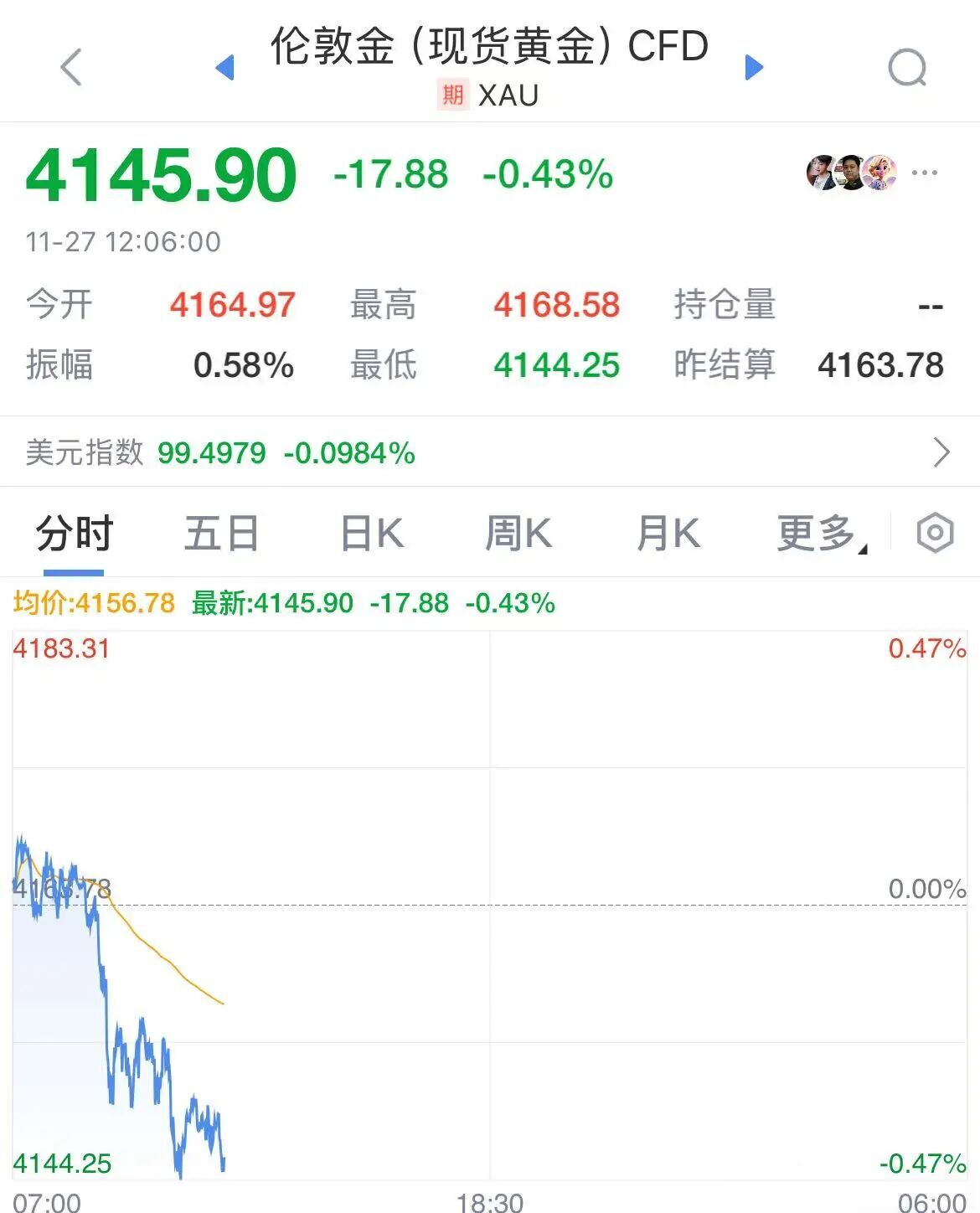
刚刚,金价、银价齐跳水!
Mei Ri Shang Bao· 2025-11-27 07:02
Core Viewpoint - The recent fluctuations in gold prices are influenced by economic indicators and expectations regarding the Federal Reserve's monetary policy, with a notable decline in gold prices observed on November 27, 2023, following a previous rise. Group 1: Gold Price Movements - On November 27, 2023, spot gold prices fell to $4145.9 per ounce, down 0.43% from previous levels [1] - The price of gold had previously reached a high of $4163.78 per ounce, marking a 0.8% increase, with an intraday peak of $4173.31 [8] - Concurrently, spot silver prices also declined, falling below $53 per ounce [8] Group 2: Economic Indicators - The Federal Reserve's "Beige Book" report indicated a decline in overall consumer spending and signs of weakness in the job market, influenced by AI technology and rising costs due to tariff policies [10] - Central banks are reportedly reducing their gold holdings as some have exceeded their target ratios of gold to reserve assets, although the overall allocation of gold by global central banks may still increase [10] Group 3: Market Expectations - There is a growing expectation that the Federal Reserve will implement interest rate cuts in December, with predictions of a 25 basis point reduction [12] - Major investment banks, including JPMorgan and Goldman Sachs, have raised their gold price forecasts, with JPMorgan predicting gold could reach $4500 per ounce by mid-2026 and Goldman Sachs adjusting its target for Q1 2026 to $4440 per ounce [12][13]