量子位

Search documents
火线解析智谱AI招股书:年营收3亿增速130%,“中国版OpenAI”率先冲刺全球大模型第一股
量子位· 2025-12-19 14:08
Core Viewpoint - Zhipu AI, regarded as the "Chinese version of OpenAI," is preparing for its IPO on the Hong Kong Stock Exchange, having recently passed the hearing process [2][4]. Company Overview - Founded in 2019, Zhipu AI has raised over 8 rounds of financing, accumulating more than 8.3 billion RMB, with a current valuation of 24.38 billion RMB [3][59]. - The company focuses on the development of Artificial General Intelligence (AGI) and has created a complete system from foundational models to application products [4][5]. Technology and Product Development - Zhipu AI has developed the "GLM" series models, which support multi-modal inputs and outputs, demonstrating strong capabilities in understanding and generating text, images, and more [9]. - The company has released flagship models GLM-4.5 and GLM-4.6, achieving significant recognition in industry benchmarks [10][11]. - Zhipu AI's models have been recognized for their efficiency, with GLM-4.5 ranking third globally in industry standards and first in China [11]. Business Model and Commercialization - Zhipu AI has been implementing a Model as a Service (MaaS) business model since 2021, which has proven to be scalable and flexible, attracting over 2.7 million enterprise and application developers [23][24]. - The company has generated significant revenue from its models, with GLM-4.5/4.6 achieving over 1 billion RMB in income from global developers [25]. Financial Performance - Zhipu AI's revenue has shown rapid growth, with projected revenues of 57.4 million RMB in 2022, 124.5 million RMB in 2023, and 312.4 million RMB in 2024, reflecting a compound annual growth rate of 130% [29]. - The company maintains a high gross margin, with rates of 54.6%, 64.6%, and 56.3% from 2022 to 2024 [34]. Industry Context - The Chinese large language model market is projected to reach 5.3 billion RMB in 2024, with expectations to grow to 101.1 billion RMB by 2030, driven primarily by institutional clients [61]. - The commercialization paths for enterprise-level LLMs are becoming clearer, indicating a promising future for the industry [62].


1年融资17亿的具身智能明星,首秀绣了个logo
量子位· 2025-12-19 14:08
Core Viewpoint - The article highlights the debut of Itstone Intelligent Navigation, a startup that has garnered significant investment and showcased its technological advancements in embodied intelligence through a unique embroidery robot demonstration [1][2][52]. Group 1: Company Overview - Itstone Intelligent Navigation was established in February 2025 and completed a record-breaking angel round of financing amounting to $120 million within a month [53]. - The company raised a total of approximately 1.7 billion RMB (around $240 million) through two rounds of funding, with notable investors including BlueRun Ventures and Meituan [53][54]. Group 2: Technological Innovations - The company showcased its first products, the A series industrial robots and T series general robots, emphasizing their capabilities in complex operations with sub-millimeter precision and tactile feedback [13][16]. - The embroidery demonstration serves two purposes: showcasing technical prowess and preserving traditional craftsmanship, as many embroidery techniques are nearing extinction [18][22]. - Itstone's technology is based on real-world data collection, utilizing a data acquisition suite called SenseHub to enhance the capabilities of embodied intelligence [29][30]. Group 3: Challenges and Solutions - The company identified three major bottlenecks in embodied intelligence models: spatial cognition, fluency, and generalization, which hinder adaptability across different environments and tasks [36][40]. - Itstone's AWE 2.0 aims to address these challenges by leveraging extensive real-world data for end-to-end learning, facilitating the transfer of knowledge to robotic systems [41][42]. Group 4: Future Directions - The company envisions a future where robots are integrated into daily life and production, functioning as reliable intelligent agents rather than mere controlled machines [52]. - Itstone's approach emphasizes a triad of data, models, and hardware, with a focus on creating a shared perception system between humans and robots [50][48].

4.98万就能买机器人通用基座?!一机三态,多场景验证,标配VLA大脑
量子位· 2025-12-19 12:16
Core Viewpoint - The article discusses the innovative features and capabilities of the TRON 2 robot developed by Zhujidi Dynamics, highlighting its versatility, performance, and ease of deployment in various tasks and environments [10][44]. Group 1: Product Features - TRON 2 is a multi-form embodied robot that can switch between three core configurations: dual arms, dual legs, and dual wheels, allowing it to adapt to different tasks [10][11]. - The robot features a 7-DoF (Degrees of Freedom) arm design that mimics human arm flexibility, enhancing its ability to perform complex tasks such as precise grabbing and positioning [18][19]. - TRON 2 is equipped with a humanoid spherical wrist structure that allows for high-precision movements in confined spaces, addressing common industry challenges related to end-effector control [20][21]. - The robot has a reach of 70 cm and can perform tasks in a wide range of environments, including high and distant operations [23]. - It supports dual-wheel and dual-leg movement modes, improving its obstacle avoidance and environmental perception capabilities [26][27]. - TRON 2 has a payload capacity of 30 kg and a battery life of up to 4 hours, making it suitable for continuous operation in various scenarios [29]. Group 2: Deployment and Usability - The design of TRON 2 emphasizes ease of deployment, allowing users to set up the robot in just 30 minutes and complete the full process from environment configuration to task execution within 2 hours [36][38]. - The robot comes with a VLA development toolkit that includes example tutorials and preset modules, facilitating integration with mainstream models like Pi 0.5 and ACT [36][38]. - TRON 2 integrates data collection, training validation, and deployment testing into a closed-loop system, enhancing research efficiency and stability [38][40]. Group 3: Company Strategy and Market Position - Zhujidi Dynamics focuses on long-term development in the embodied intelligence sector, prioritizing foundational aspects like motion control and universal platform capabilities over superficial features [44][45]. - The company has attracted significant investment from major players like Alibaba and JD.com, indicating confidence in its strategic direction and product development [45][46]. - TRON 2 represents a culmination of the company's iterative approach to product development, addressing real user needs and enhancing the usability of embodied robots [46][47].

不靠死记布局也能按图生成,多实例生成的布局控制终于“可控且不串脸”了丨浙大团队
量子位· 2025-12-19 07:20
Core Insights - The article discusses the challenges in Multi-Instance Image Generation (MIG), particularly in balancing layout control and identity consistency with reference images [1][3] - A new framework called ContextGen, developed by Zhejiang University's ReLER team, addresses these challenges by utilizing a dual-context attention mechanism [4][52] - ContextGen achieves state-of-the-art (SOTA) performance in various benchmarks, demonstrating significant improvements in spatial accuracy and identity preservation [19][20][24] Group 1: Challenges in MIG - Existing methods struggle to maintain a balance between layout control and identity consistency when generating multiple instances [1][3] - Techniques that allow explicit layout control often fail to customize instances based on reference images [2] - Conversely, methods that utilize reference images struggle with precise layout control and face identity information loss as instance numbers increase [3] Group 2: ContextGen Framework - ContextGen employs a hierarchical decoupling of context to solve the issues of layout control and identity fidelity [5] - The framework introduces a dual-context attention mechanism that integrates global control and local identity injection tasks at different levels of the DiT model [7][52] - Contextual Layout Anchoring (CLA) is used for robust global structure and position anchoring by integrating layout images with instance location information [8][9] - Identity Consistency Attention (ICA) addresses detail loss, particularly in overlapping areas, ensuring high-fidelity identity injection [11][12] Group 3: Data and Optimization - The IMIG-100K dataset, a large-scale synthetic dataset designed for image-guided multi-instance generation tasks, has been released to address the scarcity of high-quality training data [13][14] - ContextGen incorporates a reinforcement learning phase based on preference optimization (DPO) to encourage diverse image generation while maintaining identity [16][19] Group 4: Performance Metrics - ContextGen shows a 5.9% improvement in spatial accuracy (mIoU) on the COCO-MIG benchmark compared to baseline models [20] - In the LayoutSAM-Eval benchmark, ContextGen achieves SOTA across multiple metrics, particularly in maintaining instance attributes such as color, texture, and shape [20][24] - The framework outperforms existing open-source and closed-source models in identity preservation capabilities [24][26] Group 5: User Experience and Future Directions - A user-friendly front-end has been developed to support multiple reference image uploads, automatic image segmentation, and custom layout design [50] - The article emphasizes the importance of dynamic identity adaptation as generative models evolve, highlighting the need for better understanding and coordination of user text intentions and visual references [53]

量子位编辑作者招聘
量子位· 2025-12-19 07:20
编辑部 发自 凹非寺 量子位 | 公众号 QbitAI AI热潮还在汹涌,但如果你还不知道如何参与……那为什么不来 量子位 呢? 我们是一家以 追踪AI新进展 为核心的内容平台,经过8年积累,目前拥有顶流影响力,广泛且备受认可的产业资源,以及时代风口的最佳观 测和学习生态位。 目前,我们有 三大方向 岗位招聘,希望你是 (或者能成为) 这三个方向的内容专家: 岗位均为全职,工作地点:北京中关村。 岗位面向: 加入我们,你可以获得: 以下是岗位详情: 所有岗位不同能力层级职位均在开放,欢迎结合个人履历和经验申请。 AI产业方向 岗位职责: AI产业方向 :关注基建层创新,包含芯片、AI Infra、云计算; AI财经方向 :关注AI领域创投和财报,跟踪产业链资本动向; AI产品方向 :关注AI在应用和硬件终端方向的进展。 任职要求: AI财经商业方向 岗位职责: 任职要求: AI产品方向 岗位职责: 社招:覆盖编辑、主笔、主编各个层级,按能力匹配岗位; 校招:应届毕业生,接受实习且可转正。 站在AI浪潮之巅 :第一时间接触和了解AI领域最新技术和产品,构建完整的AI认知体系。 玩转AI新工具 :将各种AI新技术 ...

当年带你上网冲浪的头号老玩家,这回是真AI上头了
量子位· 2025-12-19 07:20
Core Viewpoint - QQ Browser has successfully transformed into an AI browser, leveraging Tencent's self-developed large model capabilities to enhance user experience across various scenarios, including AI search, browsing, learning, and office tasks [2][57]. Group 1: Transformation and Features - QQ Browser has shifted its product direction towards AI, introducing the QBot intelligent agent and achieving comprehensive AI integration [2][3]. - The browser has ranked highly in multiple authoritative lists in the AI Agent sector, indicating its strong performance in the industry [3]. - The evolution of QQ Browser over the past fifteen years reflects a consistent logic of simplifying complex capabilities and returning control to users [8][57]. Group 2: User Experience and AI Integration - The upgraded QQ Browser interface prioritizes AI functionality, allowing users to seamlessly switch between traditional search engines and AI dialogue [14][15]. - The AI+Mini Window feature integrates over ten AI capabilities, enhancing user efficiency without disrupting browsing flow [18][20]. - Key functionalities like webpage summarization, mind mapping, and translation are designed to assist users in managing lengthy content and improving reading efficiency [23][25][29]. Group 3: Agent Capabilities - The QBot Agent Center consolidates various agents capable of completing tasks, addressing traditional browser limitations [34]. - The AI Video Assistant offers features such as multi-language subtitle generation and content summarization, enhancing the video viewing experience [36][38]. - The AI Subscription Assistant efficiently aggregates and tracks relevant information, significantly reducing the time spent on manual searches [41][42]. Group 4: Mobile Expansion and Ecosystem - QQ Browser's AI capabilities have expanded to mobile platforms, providing comprehensive document handling and educational tools tailored for students [51][53]. - The integration with Tencent's ecosystem allows users to access various services without switching applications, streamlining the user experience [55]. - The shift towards AI in browsers reflects a broader industry trend of moving from simple information retrieval to task completion [56].


首个文本到3D生成RL范式诞生,攻克几何与物理合理性
量子位· 2025-12-19 07:20
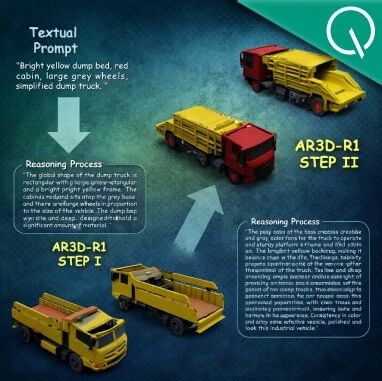
Core Insights - Reinforcement Learning (RL) has become a key method for enhancing the reasoning chain and generation quality in large language models and text-to-image generation [1] - A recent study by several universities explores the applicability of RL in the more complex domain of text-to-3D generation [2][3] Group 1: Research Focus - The study investigates whether RL can enhance the stepwise reasoning and generation process of 3D autoregressive models, given the complexity of 3D objects [3] - Key challenges include designing rewards that capture semantic alignment, geometric consistency, and visual quality, as well as the lack of benchmarks specifically assessing "3D reasoning capabilities" [6] Group 2: Findings on Reward Design - Aligning with human preference signals is crucial for improving overall 3D quality; other reward dimensions provide limited improvements when used alone [7] - Specialized reward models generally outperform large multimodal models (LMMs) in robustness, although general multimodal models like Qwen-VL show unexpected robustness in 3D-related attributes [7] Group 3: Training Techniques - In 3D autoregressive generation, RL prefers token-level strategies over sequence-level operations, leading to significant performance improvements [8] - Simple techniques can stabilize training, with dynamic sampling being effective as long as strategy updates are controlled; removing KL penalties can lead to performance drops [9] Group 4: Benchmark Development - The study introduces the MME-3DR benchmark, focusing on spatial and structural geometry, mechanical affordance, physical plausibility, organic forms, rare entities, and stylized/abstract forms [10] - MME-3DR aims to evaluate consistency, reasonableness, and interpretability under challenging constraints rather than just diversity [11] Group 5: Hierarchical RL Paradigm - The research proposes a hierarchical RL paradigm (Hi-GRPO) that treats 3D generation as a coarse-to-fine process, where high-level semantics dictate overall geometry before refining textures and local structures [14] - The findings indicate that RL helps 3D generation models enhance implicit reasoning capabilities, not just aesthetic adjustments [15] Group 6: Performance Insights - The study highlights the importance of respecting structural priors in design, showing that a hierarchical approach is more effective and interpretable than simple scoring on final images [16] - There is a trade-off between performance and stability; sparse rewards or excessive RL iterations can lead to instability and mode collapse [17] - Current models still face limitations in handling complex geometries, long-tail concepts, and highly stylized scenes, indicating that scalable 3D RL is constrained by computational power and reward acquisition costs [18]
DeepMind掌门人万字详解通往AGI之路
量子位· 2025-12-19 07:20
Core Viewpoint - Achieving AGI requires a balanced approach of technological innovation and scaling, with both aspects being equally important [2][55]. Group 1: Path to AGI - Demis Hassabis outlines a realistic path to AGI, emphasizing that 50% of efforts should focus on model scaling and 50% on scientific breakthroughs [5]. - The success of AlphaFold demonstrates AI's potential to solve fundamental scientific problems, with ongoing research expanding into materials science and nuclear fusion [5][9]. - Current AI models rely heavily on human knowledge, and the next goal is to develop autonomous learning capabilities similar to AlphaZero [5][27]. Group 2: AI Performance and Limitations - AI exhibits a "jagged intelligence" phenomenon, performing well in complex tasks like the International Mathematical Olympiad but struggling with basic logical problems [5][19]. - The need for models to improve self-reflection and verification capabilities is highlighted, as current systems often provide incorrect answers when uncertain [5][57]. - The introduction of confidence mechanisms is necessary to address the hallucination problem, where models generate plausible but incorrect responses [5][56]. Group 3: World Models and Simulation - World models enhance understanding of physical dynamics and sensory experiences, which language models struggle to convey [5][69]. - The use of simulation environments for training AI agents can lead to infinite task generation and complex behavior training, potentially aiding in the exploration of life and consciousness origins [5][80]. - The Genie project exemplifies the potential of interactive world models, which could be applied in robotics and general assistance [5][70]. Group 4: Commercialization and Social Risks - The commercialization of AI poses social risks, and there is a need to avoid the pitfalls of social media's focus on user engagement [5][101]. - Building AI personas that support scientific reasoning and personalized feedback is essential to prevent echo chambers [5][105]. Group 5: Scaling and Innovation - Despite discussions of scaling challenges, the release of Gemini 3 indicates that significant progress continues to be made [5][50]. - The combination of top-tier research capabilities and infrastructure, such as TPUs, positions the company favorably for ongoing innovation and scaling [5][54]. Group 6: Future of AI and AGI - The integration of various projects, including Gemini and world models, is crucial for developing a unified system that could serve as a candidate for AGI [5][114]. - The potential societal impacts of AGI necessitate proactive planning for labor transitions and economic adjustments, similar to lessons learned from the Industrial Revolution [5][118].


认知偏差、落地断层、体验割裂是目前AI产品的三大痛点|百度王颖@MEET2026
量子位· 2025-12-19 01:01
Core Insights - The article discusses the evolution of AI from a conversational partner to an action assistant, highlighting the increasing complexity of tasks that users face despite advancements in AI capabilities. It identifies three main challenges: cognitive bias, implementation gaps, and fragmented experiences [1][5][14]. Group 1: AI Challenges - Cognitive bias, implementation gaps, and fragmented experiences are identified as the three major pain points for users of AI products [5][14]. - Users often experience a disconnect between AI's capabilities and their ability to execute complex tasks, leading to frustration [14]. Group 2: GenFlow and AI Development - GenFlow serves as the core scheduling hub for Baidu's super personal intelligent agent framework, achieving a monthly active user base in the tens of millions, making it the largest general-purpose intelligent agent globally [5][10]. - The recently updated GenFlow 3.0 integrates a memory system that allows it to retain user interactions and preferences, enhancing personalization [13][17]. Group 3: Product Innovations - Baidu Wenku launched the AI learning platform OREATE AI, which has surpassed 1.4 million monthly active users within a month of its launch and topped the ProductHunt global daily rankings [37]. - Baidu Wangpan has expanded its services to 175 countries, featuring multilingual subtitles and AI camera functionalities, receiving positive feedback globally [39]. Group 4: Future Vision - The vision is to create a super personal intelligent agent that empowers users to become super individuals, enhancing their capabilities in various tasks [8][9]. - The integration of Office Agent and GenX aims to facilitate seamless collaboration between users and AI, enhancing productivity and creativity [20][28].


LeCun创业首轮估值247亿!Alexandre当CEO
量子位· 2025-12-19 01:01
Core Insights - The article discusses the establishment of a new company named Advanced Machine Intelligence Labs (AMI Labs), founded by Yann LeCun, which aims for a valuation of €3 billion (approximately ¥24.7 billion) and plans to officially launch in January 2026 [2][11]. Group 1: Company Overview - AMI Labs will focus on the research direction of "world models," which LeCun has been advocating, and will adopt an open-source approach while maintaining collaboration with Meta [3][5]. - The company is seeking to raise €500 million (approximately ¥4.1 billion) in its first round of funding [11]. - The CEO of AMI Labs will not be LeCun but rather Alexandre LeBrun, a former subordinate of LeCun [4][14]. Group 2: Technical Direction - AMI Labs will pursue a more challenging path than mainstream large language models (LLMs) by focusing on "world models," as LeCun believes that current LLMs have fundamental logical flaws and do not truly understand the physical world [6]. - The company will utilize a Joint Embedding Predictive Architecture (JEPA) to build its technological foundation, emphasizing "abstraction" and "planning" rather than predicting every pixel like video generation models [8][9]. - This approach aims to enable AI to focus on understanding key dynamic changes, akin to human or animal reasoning and planning capabilities [9]. Group 3: Leadership and Background - Alexandre LeBrun, the new CEO, has a strong background in AI and has previously worked closely with LeCun at Meta, where he was responsible for engineering at FAIR [25][28]. - LeBrun's experience includes founding the AI company Nabla and has a history of successful entrepreneurship in the tech sector [17][24]. - The leadership structure at AMI Labs is expected to be a dual-core model, with LeCun focusing on research and LeBrun on commercial aspects [29].