是说芯语

Search documents
DDR已被HBM超越
是说芯语· 2025-12-03 04:12
Group 1 - Major global IT companies are continuously investing in artificial intelligence and significantly acquiring DRAM and flash memory semiconductor products, while smaller capacity PC memory and solid-state drives are facing price increases and supply shortages [1] - The primary driver of rising memory prices is the demand from AI-related enterprises, with major companies planning to double their production capacity and processing power annually over the next three years [1] - Major DRAM suppliers like Samsung, SK Hynix, and Micron have notified PC manufacturers to halt production of DDR4 products and announced price increases for existing products [3] Group 2 - The sales costs for personal computer manufacturers have significantly increased due to rising memory supply prices since October, leading to losses, and new products are expected to see price increases of at least 20% next year [3][4] - Memory price fluctuations have become more pronounced since October, with prices doubling every ten days, and even the largest companies may only receive about half of their orders next year [3][4] - The only solution to the rising costs is for major memory manufacturers to increase production of DDR5 and LPDDR5 memory, or for new suppliers to emerge [4][6] Group 3 - Major memory manufacturers are focusing on increasing the production of high-value products like HBM, which have clear demand and high prices, rather than existing memory products [6] - The reduction in memory supply may lead to a decline in personal computer production, with market research firms like IDC and Gartner already lowering their PC shipment forecasts for next year [6] - The distribution model for personal computers is expected to change, with no likelihood of discounted inventory sales until at least 2028, and it is advisable to purchase personal computers within a year if possible [6]

江波龙37亿定增
是说芯语· 2025-12-03 00:23
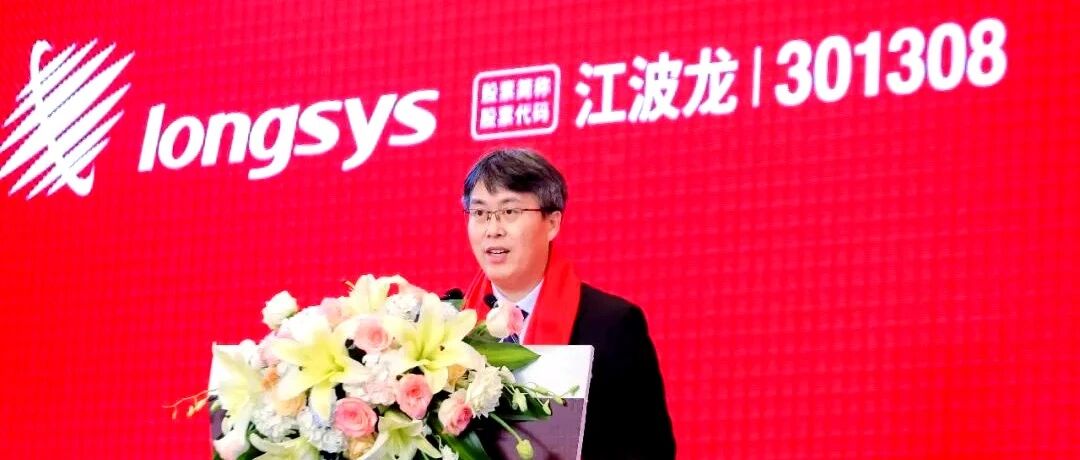
Core Viewpoint - The article highlights the strategic move by Jiangbolong, a leading independent storage company in China, to raise up to 3.7 billion yuan for AI-related storage research and industrialization projects, amidst a surge in AI computing power demand [1][4]. Group 1: Fundraising and Investment Plans - Jiangbolong plans to raise funds through a private placement, targeting a total of 3.7 billion yuan, with a focus on AI-related storage development [1][4]. - The funds will be allocated to four key areas: high-end storage for AI, semiconductor storage control chip development, high-end packaging and testing projects, and working capital [3][4]. Group 2: Market Position and Growth - Jiangbolong is the second-largest independent storage company globally, with significant market presence through its brands FORESEE and Lexar [5]. - The company reported a 138.66% year-on-year increase in enterprise storage business revenue, reaching 693 million yuan in the first half of 2025 [5][7]. Group 3: Technological Advancements - The company aims to address the challenges of performance, capacity, and cost in storage technology, particularly for AI applications [4]. - Jiangbolong's self-developed control chips have surpassed 100 million units deployed, with ongoing validation by major manufacturers [5]. Group 4: Financial Performance - For the first three quarters of 2025, Jiangbolong achieved revenue of 16.734 billion yuan, a 26.12% increase year-on-year, and a net profit of 713 million yuan, up 27.95% [7].
虞仁荣36亿巨额捐赠
是说芯语· 2025-12-02 11:45
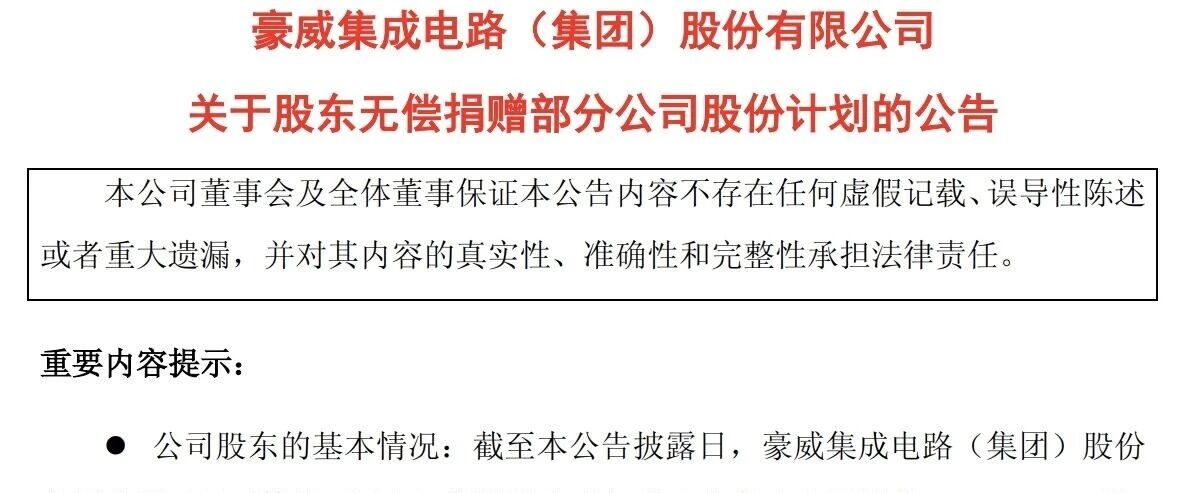
2025 年 12 月 3 日,豪威集团(603501)公告股东无偿捐赠股份计划。公司控股股东虞仁荣(持股 333,472,250 股,占比 27.57%)拟向宁波东方理工大学教育基金会捐赠 3000 万股 无限售流通股(占比 2.48%),宁波市虞仁荣教育基金会(持股 6,690,410 股,占比 0.55%)拟捐赠 60 万股(占比 0.05%),以支持宁波东方理工大学建设及教育事业发展。 | 捐赠主体 | 虞仁荣 | 教育基金会 | | --- | --- | --- | | 计划捐赠数量(股) | 30,000,000 | 600,000 | | 计划捐赠数量占总股本比例 | 2.48% | 0.05% | | 捐赠方式 | 非交易过户(捐赠) | 非交易过户(捐赠) | | 股份来源 | IPO 前取得 | 2 公 愛爾取傳 榜上海 | | 股东名称 | 捐贈前 | | 捐赠后 | | | --- | --- | --- | --- | --- | | | 持股数量(股) | 持股比例 | 持股数量(股) | 持股比例 | | 虞仁荣 | 333,472,250 | 27.57% | 303,472 ...

杭州“小巨人”冲刺港交所
是说芯语· 2025-12-02 07:39
Core Viewpoint - Zhejiang Liji Storage Technology Co., Ltd. (Liji Storage), a national-level specialized and innovative "little giant" enterprise in the memory chip design sector, has submitted a revised listing application to the Hong Kong Stock Exchange, marking the start of a new capital journey amid the dual trends of AI computing and the recovery of the storage chip market [1][4]. Company Overview - Liji Storage focuses on the design of DRAM memory chips, particularly 8GB DDR4 and earlier generations, which are widely used in consumer electronics, network communications, and automotive electronics [4]. - The company was established in March 2020 after acquiring Zental Japan, a Japanese memory chip design firm, which laid a solid technical foundation for Liji Storage [4]. - The company plans to relocate its registered office to Hangzhou by June 2025, reflecting its strategic consideration to leverage the innovation resources of the Yangtze River Delta [4]. Competitive Advantages - A stable supply chain and strong industry collaboration are key competitive advantages for Liji Storage, with Taiwan's Powerchip Semiconductor Manufacturing Corporation as its sole third-party foundry supplier [5]. - The partnership with Powerchip, which holds approximately 10.13% of Liji Storage's shares, enhances production stability and reduces supply chain risks [5]. Financial Performance - Liji Storage has shown steady growth, with total storage capacity increasing from 13.8 million GB in 2022 to 34.2 million GB in 2024, representing a compound annual growth rate (CAGR) of 57.4% [5]. - The company is expected to sell over 1 million storage chips in 2024, demonstrating strong market expansion capabilities [5]. - The gross margin has improved from -2.1% in 2022 to 10.2% in the first half of 2025, indicating enhanced profitability [8]. Market Position - According to Frost & Sullivan, Liji Storage ranks fourth among mainland Chinese companies in the niche DRAM market with a market share of 11.1%, and 11th globally with a market share of 0.8% [8]. Future Prospects - The updated listing application includes performance data for the first half of 2025, indicating the company's readiness for the capital market [8]. - The funds raised will primarily be used to expand high-bandwidth storage product development, procure wafer services, and enhance production testing capabilities [8]. - The storage chip market is expected to benefit from the growing demand for high-bandwidth and high-performance storage chips driven by AI applications, smart vehicles, and server markets [9].
超20亿融资加持!清微智能冲刺“非GPU”芯片上市标杆,启动上市筹备
是说芯语· 2025-12-02 04:44
Core Insights - Qingwei Intelligent, a leading AI chip company in Beijing, announced the completion of over 2 billion RMB in Series C financing and initiated preparations for an IPO, aiming to become the first listed benchmark in the domestic "non-GPU" new architecture chip sector [1][4] Financing and Investment - The financing round was led by Beijing state-owned enterprise Jingneng Group, with participation from multiple institutions including Beichuang Investment, Jiantou Investment, Wuyuefeng Science and Technology Innovation, and Chengdu Science and Technology Investment, among others [3] - The funds will focus on three main areas: R&D of next-generation reconfigurable chip core technologies, large-scale implementation of intelligent computing scenarios, and the cultivation of high-end technical talent [3] Technology and Product Development - Qingwei Intelligent has developed a unique non-GPU technology path, leveraging 20 years of technical accumulation from Tsinghua University [3] - The TX81 reconfigurable AI chip achieves high bandwidth and low latency data flow through "C2C computing grid technology," with a single server's computing power reaching 4 PFLOPS, supporting trillion-parameter large model deployment, reducing costs by 50%, and improving energy efficiency by three times compared to traditional solutions [3] - The company has adapted its products to mainstream large models and has received over 20,000 orders for reconfigurable computing cards, ranking sixth in domestic AI acceleration card shipments in the first half of 2025 [3] Leadership and Market Position - The founder and CEO, Wang Bo, was recently awarded the title of "Annual Entrepreneur of the IC Design Industry in China 2025," recognized for his strategic vision in promoting the localization of new architecture AI chips [4] - The simultaneous advancement of financing and IPO preparations is seen as a dual validation of the company's technological accumulation and commercial achievements [4] Industry Impact - The IPO preparations are expected to empower the company with capital and set an industry benchmark for the non-GPU sector, promoting the ecological development of reconfigurable computing technology [4] - With steady progress in funding and the IPO process, the company is poised to further break through core technologies for the next generation of chips and deepen the implementation of intelligent computing scenarios, providing robust and controllable computing power for the digital economy [4]

中国蜂窝通信芯片龙头冲刺港股
是说芯语· 2025-12-02 04:15
2025年11月30日,上海移芯通信科技股份有限公司(简称"移芯通信")正式向香港联合交易所主板递交上市申请,中信建投国际担任独家保荐人 。作为 国内领先的蜂窝物联芯片供应商,此次递表标志着公司将开启资本市场新征程,为物联网核心技术创新与产业规模化发展注入更强动力。 移芯通信成立于2017年2月,总部位于上海张江,专注于蜂窝通信芯片的研发、架构设计及商业化,核心技术与IP全部自研,覆盖算法&架构、射频、基 带、协议栈软件等全链条核心环节。 公司构建了覆盖低、中、高无线传输全速域的产品矩阵,包括NB-IoT系列芯片EC616、EC616S、EC626,Cat.1bis系列芯片EC618、EC716、EC718等,凭 借优化的PPA(功耗、性能、面积/成本)平衡优势,广泛应用于智能表计、可穿戴设备、网联汽车、工业自动化等多元场景 。其中NB-IoT产品已稳居全 球出货量第一,Cat.1bis产品位列全球第二,整体蜂窝通信芯片出货量位居中国第一、全球第三,市场竞争力显著 。 招股书披露的财务数据显示,公司经营状况持续向好。2022年至2024年,移芯通信营业收入分别达4.10亿元、5.33亿元、5.52亿元,净利润 ...

探路者6.78亿元跨界加码半导体
是说芯语· 2025-12-01 14:57
Core Viewpoint - The company, Pathfinder, is strategically expanding into the semiconductor industry by acquiring 51% stakes in two leading firms, Betley and Shanghai Tongtu, for a total of 678 million yuan, marking a significant move in its "outdoor + chip" dual business strategy [1][3]. Group 1: Acquisition Details - Pathfinder announced the acquisition of Betley for 321 million yuan and Shanghai Tongtu for 357 million yuan, both of which are recognized as high-quality assets in the semiconductor sector [3]. - Betley is a leading design firm in the mixed-signal chip field, achieving a net profit of 17.73 million yuan from January to August 2025, while Shanghai Tongtu reported a net profit of 18.8861 million yuan during the same period [3]. - The acquisition prices reflect high premiums, with Betley at a 363.26% premium and Shanghai Tongtu at a staggering 2119.65% premium, but both companies have committed to a combined net profit of no less than 150 million yuan from 2026 to 2028 [3]. Group 2: Strategic Importance - This acquisition is part of Pathfinder's ongoing transformation into the semiconductor industry, which began in 2021 under the leadership of Li Ming, a veteran in the chip sector [4]. - The revenue contribution from the chip business has increased from 0.74% in 2022 to 13.97% in 2024, indicating its growing importance as a revenue stream for the company [4]. - The traditional outdoor business has faced challenges, with a 13.98% decline in revenue and a 67.53% drop in net profit in the first three quarters of 2025, highlighting the need for diversification into the semiconductor sector [4]. Group 3: Industry Context - The semiconductor industry is currently experiencing a growth phase, driven by policy support and market demand, making it an opportune time for Pathfinder to invest in this sector [5]. - The company's financial position is robust, with approximately 764 million yuan in cash available to fund the acquisition without needing additional financing [5]. - However, the company faces potential risks related to goodwill impairment and the challenges of integrating operations across different sectors, which will test its management capabilities [5].

传日本断供光刻胶,可能严重影响中国半导体产业活力
是说芯语· 2025-12-01 09:44
Core Viewpoint - Japan has reportedly ceased exports of photoresist to China, which is seen as a significant escalation in tensions between the two countries and poses a threat to China's semiconductor industry [1][3]. Group 1: Impact on Semiconductor Industry - The semiconductor market is experiencing a general supply shortage, with demand for DRAM and HBM rising sharply, presenting an opportunity for Chinese companies to grow [3]. - The interruption of photoresist exports from Japan is expected to undermine the expansion plans of Chinese semiconductor manufacturers like CXMT and SMIC, as unstable procurement of core materials could hinder their market entry speed [3]. - The disruption may lead to a global supply chain restructuring and changes in overall price structures within the semiconductor market [3]. Group 2: Japan-China Relations and Supply Chain Dynamics - The export restrictions are seen as a move to increase the distance between Japanese and Chinese companies, while simultaneously strengthening the supply chain ties between South Korea and Japan [3]. - As Japan tightens its control over photoresist exports, South Korean companies are likely to seek more stable cooperation with Japanese SMEs, potentially positioning South Korea as a central axis in the semiconductor supply chain between China and Japan [3]. - The ongoing tensions are expected to have broader implications for the semiconductor supply chain, with South Korean industries closely monitoring the situation for potential impacts on their operations [3]. Group 3: Photoresist Market Overview - Photoresist is a critical material in semiconductor manufacturing, with Japan holding over 70% of the global market share, making it a key leverage point in geopolitical conflicts [4]. - The recent export halt is viewed as a significant setback for China's semiconductor ambitions, particularly affecting companies like SMIC and ChangXin Memory, which are looking to expand production amid rising DRAM prices [4]. - Japan's export controls may gradually extend beyond photoresist, as evidenced by the recent cessation of imports of Chinese DRAM by Japanese semiconductor firm Kioxia due to quality and safety concerns [4].
首款全国产训推一体AI芯片发布,兼容CUDA生态
是说芯语· 2025-12-01 07:29
HL100芯片FP16算力达256 TFLOPS,配备LPDDR5显存,单芯支持128GB超大容量,显存容量为国际同 类产品的1.33倍,同时兼容CUDA生态体系。该芯片支持从单机多卡到千卡级集群的灵活扩展,能效比达 3.41 TFLOPS/W——在同等功耗下算力为国际竞品的8倍,同等算力下总拥有成本(TCO)仅为对方的四 分之一。这种性能优势使其在训练推理一体化场景中展现出显著竞争力。 中诚华隆近日正式发布HL系列全国产AI芯片及全栈智算新品,标志着我国智算领域迎来全新发展阶段。作 为首款全国产训推一体AI芯片,HL100凭借自研的新一代GPGPU+NPU融合架构,在算力、能效比等核心 指标上实现突破性进展。 技术融合创新方面,中诚华隆正深化申威技术、RISC-V架构与安全可信技术的协同研发。通过整合自主指 令集架构与专利技术集群,公司在CPU、AI芯片及SoC专用芯片领域形成差异化竞争力,可提供涵盖通算、 智算、存算、超算的一体化服务方案。这种技术整合能力使其在政务、医疗、金融等关键领域具备快速响应 能力。 中国工程院院士、中诚华隆首席科学家沈昌祥指出,HL100具备大容量、高能效比、全国产化三大特征, ...

大摩大幅上调谷歌TPU产量预测,同步分享谷歌TPU专家调研纪要,图片保存!
是说芯语· 2025-12-01 07:29
Core Viewpoint - Google's self-developed AI chip, TPU, is showing significant potential to challenge the existing market landscape, with expectations of explosive growth in production over the next two years, indicating a possible shift towards large-scale sales to third parties [1][3][4]. Supply Chain Signals - The uncertainty surrounding the TPU supply chain is diminishing, with a substantial increase in production forecasts for 2027 and 2028. The production estimate for 2027 has been raised from approximately 3 million units to about 5 million units, a 67% increase [1][3]. - For 2028, the production forecast has surged from around 3.2 million units to approximately 7 million units, reflecting a remarkable 120% increase [3][4]. Financial Implications - If Google initiates an external sales strategy for TPU, it could open up a significant new revenue stream. Each sale of 500,000 TPU chips could potentially add around $13 billion in revenue and $0.40 to earnings per share (EPS) in 2027 [1][4]. - The report estimates that over the two years from 2027 to 2028, Google could secure 12 million TPU units, compared to a total of 7.9 million units over the past four years, indicating a rapid expansion in AI hardware investment and positioning [1][4]. Strategic Shift - The increase in TPU production suggests a strategic shift for Google from a "self-use" model to directly competing with major players in the AI chip market. This transition could position Google as a hardware seller rather than just a consumer and service provider [4].