13个精算师

Search documents
近16年财险公司增资分红盘点:有五家公司分红金额超过股东投入,有54家公司股东累计投入金额高达1490亿元,但从未分过红!
13个精算师· 2025-08-01 11:41
Core Viewpoint - The insurance industry has experienced significant capital inflows and profitability over the past 16 years, but there is a stark divide between companies that distribute dividends and those that do not, indicating a polarization in operational performance [2][3][14]. Group 1: Dividend Distribution in the Insurance Industry - From 2009 to 2024, the insurance industry has cumulatively distributed dividends amounting to 214.4 billion, with a total of 231 dividend distributions [7]. - The cumulative profit of the insurance industry over the same period is 606.4 billion, with a notable increase from 4 million in 2009 to 27.4 billion in 2024 [9]. - Only 35 out of 89 companies that have increased capital have distributed dividends, highlighting that 54 companies have not distributed any dividends despite significant capital inflows [10][11]. Group 2: Capital Inflows and Profitability - The insurance industry has seen a total of 325.3 billion in new shareholder capital over the past 16 years, with 249 instances of capital increases [8]. - The 35 companies that have distributed dividends accounted for 54% of the total new capital inflows, while the 54 companies that have not distributed dividends accounted for 46% of the inflows but have collectively incurred losses of 31.5 billion [13]. - The profitability of the 35 dividend-distributing companies reached 637.9 billion, surpassing the total profit of the entire industry, while the other 54 companies reported cumulative losses [13][14]. Group 3: Performance of Leading Companies - Among the companies with over 10 dividend distributions, notable performers include PICC Property and Casualty, Ping An Property & Casualty, and Taikang Property, with five companies having cumulative dividends exceeding their total shareholder contributions [17]. - The top ten companies in terms of cumulative dividends from 2009 to 2024 have been identified, showcasing the leaders in the industry [15][17]. - The industry is characterized by two camps: leading companies that have transitioned into a profit-sharing phase and others that continue to struggle with capital increases without returns [14].




普惠!金融监管总局:城市商业医疗险,要将创新药纳入责任,突出为民情怀,差异化定价,明确“六不得”...
13个精算师· 2025-07-31 13:35
Core Viewpoint - The new regulations issued by the Financial Regulatory Bureau aim to enhance the quality and sustainability of urban commercial health insurance, particularly focusing on the "Hui Min Bao" program, which has been updated after four years to better meet public health needs and expand coverage [3][8][9]. Group 1: New Regulations Overview - The new regulations emphasize the inclusive nature of "Hui Min Bao," aiming to optimize supply and include innovative drugs in the coverage [4][10]. - The regulations stress voluntary insurance participation and differentiated pricing based on health status and age, with higher payout ratios and lower deductibles for healthier individuals [20][21]. - Insurers are prohibited from adjusting the payout conditions of signed insurance contracts within the same year, ensuring stability for policyholders [39][40]. Group 2: Product Positioning and Consumer Satisfaction - The regulations highlight the need for urban commercial health insurance to maintain a public welfare focus while adhering to commercial principles [11][19]. - Insurers are encouraged to improve product offerings and customer service to enhance consumer satisfaction and retention [18][19]. - The regulations support the establishment of platforms for better communication among healthcare, insurance, and pharmaceutical sectors to facilitate claims processing [34][36]. Group 3: Risk Management and Pricing Strategies - Insurers are required to implement precise pricing strategies that reflect the risk profiles of different demographic groups, thereby enhancing fairness and adaptability in product offerings [23][25]. - The regulations address concerns about the sustainability of "Hui Min Bao" by promoting risk management practices and preventing adverse selection [22][24]. - The new rules also call for a clear distinction between commercial insurance and social insurance to avoid confusion among consumers [50]. Group 4: Market Order and Compliance - The regulations outline six prohibitions to maintain market order, including the requirement for insurers to avoid unfair competition and ensure transparent communication of product features [41][42]. - Insurers must clearly indicate the "customized" nature of their products and specify applicable regions in their offerings [51][53]. - The regulations encourage collaboration among insurers to share data and improve operational efficiency, thereby enhancing the overall ecosystem of urban commercial health insurance [38][49].
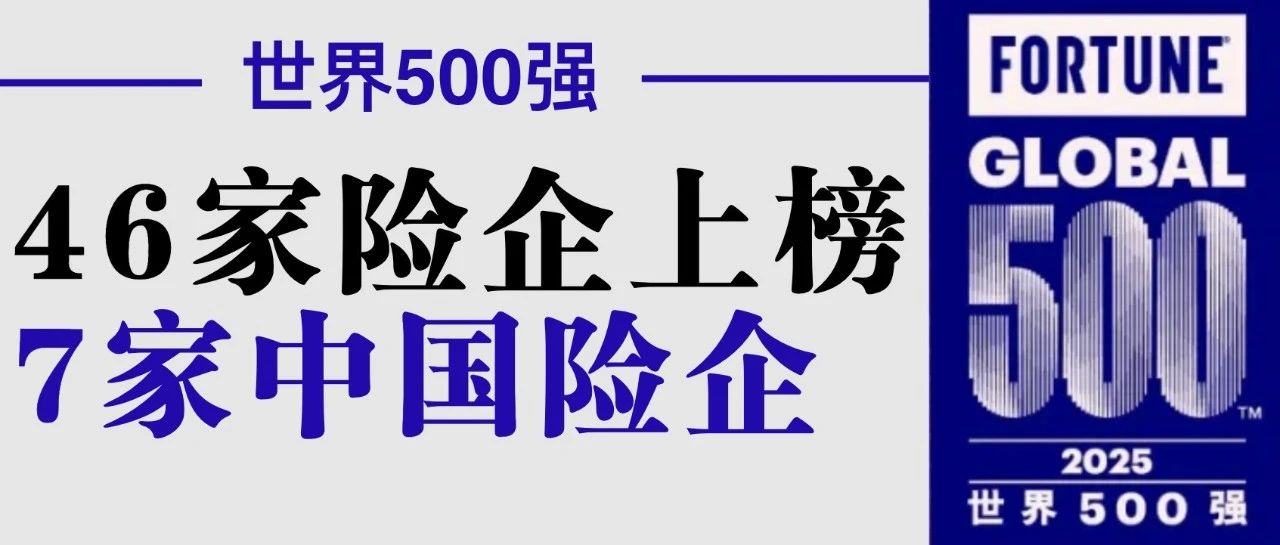
46家险企上榜!《财富》世界500强:7家中国险企上榜,国寿、平安、人保、太保、泰康、友邦!新华重新上榜~
13个精算师· 2025-07-30 03:42
Core Insights - In 2025, seven Chinese insurance companies made it to the Fortune Global 500 list, with China Life Insurance ranking first among Chinese insurers for the first time [1][11][16] - The average profit of the listed Chinese companies increased from $3.9 billion to $4.2 billion, reflecting a 7.4% year-on-year growth [8] - The rankings of all seven Chinese insurance companies improved, driven by increased investment returns and premium income [26][31] Group 1: Rankings and Performance - Seven Chinese insurance companies ranked in the Fortune Global 500, with China Life at 45th, Ping An at 47th, and New China Life returning to the list at 498th [13][16] - China Pacific Insurance saw the most significant improvement, rising 80 places to 251st [14] - Five insurance companies have been on the list for eight consecutive years, with China Life leading the Chinese insurance sector for 23 years [16][18] Group 2: Financial Growth - The operating income of Chinese insurance companies increased, with China Life reporting $16.03 billion (up 15%) and Ping An at $15.86 billion (up 9%) [22] - Profits also surged, with Ping An's profit reaching $17.76 billion, a 45% increase [34] - The overall revenue of Chinese insurance companies contributed to their improved rankings, despite a slight decline in the total number of Chinese companies on the list [24][25] Group 3: Market Trends - The insurance sector is experiencing a transformation from "large to strong," indicating a focus on quality and profitability [9] - The investment returns of leading insurance companies have significantly improved, benefiting from favorable capital market conditions [28][37] - The net profit and operating income of insurance companies are expected to continue rising, reflecting a positive outlook for the industry [10][33]


【独家拆解】揭开分红实现率数字看背后本质:死差红利如何影响你的判断?
13个精算师· 2025-07-29 12:32
Core Viewpoint - The article discusses the impact of regulatory limits on dividend realization rates in the insurance industry, highlighting the differences in calculation methods and the influence of mortality surplus on these rates [1][3]. Group 1: Regulatory Background and Dividend Realization Rates - Recent regulations require insurance companies with a rating of 1-3 or those established for less than three years to justify any proposed dividend levels exceeding the average financial return of 3.2% over the past three years [3]. - The theoretical upper limit for this year's realization rate is calculated to be 114%, based on the formula for dividend realization rate [3]. - The realization rate is defined as the actual distributed dividend amount divided by the projected benefit amount, with the denominator standardized to include only the interest spread [3]. Group 2: Calculation Methods of Dividend Realization Rates - Two types of dividend realization rates are defined: - "Two Surplus Dividend Realization Rate," which includes both interest spread and mortality surplus in the numerator. - "Interest Spread Dividend Realization Rate," which includes only the interest spread [4]. - The current horizontal comparison of dividend realization rates among major insurance companies shows a distortion, as the two surplus realization rates tend to be higher under the same actual dividend levels [5]. Group 3: Characteristics and Implications of Two Surplus Dividend Realization Rates - The two surplus realization rates exhibit two main characteristics: the mortality surplus portion's contribution to the realization rate decreases over the policy years, and there is significant variability in realization rates among different policies of the same product [6]. - In the early policy years, the realization rates can appear inflated due to the relatively small contribution of interest spread, which amplifies the impact of mortality surplus [10][11]. - The two surplus realization rate can only represent an "average" or a specific percentile of the policyholder group, leading to potential misinterpretation for individual policies [13][15]. Group 4: Long-term Investment Capability and Realization Rates - The article emphasizes that the long-term investment capability of insurance companies is crucial for sustaining dividend levels, and consumers should focus on the calculation methods and long-term perspectives of realization rates rather than short-term figures [18]. - It is recommended that insurance companies maintain transparency in disclosing the differences in individual policy realization rates to help customers understand the actual performance of their policies [15].

2024年度寿险公司加权薪保比指标排行榜,薪保比已创近15年来历史新低!
13个精算师· 2025-07-28 11:46
Core Viewpoint - The 2024 life insurance industry has seen a decline in employee compensation and a historical low in the salary-to-premium ratio, indicating potential challenges in operational efficiency and profitability [2][14]. Group 1: Salary and Premium Ratio Analysis - In 2024, the total employee compensation in the life insurance industry was 108.5 billion yuan, a decrease of 4.6% year-on-year, with a salary-to-premium ratio of 3.4%, down 0.5 percentage points, marking a 15-year low [2][14]. - The "TOP7+1" companies (including major players like China Life and Ping An) had a salary-to-premium ratio of 3.3%, which is significantly lower than that of small and medium-sized insurance companies, which stood at 3.7% [17][18]. - The average salary-to-premium ratio for 70 life insurance companies over the past five years was 4.0%, with a median of 4.9%, and 11 companies exceeding 10% [5][28]. Group 2: Impact on Return on Equity (ROE) - The salary-to-premium ratio has a significant negative impact on a company's ROE, with each 1 percentage point increase in the ratio leading to a 0.37 percentage point decrease in ROE [24][25]. - The empirical model constructed to analyze this relationship included variables such as company size and channel type, confirming the negative correlation between salary-to-premium ratio and ROE [24][25]. Group 3: Historical Trends - The salary-to-premium ratio has shown a declining trend since 2018, with a notable acceleration in the decline for small and medium-sized insurance companies since 2019 [16][18]. - The ratio increased from 4.2% in 2010 to a peak of 5.3% in 2015, followed by a steady decline to the current levels [16][18]. Group 4: Employee Compensation Insights - The life insurance industry employed approximately 345,000 individuals in 2023, with an average compensation and benefits level of 330,000 yuan [10][22]. - The fluctuation in employee numbers has shown a slight decline, while average compensation has seen minor increases over recent years [10][22].

【保险学术前沿】文章推荐:再保险实践与趋势的全面回顾
13个精算师· 2025-07-26 02:58
Core Viewpoint - Reinsurance serves as a critical risk management tool for insurance companies, allowing them to transfer risk and manage capital requirements effectively, thereby enhancing their overall stability and capacity to pay claims [2][33]. Group 1: Overview of Reinsurance - Reinsurance is an agreement between insurance underwriters and reinsurance companies, allowing insurers to transfer part or all of their risk to reinsurance firms [2]. - The primary functions of reinsurance include increasing underwriting capacity, stabilizing loss experience, limiting liability from single events, and protecting both insurers and policyholders from catastrophic events [2][3]. - Modern technology has simplified risk assessment processes, making reinsurance more efficient [2]. Group 2: Risks Associated with Reinsurance - Key risks in reinsurance include reinsurance recoverables risk, which occurs when a reinsurer defaults, causing the risk to revert to the original insurer [6]. - Counterparty risk is another significant concern, as insurers face credit risk when selecting reinsurers [6]. - Strategies such as collateral accounts can be employed to mitigate these risks by ensuring funds are available to cover claims in case of reinsurer default [6]. Group 3: Cost-Benefit Analysis of Reinsurance - While reinsurance provides benefits such as capital relief and risk diversification, it also incurs high costs, often exceeding the actuarial value of the risks transferred [7]. - The strategic value of reinsurance remains significant, as it enhances insurers' risk tolerance and provides financial buffers during extreme events [7]. Group 4: Catastrophe Risk and Reinsurance - Catastrophe risks, including natural disasters and man-made events, significantly influence the demand for reinsurance [9]. - Following catastrophic losses, insurers often increase their reinsurance purchases to enhance risk resilience, although post-disaster reinsurance can be costly and difficult to obtain [9][10]. - The structure of reinsurance contracts, including proportional and non-proportional contracts, plays a crucial role in managing catastrophe risks [11]. Group 5: Life and Non-Life Insurance - Reinsurance plays a vital role in both life and non-life insurance sectors, helping insurers manage capital guarantees and reserves effectively [14][16]. - The use of reinsurance can prevent the decline of capital guarantees in life insurance products, thereby maintaining their value [15]. - In non-life insurance, reinsurance is used to provide overall protection for risk portfolios, with different factors influencing reserve formation [16]. Group 6: Compensation Mechanisms in Reinsurance - Compensation mechanisms in reinsurance contracts are essential for risk transfer and can be optimized using various approaches [18][20]. - Structured reinsurance contracts can be designed to provide higher compensation during financial distress, benefiting both insurers and reinsurers [20]. Group 7: Financial Performance Indicators and Reinsurance - Financial performance metrics such as liquidity creation and financial flexibility are critical in assessing the impact of reinsurance on insurance companies [22]. - There exists a structural bidirectional causality between liquidity and reinsurance demand, indicating that insurers with higher risk exposure are more likely to seek reinsurance [23]. - The relationship between reinsurance and debt capacity varies based on a company's financial flexibility, affecting how insurers manage their capital structures [24]. Group 8: Mathematical Modeling in Reinsurance - Mathematical models are increasingly used to analyze reinsurance processes, aiding in decision-making and risk assessment [30][31]. - These models help predict claims payments and optimize investment-reinsurance strategies, enhancing overall financial performance [30][31]. Conclusion - Reinsurance is a fundamental tool for insurance companies to manage risks and capital requirements, ensuring they can meet claims even in the face of significant losses [33]. - The collective research highlights the importance of understanding reinsurance's core concepts, its strategic value, and the associated risks, providing a comprehensive view of the reinsurance landscape [34].

预定利率下调!国寿、平安等公告旧产品于8月31日停售;二季度研究值仅为1.99%;年内险资举牌次数已超去年全年|13精周报
13个精算师· 2025-07-26 01:47
Core Insights - The article highlights the ongoing developments in the insurance and financial sectors, focusing on regulatory updates, company activities, and industry trends. Regulatory Dynamics - The Financial Regulatory Bureau is studying ways to expand health insurance coverage and improve service levels [7] - The People's Bank of China has maintained the 1-year and 5-year Loan Prime Rates (LPR) at 3.0% and 3.5% respectively [8] - By the end of 2024, the number of participants in basic pension insurance in China is expected to reach 1.07 billion [9] - As of June 2024, the total number of participants in basic pension insurance was 1.071 billion, with a cumulative surplus of social insurance funds amounting to 9.83 trillion [9] - The number of individuals holding social security cards in China has reached 1.39 billion, covering 98.9% of the population [10] - The Ministry of Human Resources and Social Security is promoting the expansion of basic pension fund investments [11][12] - The Medical Insurance Bureau aims to maintain a basic medical insurance coverage rate of around 95% during the 14th Five-Year Plan period [13] Company Dynamics - Zhongyou Insurance has acquired a stake in Green Power Environmental H-shares, marking over 21 instances of insurance capital acquisitions this year [22] - China Ping An increased its stake in China Telecom by approximately 125,320 shares [23] - Swiss Life increased its holdings in China Shenhua by 1 million shares [24] - China Life Insurance reported a net purchase of over 90 billion in public market equity investments in the first half of 2025 [32] - China Taiping's total premium income for the first half of 2025 reached 155.67 billion, a year-on-year increase of 2.6% [31] - China Insurance has made a strategic investment of 5 billion in State Grid New Source [27] Industry Dynamics - Major insurance companies, including China Life, Ping An, and Taikang, have announced reductions in the maximum preset interest rates for insurance products [46] - Three listed insurance companies reported a combined premium income of nearly 420 billion in the first half of the year, with the bancassurance channel contributing significantly [48] - Approximately 20% of over 1,380 participating dividend insurance products achieved a dividend realization rate of 100% or more [49] - The premium income from new energy commercial vehicle insurance exceeded 66 billion, reflecting a year-on-year growth of over 40% [50] - The number of insurance companies listed in the 2025 Fortune China 500 list reached 10, with China Life ranking 12th [52] - Southbound capital inflows have reached nearly 800 billion Hong Kong dollars this year, with insurance capital being a major contributor [54] - The average annual compound growth rate of health insurance premiums in China has reached 20% over the past decade [55]

预定利率再下调!分红险1.75%,普通型2.0%:国寿、平安、太保等公告,中保协公布新一期预定利率研究值1.99%...
13个精算师· 2025-07-25 11:37
Core Viewpoint - The article discusses the recent adjustments in the predetermined interest rates for personal insurance products in China, highlighting the implications for various insurance companies and the market dynamics involved. Group 1: Predetermined Interest Rate Adjustments - The research value for the predetermined interest rate of ordinary personal insurance products is set at 1.99%, triggering a condition for rate reduction as it has been above this value by 25 basis points for two consecutive quarters [3][8][22]. - Major insurance companies such as China Life, Ping An, and Taikang have announced adjustments to their maximum predetermined interest rates, effective from September, with ordinary products at 2.0%, participating products at 1.75%, and universal products at 1.0% [2][9][18]. - Since the beginning of 2023, the predetermined interest rates have been reduced three times, with significant and rapid declines observed in the three major reference rates [19][20]. Group 2: Market Dynamics and Product Strategy - Insurance companies are promoting participating insurance products, which have only seen a 25 basis point reduction in predetermined interest rates, making them more attractive for equity investments and enhancing floating returns [33][34]. - The small adjustment in the predetermined interest rate for participating insurance products reflects a strategic shift towards products that offer both guaranteed and floating returns, aligning with current market conditions [38][41]. - The actual yield for new participating insurance products launched after October 2024 is expected to exceed 3.05%, with over 90% of these products achieving a dividend realization rate above 100% [42][43][48]. Group 3: Regulatory and Economic Context - The adjustments in predetermined interest rates are in line with the dynamic adjustment mechanism established by the financial regulatory authority, which aims to link predetermined rates with market rates [8][22]. - The continuous decline in long-term interest rates, such as the 5-year fixed deposit rate dropping from 2.65% to 1.3%, has influenced the insurance product pricing and development strategies [29][32]. - The insurance industry is undergoing a transformation towards high-quality development, with a focus on product diversification and adapting to regulatory changes [56][57].
2025年上半年:17位董事长、14位总经理履新,太平、友邦等将帅齐换
13个精算师· 2025-07-24 10:33
Group 1 - In the first half of 2025, 27 insurance companies underwent significant leadership changes, including 17 chairpersons and 14 general managers [1][4] - The leadership adjustments are a response to the urgent need for transformation in the insurance industry, driven by declining interest rates and the implementation of new accounting standards [4] - Notable companies experiencing leadership changes include Taiping, AIA, and Zhongri, with some companies seeing both chairpersons and general managers replaced simultaneously [5][4] Group 2 - Taiping Group initiated a series of personnel adjustments starting from January 2025, with key appointments including Yin Zhaojun as chairman and Li Keding as general manager [6][9] - AIA Life appointed Yu Hong as general manager, following the transition of Zhang Xiaoyu to chairman [13][19] - Zhongri Life Insurance saw the promotion of Li Qi to general manager and Tian Meiai to chairman, reflecting a trend of internal promotions among executives with actuarial backgrounds [20][21] Group 3 - The establishment of Dongwu Insurance was a response to the challenges faced by Anxin Insurance, with Jiangsu State-owned Assets stepping in to support the new company [25] - Key personnel at Dongwu Insurance include Song Jifeng as chairman and Xia Weixin as general manager, both appointed by the company's shareholders [25] Group 4 - China Life Insurance saw the appointment of Li Zhuyong, a former executive from China Insurance, as a key figure in its leadership team [31] - China Ping An made significant appointments, including Xu Jing as chief compliance officer and Fu Xin as chief financial officer, aiming for a more professional and youthful management team [32][36] - China Pacific Insurance has also undergone major changes, with Su Gang appointed as vice president and financial officer, indicating a shift towards experienced professionals in leadership roles [40] Group 5 - Smaller insurance companies like Zhongxin Baicheng and Ruizhong are also experiencing leadership changes, with new appointments reflecting strategic shifts and shareholder changes [42][44] - The trend of leadership changes across the industry is seen as a way for companies to inject new energy and seek breakthroughs amid industry challenges [46]
近16年寿险公司增资与分红盘点:有11家公司分红金额超过股东投入,有62家公司股东累计投入金额高达3423亿元,但从未分过红!
13个精算师· 2025-07-23 00:33
Core Viewpoint - The life insurance industry has experienced significant disparities in performance over the past 16 years, with only a small number of companies successfully distributing dividends while many others have struggled with capital increases and losses [1][2][3]. Summary by Sections Life Insurance Industry Dividend Situation - From 2009 to 2024, the life insurance industry has distributed a total of 850.6 billion yuan in dividends, with 180 instances of dividend distribution [7]. - The cumulative capital increase in the life insurance industry during the same period reached 587.7 billion yuan, with 366 instances of capital increase [9]. - The total profit accumulated by the industry over 16 years is 1,989.9 billion yuan, with a peak profit of 320.1 billion yuan in 2024 [10][13]. Company Performance Analysis - Out of 87 companies that have increased capital, only 27 have distributed dividends, indicating a significant divide in performance [14][15]. - The 27 companies that have distributed dividends have a cumulative profit of 2,046.4 billion yuan, while the remaining 62 companies have accumulated losses of 56.6 billion yuan [17]. - The 62 companies that have never distributed dividends accounted for 72% of the total capital increases, totaling 342.3 billion yuan [2][16]. Dividend Distribution Rankings - The top 10 companies in terms of cumulative dividends from 2009 to 2024 include Ping An Life, China Life, and Taiping Life, all of which have distributed dividends exceeding their cumulative shareholder investments [20]. - Notably, 11 companies, including the top three, have also surpassed their cumulative shareholder investments in terms of dividend payouts [20]. - In 2024, three companies made their first dividend distributions: Ping An Health, PICC Health, and Agricultural Bank Life [20].