13个精算师

Search documents
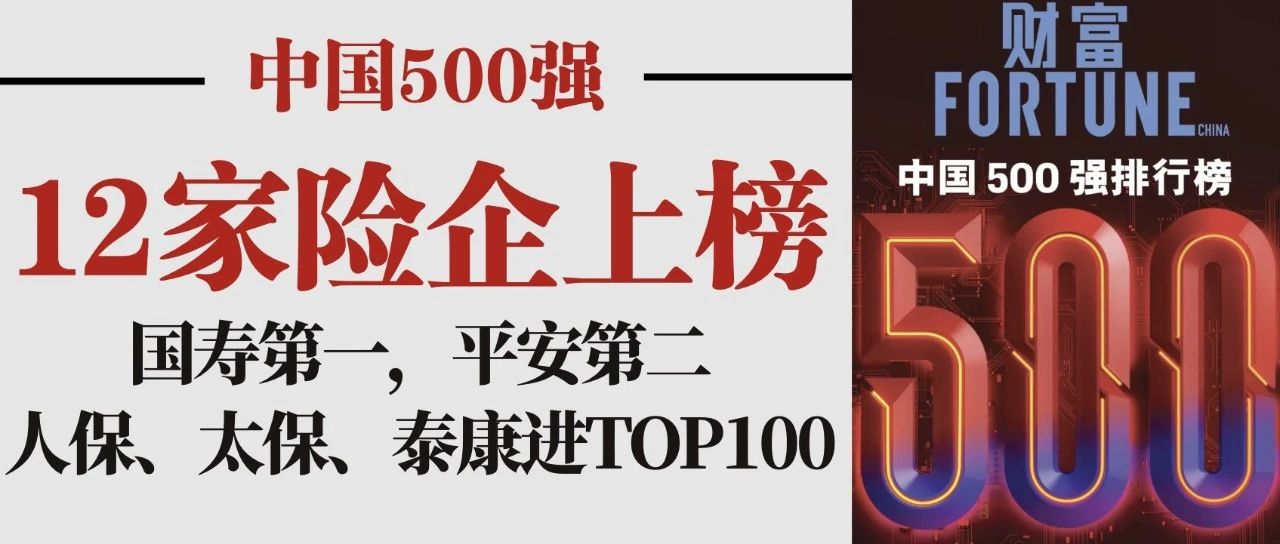
12家上榜!2025年《财富》中国500强:国寿、平安、人保、太保、泰康,位列TOP100,友邦、新华等险企排名上升!
13个精算师· 2025-07-22 10:27
Core Insights - In 2025, 12 insurance companies made it to the Fortune China 500 list, with notable revenue growth and improved rankings [7][11][12] - Major players like China Life, Ping An, and People’s Insurance ranked within the top 100, while companies such as Taikang and AIA also saw significant ranking improvements [7][12] - The most profitable companies included Ping An, AIA, Taikang, and People’s Insurance, indicating strong financial performance in the insurance sector [17][19] Group 1: Rankings and Performance - The 12 insurance companies that made the list include China Life (ranked 12), Ping An (13), People’s Insurance (39), and China Pacific Insurance (65) [7][10] - All ranked insurance companies saw an increase in their positions compared to the previous year, with China Life rising by 6 places and Ping An by 1 place [11][12] - The collective rise in rankings is attributed to increased premium income and investment returns, leading to higher overall revenue [12][14] Group 2: Profitability - Among the top 40 most profitable companies, four insurance firms were included: Ping An (profit of $17.6 billion), AIA ($6.8 billion), China Pacific Insurance ($6.3 billion), and People’s Insurance ($5.9 billion) [18][19] - The insurance sector achieved a record profit of 318 billion yuan in 2024, marking a 133% year-on-year increase [19] Group 3: Potential New Entrants - Several non-listed insurance companies, such as Ruizhong Life and Postal Life Insurance, could potentially qualify for the Fortune 500 list if they report their revenues [30][32] - The threshold for inclusion in the 2025 list is approximately 26 billion yuan in revenue, suggesting that many companies with revenues above this mark could enter the rankings [30][31]




184款终身寿险保费榜!1款超550亿,3款超200亿,中邮超1千亿,平安、太保、太平超500亿,分红型产品增多...
13个精算师· 2025-07-21 15:58
Core Viewpoint - The article highlights the continued popularity and growth of whole life insurance products, with a total of 184 products generating over 700 billion in premium income, marking a new historical high for the industry [1][3][17]. Group 1: Whole Life Insurance Popularity - Whole life insurance remains a hot product category, with 184 products available, including 63 new products launched after August 2023 [12][18][28]. - The total premium income from these whole life insurance products exceeds 700 billion, showcasing significant market demand [24][26]. - The growth rate of premium income for whole life insurance has slowed from 62% in 2022 to 26% in 2024, indicating a potential cooling in sales momentum [26][27]. Group 2: Transition to Participating Policies - There is a noticeable shift from traditional whole life insurance to participating (dividend) policies, with 13 new participating whole life insurance products introduced [40][43]. - The increase in participating policies reflects a broader trend in the industry towards products that offer both guaranteed and variable returns [44][47]. - The sales channels for participating whole life insurance are predominantly through bank insurance channels, which account for a significant portion of the sales [46][47]. Group 3: Major Players and Premium Contributions - Major insurance companies such as Ping An, Zhongyi, and Taikang have reported substantial premium incomes, with Ping An's top product generating 238.95 billion and Zhongyi's product at 191.76 billion [2][36][37]. - The top five products from various companies collectively contribute significantly to the overall premium income, indicating the competitive landscape among leading insurers [30][31][36]. - The article notes that the premium income from new products launched after August 2023 is expected to exceed 200 billion, highlighting the ongoing innovation in the market [37][39].



9月预定利率或再下调!监管:保险销售全面分级倒计时;中国人寿清仓杭州银行或套现39亿|13精周报
13个精算师· 2025-07-19 01:59
Regulatory Dynamics - The Financial Regulatory Bureau has announced a countdown for the comprehensive grading of insurance sales, indicating a new development stage for insurance sales practices [4] - Local asset management companies are prohibited from assisting financial institutions in concealing non-performing assets through false reporting [5] - The Financial Regulatory Bureau has emphasized the need for standardized data reporting by life insurance companies, establishing a responsibility system based on "who manages the business, who manages the data" [6] - The National Taxation Bureau identified three core drivers of silver-haired consumption: necessity, health, and self-satisfaction, highlighting the growing potential of the silver economy [7] - The National Bureau of Statistics reported that the insurance industry's business activity index remained above 55%, indicating a high level of prosperity [8] - As of June, M2 money supply grew by 8.3% year-on-year, with social financing increasing by 4.74 trillion yuan in the first half of the year [10] - The National Medical Insurance Bureau reported that the basic medical insurance coverage rate remains stable at over 95% [11] - By 2024, long-term care insurance is expected to cover nearly 188 million people, with 8,837 designated institutions [12] - The Shenzhen Financial Regulatory Bureau has mandated that insurance companies establish comprehensive claims processes for drone insurance services [13] - The Zhejiang Financial Regulatory Bureau is enhancing the use of "insurance + smart technology" to assist in risk management for freight transportation [14] Company Dynamics - Dajia Insurance increased its stake in Datang Environment by 29.6754 million shares [15] - China Life has fully divested from Hangzhou Bank, realizing approximately 3.9 billion yuan through four rounds of share reductions [16] - China Life made a strategic investment of 2 billion yuan, becoming the third-largest shareholder in Huadian New Energy, marking the largest IPO in A-shares this year [17] - China Pacific Insurance has been approved to invest 180 million yuan in Shanghai Guozhi Technology Co., Ltd. [18] - In the first half of the year, China Pacific Insurance reported original premium income of 282.008 billion yuan, a year-on-year increase of 5.94% [19] - New China Life reported a cumulative original premium income of 121.262 billion yuan in the first half of the year, up 23% year-on-year [20] - ZhongAn Online's original insurance premium income for the first half of the year was approximately 16.659 billion yuan, reflecting a year-on-year growth of 9.32% [21] - Sunshine Life reported 2.08 billion yuan in claims for the first half of 2025, demonstrating the social value of insurance [22] - China Life's Alibaba branch has officially opened, filling the last gap in Tibet without a life insurance institution [23] - The first board of directors of China Life Group has officially assumed office [24] - Guoshou Property Insurance has participated in road traffic accident relief fund services across multiple provinces, with cumulative payments of 1.46 billion yuan [25] Personnel Changes - Li Lunbing has been appointed as the head of the discipline inspection and supervision group at China Taiping Insurance [26] - Li Kedong has been approved as the chairman of Taiping Pension [27] - Jin Chao has been appointed as the general manager of Ping An Pension [29] - The general manager of Ruihua Health Insurance has resigned, with mixed performance during his tenure [30] Industry Dynamics - The second quarter's research value for life insurance product interest rates is expected to be below 2.25%, with some insurers set to complete product transitions by the end of August [31] - Insurance companies have raised over 74 billion yuan through capital increases and bond issuances this year, with diverse methods of capital replenishment [32] - Insurance capital has significantly increased its investment in real estate, with a nearly 600% rise in large-scale investments in the first half of the year [34] - A total of 1,338 insurance asset management products have seen net value growth, with the highest increase exceeding 30% [35] - Zhongzai Asset has launched the first financial "Five Articles" themed bond index in the insurance asset management industry [36] - Guojin Securities reported that high growth in bancassurance has driven positive growth in life insurance premiums, while property insurance growth has generally slowed [37] - Manulife's survey revealed significant gaps in health management and financial planning among Chinese consumers [39] - Shenzhen has completed the "three-in-one" reform of insurance industry organizations, consolidating various associations [40] - AIA's chairman expressed optimism about the insurance industry's future, highlighting the vast potential of the silver-haired market [41] - Meituan announced the nationwide rollout of rider pension insurance, establishing a fund for major illness care and children's education [42] Product Services - China People's Insurance has launched innovative insurance products for industrial chains at the Supply Chain Expo, focusing on key sectors [44] - The first public liability insurance product specifically for tourism enterprises has been launched in Hebei [45] - China Export Credit Insurance has successfully implemented an innovative barter insurance policy in Suifenhe [46]

成立至今再保险公司累积回报率排行榜:德国通用再保险、中再寿险和慕尼黑再保险累积回报率超过200%!
13个精算师· 2025-07-18 09:23
Core Viewpoint - The reinsurance industry has shown significant cumulative return rates, with notable companies achieving over 200% cumulative returns since their establishment, indicating strong profitability and shareholder value creation [1][4][19]. Summary by Sections Cumulative Return Rate Definition - Cumulative return rate is defined as: (Net assets at year-end - Total shareholder capital + Total dividends paid) / Total shareholder capital at year-end * 100% [9][12]. - This metric reflects the ratio of cumulative profits to total shareholder investments since the company's inception [1]. Industry Performance (2017-2024) - The reinsurance industry generated a net profit of approximately 31.9 billion yuan during the period from 2017 to 2024 [10]. - By the end of 2024, the total shareholder capital in the reinsurance sector was about 63.3 billion yuan, with total net assets reaching approximately 105.9 billion yuan [12]. - Cumulative dividends paid by the industry amounted to 11.4 billion yuan, with a record high of 2.77 billion yuan in dividends for 2024 [12][14]. Cumulative Return Rates - The cumulative return rate for the reinsurance industry in 2024 was reported at 85.3%, with an annualized return rate of 8.0% [14]. - Excluding the impact of Zhongnong Re, the cumulative return rate would have been 115.0%, with an annualized return of 10.0% [5][16]. Company Rankings - Among 15 reinsurance companies, five achieved cumulative return rates exceeding 100%, with the highest being 803% for Deutsche Allgemeine Rückversicherung [19][27]. - The average cumulative return rate for these companies was 109.8%, with a median of 24.9% [17][23]. Dividend Distribution - In 2024, six reinsurance companies distributed dividends, marking the highest number of dividend-paying companies in the past eight years [4][13]. - China Re Life Insurance led in cumulative dividends with 5.13 billion yuan, followed by China Re Property & Casualty with 3.33 billion yuan [13]. Recent Trends - The cumulative profitability efficiency of the reinsurance industry has been declining in recent years, primarily due to increased shareholder investments, which rose by 16.1 billion yuan, leading to a nearly 40% increase in total shareholder capital [15][16].

【保险学术前沿】文章推荐:保险科技及其对保险行业的影响概述
13个精算师· 2025-07-18 06:38
Core Insights - Insurtech refers to the application of technological innovations to enhance the efficiency of existing insurance models [3][5] - By leveraging data analytics, IoT, and AI, insurtech can achieve more competitive product pricing [3][8] - Insurtech applications improve efficiency across claims processing, risk assessment, contract management, and underwriting [3][10] - Insurtech is similar to fintech, both driving transformation in traditional industries through modern technological solutions [3][4] - Challenges facing insurtech development include regulatory issues and resistance from traditional insurance companies [3][37] What is Insurtech? - Insurtech combines "insurance" and "technology," aiming to reduce costs and enhance efficiency in the insurance industry [5][6] Understanding Insurtech - Insurtech is driven by the need for innovation and transformation in the insurance sector, focusing on areas neglected by traditional insurers [7][8] - It aims to provide highly customized policies and dynamically adjust premiums based on user behavior through new data streams [7][8] Importance of Insurtech - **Optimizing Customer Experience**: Technology empowers customers to actively participate in insurance selection and receive personalized services [10] - **Enhancing Operational Efficiency**: Insurtech allows users to research insurance options independently, breaking free from traditional service constraints [11] - **Strengthening Customization**: Innovative data collection and processing tools enable precise understanding of user needs, optimizing pricing mechanisms [12] - **Increasing Service Flexibility**: Insurtech products offer customizable, short-term, or transferable features, unlike traditional long-term contracts [13] - **Reducing Operational Costs**: Insurtech companies can operate globally and remotely, significantly lowering operational expenses while maintaining service quality [14] - **Mitigating Fraud**: Data analysis and machine learning help identify anomalies and potential fraud, allowing timely interventions [15][16] Problems Addressed by Insurtech - **Claims Management**: Insurtech automates claims processes, enabling intelligent claims review and fraud detection [18] - **Underwriting Processes**: Automation allows for dynamic risk assessment and fair pricing based on comprehensive data analysis [19] - **Contract Execution**: Blockchain technology facilitates automatic execution of smart contracts, ensuring fairness and reducing human error [20] - **Risk Mitigation**: Big data enables effective identification of fraud and inappropriate risks, enhancing overall risk management [21] Innovative Technologies Driving Insurtech Transformation - **Artificial Intelligence/Machine Learning**: Automates processes and optimizes premium calculations based on historical data [24] - **Automation Technology**: Enhances efficiency by minimizing human intervention in data entry and policy generation [25] - **Big Data**: Allows comprehensive analysis of customer risk profiles and behavior patterns [26] - **Blockchain**: Provides secure, immutable records for smart contract execution in insurance [27] - **Drone Technology**: Used for property assessments and claims audits, improving evaluation accuracy [28] - **Internet of Things (IoT)**: Collects detailed data for precise premium pricing and risk assessment [29] Representative Insurtech Company Cases - **Lemonade**: Directly sells insurance products through a mobile app, bypassing traditional brokers, with a fully digital claims process [31] - **Dacadoo**: Uses API data from devices to create dynamic user profiles and adjust risk assessments in real-time [31] - **Bdeo**: Employs AI solutions for guiding customers through claims processes and reducing assessment errors [31] - **Etherisc**: Integrates blockchain for automated claims processing based on verified third-party data [32] - **Avinew**: Utilizes IoT for real-time monitoring of driving behavior, offering usage-based insurance discounts [34] Insurtech Profit Models - Insurtech's profitability hinges on simplified operational structures and efficient process management, significantly reducing labor costs [35] Criticisms of Insurtech - **Regulatory Barriers**: The highly regulated nature of insurance creates hesitance among traditional companies to collaborate with startups [37] - **Ecosystem Dependency**: Many insurtech startups rely on traditional insurers for underwriting and risk management, creating structural challenges [38] - **Privacy Concerns**: The use of insurtech often involves compromises on personal privacy, which may deter some consumers [39]

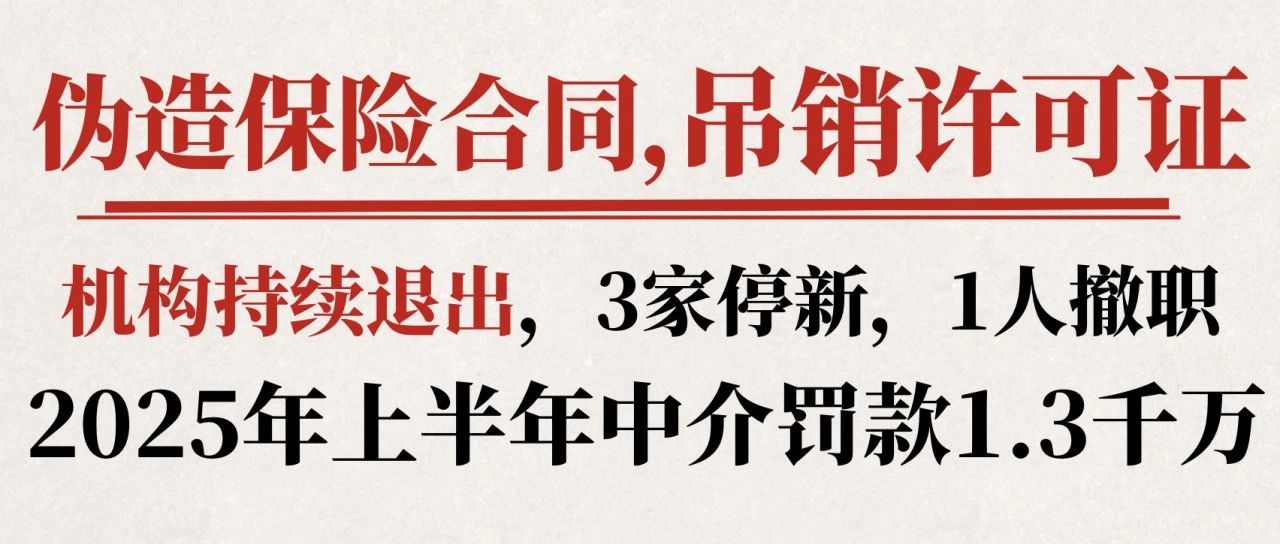
伪造保险合同,吊销许可证!出借许可证,没收违法所得!3家停新,1人撤职:2025上半年保险中介罚款超1.3千万!
13个精算师· 2025-07-17 14:47
Core Viewpoint - The insurance intermediary sector is experiencing a significant reduction in penalties and the number of institutions, indicating a trend of consolidation and regulatory tightening in the industry [6][12][14]. Group 1: Penalties and Regulatory Actions - In the first half of 2025, penalties imposed on insurance intermediaries exceeded 13 million, representing a substantial decrease of over 8.6 million compared to the same period last year, with a year-on-year decline of nearly 40% [6][12][11]. - A total of 160 penalties were issued, with the largest fines being two 800,000 and four 500,000 fines [19][28]. - Despite the reduction in total penalties, regulatory measures remain stringent, with one company having its license revoked for contract forgery and three others being prohibited from accepting new business [20][22]. Group 2: Industry Trends - The number of insurance intermediaries has decreased by 103 over the past five years, from 2,642 to 2,539 [14][15]. - The most significant decline has been in specialized insurance agencies, which saw a reduction of 89 institutions [14]. - The exit of many small and local intermediaries reflects intensified competition within the market [18]. Group 3: Company-Specific Penalties - Notable penalties include three subsidiaries of Ping An Chuangzhan, which collectively faced fines exceeding 2.6 million due to issues such as false customer information and improper business practices [30][36]. - Other companies, such as Hubei Xinhua Xin and Beijing Zhongtian Jiahua, also faced significant fines for various violations, contributing to the overall penalty totals [36][40]. Group 4: Regional Regulatory Actions - Guangdong and Shandong provinces accounted for over 2 million in penalties, with Guangdong alone imposing 297.3 million in fines across multiple companies [43][45]. - The regulatory environment remains focused on accountability, with increased scrutiny on the actions of responsible individuals within the companies [32][33].
2025半年度249个投连险投资账户加权收益率为2.5%,安联平衡型账户领衔,泰康则在权益型账户拔得头筹!
13个精算师· 2025-07-16 11:03
Core Viewpoint - The article provides an update on the performance of various types of investment-linked insurance (投连险) accounts as of mid-2025, highlighting the weighted average returns across different account types and identifying top-performing accounts in each category [1][16]. Group 1: Investment Account Overview - As of June 2025, a total of 249 investment-linked insurance accounts were recorded, categorized into four types: 38 money market accounts, 91 bond-type accounts, 47 balanced accounts, and 73 equity accounts [18][20]. - The total asset scale of these accounts amounts to 190.2 billion yuan, with the breakdown as follows: money market accounts at 4.9 billion yuan, bond-type accounts at 101.7 billion yuan, balanced accounts at 11.4 billion yuan, and equity accounts at 72.3 billion yuan [22]. Group 2: Performance of Different Account Types - The overall weighted average return for investment-linked insurance accounts in mid-2025 was 2.5%, with the following breakdown by account type: - Money market accounts: 0.73% - Bond-type accounts: 1.0% - Balanced accounts: 1.4% - Equity accounts: 4.8% [25]. Group 3: Detailed Performance Metrics - Money Market Accounts: - Weighted average return: 0.73% - Simple average return: 0.46% - Median return: 0.48% - Maximum return: 1.21% (恒安标准现金型投资账户) [27]. - Bond-Type Accounts: - Weighted average return: 1.0% - Simple average return: 0.3% - Median return: 0.8% - Maximum return: 4.2% (瑞泰财智增值投资账户) [7][39]. - Balanced Accounts: - Weighted average return: 1.4% - Simple average return: 2.8% - Median return: 2.2% - Maximum return: 26.1% (中德安联安赢慧选2号投资账户) [10][47]. - Equity Accounts: - Weighted average return: 4.8% - Simple average return: 2.6% - Median return: 1.7% - Maximum return: 13.2% (泰康沪港深精选投资账户) [12][53]. Group 4: Top-Performing Accounts - The article lists the top ten performing accounts in each category, showcasing the highest returns achieved by various insurance companies [31][40][45][50].

2025年百万圆桌 (MDRT)会员:友邦保险回归第一,友邦人寿COT蝉联第一,明亚TOT和COT均进TOP25!
13个精算师· 2025-07-15 15:53
Core Insights - The article discusses the 2025 Million Dollar Round Table (MDRT) rankings, highlighting the top insurance companies and changes in their standings compared to previous years [1][2][3]. Group 1: MDRT Rankings - AIA Insurance ranks first globally with 4,110 members, while AIA China follows in second place with 3,892 members [1][18]. - Mingya Insurance Brokers ranks eighth, and MetLife ranks seventeenth, with several companies like Dajia Life and Zhongyin Group Life making their debut on the list [1][3][14]. - A total of 34 Chinese insurance companies made it to the global top 100, with notable improvements in rankings for companies like MetLife, Dajia Life, and Zhongyin Group Life [3][10]. Group 2: Changes in Membership Numbers - China remains the leader in total MDRT membership with 14,945 members, despite a significant decrease of 6,661 members from the previous year [11][12]. - The decline in membership is attributed to changes in the insurance market, including the discontinuation of certain products and a shift in focus towards a more elite sales force [12][13]. - The article notes that while the number of MDRT members has decreased, the quality and standards for membership have been rising, making it more challenging to qualify [31][40]. Group 3: Company Performance - AIA Life continues to dominate with the highest number of COT (Court of the Table) members, while Mingya ranks fifth in this category [19][24]. - AIA Life also leads in TOT (Top of the Table) members, surpassing Mingya and CITIC Prudential, which are also in the top 25 [24][25]. - The article emphasizes the importance of maintaining high standards for membership, reflecting a trend towards quality over quantity in the insurance sales force [31][42]. Group 4: Industry Trends - The insurance industry is undergoing a transformation towards a more elite model, moving away from the previous "mass recruitment" strategy [42][45]. - The establishment of a professional honor evaluation system for insurance sales personnel is being promoted to enhance the quality of the workforce [50][51]. - The article highlights the need for a shift in focus towards high-quality development in the insurance sector, aligning with regulatory changes and market demands [45][48].

新规!金融监管总局:禁止混淆存款和保险!销售保险产品,要考虑客户需求、收入,提出适当性匹配意见!不适配要建议终止投保...
13个精算师· 2025-07-14 15:04
Core Viewpoint - The new regulation "Product Appropriateness Management" issued by the Financial Regulatory Bureau emphasizes that insurance institutions must understand both the products and the customers to ensure suitable product sales [7][8]. Group 1: Product Appropriateness Management - Insurance institutions are required to match products with customers based on their financial needs and risk tolerance, ensuring that the products sold are appropriate for the customers [14][21]. - The regulation categorizes insurance products separately from other financial products like wealth management, highlighting the unique characteristics of insurance [12][19]. - The management of product appropriateness will be included in the annual consumer protection regulatory evaluation [60][63]. Group 2: Sales Process and Personnel Management - The regulation mandates a tiered sales approach, where life insurance products are classified into five levels, and sales personnel must have the appropriate qualifications to sell corresponding products [27][30]. - Sales personnel are required to undergo continuous training to ensure they understand the products they are selling, and their performance will be evaluated based on compliance and customer feedback, not just sales figures [29][30]. - Financial institutions must not replace customers in assessments or provide misleading information regarding product risks [43][44]. Group 3: Customer Understanding and Risk Assessment - Institutions must conduct thorough assessments of customer needs and financial situations before recommending products, especially for products with floating returns like dividend insurance [54][56]. - If a product is deemed inappropriate for a customer, the institution must advise against purchasing it, and if the customer insists, a written confirmation of understanding the risks must be obtained [50][54]. - Specific conditions, such as annual premiums exceeding four times the household income, require additional confirmation from the customer before proceeding with the insurance [46][54]. Group 4: Regulatory Compliance and Consumer Protection - The new regulation aims to enhance consumer rights protection by ensuring that the sales process is transparent and that customers are well-informed about the products they are purchasing [64][65]. - Financial institutions are required to establish internal systems to support the management of product appropriateness and ensure compliance with the new regulations [61][62]. - Violations of the appropriateness management regulations may lead to regulatory actions against the institutions and responsible personnel [62][63].

金融监管总局发布《金融机构产品适应性管理办法》;国有险企长周期考核增五年周期指标;险资扎堆举牌港股获15%超额回报;|13精周报
13个精算师· 2025-07-12 02:56
Regulatory Dynamics - The National Financial Regulatory Administration issued the "Financial Institutions Product Suitability Management Measures," effective from February 1, 2026, to enhance consumer protection and appropriate management of financial products [5][6]. - Seven departments encouraged childcare service institutions to purchase liability insurance and property insurance [7]. - The State Council is promoting the internationalization of the reinsurance industry [10]. - The Ministry of Finance announced that state-owned commercial insurance companies will implement long-term assessments starting this year, adding five-year indicators [11]. - The National Development and Reform Commission reported that over 180 million people are expected to be insured under long-term care insurance during the "14th Five-Year Plan" period [12]. Company Dynamics - AIA Group acquired 2,252 apartments in Shanghai [21]. - Hongkang Life increased its stake in Zhengzhou Bank, triggering a mandatory bid [22]. - Zhong An Online completed the placement of new H-shares, raising approximately 3.92 billion HKD [23]. - AIA faced a sell-off of 3.7% of its shares by the Kuwait Investment Authority, realizing 26.8 billion HKD [24]. - Jintai Property Insurance received approval for an 800 million yuan capital increase [25]. - Taikang Life reported insurance claims of 9.92 billion yuan in the first half of the year [27]. - China Pacific Insurance announced a cash dividend of 1.08 yuan per share, totaling approximately 10.39 billion yuan [29]. Industry Dynamics - There were 88 changes in core executive positions in the insurance industry in the first half of the year, reflecting a search for solutions amid multiple pressures [47]. - The insurance industry faced over 600 penalties in the first half of the year, with providing false materials being a major issue [49]. - The registration scale of "insurance ABS" exceeded 180 billion yuan, marking a 46% year-on-year increase [50]. - Insurance capital has made 20 bids for listed companies this year, matching last year's total [51]. - Insurance capital has achieved a 15% excess return from investments in Hong Kong stocks [52]. - The insurance sector is expected to increase allocations to equity assets in the second half of the year, focusing on high dividend and high growth stocks [53]. - Five insurance-related private equity fund companies have been approved, with three products already in the market [54]. - The employment report for 2025 insurance graduates indicates a 96.3% employment rate, with a significant demand for talent in the insurance and technology sectors [55].