
GEELY AUTO(00175)

Search documents
吉利控股集团:计划到2030年实现年销量650万辆
Xin Lang Cai Jing· 2026-01-22 10:08
1月22日消息,吉利控股集团计划到2030年实现年销量650万辆,年销售额为1万亿元人民币。 1月22日消息,吉利控股集团计划到2030年实现年销量650万辆,年销售额为1万亿元人民币。 ...
吉利汽车(00175.HK)1月22日回购949.29万港元,年内累计回购4.87亿港元
Zheng Quan Shi Bao Wang· 2026-01-22 09:35
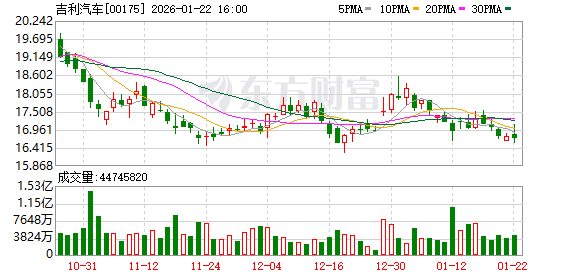
Core Viewpoint - Geely Automobile has been actively repurchasing its shares, indicating a strategy to support its stock price amid recent declines [2][3] Group 1: Share Repurchase Activity - On January 22, Geely repurchased 571,000 shares at prices ranging from HKD 16.580 to HKD 16.740, totaling HKD 9.49 million [2] - The stock closed at HKD 16.710 on the same day, reflecting a decrease of 0.24%, with a total trading volume of HKD 749 million [2] - Since January 19, the company has conducted share repurchases for four consecutive days, acquiring a total of 6.832 million shares for a cumulative amount of HKD 11.4 million, during which the stock price fell by 2.45% [2] Group 2: Year-to-Date Repurchase Summary - Year-to-date, Geely has completed 10 share repurchase transactions, acquiring a total of 28.542 million shares for a total expenditure of HKD 48.7 million [3] - The detailed repurchase activities include various dates, share quantities, and price ranges, with the highest repurchase price recorded at HKD 17.900 and the lowest at HKD 16.580 [3]

吉利控股:2030年全球销量将超650万辆
Xin Lang Cai Jing· 2026-01-22 09:13
【吉利控股:2030年全球销量将超650万辆】智通财经1月22日电,吉利控股集团CEO安聪慧今日表示, 2030年吉利吉利控股集团全球销量将突破650万辆(含商用车),营收超1万亿元,跻身全球车企销量前 五。其中,新能源销量占比约75%;海外市场销量占比超1/3。安聪慧同时表示,公司将开发覆盖A到E 级车型的全球新能源架构,基于全新架构的平均单车型研发周期和综合成本下降30%以上。(智通财经 记者 刘阳) 转自:智通财经 ...
吉利控股明确:2030年全球汽车销量650万辆
Zheng Quan Shi Bao Wang· 2026-01-22 09:04
Core Insights - Geely Holding Group has set ambitious targets for 2030, aiming for global vehicle sales of 6.5 million units, with approximately 75% being new energy vehicles, and global revenue exceeding 1 trillion yuan [1] Group 1 - Geely's 2030 global vehicle sales target is 6.5 million units [1] - The company aims for new energy vehicles to account for about 75% of total sales by 2030 [1] - Geely projects global revenue to surpass 1 trillion yuan by 2030 [1]
吉利汽车(00175)1月22日斥资949.29万港元回购57.1万股
智通财经网· 2026-01-22 08:48
Group 1 - The core point of the article is that Geely Automobile (00175) announced a share buyback plan, intending to repurchase 571,000 shares at a total cost of HKD 9.4929 million, with a per-share price range of HKD 16.58 to HKD 16.74 [1] Group 2 - The share buyback is scheduled to take place on January 22, 2026 [1] - The total number of shares to be repurchased is 571,000 [1] - The total expenditure for the buyback is HKD 9.4929 million [1]
吉利汽车1月22日斥资949.29万港元回购57.1万股
Zhi Tong Cai Jing· 2026-01-22 08:48
Group 1 - The company Geely Automobile (00175) announced a share buyback plan, committing to repurchase 571,000 shares at a total cost of HKD 9.4929 million [1] - The buyback will occur on January 22, 2026, with the repurchase price ranging from HKD 16.58 to HKD 16.74 per share [1]
吉利汽车(00175) - 翌日披露报表
2026-01-22 08:42
FF305 翌日披露報表 (股份發行人 ── 已發行股份或庫存股份變動、股份購回及/或在場内出售庫存股份) 表格類別: 股票 狀態: 新提交 公司名稱: 吉利汽車控股有限公司 呈交日期: 2026年1月22日 如上市發行人的已發行股份或庫存股份出現變動而須根據《香港聯合交易所有限公司(「香港聯交所」)證券上市規則》(「《主板上市規則》」)第13.25A條 / 《香港聯合交易所有限公司GEM證券 上市規則》(「《GEM上市規則》」)第17.27A條作出披露,必須填妥第一章節 。 | 第一章節 | | | | | | | | | --- | --- | --- | --- | --- | --- | --- | --- | | 1. 股份分類 | 普通股 | | 股份類別 不適用 | | 於香港聯交所上市 | 是 | | | 證券代號 (如上市) | 00175 | | 說明 | | | | | | 多櫃檯證券代號 | 80175 | RMB | 說明 | | | | | | A. 已發行股份或庫存股份變動 | | | | | | | | | | | | 已發行股份(不包括庫存股份)變動 | | 庫存股份變動 | ...
“和而不同” 见真章 雷诺CEO福兰:懂中国生态,更懂双向赋能的共赢密码
Huan Qiu Wang· 2026-01-22 07:07
"想要跟上中国的节奏,感觉就像攀登珠穆朗玛峰一样。"福兰如此描述了他间隔八个月后的重返中国感 受。从过去三到四个月一次的访华频率,到见证中国智能汽车生态的爆发式增长,福兰深知,在这个全 球竞争最激烈的市场中,单纯的"产品导入"或"合资生产"模式早已过时。 因此,福兰明确否定了雷诺短期内重返中国销售市场的可能,理由是"竞争非常激烈"和"价格战的现 实"。 他表示,"价格战是双输的战争,既会导致车辆残值暴跌,也会损害品牌价值,最终不利于消费 者与行业发展。"这种"不逐量、重价值"的判断,与雷诺集团在欧洲市场从"追求销量"转向"追求价 值"的战略一脉相承。 来源:环球网 【环球网科技报道 记者 张阳】2026年新年第三周,雷诺集团CEO福兰(François Provost)将中国定为 年度首个海外市场走访目的地。这位与中国有着长期深厚渊源的管理者,在过去八个月的CEO任期里完 成了集团组织架构重组,再度踏上中国土地,带来的并非急功近利的市场扩张计划,而是一套经过深思 熟虑的"中国生态深耕战略"——以技术合作为纽带,成为全球技术迭代与竞争力重构的关键支点。 在竞争白热化、价格战持续的中国汽车市场中,这种"克制存在" ...
1月21日港股回购一览


Zheng Quan Shi Bao Wang· 2026-01-22 02:09
Group 1 - On January 21, 42 Hong Kong-listed companies conducted share buybacks, totaling 29.73 million shares and an amount of HKD 512 million [1] - Xiaomi Group-W had the highest buyback amount of HKD 248 million, repurchasing 7 million shares [1] - Other notable buybacks included Pop Mart with HKD 96.49 million and Sunny Optical Technology with HKD 61.39 million [1] Group 2 - The highest buyback price for Xiaomi was HKD 35.480, while the lowest was HKD 35.220, with a cumulative buyback amount of HKD 20.49 billion for the year [1] - Pop Mart's buyback ranged from HKD 194.900 to HKD 191.100, with a cumulative buyback amount of HKD 348 million for the year [1] - Sunny Optical Technology's buyback prices were between HKD 63.950 and HKD 62.300, with a cumulative buyback amount of HKD 686 million for the year [1]
甲醇技术路线重构商用车绿色发展版图,加速进入主流市场
Xin Hua Cai Jing· 2026-01-22 01:45
Core Viewpoint - The methanol-based alcohol-hydrogen electric technology is accelerating its entry into the mainstream commercial vehicle market, providing a competitive alternative to pure electric and hydrogen fuel cell technologies, and is expected to create a new trillion-level renewable energy sector [1][4]. Group 1: Market Overview - China is the largest commercial vehicle market globally, with rapid development expected in electric, hydrogen fuel cell, and methanol technologies, driven by supportive policies and both domestic and export demand [2]. - By 2025, domestic sales of commercial vehicles are projected to reach 3.237 million units, with 871,000 units being new energy commercial vehicles, resulting in a penetration rate of 26.9% [2]. - The current penetration rate of new energy in commercial vehicles is low compared to passenger vehicles, which have surpassed 50% [2]. Group 2: Challenges and Opportunities - The slow development of new energy in commercial vehicles is attributed to the limitations of existing technologies, which do not meet the specific needs of commercial vehicle usage [3]. - The commercial vehicle sector is a significant energy consumer, accounting for over half of vehicle fuel consumption and 56% of CO2 emissions from all vehicles [2]. Group 3: Technological Advantages - The alcohol-hydrogen electric vehicle technology, which utilizes methanol as a liquid hydrogen substitute, has shown practical and economic advantages, making it suitable for various operational conditions [4][5]. - Compared to pure electric vehicles, alcohol-hydrogen electric vehicles offer stronger endurance, less impact from weather conditions, and lower infrastructure costs [5]. - The latest generation of methanol-powered systems has achieved a thermal efficiency of 50.3%, with comprehensive energy costs reduced by 32%-52% compared to diesel vehicles [5]. Group 4: Infrastructure and Policy Support - The existing oil and gas pipeline network can be utilized for low-cost transportation of liquid methanol, and converting existing gas stations to methanol refueling stations is significantly cheaper than building new hydrogen stations [6]. - The Chinese government has introduced over 70 policy documents to support the promotion of methanol vehicles, indicating strong institutional backing for the industry [8][9]. Group 5: Global Trends and Future Outlook - European car manufacturers are increasingly developing methanol as a vehicle fuel, with models expected to enter the market post-2035 [7]. - The global methanol industry is expanding, with 414 ships confirmed to adopt methanol fuel by the end of 2025, indicating a growing acceptance of methanol in various transportation sectors [7]. - The integration of green hydrogen, ammonia, and methanol is becoming a key pathway for clean energy consumption and industrial innovation [10].