GEELY AUTO(00175)

Search documents
港股汽车股尾盘涨幅扩大 吉利汽车涨4.9%
Mei Ri Jing Ji Xin Wen· 2026-03-24 07:43
Core Viewpoint - The Hong Kong automotive stocks experienced significant gains in the late trading session, indicating a positive market sentiment towards the sector [1] Group 1: Stock Performance - Geely Automobile (00175.HK) rose by 4.9%, reaching HKD 20.98 [1] - BYD Company (01211.HK) increased by 4.1%, trading at HKD 106.6 [1] - Li Auto-W (02015.HK) saw a rise of 4.01%, with shares priced at HKD 67.4 [1] - Xpeng Motors-W (09868.HK) gained 3.21%, with a share price of HKD 73.9 [1]


吉利汽车:业绩符合预期,强阿尔法趋势高度确定-20260324
CAITONG SECURITIES· 2026-03-24 07:30
Investment Rating - The investment rating for the company is upgraded to "Buy" [2] Core Views - The company has shown strong performance with a significant increase in vehicle deliveries and revenue, achieving a total of 3.025 million vehicles delivered in 2025, a year-on-year increase of 39% [8] - The company's revenue for Q4 reached 105.76 billion RMB, reflecting a year-on-year growth of 43.7% [8] - The company is focusing on high-end and international markets, with the launch of the Zeekr 9X contributing positively to sales and profitability [8] - The financial outlook is positive, with projected revenues of 445.93 billion RMB in 2026 and net profits of 19.80 billion RMB, indicating a strong growth trajectory [8] Financial Forecasts - Revenue projections for the upcoming years are as follows: - 2024: 240.19 billion RMB - 2025: 345.23 billion RMB - 2026: 445.93 billion RMB - 2027: 514.93 billion RMB - 2028: 590.25 billion RMB [7] - Net profit forecasts are: - 2024: 16.63 billion RMB - 2025: 16.85 billion RMB - 2026: 19.80 billion RMB - 2027: 21.99 billion RMB - 2028: 26.59 billion RMB [7] - The company is expected to maintain a strong return on equity (ROE), projected at 959.76% in 2026 [7]
汽车行业:26年数据点评系列之四:乘用车连续两个月库存去化,出口增速表现亮眼
GF SECURITIES· 2026-03-24 07:06
Investment Rating - The report maintains a "Buy" rating for the automotive industry, consistent with the previous rating [2] Core Insights - The automotive industry is expected to experience a stable price increase and volume growth in 2026, despite a decline in terminal sales in January and February due to consumer hesitation [15][16] - The passenger vehicle inventory has decreased for two consecutive months, and export growth has been impressive, with a 53.3% year-on-year increase in exports for the first two months of 2026 [15] - The penetration rate of new energy vehicles (NEVs) in the domestic market is under pressure, but exports have surged by 113.0% year-on-year [15] Summary by Sections 1. Passenger Vehicle Sales and Market Dynamics - In January and February 2026, the cumulative sales of passenger vehicles were 2.642 million units, down 14.7% year-on-year, indicating a projected annual decline of 5.3% [15] - The average selling price (ASP) of passenger vehicles increased by 8.8% year-on-year, marking five consecutive months of positive growth [15] - The inventory of passenger vehicles stood at 4.346 million units by the end of February 2026, with a dynamic inventory-to-sales ratio of 2.34 [15] 2. New Energy Vehicle Performance - The cumulative export of new energy vehicles reached 572,000 units in the first two months of 2026, reflecting a 113.0% year-on-year increase [15] - The penetration rates for pure electric and plug-in hybrid vehicles were 23.4% and 15.0%, respectively, with year-on-year declines of 9.2 percentage points and 3.0 percentage points [15] 3. Investment Recommendations - The report suggests focusing on various automotive companies based on their market positioning: - Right-side targets include Geely, BYD, Seres, Chery, Xpeng, and Leap Motor [15] - Left-side targets include Li Auto and Changan [15] - Companies at inflection points include Great Wall Motors and SAIC Motor, with a recommendation to pay attention to JAC Motors [15] - In the upstream and downstream supply chain, recommended right-side targets include Minth Group, Yinlun, and others, while left-side targets include Yongda Automotive and New Coordinates [15]


顺周期-冰火转换-时刻-策略对话汽车
2026-03-24 01:27
Summary of Key Points from the Conference Call Industry Overview - The overseas penetration rate of new energy vehicles (NEVs) is currently only 10%, with long-term potential expected to reach 50%-60%, allowing Chinese automakers to access a market capacity of approximately 40-50 million vehicles [1][4] - The global automotive market's annual sales volume is estimated to be between 80 million to 100 million vehicles, excluding the Chinese market of about 20-24 million and the U.S. market of approximately 15-16 million [3] Company-Specific Insights BYD - BYD's overseas sales are projected to reach 1.6 to 1.7 million units by 2026, contributing profits of 30-35 billion yuan, which will account for 60%-70% of the company's total profits [1][6] - The company is expected to further increase its overseas sales to 2.8 to 3.5 million units by 2027, indicating a strong growth trend [6] Geely - Geely's export volume is expected to grow from 420,000 units in 2025 to 750,000-800,000 units in 2026, with nearly 40% being NEVs [6] - The profit contribution from Geely's NEV exports is estimated to be between 6-8 billion yuan, with overall export business contributing over 50% to the company's profits [6] Chery - Chery's NEV exports are projected to exceed 600% year-on-year growth in 2025, with expected exports of 550,000-600,000 units by 2026 [1][6] Market Dynamics - The demand for NEVs in overseas markets has been positively impacted by the recent U.S.-Iran conflict, particularly in oil-sensitive regions like Europe and Singapore, where foot traffic in stores has increased by approximately 80%-90% year-on-year [2] - The penetration rate of NEVs in Europe is nearing 30% by 2025, indicating a high market acceptance compared to China's current rate of about 55% [2] Competitive Advantages - Chinese NEV manufacturers and their supply chains exhibit significant cost advantages, particularly in battery costs, with domestic battery costs at around 0.3 yuan/Wh compared to 0.8-1.0 yuan/Wh overseas [5] - The export gross margin for domestic NEV manufacturers is generally over 20%, with some regions approaching 30%, translating to a per-vehicle profit of around 20,000 yuan, which is 8-10 times higher than domestic profit levels [5] Supply Chain Beneficiaries - Companies like Fute Technology and Weimais are expected to benefit significantly from the growth in the European NEV market, with profit contributions projected at 35%-40% and over 30%, respectively [7] - Fute Technology's European NEV business is anticipated to account for 25%-30% of its total revenue [7] - Other suppliers such as United Power and Jingjin Electric are also expected to benefit from the trend of NEVs going overseas [7]

汽车行业2026一季度业绩前瞻
2026-03-24 01:27
Summary of Automotive Industry Conference Call Industry Overview - The automotive industry is facing dual pressure on volume and profit in Q1 2026, with wholesale volume expected to decline by approximately 8% year-on-year, while new energy vehicle sales are projected to slightly decrease. Exports are the only bright spot, with a year-on-year increase of 55% [1][2][3]. Key Points Performance Expectations - **Overall Industry Performance**: Q1 2026 is anticipated to be the low point for volume and profit in the passenger car sector, with most automakers expected to see profit declines exceeding 20% year-on-year due to rising costs from copper, aluminum, lithium carbonate, and the appreciation of the RMB [1][2][3]. - **Geely Auto**: Expected to report profits exceeding 4 billion yuan, with a quarter-on-quarter increase of over 10%, driven by the high profitability of the Geely 9X model and a year-on-year export growth of 140% [1][4]. - **Heavy Truck Sector**: Strong export performance with a year-on-year increase of 30% in January-February 2026. China National Heavy Duty Truck Corporation (CNHTC) is expected to see a profit increase of 60% to 500 million yuan [1][2][3]. Segment Performance - **Intelligent Vehicle Sector**: Outperforming the overall vehicle sector, with Huayang Group expected to see a nearly 20% year-on-year growth, benefiting from Xiaomi's automotive sales and new product lines [1][7]. - **Parts Sector**: Mixed performance with leading companies like Fuyao Glass and Xingyu maintaining lower pressure due to strong overseas expansion. Companies like Kingood are expected to benefit from the rising aluminum prices [1][6]. Sales and Profitability - **Sales Disparities**: Despite overall industry decline, companies like NIO and Seres are expected to show significant sales growth due to new model launches, while BYD and XPeng are facing larger declines [2][3][4]. - **Profit Expectations**: Most passenger car companies are expected to see a year-on-year profit decline of over 20%. Geely is projected to stand out with a profit of over 4 billion yuan [4][5]. Market Trends - **Two-Wheeler Sector**: The sector continues to show strong growth in large-displacement exports, with Chuanfeng Power's exports expected to increase by 60% year-on-year, although overall performance is expected to remain flat due to tariff impacts [1][10]. Additional Insights - **Investment Strategy**: The investment strategy for 2026 focuses on performance and valuation, with recommendations in areas such as AIGC-enabled "power shortage," L4-level intelligence, and robotics. Key companies recommended include Weichai Power, Xpeng Motors, and Top Group [2]. - **Challenges**: The industry faces challenges from rising raw material costs and currency fluctuations, which are expected to negatively impact profitability in Q1 2026 [3][4]. This summary encapsulates the key insights and performance expectations for the automotive industry as discussed in the conference call, highlighting both opportunities and challenges within various segments.




继续全面看好新能车锂电赛道
2026-03-24 01:27
Summary of Key Points from Conference Call Records Industry Overview - **Industry Focus**: The records primarily discuss the electric vehicle (EV) and lithium battery sectors, with a particular emphasis on the growth of lithium battery demand and the energy storage market leading up to 2026 [1][5][4]. Key Insights and Arguments - **Lithium Battery Demand**: Global lithium battery demand is projected to exceed 2,800 GWh in 2026, representing a 25% increase from 2025. This includes approximately 2,000 GWh for power batteries (up 13.5%) and around 830 GWh for energy storage batteries [1][5]. - **Energy Storage Growth**: The global energy storage market is expected to grow to 450 GWh, a 45% increase, with significant contributions from the Middle East and Africa, where installations are expected to double [1][4]. - **Material Production Recovery**: The operating rates for lithium battery materials have significantly improved, with the average operating rate for wet separators rising from 60% to 90%. Prices and unit profitability for lithium iron phosphate and hexafluorophosphate are entering a recovery phase due to tight supply and demand [1][9]. - **Geely Auto's Export Strategy**: Geely is expected to export 900,000 to 1 million vehicles by 2026, with significant profits anticipated from its high-end models, contributing over 20 billion yuan in profit [1][13]. - **Solid-State Battery Development**: The solid-state battery sector is entering a critical phase, with several catalysts expected between March and May 2026, including the introduction of semi-solid and fully solid-state battery models [1][15][16]. Market Dynamics - **New Energy Vehicle Sales**: The global new energy vehicle market is projected to grow by over 10% in 2026, with China expected to reach 1.8 million units sold, a 10% increase from 2025. Commercial vehicles are anticipated to see a 40% increase in sales [3][7]. - **Regional Energy Storage Growth**: The energy storage market in China is expected to grow to 275 GWh, with the U.S. market facing uncertainties due to regulatory constraints. Europe is projected to grow by 42%, with potential for exceeding expectations [4][5]. - **Market Recovery Signals**: In March 2026, there are signs of recovery in the new energy vehicle market, with order urgency increasing by 20-30%. High oil prices and local incentives are expected to drive demand [2][7][12]. Additional Important Insights - **Material Price Drivers**: The price increases in the lithium battery materials sector are driven by capacity utilization rates and raw material costs, particularly in petrochemical-related materials [8][9]. - **Investment Logic for Lithium Materials**: The investment logic for lithium materials includes the dual benefits of inventory and energy storage revenues, with significant contributions expected from the energy storage sector in 2026 [10]. - **Sodium-Ion Battery Opportunities**: The sodium-ion battery sector is expected to see significant advancements in 2026, with costs potentially dropping to 0.4 yuan/Wh, making it competitive with lithium batteries [21][22][23]. Conclusion The records highlight a robust growth trajectory for the lithium battery and new energy vehicle sectors, driven by increasing demand, technological advancements, and strategic market positioning by key players like Geely. The anticipated recovery in sales and the introduction of innovative battery technologies are set to shape the industry's landscape in the coming years.

全年营收3452亿元 吉利汽车2025年实现高质量发展
Bei Jing Ri Bao Ke Hu Duan· 2026-03-24 00:37
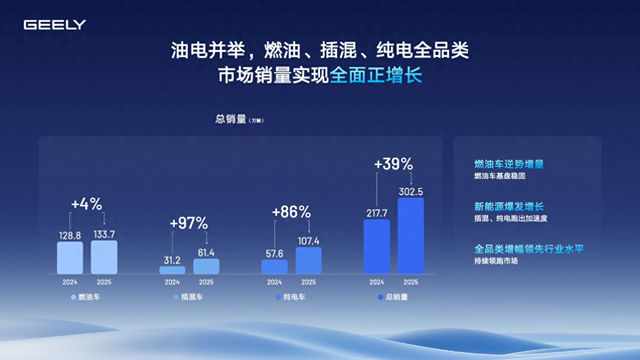
Core Insights - Geely Automobile Holdings Limited reported a record total revenue of 345.2 billion yuan for 2025, representing a 25% year-on-year increase. The core net profit reached 14.41 billion yuan, up 36%, indicating high-quality growth as profit growth outpaced revenue growth [1][13] - The company achieved a total sales volume of 3.025 million vehicles in 2025, a 39% increase, exceeding the annual target of 3 million units. New energy vehicle sales surpassed 1.68 million units, marking a 90% increase [1][13] Financial Performance - Total revenue for 2025 was 345.2 billion yuan, a 25% increase year-on-year, with core net profit at 14.41 billion yuan, up 36% [1][13] - Gross profit rose to 57.3 billion yuan, also a 25% increase year-on-year, reflecting the benefits of scale effects and optimized product structure [1][13] - Cash reserves increased by 46% to 68.2 billion yuan, allowing for a proposed dividend increase of 51.5% to 0.5 HKD per share, totaling 5.39 billion HKD [1][13] Sales and Market Performance - Geely's total vehicle sales reached 3.025 million units in 2025, exceeding the target by 25% [1][13] - New energy vehicle sales accounted for over 1.68 million units, achieving a 90% year-on-year growth, positioning Geely among the top players in the new energy sector [1][13] - In the first two months of 2026, Geely sold 476,000 vehicles, maintaining the industry's leading position [1][13] Strategic Developments - The "One Geely" strategy was further deepened in 2025, with the integration of the Zeekr brand, creating a comprehensive brand layout across mainstream, high-end, and luxury markets [3][15] - Zeekr brand sales exceeded 224,000 units, while Lynk & Co. sales reached 350,000 units, a 23% increase year-on-year [3][15] - Geely's fuel vehicle business remained stable, with the Geely China Star selling 1.21 million units, a 3% increase [3][15] Technological Innovations - Geely launched its first comprehensive AI technology system in 2025, with a 2.0 version iteration planned for CES 2026 [5][18] - The Flyme Auto intelligent cockpit system reached 2.26 million units, with the new AI cockpit operating system Flyme Auto 2 officially released [7][20] - In the new energy "three electric" sector, the ShenDun JinZhuan battery achieved industry-leading safety, lifespan, and fast-charging capabilities [8][20] International Expansion - Geely's overseas sales reached 420,000 units in 2025, meeting export targets, with over 120,000 units in new energy exports [8][22] - The brand entered 13 new markets in 2025, including major European markets and high-potential new energy markets [10][22] - By the end of 2025, Geely's brand network expanded to 88 countries and regions, with over 1,200 outlets [10][22] Future Outlook - Geely plans to launch multiple new products in 2026, targeting a total sales goal of 3.45 million units [12][24] - The company aims to enhance its product matrix and continue to provide safer, smarter, and more sustainable mobility solutions for global users [12][24]

全球视野看电车之五:基于能源安全视角看全球新能源增长潜力
Changjiang Securities· 2026-03-23 23:30
Investment Rating - The investment rating for the automotive and automotive parts industry is "Positive" and maintained [7] Core Insights - The rise in oil prices, influenced by the Middle East situation, has raised energy security concerns, prompting South Korea to initiate a resource security crisis alert and consider implementing vehicle restrictions [2][17] - The transportation sector accounts for a significant portion of oil consumption in many countries, and the current low penetration of new energy vehicles (NEVs) globally means that reliance on traditional fuel vehicles exacerbates risks associated with energy supply constraints. Diversifying the energy structure can mitigate these risks, and rising oil prices can accelerate the transition to NEVs in the global passenger vehicle market [2][19] - The potential for domestic NEVs to expand internationally is substantial, with projected sales for EVs, PHEVs, and HEVs in regions excluding China, the US, and Japan reaching 3.54 million, 1.4 million, and 4.62 million units respectively by 2025. If domestic NEVs capture 50%-60% of the market share in these categories, it could represent a growth potential of 4.3-5.3 times [23][24] Summary by Sections Global Energy Security Perspective - The recent increase in oil prices has raised energy security issues, with Brent crude oil futures reaching $108.65 per barrel, a 70% increase over the past two months. South Korea has raised its resource security crisis alert level and is considering measures such as vehicle restrictions to manage demand [17][19] New Energy Vehicle Market Potential - The transportation sector's oil consumption is significant, with many countries having low NEV penetration rates. High oil prices can drive the shift towards NEVs, as traditional fuel vehicles' dependence on oil resources increases risks associated with supply constraints [19][20] - Major regions for NEV exports from China include Western Europe, Southeast Asia, and Latin America, where leading companies like BYD, SAIC, and Geely are currently underrepresented in market share. As NEV penetration increases, these companies are expected to capture a larger share of the market [26][29]


吉利汽车因认股权获行使而发行合计72.65万股
Zhi Tong Cai Jing· 2026-03-23 11:03
Group 1 - Geely Automobile (00175) announced the issuance of 626,000 ordinary shares on March 23, 2026, due to employees exercising stock options under a plan adopted on April 28, 2023 [2] - An additional 100,500 ordinary shares will be issued on the same date as related entity participants also exercise stock options under the same plan [2]
汽车与零部件行业周报:能源安全将促进我国新能源车出海,关注出海链整车及汽零
Orient Securities· 2026-03-23 10:24
Investment Rating - The industry investment rating is Neutral (maintained) [5] Core Insights - Energy security will promote the export of new energy vehicles from China, with domestic brands expected to capture overseas markets due to their technological, cost, and supply chain advantages [2][9] - The upcoming launch of several key new energy models is anticipated to boost demand in the passenger car market, with a gradual recovery expected as consumer sentiment improves [10] - The IPO application of Yushun Technology has been accepted, indicating strong growth potential in the humanoid robot sector, which may positively influence market sentiment [11] Summary by Sections Investment Suggestions and Targets - Strong alpha vehicle and parts companies are expected to withstand industry risks and achieve revenue and profit growth; focus on companies in the gas power generation chain, humanoid robotics, liquid cooling, and advanced driving industries [12] - Recommended vehicle-related stocks include BYD, Geely, SAIC Motor, JAC Motors, and Seres; gas generator stocks include Yinlun and Weichai Power; liquid cooling stocks include InvoTech, Yinlun, Top Group, Feilong, and Chuanhuan Technology; robotics stocks include Xinquan, Top Group, Yinlun, Daimai, Sanhua Intelligent Control, Zhejiang Rongtai, Xusheng Group, and others; advanced driving stocks include Jingwei Hirain, Bertel, and Desay SV [13]