
GEELY AUTO(00175)

Search documents
吉利汽车(00175):2025年业绩点评:2025年核心净利润高增,高端化+出口双轮驱动
Guohai Securities· 2026-03-20 08:35
Investment Rating - The investment rating for the company is "Buy" (maintained) [1][12] Core Insights - The company reported a total delivery volume of 3.025 million vehicles in 2025, representing a year-on-year increase of 39.0%. The total revenue for the year was 345.23 billion yuan, up 25.1% year-on-year, with a net profit attributable to shareholders of 16.85 billion yuan, a slight increase of 0.2% year-on-year. The core net profit reached 14.41 billion yuan, marking a significant increase of 35.8% year-on-year [6][11] - The company is expected to achieve a revenue of 421.84 billion yuan in 2026, with a growth rate of 22%. The net profit attributable to shareholders is projected to be 21.45 billion yuan, reflecting a growth rate of 27% [10][11] Recent Performance - In Q4 2025, the company delivered 854,000 vehicles, a year-on-year increase of 24.4% and a quarter-on-quarter increase of 12.3%. The single-quarter revenue exceeded 100 billion yuan, reaching 105.75 billion yuan, with a year-on-year growth of 22.4% [8] - The gross profit margin for Q4 was 16.9%, showing a year-on-year decrease of 0.5 percentage points but an increase of 0.3 percentage points quarter-on-quarter [8] Product Development and Market Expansion - The company plans to launch multiple new models in 2026, including the Zeekr 8X, which has shown strong pre-sale performance, and the Galaxy M7, targeting the mainstream SUV market. The Galaxy V900 has already been launched, focusing on family users [8] - The export volume for January-February 2026 reached 121,000 vehicles, a remarkable year-on-year increase of 129.4%. The company aims to achieve an annual export target of 640,000 vehicles and expand its overseas channels to over 2,000 [8] Financial Projections - The company is expected to achieve net profits of 25.82 billion yuan and 29.17 billion yuan in 2027 and 2028, respectively, with growth rates of 20% and 13% [10][11] - The projected earnings per share (EPS) for 2026, 2027, and 2028 are 1.98 yuan, 2.38 yuan, and 2.69 yuan, respectively [10][11]

数据简报 | 2026年1-2月前十位汽车生产企业(集团)销售情况简析
中汽协会数据· 2026-03-20 07:23
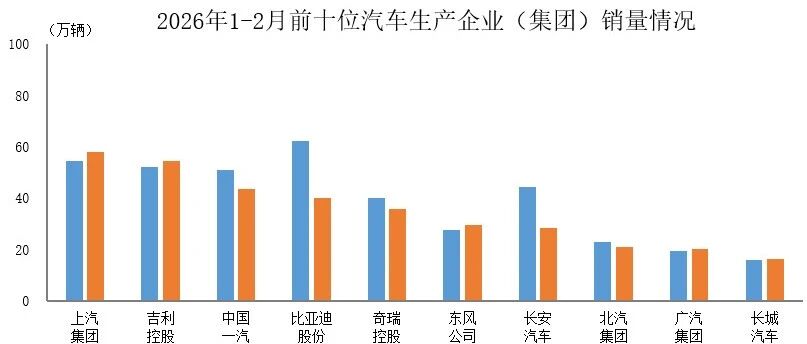
Group 1 - The core viewpoint of the article highlights that the top ten automotive companies in China sold a total of 3.484 million vehicles in January and February 2026, accounting for 83.9% of the total automotive sales [2] - Among these ten companies, SAIC Motor, Geely Holding, Dongfeng Motor, GAC Group, and Great Wall Motors experienced varying degrees of sales growth compared to the same period last year [2] - In contrast, the other companies in the top ten saw a decline in sales during the same timeframe [2]





花旗:对吉利汽车(00175)展开为期30天正面催化剂观察
智通财经网· 2026-03-20 06:03
Core Viewpoint - Citi has initiated a 30-day positive catalyst observation for Geely Automobile (00175), assigning a "Buy" rating with a target price of HKD 26 [1] Group 1: Delivery and Revenue Expectations - The company is expected to deliver 690,000 vehicles in the first quarter of this year, with an average selling price increasing by 8% quarter-on-quarter, leading to an anticipated revenue of approximately RMB 91 billion [1] - The estimated comprehensive gross margin for the first quarter is projected to rise by 0.3 percentage points to 17.2% [1] Group 2: Profit Forecast - Assuming a sales and management expense ratio of 12.4% to quarterly revenue, the core net profit for the first quarter is expected to be between RMB 3.8 billion and RMB 4.2 billion, exceeding market expectations [1] Group 3: Future Projections - The company anticipates an increase in profit margins for the second quarter, with expected sales of the high-margin model 8X reaching between 10,000 and 20,000 units [1] - It is also projected that the export volume in the second quarter will grow by 10% quarter-on-quarter [1]
多重利好叠加,吉利汽车涨超7%刷新阶段新高
Ge Long Hui· 2026-03-20 03:20
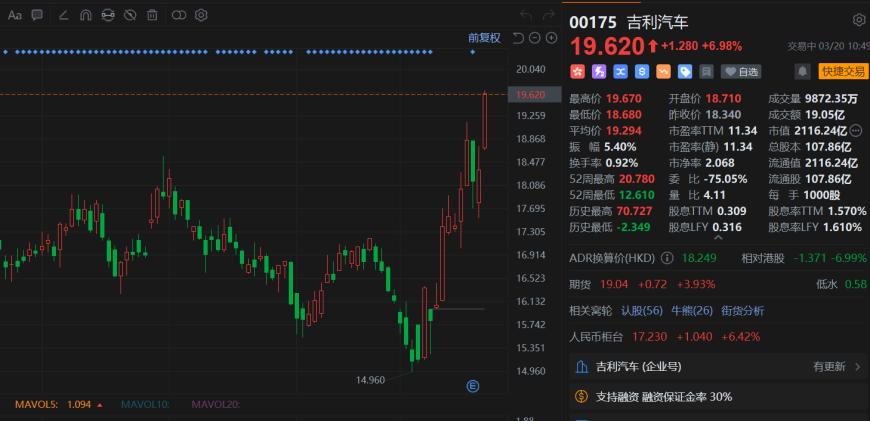
Group 1 - Geely Automobile (0175.HK) saw a significant increase of over 7%, reaching a new high of HKD 19.62, with a total market capitalization exceeding HKD 210 billion [1] - The company announced a projected total revenue of CNY 345.2 billion for 2025, representing a year-on-year growth of 25%, marking a historical high [1] - Core net profit attributable to shareholders, excluding foreign exchange and other non-core items, is expected to reach CNY 14.41 billion, reflecting a 36% year-on-year increase, indicating high-quality growth [1] Group 2 - Geely is set to launch multiple new models in 2026, targeting a total annual sales goal of 3.45 million units, covering various segments from mainstream to luxury and from fuel to new energy vehicles [1] - The Zeekr brand recently held a technology launch event in Shanghai, where pre-sales for the new Zeekr 8X model began, achieving over 10,000 orders in just 38 minutes and exceeding 30,000 orders within 48 hours [1] - According to CMB International, Geely has entered a clearer upward phase with rapid sales growth, improved profitability in new energy, and an increase in gross margin driven by premiumization [1]
吉利汽车再涨超5% 极氪8X市场反响热烈 机构指公司进入清晰向上阶段
Zhi Tong Cai Jing· 2026-03-20 03:01
Group 1 - Geely Automobile's stock price increased by over 5%, with a cumulative rise of nearly 20% in the month [2] - As of the latest report, the stock is priced at HKD 19.27, with a trading volume of HKD 652 million [2] - The Zeekr brand launched the pre-sale of the new model Zeekr 8X, achieving over 10,000 orders in just 38 minutes and exceeding 30,000 orders within 48 hours [2] Group 2 - According to CMB International, Geely has entered a clearer upward phase characterized by rapid sales growth and improved profitability in the new energy sector [2] - The high-end strategy is beginning to enhance gross margins, while the integration and synergy effects are expected to manifest more significantly by 2026 [2] - The integration of Lynk & Co and Zeekr, along with unified backend operations and procurement and manufacturing synergies, has not yet fully reflected in the financial reports, indicating further potential for growth [2]
吉利汽车2025年总销量突破300万辆 吉利汽车在销量增长的同时,也呈现出经营效率改善的特征
Zheng Quan Ri Bao· 2026-03-20 03:01
Core Viewpoint - Geely Automobile achieved significant growth in 2025, with total sales reaching 3.025 million units, a 39% year-on-year increase, marking the first time surpassing 3 million units [2] Group 1: Financial Performance - Total revenue for 2025 was CNY 345.2 billion, reflecting a 25% year-on-year growth [2] - Core net profit attributable to shareholders was CNY 14.41 billion, up 36% year-on-year [2] - New energy vehicle sales reached 1.688 million units, a remarkable 90% increase, with the annual new energy penetration rate exceeding 50% for the first time [2] Group 2: Business Structure and Strategy - Geely's business structure in 2025 showed a strong performance across various brands, with Galaxy brand sales at 1.236 million units, a 150% increase, and Lynk & Co sales at 350,000 units, up 23% [3] - The company maintained resilience in fuel vehicle sales, with 1.314 million units sold, leading the Chinese independent brand fuel vehicle market [3] - Geely continues to pursue a multi-faceted energy strategy, integrating fuel, hybrid, extended-range, pure electric, and methanol technologies, providing strong volatility resistance [3] Group 3: Future Focus Areas - The company aims to enhance its focus on intelligence, product premiumization, and globalization as key growth areas [4] - Geely plans to export 420,000 vehicles in 2025, including 124,000 new energy vehicles, a 240% increase, with a target of 640,000 exports in 2026 [4] - The transition to a localized global strategy will involve a shift from trade-based exports to a comprehensive local supply chain approach [4]
交银国际:维持吉利汽车“买入”的投资评级 今明两年每股盈利预测8.8%及16.4%
Zhi Tong Cai Jing· 2026-03-20 03:01
Group 1 - The core viewpoint of the report is that Geely Automobile (00175) is rated as "Buy" with a target price of HKD 24.21, reflecting strong sales and improved profitability in the electric vehicle sector [2] - Earnings per share forecasts for 2026 and 2027 have been raised by 8.8% and 16.4% respectively, driven by stronger sales, gross margins, and integration expectations [2] - Geely achieved record highs last year, with continued improvement in profit quality in the fourth fiscal quarter, indicating a clearer upward trajectory for the company [2] Group 2 - The report highlights that Geely's sales growth is accelerating, with enhanced profitability in the new energy segment and a shift towards higher-end products contributing to margin improvements [2] - The integration of Lynk & Co and Zeekr, along with unified backend operations, procurement, and manufacturing synergies, is expected to provide further efficiency gains, although these benefits have not yet fully reflected in financial reports [2] - The focus for 2026 will be on new vehicle launches, international expansion, and integration efforts, which are anticipated to yield significant results [2]
麦格理:升吉利汽车目标价至24港元 季绩稳固 维持行业首选
Zhi Tong Cai Jing· 2026-03-20 03:01
Core Viewpoint - Macquarie's research report indicates that Geely Automobile's Q4 2025 performance is solid, with sales and net profit exceeding market expectations by 5% and 10% respectively, driven by an improved luxury vehicle mix [2] Group 1: Financial Performance - Geely's sales guidance for 2026 is maintained at 3.45 million units, representing a year-on-year growth of 14% [2] - Adjusted net profit forecast for Geely for the current year is raised by 6% to RMB 19.3 billion [2] Group 2: Market Position - Macquarie has raised Geely's target price by 4.3%, from HKD 23 to HKD 24, which corresponds to a projected P/E ratio of 12 times for 2026 [2] - In the Greater China region, Macquarie believes Geely offers the best risk-reward ratio among Chinese automotive stocks and maintains it as their industry preferred stock [2] Group 3: Sales Strategy - Management reiterated the overseas sales target for 2026 at 640,000 units, with an internal challenge target close to 750,000 units [2]
港股异动丨多重利好叠加,吉利汽车涨超7%刷新阶段新高
Ge Long Hui· 2026-03-20 02:57
Core Viewpoint - Geely Automobile (0175.HK) has seen a significant increase of over 7%, reaching a new low of HKD 19.62, with a total market capitalization exceeding HKD 210 billion. The company announced a projected total revenue of CNY 345.2 billion for 2025, representing a year-on-year growth of 25%, marking a historical high [1] Financial Performance - The core net profit attributable to shareholders, excluding foreign exchange gains and other non-core items, is expected to reach CNY 14.41 billion, reflecting a year-on-year increase of 36%. The growth rate of core profit outpaces revenue growth, indicating high-quality growth [1] Future Outlook - Geely is set to enter another product year in 2026, planning to launch multiple new models that will cover various segments from mainstream to luxury and from fuel to new energy vehicles, aiming for an annual sales target of 3.45 million units [1] Market Response - The Zeekr brand recently held a technology launch event in Shanghai, initiating pre-sales for the new model Zeekr 8X. Within just 38 minutes, orders exceeded 10,000 units, and within 48 hours, orders surpassed 30,000, indicating a strong market response [1] Strategic Developments - According to CMB International, Geely has entered a clearer upward phase characterized by rapid sales growth, improved profitability in new energy, and an increase in gross margin driven by premiumization. The integration and synergy of Lynk & Co and Zeekr, along with unified back-office operations and procurement efficiencies, are expected to further enhance performance, although these benefits have not yet fully reflected in financial reports [1]
交银国际发布研报称,维持吉利汽车(00175.HK)“买入”的投资评级,目标价24.21港元
Sou Hu Cai Jing· 2026-03-20 02:52
Group 1 - The core viewpoint of the report is that the investment rating for Geely Automobile (00175.HK) is maintained as "Buy" with a target price of HKD 24.21 [1] - Earnings per share forecasts for 2026 and 2027 have been raised by 8.8% and 16.4% respectively, based on stronger sales, gross margins, and integration expectations [1] - In the past 90 days, 17 investment firms have issued "Buy" ratings for Geely Automobile, with an average target price of HKD 27.16 [1] Group 2 - CICC has given Geely Automobile an "Outperform" rating with a target price of HKD 24.4 [1] - Geely Automobile has a market capitalization of HKD 195.768 billion, ranking second in the automotive manufacturing industry [2]
