KINGDEE INT'L(00268)

Search documents
金蝶国际5年连亏近14亿 AI及出海能否筑就业绩拐点?
Xin Lang Zheng Quan· 2025-05-15 02:19
Core Viewpoint - Kingdee International reported a revenue of 6.256 billion yuan for 2024, marking a year-on-year increase of 10.15%, but still recorded a net loss of 142 million yuan, continuing its trend of losses for the fifth consecutive year since 2020, totaling nearly 1.4 billion yuan in losses over this period [1] Group 1: Financial Performance - The company has successfully transitioned to cloud services, with cloud service revenue accounting for 81.63% of total revenue in 2024, up from 56.98% in 2020 [2] - Despite the increase in cloud service revenue, the profitability of this segment remains concerning, with losses from cloud services decreasing from 607 million yuan in 2020 to 241 million yuan in 2024, but still contributing to overall losses [3] - Kingdee's current liquidity ratio has decreased from 1.26 in 2023 to 1.03 in 2024, with net current assets dropping by 87.05% to 152 million yuan [4] Group 2: Growth Strategies - Kingdee is focusing on international expansion and AI as new growth drivers, having secured an investment of approximately 200 million USD from the Qatar Investment Authority [5] - The company has established a presence in Singapore as a hub for overseas business, aiming to serve Southeast Asia and support Chinese enterprises in their international operations [6] - Kingdee's overseas revenue was only 70 million yuan in 2024, accounting for just 1.12% of total revenue, although it saw a significant growth rate of 63.37% compared to the previous year [6] Group 3: AI Strategy - Kingdee has committed to an "ALL IN AI" strategy, planning to enhance its capabilities in AI over the next three years, with specific initiatives including integrating the DeepSeek model and upgrading its management platform [7] - The CEO has indicated that the AI transformation will be more comprehensive than the previous cloud transformation, although the commercial viability of AI remains uncertain [7]
突发利好,A50指数直线飙升!
Zheng Quan Shi Bao Wang· 2025-05-12 11:13
Group 1: 3D Printing Technology Development - The development of smart manufacturing technology has made 3D printing an important force in cultivating new productive forces in China [1] - 3D printing technology is transitioning from an optional choice to a necessary option in high-end manufacturing fields such as aerospace [7] - The global 3D printing market is expected to reach $88.3 billion by 2030, while the Chinese 3D printing equipment market is projected to exceed 120 billion yuan by 2029, with a compound annual growth rate of approximately 19.5% from 2024 to 2029 [7] Group 2: Company Activities in 3D Printing - Companies like Protolabs predict significant growth in the 3D printing market, indicating a robust future for the industry [7] - A-share market has over 30 stocks related to 3D printing, with companies like Jinggong Technology focusing on robot-related 3D printing equipment [7] - Aitide has developed 3D printing zirconia ceramic technology and has received FDA and NMPA registration for its high solid content printing materials [7] Group 3: Market Performance and Trends - The average increase of 3D printing concept stocks is 17.18% year-to-date, with four stocks seeing cumulative gains over 50% [10] - Sixteen 3D printing concept stocks have seen a daily average trading volume increase of over 10% since May, with five stocks doubling their trading volume [11] - As of May 12, eight stocks have a rolling price-to-earnings ratio below 40, indicating potential investment opportunities [11]




中证香港300内地高贝塔指数报898.38点,前十大权重包含微创机器人-B等
Jin Rong Jie· 2025-05-12 08:06
Group 1 - The core index, the China Securities Hong Kong 300 Mainland High Beta Index (H300CNHB), reported a value of 898.38 points, with a one-month increase of 7.01%, a three-month increase of 1.94%, and a year-to-date increase of 6.72% [1][2] - The index reflects the overall performance of securities listed on the Hong Kong Stock Exchange from various strategic investment perspectives, with a base date of December 30, 2005, set at 1000.0 points [1][2] - The top ten holdings of the index include MicroPort Scientific Corporation-B (5.17%), Hua Hong Semiconductor (2.95%), Alibaba Health (2.72%), XPeng Inc.-W (2.7%), Guotai Junan Securities (2.55%), WuXi Biologics (2.53%), Country Garden Services (2.51%), Kingdee International Software Group (2.43%), China Jinmao Holdings Group (2.37%), and GDS Holdings Limited-SW (2.31%) [1][2] Group 2 - The index's holdings are entirely composed of securities from the Hong Kong Stock Exchange, with the real estate sector accounting for 21.70%, financials for 20.95%, healthcare for 18.32%, consumer discretionary for 16.93%, information technology for 10.92%, communication services for 4.34%, materials for 2.93%, consumer staples for 2.01%, and industrials for 1.89% [2] - The index samples are adjusted semi-annually, with adjustments occurring on the next trading day after the second Friday of June and December each year, and weight factors are generally fixed until the next scheduled adjustment [2]


金十图示:2025年05月09日(周五)中国科技互联网公司市值排名TOP 50一览
news flash· 2025-05-09 02:53
Core Insights - The article presents the market capitalization rankings of the top 50 Chinese technology and internet companies as of May 9, 2025, highlighting significant players in the industry [1]. Group 1: Market Capitalization Rankings - The top three companies by market capitalization are Alibaba Group with 3003.74 billion, Xiaomi Group with 1693.44 billion, and Pinduoduo with 1560.19 billion [3][4]. - Other notable companies in the top 10 include Meituan at 1104.71 billion, JD.com at 495.86 billion, and Baidu at 301.32 billion [4][5]. - The rankings reflect a diverse range of companies, including those in e-commerce, food delivery, and automotive sectors, indicating a broad technological landscape [5][6]. Group 2: Emerging Players - Companies like Li Auto and Kuaishou are also featured in the rankings, with market capitalizations of 291.48 billion and 286.48 billion respectively, showcasing the growth of electric vehicles and social media platforms [4][5]. - The presence of companies such as Xpeng Motors and NIO, with market caps of 186.55 billion and 89.68 billion respectively, highlights the increasing importance of the electric vehicle sector in the technology landscape [5][6]. Group 3: Overall Trends - The data indicates a strong performance of technology companies in China, with significant market capitalizations reflecting investor confidence and growth potential in the sector [1][3]. - The rankings are calculated based on the latest exchange rates, emphasizing the importance of currency fluctuations in assessing market value [6].




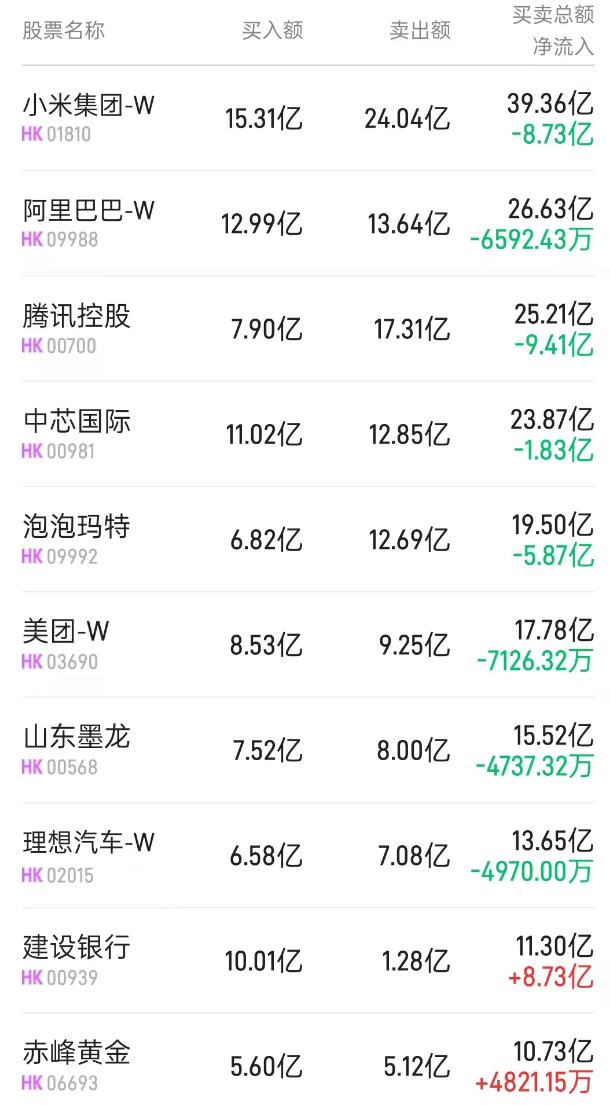
北水动向|北水成交净卖出23.85亿 北水继续抢筹建设银行(00939) 抛售中芯国际(00981)近7亿港元
智通财经网· 2025-05-08 10:00
Summary of Key Points Core Viewpoint - The Hong Kong stock market experienced significant net selling from Northbound capital, totaling 23.85 billion HKD on May 8, with notable net selling in major stocks like Tencent and Xiaomi, while Construction Bank and Meituan saw net buying [1]. Group 1: Northbound Capital Flow - Northbound capital recorded a net selling of 23.85 billion HKD, with 10.97 billion HKD from Shanghai Stock Connect and 12.88 billion HKD from Shenzhen Stock Connect [1]. - The stocks with the highest net buying included Construction Bank (00939), Chifeng Jilong Gold (06693), and Meituan-W (03690) [1]. - The stocks with the highest net selling included Tencent (00700), Xiaomi Group-W (01810), and the Tracker Fund of Hong Kong (02800) [1]. Group 2: Individual Stock Performance - Construction Bank (00939) received a net inflow of 8.73 billion HKD, supported by a recent announcement of a basket of financial policies aimed at stabilizing the market [4]. - Chifeng Jilong Gold (06693) saw a net inflow of 4.82 billion HKD, with expectations of meeting market performance in 2024 and successful overseas financing for acquisitions [5]. - Semiconductor Manufacturing International Corporation (00981) faced a net outflow of 6.97 billion HKD, with upcoming board meetings to discuss financial results amid potential changes in U.S. AI chip regulations [5]. - The Tracker Fund of Hong Kong (02800) experienced a net outflow of 7.1 billion HKD, with market sentiment remaining cautious despite some optimism [6]. - Xiaomi Group-W (01810) had a net outflow of 8.41 billion HKD, following recent controversies regarding its vehicle specifications [6]. - Tencent (00700) faced a net outflow of 11.79 billion HKD, with expectations for stable core business performance in its upcoming quarterly report [6].



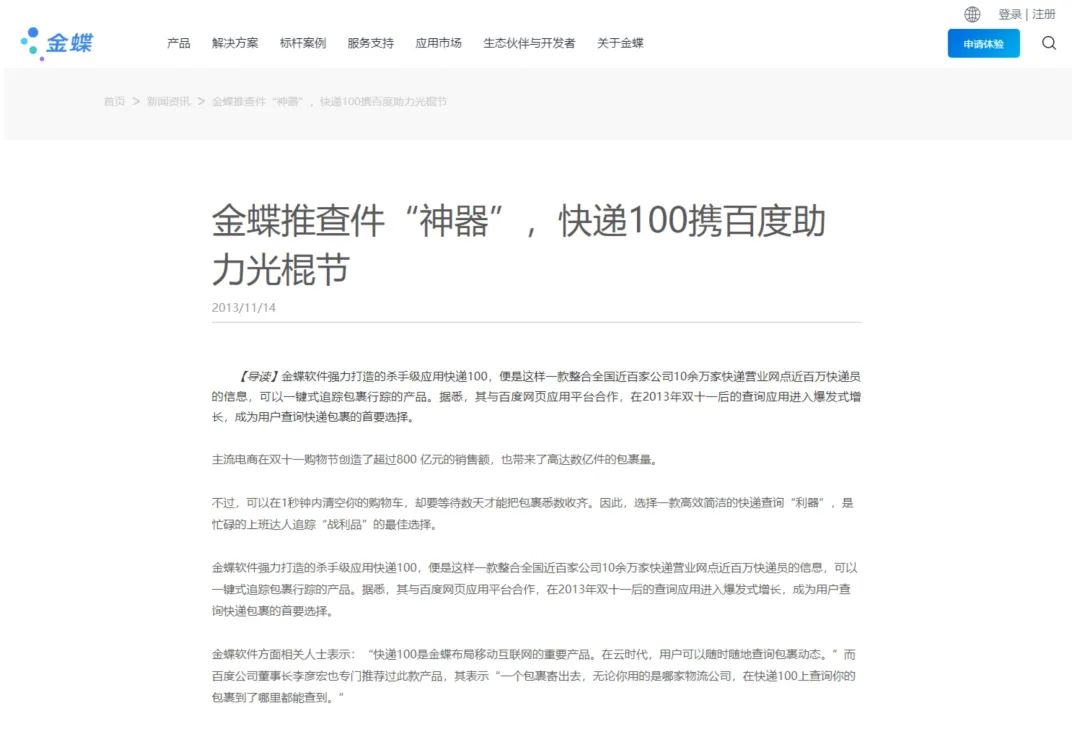
金蝶推查件“神器”,成用户查询快递包裹的首要选择
Zhong Guo Chan Ye Jing Ji Xin Xi Wang· 2025-05-08 04:52
Core Insights - Kuaidi 100 is a one-stop platform for express logistics, integrating tracking, shipping, and management services, and is recognized as a leading brand in logistics information cloud services in China [1][4] - The platform was incubated by Kingdee International in 2010, initially developed to meet the logistics tracking needs of ERP customers [1][2] Company Development - Kuaidi 100 was officially launched in 2010, with its app going live in 2011, becoming the sole partner for express query on Baidu's platform [1][4] - The application has integrated information from nearly 100 logistics companies and over 100,000 service points, allowing users to track packages with ease [4][6] Market Performance - During the 2013 Double Eleven shopping festival, major e-commerce platforms generated over 800 billion yuan in sales, leading to a package volume exceeding 300 million [5][9] - Kuaidi 100's query application experienced explosive growth post-Double Eleven 2013, becoming the primary choice for users to track their packages [4][5] User Experience - The previous process for users to track a package involved up to six steps, while Kuaidi 100 streamlined this to just three steps, significantly enhancing user convenience [7][8] - By November 11, 2013, Kuaidi 100 had provided 12.0044 billion package queries on Baidu, covering 20% of China's internet users during the 2012 Double Eleven period [8] Strategic Positioning - Kuaidi 100 is positioned as a pioneer product in Kingdee's strategy to penetrate the mobile internet market, achieving profitability and contributing to the overall profitability of Kingdee's enterprise internet services [9] - Kingdee's chairman emphasized the internet as a significant opportunity for the company's growth, with expectations for transformation driven by advancements in mobile internet, social networking, cloud computing, and big data technologies [9]
金蝶软件申请支持复杂过滤条件的数据查询专利,支持复杂过滤条件下的数据查询
Jin Rong Jie· 2025-05-06 09:42
天眼查资料显示,金蝶软件(中国)有限公司,成立于1993年,位于深圳市,是一家以从事软件和信息 技术服务业为主的企业。企业注册资本140000万人民币。通过天眼查大数据分析,金蝶软件(中国)有 限公司共对外投资了64家企业,参与招投标项目3064次,财产线索方面有商标信息795条,专利信息 1857条,此外企业还拥有行政许可97个。 本文源自:金融界 金融界2025年5月6日消息,国家知识产权局信息显示,金蝶软件(中国)有限公司申请一项名为"支持 复杂过滤条件的数据查询方法以及相关设备"的专利,公开号 CN119917533A,申请日期为 2024 年 12 月 。 专利摘要显示,本申请实施例公开了提供了支持复杂过滤条件的数据查询方法以及相关设备,用于支持 复杂过滤条件下的数据查询。本申请实施例方法包括:获取数据查询方案,数据查询方案包括多个查询 字段以及每个查询字段对应的过滤条件,多个查询字段包括计算类字段以及属于任一存量表的存量类字 段,计算类字段具有对应的取值公式,取值公式中包括预设的存量类字段,至少一个查询字段对应的过 滤条件包括计算类字段;确定计算类字段的取数框架以及存量类字段的取数框架,其中,取数 ...
金十图示:2025年05月02日(周五)中国科技互联网公司市值排名TOP 50一览
news flash· 2025-05-02 02:56
Core Insights - The article presents the market capitalization rankings of the top 50 Chinese technology and internet companies as of May 2, 2025, highlighting significant players in the industry [1]. Group 1: Top Companies by Market Capitalization - Alibaba ranks first with a market capitalization of $287.81 billion [3]. - Xiaomi Group follows in second place with a market capitalization of $174.25 billion [3]. - Pinduoduo is in third place with a market capitalization of $150.44 billion [3]. - Meituan ranks fourth with a market capitalization of $103.72 billion [3]. - NetEase holds the fifth position with a market capitalization of $67.61 billion [3]. Group 2: Additional Notable Companies - Semiconductor Manufacturing International Corporation (SMIC) ranks eighth with a market capitalization of $48.79 billion [4]. - JD.com is in ninth place with a market capitalization of $47.74 billion [4]. - Baidu ranks eleventh with a market capitalization of $30.22 billion [4]. - Kuaishou is in twelfth place with a market capitalization of $29.56 billion [4]. - Li Auto ranks thirteenth with a market capitalization of $26.28 billion [4]. Group 3: Companies with Lower Market Capitalization - Xpeng Motors ranks seventeenth with a market capitalization of $17.77 billion [5]. - NIO is in twenty-second place with a market capitalization of $8.90 billion [5]. - Bilibili ranks twenty-fourth with a market capitalization of $7.34 billion [5]. - Kingsoft has a market capitalization of $6.98 billion, ranking twenty-fifth [5]. - 37 Interactive Entertainment ranks forty-second with a market capitalization of $4.62 billion [6].





从披露到治理:AI驱动企业ESG价值链升级
Zhong Guo Zheng Quan Bao· 2025-04-27 21:02
Core Viewpoint - The integration of AI technology with sustainable development is driving industrial upgrades and green transformation, enhancing energy efficiency and operational effectiveness across various sectors [1][3]. Group 1: AI in ESG Reporting and Management - Companies are leveraging AI technology to innovate ESG management practices, making it a highlight in their 2024 ESG disclosures [1]. - Guodian Power has released its first ESG report compiled using AI, which enhances the quality and efficiency of ESG reporting by improving research and topic identification processes [1]. - DNV's director noted that AI can reduce disclosure costs and reliance on professional ESG analysts, minimizing repetitive human input [1]. Group 2: AI Empowering Corporate Governance - Keda Intelligent has upgraded its ESG practice system by creating an "ESG+AI" innovation platform, optimizing energy management and providing smart industrial solutions [2]. - China Ping An has established a unified ESG evaluation standard and an AI-ESG platform to enhance ESG management and risk control [2]. - Kain Co. has integrated AI into its manufacturing processes, creating a responsible production system that promotes green and smart factories [2]. Group 3: AI Driving Efficiency and Sustainability - A Deloitte report indicates that 78% of surveyed companies plan to increase AI investments by 2025, focusing on generative AI for supply chain management and compliance [3]. - Kingdee International collaborates with HeSteel Digital to enhance steel waste quality verification and carbon asset management using AI, achieving over 90% accuracy in identifying medium and heavy steel waste types [3]. - WanGuo Data is utilizing AI to improve energy efficiency in data center operations, addressing high energy consumption challenges [3]. Group 4: AI Applications Across Industries - In logistics, SF Technology is using its self-developed AI model to enhance green logistics supply chains, achieving cost reduction and energy savings [4]. - In finance, Bank of China Hong Kong is enhancing its fraud detection capabilities through AI, improving transaction monitoring [4]. - In insurance, China Ping An's AI platform has served over 6,000 personnel in risk control, achieving over 92% accuracy in financial risk warnings [4][5]. Group 5: AI Ethics and Data Security - Industry experts emphasize the need for data compliance and security in AI applications for ESG governance, highlighting the challenges of data legality and privacy [5]. - Kingdee International has established an algorithm safety studio to manage AI risks and ensure responsible technology innovation through ethical review mechanisms [6]. - China Ping An has committed to ethical governance in AI development and application, forming committees to ensure information security and privacy protection [6].





研判2025!中国税务大数据行业产业链图谱、发展历程、发展现状、竞争格局、重点企业以及发展趋势分析:税务大数据市场前景广阔[图]
Chan Ye Xin Xi Wang· 2025-04-24 01:18
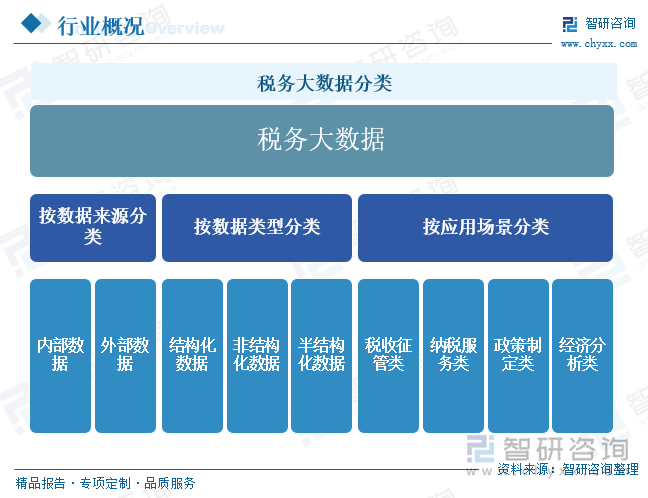
Core Insights - The tax big data market in China is experiencing significant growth, with the market size projected to increase from 30.869 billion yuan in 2019 to 103.213 billion yuan by 2024, indicating a strong demand driven by ongoing tax administration reforms [1][9]. Tax Big Data Industry Definition and Classification - Tax big data refers to the vast and diverse data sets generated, collected, stored, and managed during tax management, collection, and inspection processes, encompassing structured, unstructured, and semi-structured data [1]. Tax Big Data Industry Value Chain Analysis - The industry value chain includes data collection from various sources, data storage and processing, and application services, with a focus on optimizing tax management and enhancing taxpayer services [3]. Development History of China's Tax Big Data Industry - The industry has evolved from initial informatization in the 1980s to intelligent applications post-2013, with significant advancements in data integration and risk management [5]. Current State of China's Tax Big Data Industry - The market is growing steadily, with a notable increase in demand for tax big data software and services due to the implementation of data-driven tax management strategies [9]. Downstream Application Areas of Tax Big Data - The industry exhibits a diversified application landscape, with tax collection accounting for 45% of the market, risk prevention at 25%, taxpayer services at 18%, and economic analysis at 10% [11]. Key Enterprises in China's Tax Big Data Industry - Major players include Digital China, which focuses on tax digitalization solutions; Aerospace Information, a leader in electronic invoicing; Inspur, which provides infrastructure and data governance; and Yonyou Network, specializing in enterprise tax management [13][14][16]. Future Development Trends of China's Tax Big Data Industry - The industry is expected to enhance data governance and compliance, expand data sharing and integration across departments, and leverage technologies like AI and blockchain to innovate business scenarios and improve efficiency [18][19][20].