
HKEX(00388)

Search documents
港交所上半年业绩创新高新股集资额居全球首位
Qi Lu Wan Bao· 2025-08-20 21:10
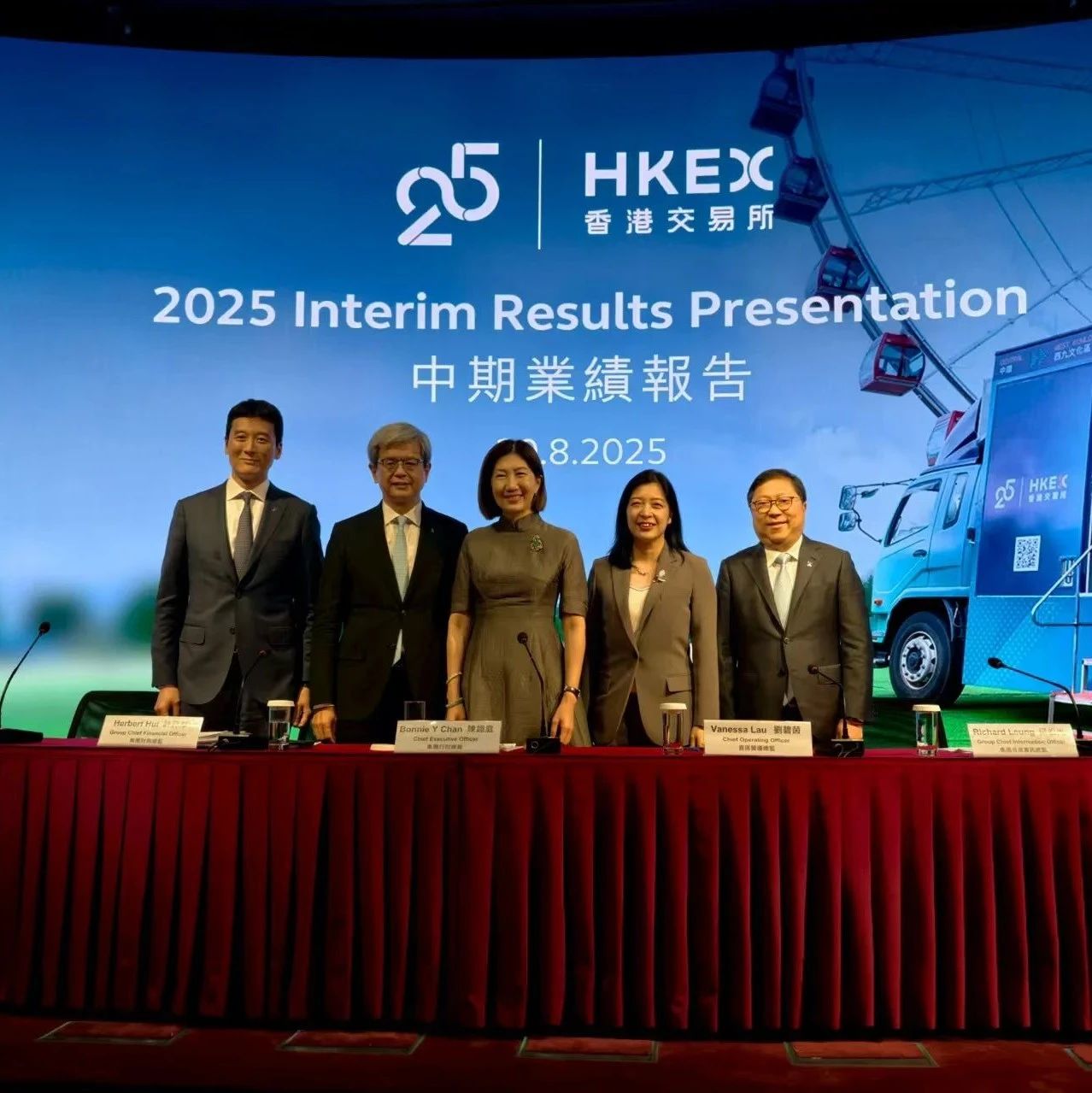
香港交易及结算所有限公司(港交所)20日在港公布的2025年中期业绩报告显示,港交所今年上半年收入及 其他收益和溢利创历来同期新高。港交所行政总裁陈翊庭表示,港交所今年开局良好。现货市场、衍生 产品市场及沪深港通的成交量均创半年新高。香港新股市场在今年延续强劲增长,上半年集资额居全球 首位。 中新 ...

港交所上半年业绩大增,IPO火爆,CEO回应24小时交易可能性
Sou Hu Cai Jing· 2025-08-20 20:45
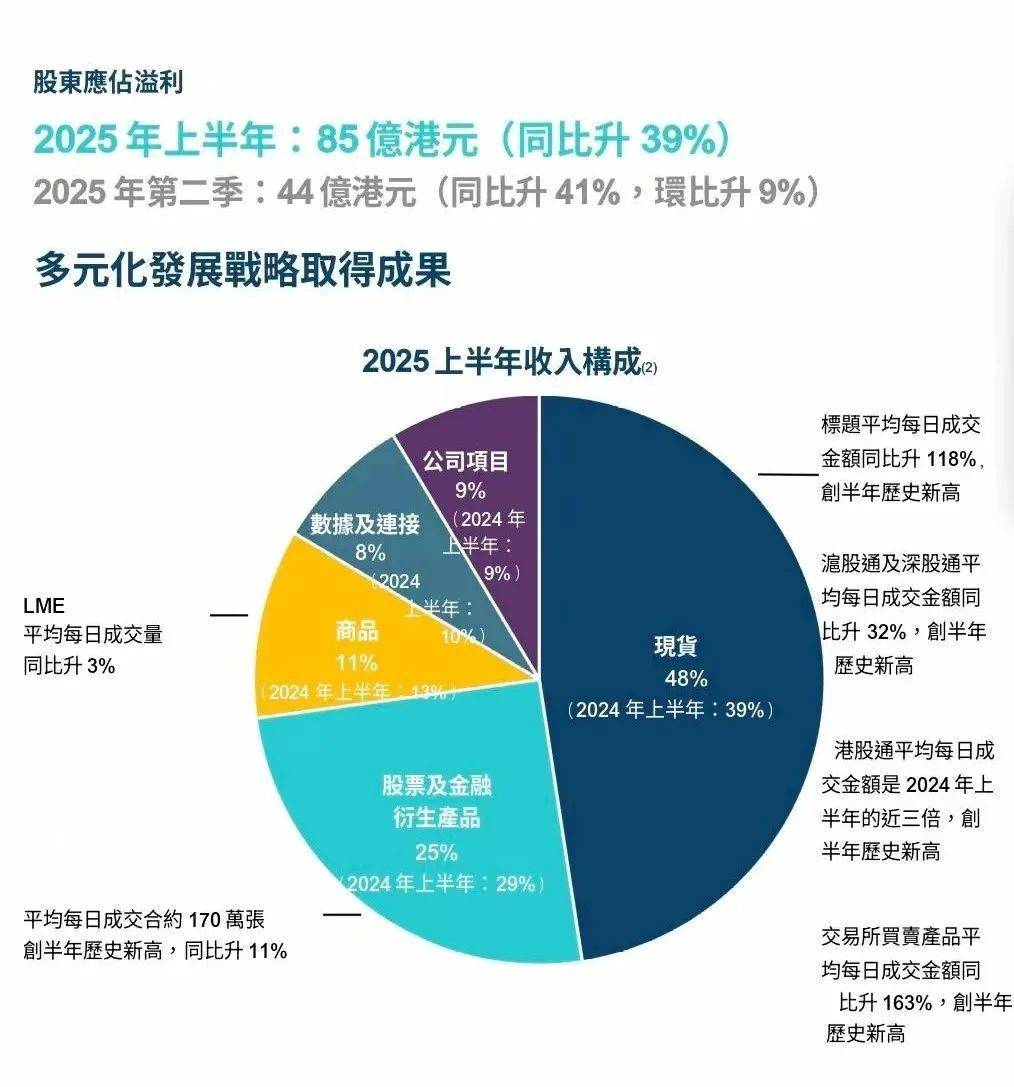
Group 1: Core Performance Highlights - Hong Kong Stock Exchange (HKEX) reported record-breaking performance in multiple business metrics for the first half of 2025, driven by significant growth in spot trading, derivatives trading, and the trading volume of the Stock Connect programs [1][4] - For the first half of 2025, HKEX achieved total revenue (including other income) of HKD 14.1 billion, a 33% increase year-on-year, with main business revenue reaching HKD 13 billion, up 32% [1] - Net profit after tax for the period was HKD 8.5 billion, reflecting a 39% year-on-year growth, primarily due to a robust increase in trading volumes, with average daily trading value up 95% year-on-year [1] Group 2: IPO and Market Dynamics - Over 230 companies have submitted IPO applications to HKEX, indicating a positive trend in the IPO review process in mainland China, which is seen as beneficial for the Chinese market [1] - The Hong Kong market saw a strong IPO momentum with 44 new listings in the first half, raising HKD 109.4 billion, more than eight times the amount from the same period last year [5] - The refinancing scale exceeded HKD 240 billion, marking the highest semi-annual record since 2021, with the introduction of the "Tech Company Special Line" adding 50 applications under chapters 18A and 18C [5] Group 3: International Investment Trends - International investors show high participation in Hong Kong IPOs, with retail investors comprising only 10% of the secondary market, while southbound funds from the Stock Connect account for 23% [5] - HKEX is prepared to capitalize on the trend of international funds returning to Chinese assets, as global investors seek diversified cross-regional and cross-asset class investments [4] Group 4: Future Outlook - HKEX plans to continue optimizing trading mechanisms, including shortening settlement cycles and improving settlement efficiency to align with global markets [5] - The company acknowledges potential declines in investment income in the second half of the year due to factors such as the decrease in Hong Kong Interbank Offered Rate (HIBOR) and property acquisition impacts [5]

港交所上半年业绩刷新同期历史纪录
Shang Hai Zheng Quan Bao· 2025-08-20 19:11
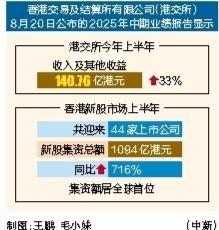
Core Insights - Hong Kong Stock Exchange (HKEX) reported record high revenue and net profit for the first half of 2025, with total revenue reaching HKD 14.076 billion, a 33% year-on-year increase, and net profit at HKD 8.519 billion, up 39% [2][3] Financial Performance - HKEX's net profit for the first half was HKD 8.519 billion, with Q2 net profit at HKD 4.442 billion, reflecting a 41% increase compared to Q2 2024 [3] - The average daily trading volume in the Hong Kong stock market was HKD 240.2 billion, a 118% year-on-year increase [3] - The average daily trading volume for Hong Kong ETFs reached HKD 33.8 billion, up 184% year-on-year [3] - Northbound and Southbound trading volumes under the Stock Connect program reached record highs, with Northbound daily trading volume at RMB 171.3 billion, a 32% increase, and Hong Kong Stock Connect daily trading volume at HKD 111 billion, up 196% [3] - The Bond Connect Northbound daily trading volume was RMB 45.9 billion, a 3% year-on-year increase [3] - HKEX declared a mid-term dividend totaling approximately HKD 7.6 billion, indicating that nearly 90% of profits are distributed as dividends, reflecting strong cash flow and a focus on shareholder returns [3] IPO Market Activity - In the first half of 2025, 44 companies listed on the Hong Kong stock market, raising a total of HKD 109.4 billion, a 716% year-on-year increase, marking the strongest half-year performance since 2021 [4] - Notable IPOs included Contemporary Amperex Technology Co., Ltd. (CATL), which raised HKD 41 billion, the largest IPO in Hong Kong since February 2021 [4] - Interest from international issuers has increased, with several Southeast Asian companies listing on HKEX, such as Thailand's IFBH [4] - As of June 30, 2025, the number of IPO applications being processed by HKEX reached 207, more than double the 84 applications at the end of the previous year [4] Reform and Development - During the mid-term performance meeting, HKEX's CEO revealed several ongoing reform initiatives [5] - The introduction of the "Tech Company Fast Track" in May 2025 aims to provide pre-listing guidance for specialized technology and biotech companies, with 50 new IPO applications received under this program [6] - HKEX is exploring the possibility of shortening the settlement cycle for the cash market, with a technical system upgrade expected to support T+1 settlement by the end of the year [6] - Future initiatives include expanding the paperless listing mechanism and implementing new pricing regulations for IPOs [6]
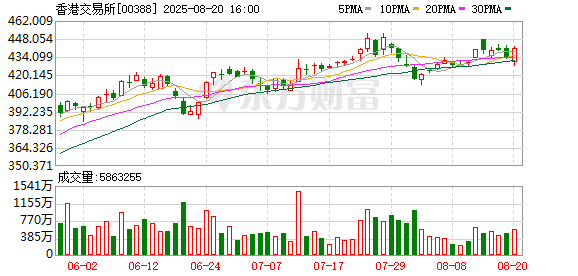
港交所上半年新股集资额1094亿港元
Shen Zhen Shang Bao· 2025-08-20 16:57
Core Viewpoint - The article discusses the recent financial performance and strategic developments of a specific company, highlighting its growth trajectory and market positioning [2] Financial Performance - The company reported a revenue increase of 15% year-over-year, reaching a total of 1.5 billion in the last quarter [2] - Net profit rose by 10%, amounting to 300 million, indicating strong operational efficiency [2] Strategic Developments - The company has announced plans to expand its market presence in Asia, targeting a 20% increase in market share over the next two years [2] - A new product line is set to launch in Q3, expected to contribute an additional 200 million in revenue [2] Market Positioning - The company currently holds a 25% market share in its primary sector, positioning it as a leader among competitors [2] - Recent partnerships with key industry players are anticipated to enhance distribution channels and customer reach [2]
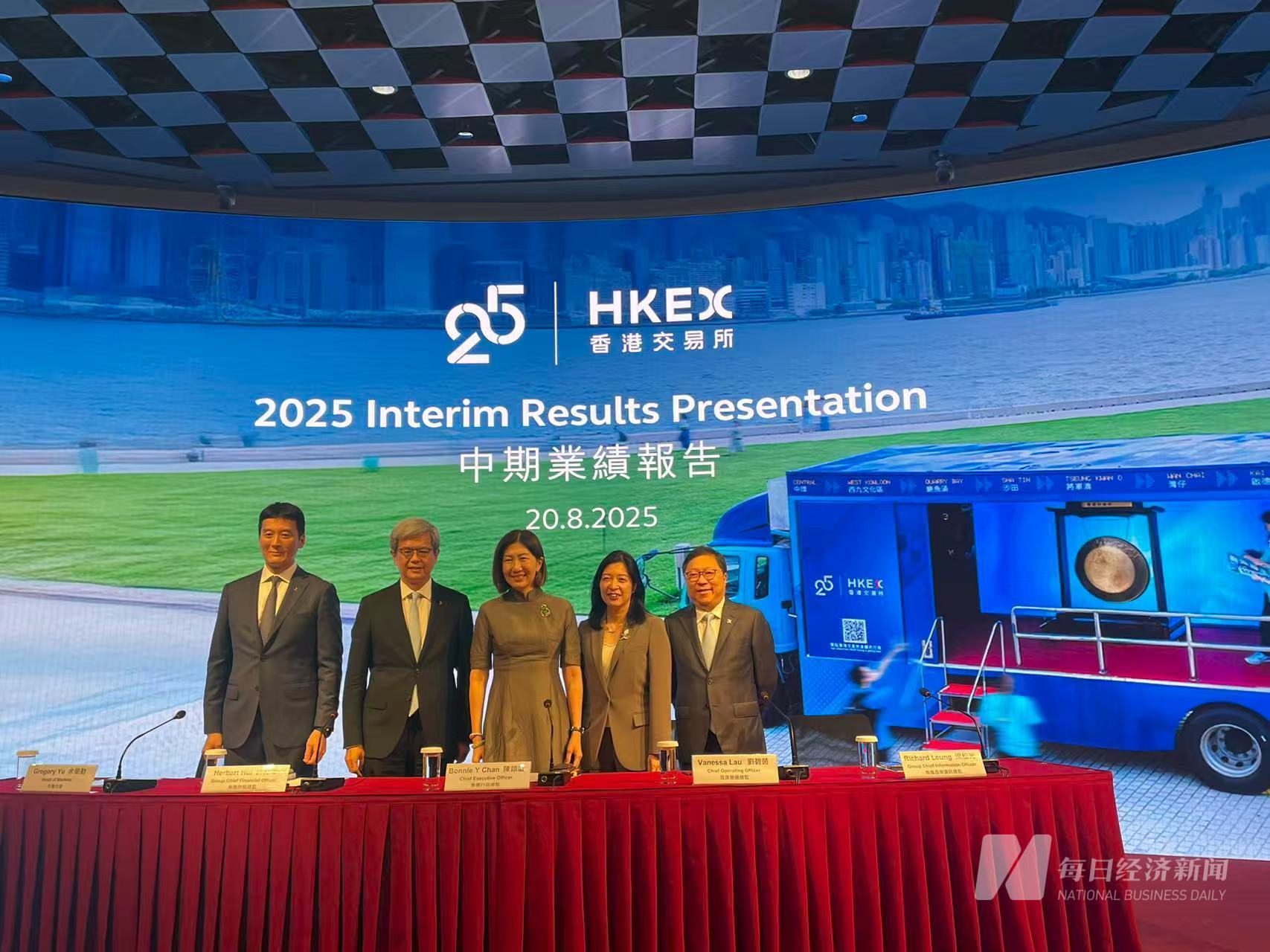
港交所上半年收入创历史新高 行政总裁陈翊庭:还有近230家公司的递表正在处理中
Mei Ri Jing Ji Xin Wen· 2025-08-20 16:46
Group 1 - The core viewpoint of the article highlights the strong financial performance of Hong Kong Exchanges and Clearing Limited (HKEX) in the first half of 2025, with record revenue and profit figures [1] - HKEX reported a revenue and other income of HKD 14.076 billion, a year-on-year increase of 33%, and a profit attributable to shareholders of HKD 8.519 billion, up 39%, both reaching historical highs [1] - The board declared an interim dividend of HKD 6.00 per share, representing a 38% increase compared to the previous year [1] Group 2 - In the first half of the year, HKEX welcomed 44 new listed companies, raising a total of HKD 109.4 billion, which is the highest globally and a 716% increase year-on-year [1] - The average daily trading volume in the securities market was HKD 240.2 billion, a 118% increase year-on-year, while the average daily trading volume for ETFs rose by 184% to HKD 33.8 billion [3] - The introduction of the "Science and Technology Company Fast Track" has led to 50 companies applying for IPOs under the 18A and 18C rules since its launch [3][4] Group 3 - HKEX's CEO mentioned that the confidentiality of submissions is not new and is designed to protect sensitive information of companies in the R&D phase [4] - The discussion around extending trading hours to 24 hours is ongoing, with the aim of enhancing market accessibility for investors [5] - HKEX has initiated consultations on shortening the settlement cycle to T+1, aligning with global trends, and aims to establish a feasible implementation timeline [6][7]
港交所上半年收入创半年度历史新高;天岳先进上市首日收涨6.4%丨港交所早参
Mei Ri Jing Ji Xin Wen· 2025-08-20 16:44
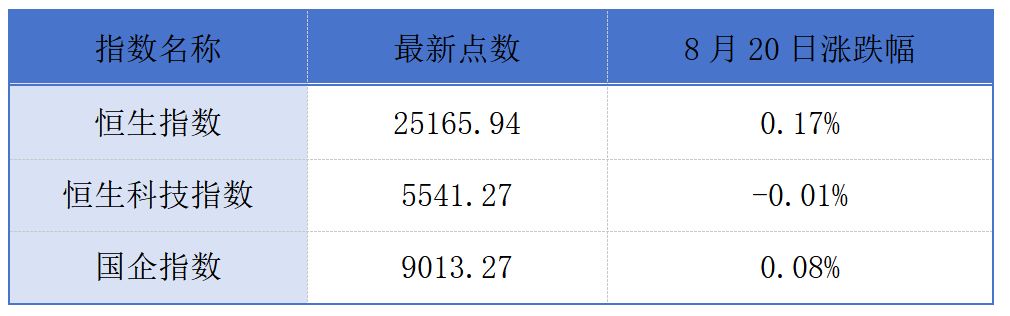
Group 1: Hong Kong Stock Exchange Performance - Hong Kong Stock Exchange reported a record high total revenue of HKD 14.076 billion and a shareholder profit of HKD 8.519 billion for the first half of 2025, marking a historical peak for the semi-annual performance [1] - The new stock market financing amount has returned to the top of global exchanges, reinforcing Hong Kong's leading position in the global capital market [1] Group 2: Tianyue Advanced Listing - Tianyue Advanced, a semiconductor silicon carbide substrate manufacturer, officially listed on the Hong Kong Stock Exchange, with its stock price rising by 6.4% on the first day of trading [2] - The company issued 47.7457 million shares at a price of HKD 42.80 per share, focusing on the research and industrialization of silicon carbide substrates [2] Group 3: Zhaochuang Information's IPO Plans - Zhaochuang Information announced plans to issue H-shares and list on the Hong Kong Stock Exchange to enhance its global strategy and brand image [3] - The details of the H-share issuance and listing are yet to be determined, but this move aims to provide new opportunities in the international market [3] Group 4: Hansoh Pharmaceutical Fundraising - Hansoh Pharmaceutical announced a placement agreement to raise approximately HKD 3.897 billion by issuing 108 million shares at a price of HKD 36.30 per share, representing a discount of about 6.49% from the previous closing price [4] - The fundraising is expected to improve the company's financial position and support future research and business expansion [4] Group 5: Hong Kong Stock Market Overview - The Hong Kong stock market index closed at 25,165.94, with a slight increase of 0.17% on August 20 [5] - Other indices showed minor fluctuations, indicating a stable market environment [5]

沪深股通升高三成 互联互通笃行不怠
Xin Hua She· 2025-08-20 16:08
新华财经香港8月20日电(记者林迎楠、王茜)沪深股通平均每日成交金额达人民币1713亿元,同比上 升32%。香港交易所20日公布中期业绩,业内人士表示,这很大程度上得益于沪深港通互联互通机制的 笃行不怠,特别是南向资金的持续流入,对港股市场形成稳定而有力的支撑。 随着内地资本寻求多元化投资渠道,内地投资者的离岸市场参与度不断提高,带动港股通2025年上半年 平均每日成交金额达1110亿港元,是2024年上半年的近3倍,占2025年上半年现货市场成交量的23%。 "香港交易所今年开局良好,上半年收入及溢利均创下集团半年度历史新高。现货市场、衍生产品市场 及沪深港通的成交量均创半年新高,新股市场融资额重回全球交易所榜首。"香港交易所集团行政总裁 陈翊庭表示。 亮眼成绩背后是机制的护航。香港经济学家、丝路智谷研究院院长梁海明认为,互联互通机制使内地投 资者能够更便捷地配置港股资产,尤其在当前港股估值相对较低、部分蓝筹具备高股息优势的背景下, 对中长期资金具有较大吸引力。 万得数据显示,今年以来,南向资金加速流入港股。南向资金在本月15日成交净买入358.76亿港元,单 日净买入金额创历史新高。截至8月19日,今年以 ...
港交所业绩创新高!最新回应IPO及24小时交易等热门话题
券商中国· 2025-08-20 15:27
Core Viewpoint - Hong Kong Stock Exchange (HKEX) achieved record high revenue and profit in the first half of 2025, driven by significant increases in spot trading, derivatives, and trading volumes through the Stock Connect programs [1][4]. Group 1: Financial Performance - In the first half of 2025, HKEX reported total revenue (including other income) of HKD 14.1 billion, a year-on-year increase of 33% [4]. - The main business revenue reached HKD 13 billion, up 32% year-on-year, while net profit after tax was HKD 8.5 billion, reflecting a 39% increase compared to the previous year [4]. - Despite a slight decline in trading volume in Q2 compared to Q1, HKEX still achieved record quarterly revenue and profit, with average daily trading volume increasing by 95% year-on-year [7]. Group 2: Trading Volume and Market Dynamics - Spot trading revenue grew by 39% year-on-year, while revenue from stock and financial derivatives increased by 29% [7]. - The average daily trading volume for the Shanghai-Hong Kong Stock Connect and Shenzhen-Hong Kong Stock Connect reached new highs, with the daily average for the Shanghai-Hong Kong Stock Connect increasing by 32% year-on-year [7]. - The cumulative revenue from the Stock Connect programs amounted to HKD 1.813 billion, representing a 51% year-on-year growth [7]. Group 3: IPO Activity - The Hong Kong market saw strong momentum in IPOs, with 44 new listings and a total fundraising amount of HKD 109.4 billion, more than eight times that of the same period last year [8]. - HKEX approved 50 IPO applications in the first half of the year, with over 230 IPO applications currently submitted [8][9]. - The introduction of the "Science and Technology Enterprise Channel" has facilitated the addition of 50 new applications under categories 18A and 18C [8]. Group 4: Future Outlook and Strategic Initiatives - HKEX plans to continue optimizing its trading mechanisms, including shortening the settlement cycle for the cash market to enhance efficiency [10]. - The company anticipates a potential decline in investment income in the second half of the year due to falling interbank rates and property acquisitions [10]. - HKEX is preparing to adapt to the trend of international capital returning to Chinese assets, with a focus on meeting the diverse investment needs of global investors [7].
香港交易所(00388):成交额支撑单季利润再创新高
SINOLINK SECURITIES· 2025-08-20 15:23
Investment Rating - The report maintains a "Buy" rating for Hong Kong Exchanges and Clearing Limited (00388.HK) [1] Core Views - The report highlights that Hong Kong Exchanges achieved record high quarterly profits supported by trading volume, with a 33% year-on-year increase in revenue to HKD 14.076 billion and a 39% increase in net profit to HKD 8.519 billion for the first half of 2025 [1][2] - The trading fee income from the stock market saw a significant increase of 112% to HKD 2.556 billion, driven by a 122% year-on-year growth in average daily trading volume [2] - The report anticipates continued growth in net profit for 2025-2027, projecting HKD 17 billion, HKD 18 billion, and HKD 19.6 billion respectively, with corresponding EPS of HKD 13.48, HKD 14.22, and HKD 15.43 [3] Summary by Sections Performance Overview - In 1H25, the revenue breakdown by business lines showed significant growth rates: cash market at 62%, derivatives at 15%, commodities at 8%, data and connectivity at 5%, and company projects at 28% [1] - The trading and transaction system usage fees increased by 49%, while listing fees rose by 30% due to a recovery in the IPO market [2] Revenue and Profit Forecast - The report forecasts revenue growth rates of 26% for 2025, followed by 6% and 7% in subsequent years, with net profit growth rates of 31%, 6%, and 9% respectively [3][7] - The projected P/E ratios for the next three years are 33, 31, and 29 times [3]
财经观察|沪深股通升高三成 互联互通笃行不怠
Xin Hua Wang· 2025-08-20 14:57
Core Insights - The average daily trading volume of the Shanghai-Hong Kong Stock Connect has reached RMB 171.3 billion, a year-on-year increase of 32% [1] - The Hong Kong Stock Exchange reported record half-year revenue and profit, driven by the robust performance of the stock connect mechanism and sustained inflow of southbound funds [1][3] - Southbound funds have accelerated their inflow into Hong Kong stocks, with a net purchase of HKD 35.876 billion on August 15, marking a historical single-day high [2] Group 1: Market Performance - The average daily trading volume of the Hong Kong Stock Connect for the first half of 2025 reached HKD 111 billion, nearly three times that of the first half of 2024, accounting for 23% of the spot market trading volume [1] - The average daily trading volume of the Hong Kong Stock Exchange's securities market for the first half of 2025 was HKD 240.2 billion, a year-on-year increase of 118% [3] - The revenue and other income of the Hong Kong Stock Exchange for the first half of the year was HKD 14.076 billion, a year-on-year increase of 33%, setting a record for half-year performance [3] Group 2: Investment Trends - The influx of southbound funds is changing the capital structure and participant composition of the Hong Kong stock market, with more long-term institutional investors becoming key players [2] - The current low valuation of Hong Kong stocks and the high dividend yield of certain blue-chip stocks are attracting mainland investors, making the market appealing for long-term capital [1][2] - The plan to include RMB-denominated stocks in the Hong Kong Stock Connect aims to deepen the interconnectivity between Hong Kong and mainland markets [3]