HKEX(00388)

Search documents
智通ADR统计 | 8月15日
智通财经网· 2025-08-14 22:43
Market Overview - Most large-cap stocks experienced declines, with HSBC Holdings closing at HKD 103.043, up 2.63% from the previous close, while Tencent Holdings closed at HKD 585.875, down 0.70% [1][2] Stock Performance Summary - Tencent Holdings (00700) latest price: HKD 590.000, change: +HKD 4.000 (+0.68%), ADR price: HKD 585.875, decline: -HKD 4.125 (-0.70%) [2] - Alibaba Group (09988) latest price: HKD 121.800, change: -HKD 1.900 (-1.54%), ADR price: HKD 119.737, decline: -HKD 2.063 (-1.69%) [2] - HSBC Holdings (00005) latest price: HKD 100.400, change: -HKD 0.315 (-0.31%), ADR price: HKD 103.043, increase: +HKD 2.643 (+2.63%) [2] - AIA Group (01299) latest price: HKD 76.900, change: +HKD 0.500 (+0.65%), ADR price: HKD 76.338, decline: -HKD 0.562 (-0.73%) [2] - Meituan (03690) latest price: HKD 124.400, change: +HKD 0.100 (+0.08%), ADR price: HKD 121.813, decline: -HKD 2.587 (-2.08%) [2] - NetEase (099999) latest price: HKD 207.800, change: -HKD 7.600 (-3.53%), ADR price: HKD 203.157, decline: -HKD 4.643 (-2.23%) [2] - Hong Kong Exchanges and Clearing (00388) latest price: HKD 439.200, change: -HKD 0.600 (-0.14%), ADR price: HKD 435.548, decline: -HKD 3.652 (-0.83%) [2] - Ping An Insurance (02318) latest price: HKD 57.900, change: +HKD 1.100 (+1.94%), ADR price: HKD 57.146, decline: -HKD 0.754 (-1.30%) [2] - JD.com (09618) latest price: HKD 125.100, change: -HKD 2.300 (-1.81%), ADR price: HKD 123.693, decline: -HKD 1.407 (-1.13%) [2] - Kuaishou Technology (01024) latest price: HKD 75.200, change: +HKD 0.250 (+0.33%), ADR price: HKD 74.811, decline: -HKD 0.389 (-0.52%) [2]


中华港股通优选50指数下跌0.28%,前十大权重包含建设银行等
Jin Rong Jie· 2025-08-14 13:56
Group 1 - The core index, the CESP50, experienced a decline of 0.28%, closing at 3170.29 points with a trading volume of 932.59 billion [1] - Over the past month, the CESP50 index has increased by 5.33%, by 8.84% over the last three months, and has risen by 26.77% year-to-date [1] - The CESP50 index is designed to reflect the overall performance of the top 50 blue-chip securities listed on the Hong Kong Stock Exchange under the "Hong Kong Stock Connect" program [1] Group 2 - The top ten holdings of the CESP50 index include Tencent Holdings (10.86%), HSBC Holdings (10.2%), Alibaba-W (9.9%), Xiaomi Group-W (6.25%), and others [1] - The index's holdings are entirely composed of securities from the Hong Kong Stock Exchange, with financials making up 39.60%, consumer discretionary 23.52%, and communication services 17.16% [2] - Other sectors represented in the index include information technology (8.46%), energy (3.94%), real estate (3.37%), utilities (1.66%), consumer staples (1.00%), industrials (0.83%), and healthcare (0.45%) [2]

港股评级汇总 | 中金公司维持腾讯控股跑赢行业评级
Xin Lang Cai Jing· 2025-08-14 07:45
Group 1: Tencent Holdings - Company reported a 14.5% year-on-year revenue growth to 184.5 billion yuan in Q2 2025, with Non-IFRS net profit increasing by 10% to 63.05 billion yuan [1] - AI applications are accelerating in advertising, gaming, and cloud services, with video account advertising revenue growing by 50% and overseas gaming revenue increasing by 35% [1] - Capital expenditure is primarily focused on AI infrastructure, indicating significant potential for efficiency improvements in the future [1] Group 2: Huahong Semiconductor - Company is expected to benefit from short-term price recovery and full capacity utilization, with a strong competitive position in specialty foundry services [1] - Projected net profits for 2025-2027 are 90 million, 152 million, and 202 million USD respectively, with current stock price corresponding to PB ratios of 1.56, 1.52, and 1.48 [1] Group 3: Hong Kong Exchanges and Clearing - As of July 2023, the company's PE ratio is 38.24x, positioned at the 58th percentile historically since 2016, suggesting attractive valuation [1] - Anticipated increase in market liquidity due to ongoing connectivity policies, which may enhance overall market activity and valuation [1] Group 4: 361 Degrees - Company reported an 11% year-on-year revenue growth to 5.7 billion yuan in H1 2025, with a slight increase in gross margin to 41.5% [2] - Significant improvement in operating cash flow to 520 million yuan, attributed to better inventory management and aging structure [2] - Strong performance in footwear and children's clothing segments, with steady growth in e-commerce channels [2] Group 5: Hongteng Precision - Company experienced a 9% year-on-year revenue growth in Q2 2025, with net profit increasing by 13%, driven by rapid growth in cloud computing/AI server business (+28% YoY) [3] - Despite challenges in the smartphone sector, the company is strategically expanding into AI servers, automotive cables, and new consumer electronics projects [3] - Current valuation is considered attractive, with a target price raised to 4.96 HKD [3] Group 6: Kingdee International - Company reported a 22.1% year-on-year growth in cloud subscription revenue, accounting for 52.8% of total revenue in H1 2025 [5] - Significant improvement in cash flow and reduction in operating losses, with AI contract amounts exceeding 150 million yuan [5] - Positive outlook on AI commercialization and global expansion efforts [5] Group 7: Reading Group - Company reported a 23.9% year-on-year decline in total revenue to 3.191 billion yuan in H1 2025, with Non-IFRS net profit of 508 million yuan [6] - Rapid growth in IP derivative business, with GMV reaching 480 million yuan, nearing the total for the entire year of 2024 [6] - AI technology is enhancing creative, visualization, and translation processes, improving efficiency and reducing costs [6] Group 8: Galaxy Entertainment - Company reported a 10% year-on-year increase in total revenue to 11.2 billion HKD in Q2 2025, with adjusted EBITDA growing by 12% to 3.6 billion HKD [7] - Strong recovery in gaming business with a market share of 20.5%, supported by the opening of high-end hotel Capella [7] - Anticipated growth driven by a rich project pipeline, with Galaxy Phase IV expected to be completed by 2027 [7] Group 9: Galaxy Entertainment (Alternative Report) - Company reported a 10.3% year-on-year increase in net revenue to 12.04 billion HKD in Q2 2025, with adjusted EBITDA rising by 12.4% to 3.57 billion HKD [7] - VIP business saw a significant increase of 73.5%, with market share reaching 20.2%, up 0.7 percentage points from Q1 2025 [7] - Continued success in high-end projects, with Capella hotel performing exceptionally well [7]

湖南军信环保股份有限公司(301109)称,公司已向香港交易所提交在港上市申请。

Xin Lang Cai Jing· 2025-08-14 04:04
Core Viewpoint - Hunan Junxin Environmental Protection Co., Ltd. has submitted an application for listing on the Hong Kong Stock Exchange [1] Group 1 - The company is identified by its stock code 301109 [1]
港交所IPO新规发布!国配成为新趋势
贝塔投资智库· 2025-08-14 04:01
Core Viewpoint - The recent changes in Hong Kong's IPO regulations signify a shift from a retail investor-dominated market to one that favors institutional investors, reflecting the increasing participation of international and institutional investors in the market [1][5]. Group 1: Allocation of Shares - The new regulations require that at least 40% of the shares in an IPO be allocated to the institutional placement portion, down from the previously suggested 50%, enhancing the importance of institutional investors and their pricing power [1][2]. - The revised allocation and reallocation mechanisms include two new systems: Mechanism A and Mechanism B, which adjust the public subscription and allocation ratios, ultimately reducing the chances of retail investors securing shares [2][4]. - Mechanism A allows for a maximum reallocation percentage of 35%, while Mechanism B introduces a fixed allocation ratio of 10%-60% for public subscriptions, contingent on maintaining the 40% allocation for institutional investors [2][3]. Group 2: Public Holding Requirements - The Hong Kong Stock Exchange has introduced a tiered mechanism based on market capitalization, lowering the public holding requirement for larger companies. Previously, all companies had to maintain at least 25% public holding, but now companies with a market cap of HKD 3 billion can meet either a 10% public holding or a 30 billion market cap requirement [5]. - This adjustment aims to reduce compliance difficulties while retaining necessary regulatory flexibility, allowing larger companies to maintain control without being forced to sell excessive shares [5]. Group 3: Market Trends - The overall changes in regulations reflect a broader market trend where institutional investors dominate over retail investors, with institutions now accounting for over 90% of trading activity in the Hong Kong market [1][5]. - The new rules are expected to attract more international and institutional investors, aligning with the current trading landscape and enhancing the quality of companies listed on the Hong Kong Stock Exchange [5].
9月降息预期升温!全市场唯一港股通非银ETF(513750)年内涨近57%,机构:流动性改善非银板块有望直接受益
Sou Hu Cai Jing· 2025-08-14 01:53
Group 1 - The Hong Kong Stock Connect Non-Bank ETF (513750) has seen a significant increase of 1.78% as of August 13, 2025, and a cumulative rise of 56.70% since its low on April 10 [1] - The ETF's trading volume was active, with a turnover rate of 17.57% and total transactions amounting to 2.628 billion yuan [1] - The latest inflation data from the US showed a mild increase, with a month-on-month rise of 0.2% and a year-on-year increase of 2.7%, which is below market expectations [1] Group 2 - As of August 13, 2025, the Hong Kong Stock Connect Non-Bank ETF reached a record high in size at 14.879 billion yuan, with a year-to-date growth of over 1785.80% [2] - The ETF has seen continuous net inflows over the past six days, with a peak single-day net inflow of 906 million yuan, totaling 1.720 billion yuan in net inflows year-to-date [2] - The ETF's net asset value has increased by 94.24% over the past year, ranking 37 out of 2956 index equity funds, placing it in the top 1.25% [2] Group 3 - The CSI Hong Kong Stock Connect Non-Bank Financial Theme Index (931024) has its top ten weighted stocks accounting for 78.19%, with major holdings including China Ping An, AIA, and Hong Kong Exchanges [3] - Insurance stocks are viewed as having dual dividend advantages, benefiting from both high dividends and the performance of high-dividend assets in which leading insurers have invested [3] - The non-bank sector is expected to benefit from macroeconomic stability and potential interest rate cuts by the Federal Reserve, which could enhance market activity in both A-shares and Hong Kong stocks [3] Group 4 - The Hong Kong Stock Connect Non-Bank ETF (513750) is the first and only ETF tracking the non-bank index, with over 60% of its composition in insurance stocks [4] - The ETF selects up to 50 listed companies that meet the non-bank financial theme from the Hong Kong Stock Connect securities range to reflect the overall performance of this sector [4]

智通ADR统计 | 8月14日





智通财经网· 2025-08-13 22:49
Group 1 - Major blue-chip stocks mostly rose, with HSBC Holdings closing at HKD 101.986, up 0.48% from the previous close [2] - Tencent Holdings closed at HKD 604.977, an increase of 3.24% from the previous close [2] Group 2 - The table lists various stocks with their respective ADR conversion prices, showing Tencent Holdings with an ADR price of HKD 604.977, up HKD 18.977 or 3.24% [3] - Alibaba-W saw a slight increase of 0.61%, closing at HKD 124.461 [3] - Meituan-W increased by 2.20%, closing at HKD 127.031 [3] - NetEase-S experienced a decline of 1.69%, closing at HKD 211.758 [3] - BYD Company saw an increase of 1.76%, closing at HKD 117.024 [3]
港股13日涨2.58% 收报25613.67点
Xin Hua Wang· 2025-08-13 11:27
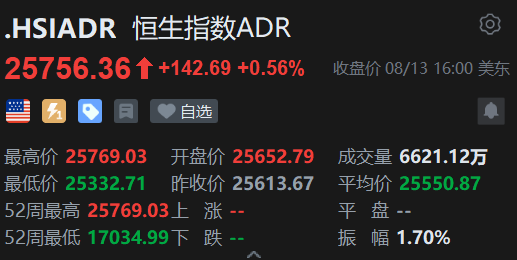
新华社香港8月13日电 香港恒生指数13日涨643.99点,涨幅2.58%,收报25613.67点。全日主板成交 2840.41亿港元。 国企指数涨233.2点,收报9150.05点,涨幅2.62%。恒生科技指数涨191.62点,收报5630.78点,涨 幅3.52%。 蓝筹股方面,腾讯控股涨4.74%,收报586港元;香港交易所涨2.28%,收报439.8港元;中国移动涨 0.57%,收报88.8港元;汇丰控股涨1.3%,收报101.5港元。 香港本地股方面,长实集团涨1.44%,收报37.94港元;新鸿基地产涨1.54%,收报95.35港元;恒基 地产涨1.99%,收报28.7港元。 中资金融股方面,中国银行涨1.1%,收报4.6港元;建设银行涨0.88%,收报8.02港元;工商银行涨 0.98%,收报6.16港元;中国平安涨1.61%,收报56.8港元;中国人寿涨0.71%,收报22.8港元。 石油石化股方面,中国石油化工股份涨0.68%,收报4.47港元;中国石油股份涨0.39%,收报7.7港 元;中国海洋石油涨1.17%,收报19.01港元。 【纠错】 【责任编辑:吴京泽】 ...

香港交易所(00388):7月跟踪:赴港上市步伐加快,市场热度仍处高位
Changjiang Securities· 2025-08-13 08:14
Investment Rating - The report maintains a "Buy" rating for the company [6] Core Views - The company's PE ratio as of the end of July is 38.24x, which is at the 58th percentile historically since 2016, indicating a certain level of value for allocation. It is expected that with the continuous enhancement of the mutual access policy in the Hong Kong capital market, liquidity in the Hong Kong stock market will continue to rise, leading to an increase in overall market activity and valuation. The company is projected to achieve revenues and other income of 28.4 billion, 31.1 billion, and 33.7 billion HKD for 2025-2027, with net profits attributable to shareholders of 17.7 billion, 18.7 billion, and 20.6 billion HKD, corresponding to PE valuations of 30.9, 29.2, and 26.4 times respectively [2][52] Summary by Sections Market Performance - In July, the Hong Kong stock market continued its upward trend, supported by domestic policy drivers. The Hang Seng Index and Hang Seng Tech Index increased by 23.5% and 22.0% respectively compared to the end of 2024. The monthly average daily trading (ADT) for the Hong Kong Stock Exchange was 262.9 billion HKD, reflecting a month-on-month increase of 14.2% and a year-on-year increase of 166.6% [7][10][15] Derivatives Market - In July, the average daily volume (ADV) for futures was 572,000 contracts, showing a slight decrease of 0.1% month-on-month and 3.7% year-on-year. Conversely, the ADV for options increased by 14.8% month-on-month and 30.6% year-on-year, reaching 942,000 contracts. The ADT for structured products was 15.7 billion HKD, with a month-on-month decrease of 2.4% but a year-on-year increase of 48.0% [19][25] Primary Market - The IPO scale in the Hong Kong stock market saw a significant year-on-year increase of 333% in July, with 9 new listings totaling 19.9 billion HKD. However, this represented a month-on-month decrease of 34%. The cumulative number of new listings from January to July was 52, with a total scale of 128.7 billion HKD, reflecting a year-on-year increase of 610% [30][31] Investment Income - As of the end of July, the HIBOR rates for 6 months, 1 month, and overnight were 2.27%, 1.03%, and 0.19% respectively, showing a mixed trend with some rates declining year-on-year. The U.S. overnight bank funding rate remained stable at 4.33% [41][52] Macroeconomic Environment - The domestic economic sentiment has declined, with the manufacturing PMI for July at 49.30%, indicating a contraction. The overseas liquidity is tightening due to the Federal Reserve's pause on interest rate cuts, with expectations of a 25 basis point cut in September 2025 [44][46]
港股资讯|港交所交易规则大升级!8月4日生效,拟上市企业迎新机遇!
Sou Hu Cai Jing· 2025-08-13 06:40
Group 1 - The Hong Kong Stock Exchange (HKEX) has implemented a significant market reform, adjusting the minimum price fluctuation units for stocks priced between 10 to 50 HKD, effective August 4 [2][3] - The minimum price change for stocks priced between 10 to 20 HKD has been reduced from 0.02 HKD to 0.01 HKD, while for those priced between 20 to 50 HKD, it has decreased from 0.05 HKD to 0.02 HKD, representing reductions of 50% and 60% respectively [2] - This reform aims to lower trading costs, enhance trading efficiency, and improve market competitiveness, making it easier for orders to be executed at expected prices [2][3] Group 2 - The reform will be implemented in two phases, with the second phase set to begin next year, targeting securities priced between 0.5 to 10 HKD, which will see a further 50% reduction in minimum price fluctuation units [3] - Market participants believe that this change will facilitate order matching for retail investors and reduce the premiums they pay for immediate execution [4] - However, there are concerns that traders relying on small price differences for arbitrage may be forced out of the market, potentially affecting market depth [5][7] Group 3 - Most brokerage firms have indicated that no major adjustments to their systems are necessary to accommodate the new pricing structure, as current systems can support three decimal places for pricing [8] - The Hong Kong stock market has experienced volatility, with mid-year earnings reports expected to be a focal point in August, particularly in the last week of the month [8] - As of August 4, the Hang Seng Index has seen a slight increase of 0.42% [10] Group 4 - Analysts from CITIC Securities project a 12.3% growth in earnings for the Hang Seng Tech Index constituents [11] - There are significant discrepancies in earnings expectations for the new energy vehicle and semiconductor sectors, indicating higher potential volatility, while the consumer electronics sector is viewed as a more stable choice [12] - Guosen Securities expresses an optimistic outlook for the Hong Kong stock market, suggesting a "synchronized easing" between domestic and foreign capital, with valuations remaining reasonable compared to A-shares [12]