CNOOC(00883)

Search documents
中国海油(600938):前三季度油气产量显著增长,盈利能力保持韧性:——中国海油(600938.SH)2025年三季报点评
EBSCN· 2025-10-31 02:57
Investment Rating - The report maintains a "Buy" rating for the company [1] Core Views - The company has demonstrated resilience in profitability despite a decline in oil prices, with a significant increase in oil and gas production in the first three quarters of 2025 [4][5] - The company achieved total revenue of 312.5 billion yuan in the first three quarters, a year-on-year decrease of 4.1%, and a net profit attributable to shareholders of 102 billion yuan, down 12.6% year-on-year [4][5] - The report highlights the company's strong cash flow and effective cost control measures, which have contributed to its stable performance during periods of fluctuating oil prices [5][9] Summary by Sections Production and Revenue - In the first three quarters of 2025, the company achieved a net oil and gas production of 578 million barrels of oil equivalent, a year-on-year increase of 6.7%, with crude oil production up 5.4% and natural gas production up 11.6% [6] - The average realized oil price was 68.29 USD per barrel, down 13.6% year-on-year, while the average natural gas price was 7.86 USD per thousand cubic feet, up 1.0% year-on-year [6] Cost Control - The company reported a decrease in the cost per barrel of oil equivalent to 27.35 USD, down 2.8% year-on-year, with operational costs and depreciation also showing slight reductions [7] Capital Expenditure and Future Outlook - The company completed capital expenditures of 86 billion yuan in the first three quarters, a decrease of 9.8% year-on-year, with a budget of 125-135 billion yuan for 2025 to support stable production growth [8] - The production targets for 2025 to 2027 are set at 760-780 million barrels of oil equivalent, with expected growth rates of 5.9%, 2.6%, and 3.8% respectively [8] Profitability Forecast - The report forecasts net profits for 2025, 2026, and 2027 to be 135.4 billion, 139.8 billion, and 144.3 billion yuan respectively, with corresponding EPS of 2.85, 2.94, and 3.04 yuan per share [9][10]

探寻“新增长”的答案——2025中国国际石油化工大会侧记
Zhong Guo Hua Gong Bao· 2025-10-31 02:54
Core Insights - The conference highlighted the urgent need for the petrochemical industry to embrace "new growth" through innovation, green transformation, and digital empowerment in response to current economic challenges [2][3][4] Group 1: Industry Development - The petrochemical industry aims to achieve high-quality development by focusing on intelligent, green, and integrated approaches, as emphasized by industry leaders [2] - The consensus among participants is that new growth should be driven by innovation, characterized by green and low-carbon transitions, and supported by digital technologies [2][3] Group 2: Technological Innovations - Significant technological breakthroughs were showcased, such as the development of the MegaMax catalyst for CO2-to-methanol conversion, demonstrating the industry's commitment to innovation [3] - A notable collaboration between China National Petroleum Corporation and BASF on carbon footprint accounting methods was recognized as a substantial achievement in carbon management [4] Group 3: Sustainable Practices - Companies like Covestro reported a 75% reduction in carbon emissions per product through innovative processes and high renewable energy usage [5] - Ningbo's zero-carbon park initiatives achieved a 99.7% comprehensive utilization rate of solid waste, showcasing effective circular economy practices [5] Group 4: Challenges and Opportunities - The industry faces challenges in plastic circular economy related to raw material-market alignment, policy coherence, and economic viability, necessitating collaborative efforts [7] - Discussions on financial tools to support the petrochemical industry's low-carbon transition highlighted the importance of unified standards and incentive mechanisms [7] Group 5: Talent Development - The need for talent cultivation was emphasized as crucial for achieving new growth, with calls for enhanced exchanges between China and Saudi Arabia [7] - The urgency for companies to establish clear technical pathways for carbon reduction was noted, indicating a gap in current strategies [7]


中国海油前三季度实现归母净利润1019.7亿元 产量稳步上涨
Zheng Quan Ri Bao Wang· 2025-10-31 02:49
Core Viewpoint - China National Offshore Oil Corporation (CNOOC) reported strong operational performance for the first three quarters of 2025, with significant increases in oil and gas production and revenue generation [1][2]. Group 1: Financial Performance - Oil and gas sales revenue reached 255.48 billion yuan, with a net profit attributable to shareholders of 101.97 billion yuan [1]. - The net production of oil and gas for the first three quarters was 578.3 million barrels of oil equivalent, representing a year-on-year increase of 6.7% [1]. - Domestic net production was 400.8 million barrels of oil equivalent, up 8.6% year-on-year, driven by contributions from projects like Deep Sea No. 1 Phase II and Bohai Zhong 19-2 [1]. - Overseas net production was 177.4 million barrels of oil equivalent, an increase of 2.6% year-on-year, primarily due to the Mero 3 project in Brazil [1]. - In the third quarter, net production reached 193.7 million barrels of oil equivalent, reflecting a year-on-year growth of 7.9% [1]. Group 2: Exploration and Development - In the first three quarters, the company made five new discoveries and successfully evaluated 22 oil and gas structures [1]. - The third quarter saw the successful evaluation of Kenli 10-6, which is expected to become a medium-sized oil field, and significant results from the integrated rolling reserve increase at Ling Shui 17-2 [1]. - The company launched 14 new projects in the first three quarters, including the development of the Kenli 10-2 oil field group (Phase I), Dongfang 29-1 gas field, Wenchang 19-1 oil field, and the Guyana Yellowtail project [1]. Group 3: Management Outlook - The President of CNOOC, Yan Hongtao, stated that the company is steadily advancing engineering construction and effectively controlling costs, aiming to meet annual production and operational targets in the fourth quarter [2].
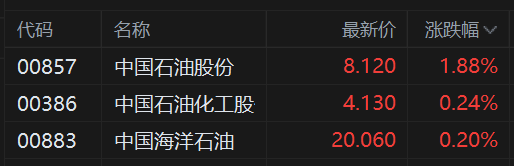
港股三桶油逆势上涨,中国石油股份涨约2%,中国石油化工、中国海洋石油跟涨!三桶油三季度盈利832.3亿,日赚9亿
Ge Long Hui· 2025-10-31 02:11
Core Viewpoint - The three major oil companies in Hong Kong, namely China National Petroleum Corporation (CNPC), China Petroleum & Chemical Corporation (Sinopec), and China National Offshore Oil Corporation (CNOOC), have shown resilience in their stock performance despite broader market trends, with significant profit reports for the third quarter [1][2]. Group 1: Financial Performance - CNPC reported a net profit attributable to shareholders of 42.29 billion yuan, leading the profitability rankings among the three companies [2]. - The combined profit for the three companies in the third quarter reached 83.23 billion yuan, averaging a daily profit of 900.5 million yuan [2]. Group 2: Production and Sales Growth - With the onset of the heating season, natural gas production and sales for the three major oil companies have seen notable increases [1]. - CNOOC's natural gas production increased by 11.6% year-on-year in the first three quarters [2]. - Sinopec's natural gas production reached 31.1 billion cubic meters, reflecting a year-on-year growth of 4.9% [2]. - CNPC's marketable natural gas production grew by 4.6% year-on-year, with domestic production increasing by 5.2% [2].


三桶油普涨 中国石油涨约2% 三季报业绩表现稳健
Ge Long Hui· 2025-10-31 02:09
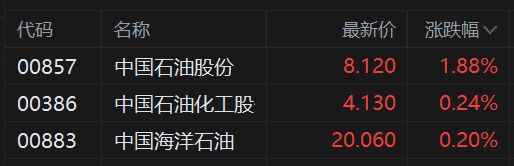
港股频道更多独家策划、专家专栏,免费查阅>>责任编辑:栎树 消息上,中国石油、中国石化、中国海油等相继公布了三季报,整体表现还是很稳健的。其中,中国石 油以422.9亿元归母净利润居盈利榜首。三家公司三季度合计盈利832.3亿元,相当于日赚9.05亿元。随 着采暖季到来,"三桶油"天然气产销量明显增长。前三季度,中国海油天然气产量同比增长11.6%;中 国石化天然气产量311亿立方米,同比增长4.9%;中国石油可销售天然气产量同比增长4.6%,其中国内 产量同比增长5.2%,保持较快增长势头。 | 代码 | 名称 | 最新价 涨跌幅 v | | --- | --- | --- | | 00857 | 中国石油股份 | 8.120 1.88% | | 00386 | 中国石油化工股 | 4.130 0.24% | | 00883 | 中国海洋石油 | 20.060 0.20% | 10月31日,港股三桶油逆势上涨,其中,中国石油股份涨约2%,中国石油化工、中国海洋石油跟涨。 ...
港股异动丨三桶油普涨 中国石油涨约2% 三季报业绩表现稳健
Ge Long Hui· 2025-10-31 02:04
港股三桶油逆势上涨,其中,中国石油股份涨约2%,中国石油化工、中国海洋石油跟涨。 消息上,中国石油、中国石化、中国海油等相继公布了三季报,整体表现还是很稳健的。其中,中国石 油以422.9亿元归母净利润居盈利榜首。三家公司三季度合计盈利832.3亿元,相当于日赚9.05亿元。 随着采暖季到来,"三桶油"天然气产销量明显增长。前三季度,中国海油天然气产量同比增长11.6%; 中国石化天然气产量311亿立方米,同比增长4.9%;中国石油可销售天然气产量同比增长4.6%,其中国 内产量同比增长5.2%,保持较快增长势头。(格隆汇) | 代码 | 名称 | | 最新价 涨跌幅 v | | --- | --- | --- | --- | | 00857 | 中国石油股份 | 8.120 | 1.88% | | 00386 | 中国石油化工股 | 4.130 | 0.24% | | 00883 | 甲国海洋石油 | 20.060 | 0.20% | ...
智通港股通持股解析|10月31日
智通财经网· 2025-10-31 00:34
Core Insights - The top three companies by Hong Kong Stock Connect holding ratios are China Telecom (71.15%), COSCO Shipping Energy (70.14%), and GCL-Poly Energy (70.09%) [1][2] - The companies with the largest increase in holding amounts over the last five trading days are CNOOC (+2.183 billion), SMIC (+2.136 billion), and Tencent (+1.679 billion) [1][2] - The companies with the largest decrease in holding amounts over the last five trading days are Alibaba (-1.659 billion), Tracker Fund (-1.405 billion), and CSPC Pharmaceutical (-1.324 billion) [1][3] Hong Kong Stock Connect Holding Ratios - China Telecom (00728): 9.876 billion shares, 71.15% [2] - COSCO Shipping Energy (01138): 909 million shares, 70.14% [2] - GCL-Poly Energy (01330): 283 million shares, 70.09% [2] - Other notable companies include China Shenhua (67.76%) and Tianjin Capital Environmental Protection (66.42%) [2] Recent Increases in Holdings - CNOOC (00883): +2.183 billion, +10.9063 million shares [2] - SMIC (00981): +2.136 billion, +2.6983 million shares [2] - Tencent (00700): +1.679 billion, +257.85 thousand shares [2] - Other companies with significant increases include China Mobile (+1.498 billion) and Meituan (+1.186 billion) [2] Recent Decreases in Holdings - Alibaba (09988): -1.659 billion, -964.24 thousand shares [3] - Tracker Fund (02800): -1.405 billion, -5.3224 million shares [3] - CSPC Pharmaceutical (01093): -1.324 billion, -17.72074 million shares [3] - Other companies with notable decreases include Li Auto (-894 million) and BYD Company (-370 million) [3]






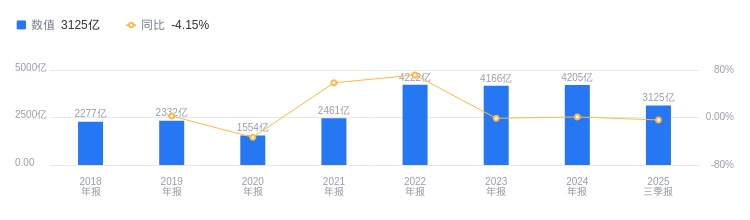
能源早新闻丨中国海油:收入3125亿元!
中国能源报· 2025-10-30 22:33
Industry News - The National Energy Administration is advancing the standardization of safety production in the electricity sector, emphasizing the need for companies to fulfill their safety responsibilities and improve management systems [2] - In September 2025, the National Energy Administration issued 229 million green certificates related to renewable energy projects, with 158 million being tradable, accounting for 68.86% of the total [2] - The 750 kV ultra-high voltage transmission ring network in Xinjiang has officially commenced operations, marking it as the largest of its kind in China [3] - A breakthrough in key equipment for deep-sea wind power has been achieved with the successful testing of a domestically developed high-capacity drag anchor, meeting international standards [3] - China has secured nearly 70% of global orders for green ships, with the delivery of two large LNG carriers showcasing advancements in domestic technology [3] - Shanghai has set the maximum regasification service price for imported LNG at 0.20 yuan per cubic meter, effective from November 1, 2025 [4] - In Shaanxi province, renewable energy installed capacity has surpassed thermal power for the first time, reaching 6,318 MW, which constitutes 50.3% of the total power capacity [4] - Henan province aims for 65% of coal mine capacity to be intelligent by 2027, with a focus on safety and efficiency improvements [4] Company News - China National Offshore Oil Corporation (CNOOC) reported a revenue of 312.5 billion yuan for the first three quarters of 2025, with a net profit of 101.97 billion yuan and a 6.7% year-on-year increase in oil and gas production [7] - A project by State Power Investment Corporation in Jilin has received the world's first certification for non-biological renewable fuel ammonia, highlighting advancements in sustainable energy [7]
“三桶油”持续推进增储上产
Zheng Quan Ri Bao Zhi Sheng· 2025-10-30 16:42
Core Viewpoint - The "Big Three" oil companies in China, namely China National Petroleum Corporation (CNPC), China Petroleum & Chemical Corporation (Sinopec), and China National Offshore Oil Corporation (CNOOC), have demonstrated strong resilience and maintained high profit levels despite a decline in international oil prices during the first three quarters of 2025 [1][2]. Financial Performance - CNPC reported a net profit of 126.279 billion yuan for the first three quarters, while Sinopec achieved a net profit of 29.984 billion yuan, and CNOOC recorded a net profit of 101.971 billion yuan [1]. - The average Brent crude oil futures price was $69.91 per barrel, reflecting a year-on-year decrease of 14.6% [1]. Production and Growth - All three companies have focused on increasing reserves and production, with oil and gas equivalent production growing steadily: CNPC's production was 1,377.2 million barrels (up 2.6% year-on-year), Sinopec's was 394.48 million barrels (up 2.2%), and CNOOC's was 578.3 million barrels (up 6.7%) [2]. - Natural gas production saw significant growth, with CNOOC's output increasing by 11.6%, Sinopec's by 4.9%, and CNPC's by 4.6%, with domestic production rising by 5.2% [2]. Strategic Focus - CNOOC's management emphasized that natural gas is a key strategic focus, with production growth driven by major projects such as Deepwater No. 1 Phase II and Dongfang 13-2 [3]. - The company aims to maintain cost competitiveness and pursue high-quality development, ensuring sustainable long-term value for shareholders [1][3].
中国海油的前世今生:营收3125.03亿行业居首,净利润1020.61亿远超同行
Xin Lang Cai Jing· 2025-10-30 16:01
Core Viewpoint - China National Offshore Oil Corporation (CNOOC) is the largest offshore oil and gas producer in China and one of the largest independent oil and gas exploration and production groups globally, showcasing strong operational performance and financial metrics [1][2]. Group 1: Business Performance - In Q3 2025, CNOOC achieved a revenue of 312.5 billion yuan, ranking first in the industry, significantly higher than the industry average of 80.3 billion yuan and the median of 3.6 billion yuan [2]. - The main business composition includes oil and gas sales at 171.7 billion yuan (82.73%), trade at 31.1 billion yuan (14.96%), and other revenues at 4.8 billion yuan (2.31%) [2]. - The net profit for the same period was 102.1 billion yuan, also ranking first in the industry, with the industry average at 25.9 billion yuan and the median at 0.8 billion yuan [2]. Group 2: Financial Health - CNOOC's debt-to-asset ratio in Q3 2025 was 30.09%, lower than the previous year's 33.24% and below the industry average of 34.47%, indicating strong solvency [3]. - The gross profit margin for the period was 52.24%, slightly down from 54.45% year-on-year but still above the industry average of 45.74%, reflecting robust profitability [3]. Group 3: Management and Shareholder Structure - The chairman, Zhang Chuanjiang, has extensive experience in the energy sector and has been in his current role since June 2025 [4]. - The president, Yan Hongtao, saw a salary reduction from 1.43 million yuan in 2023 to 1.17 million yuan in 2024, a decrease of 260,000 yuan [4]. - As of September 30, 2025, the number of A-share shareholders decreased by 7.08% to 214,800, while the average number of circulating A-shares held per account increased by 7.62% to 13,900 [5]. Group 4: Operational Highlights - In the first half of 2025, CNOOC's oil and gas net production reached a historical high, with domestic production up by 7.6% and overseas production up by 2.8% [6]. - The company achieved a 12.0% increase in natural gas production and maintained a reserve replacement rate above 130% [6]. - The average cost per barrel of oil equivalent decreased to 26.94 USD, and the natural decline rate of offshore oil fields dropped to 9.5% [6].