
LENOVO GROUP(00992)

Search documents
联想“梦想未来”公益项目落地甘肃漳县 科技与爱心共筑乡村教育新基石
Jing Ji Guan Cha Bao· 2025-09-11 10:49
Core Viewpoint - The "Dreaming Future" public welfare project by Lenovo aims to enhance rural education in Gansu Province by providing resources and technology to bridge the urban-rural digital education gap [1][2][3] Group 1: Project Implementation - The project was launched in Gansu's Yangchuan School, benefiting 1,623 students with a focus on reading needs and digital literacy [1] - Two main functional learning spaces were established: the "Dreaming Future Library" and the "Dreaming Future Recycled Computer Classroom" [1] - The library features a carefully curated collection of books across various fields, catering to students' basic reading needs and expanding their knowledge [1] - The computer classroom is equipped with refurbished computers and ongoing operational support, addressing the digital teaching equipment gap in rural areas [1][2] Group 2: Educational Initiatives - Lenovo invited AI experts to conduct an "AI First Lesson" for students, introducing them to basic computer operations and AI technology [2] - The interactive teaching approach sparked students' interest in technology, marking their first close encounter with AI [2] Group 3: Environmental and Educational Integration - The project reflects Lenovo's commitment to integrating environmental protection with educational support, continuing its "Environmental Protection + Education Assistance" public welfare philosophy [2] - The initiative includes book recycling donations and electronic device reuse, promoting resource efficiency and addressing rural educational needs [2] Group 4: Broader Impact - The establishment of the "Dreaming Future Library" is part of Lenovo's plan to build 100 libraries over three years, with previous donations benefiting 33 rural schools across multiple provinces [3] - The project is transforming the local educational landscape, providing students with quality resources and opportunities to access a broader world, thus empowering their future growth [3]

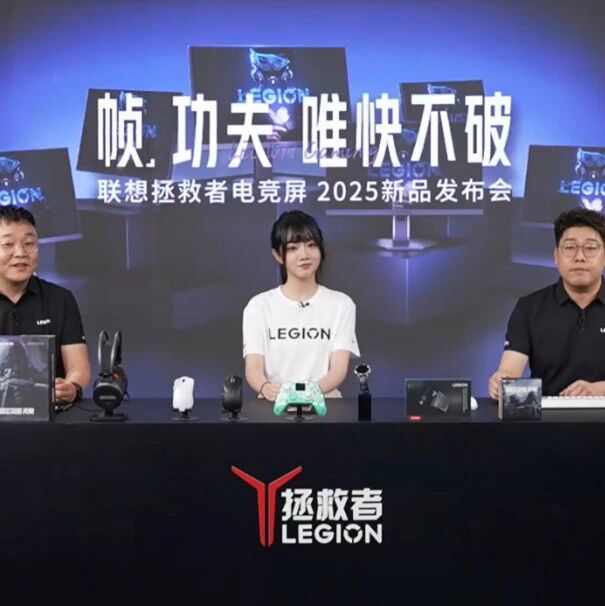
TCL华星助力联想拯救者电竞屏新品发布,“唯快不破”刷新电竞显示性能
WitsView睿智显示· 2025-09-11 10:08
Core Viewpoint - Lenovo's launch of three new gaming monitors, powered by TCL Huaxing's customized high-refresh display solutions, aims to enhance the gaming experience by addressing traditional shortcomings in smoothness, response speed, and color performance [2][4]. Group 1: Product Features - The three new gaming monitors include Legion 27Q-11, Legion 24-10, and Legion 25-10, each designed to meet different size and performance needs, showcasing TCL Huaxing's targeted technological empowerment [4]. - Legion 27Q-11 features a 27-inch QHD resolution with a native refresh rate of 300Hz, 1ms response time, and 99% sRGB + 95% DCI-P3 color gamut, balancing immersive large-screen experience with quality performance [5]. - Legion 24-10 offers a native refresh rate of 240Hz and 1ms GTG response time, achieving a balance between smoothness and color accuracy with 99% sRGB color gamut [5]. - Legion 25-10 is upgraded to a native refresh rate of 320Hz, further reducing latency to meet extreme speed demands [5]. Group 2: Technological Innovation - TCL Huaxing's advanced display technology, APEX, focuses on high refresh rates, high resolution, high contrast, and fast response times, providing gamers with an immersive, tear-free, and color-accurate visual experience [6]. - The collaboration between TCL Huaxing and Lenovo emphasizes user needs, driving technological innovation and product upgrades to deliver superior display products to global consumers [6].


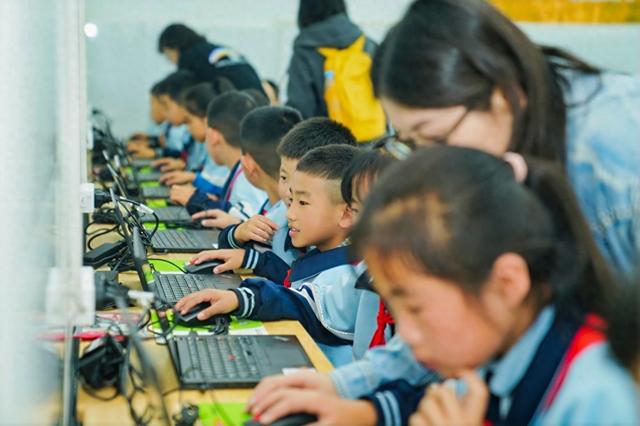
联想“梦想未来”公益行动在高原播下AI种子
Huan Qiu Wang· 2025-09-11 08:38
Group 1 - The core initiative involves the establishment of the "Dream Future Lenovo Library" and the "Dream Future Lenovo Recycled Computer Classroom" in a rural school in Gansu Province, aimed at enhancing educational resources for children [1][3] - Lenovo Group is providing support through the donation of recycled electronic devices and operational resources for the computer classroom, along with a certain percentage of computer donations [3] - The AI introductory lesson aims to equip students with basic knowledge and skills in using the technology available in the recycled computer classroom [3] Group 2 - Lenovo Group's representative expressed the hope that the library will serve as a "spiritual castle" for students and the computer classroom as a "starting point for technology," emphasizing the importance of AI education in broadening students' horizons [3] - The project is part of Lenovo's broader "Lenovo Vision Plan," which started in 2021, focusing on environmental restoration and balanced development in rural education [3] - The initiative combines environmental protection with educational support, promoting the recycling of books and electronic devices to reduce electronic waste while improving learning conditions for rural students [3]
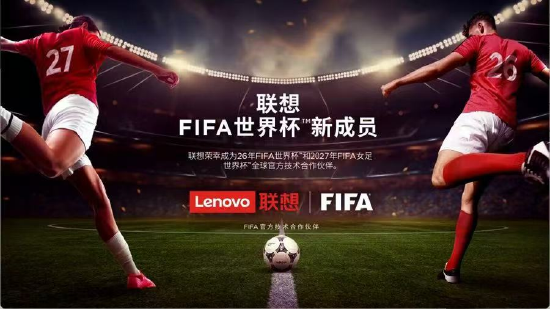
首届AI世界杯门票正式开售!这或许是你离抢票成功最近的一次
Xin Lang Cai Jing· 2025-09-11 04:38
Group 1 - The 2026 FIFA World Cup is set to be the largest in history, with ticket sales already generating significant interest among fans [1][4] - FIFA is implementing a new ticketing system that combines a lottery and deposit model to combat scalping and improve accessibility for fans [4][10] - Lenovo has been named the first official technology partner of FIFA, providing end-to-end technical support for the upcoming World Cup and other major events [1][3][8] Group 2 - The integration of AI technology in the World Cup will enhance various aspects, including ticketing, real-time data analysis, and officiating, marking the event as the first "AI World Cup" [5][10][11] - Lenovo's AI solutions will play a crucial role in improving the speed and stability of FIFA's technical systems, thereby enhancing the overall fan experience [7][10] - The collaboration between FIFA and Lenovo aims to create a seamless integration of technology in sports, making the World Cup not just a sporting event but a showcase of technological innovation [10][11]
智通港股通持股解析|9月11日
智通财经网· 2025-09-11 00:32
Core Insights - The top three companies by Hong Kong Stock Connect holding ratios are China Telecom (00728) at 72.15%, Green Power Environmental (01330) at 69.21%, and China Shenhua (01088) at 67.95% [1] - Alibaba-W (09988), Horizon Robotics-W (09660), and Meituan-W (03690) saw the largest increases in holding amounts over the last five trading days, with increases of +8.316 billion, +3.294 billion, and +2.859 billion respectively [1] - The largest decreases in holding amounts over the last five trading days were recorded by the Tracker Fund of Hong Kong (02800) at -1.974 billion, Kuaishou-W (01024) at -1.353 billion, and China Telecom (00728) at -1.284 billion [3] Hong Kong Stock Connect Holding Ratios - China Telecom (00728) has a holding of 10.014 billion shares, representing 72.15% [1] - Green Power Environmental (01330) has a holding of 0.280 billion shares, representing 69.21% [1] - China Shenhua (01088) has a holding of 2.295 billion shares, representing 67.95% [1] Recent Increases in Holdings - Alibaba-W (09988) increased by +8.316 billion, with a change of +58.233 million shares [1] - Horizon Robotics-W (09660) increased by +3.294 billion, with a change of +32.610 million shares [1] - Meituan-W (03690) increased by +2.859 billion, with a change of +28.108 million shares [1] Recent Decreases in Holdings - Tracker Fund of Hong Kong (02800) decreased by -1.974 billion, with a change of -73.655 million shares [3] - Kuaishou-W (01024) decreased by -1.353 billion, with a change of -18.241 million shares [3] - China Telecom (00728) decreased by -1.284 billion, with a change of -21.994 million shares [3]



智通港股通资金流向统计(T+2)|9月11日
智通财经网· 2025-09-10 23:32
Core Insights - The article highlights the net inflow and outflow of capital in the Hong Kong stock market, with specific focus on the top companies experiencing significant changes in capital flow [1][2]. Group 1: Net Inflow - Alibaba-W (09988) leads with a net inflow of 5.14 billion, representing a 25.60% increase in capital [2]. - Horizon Robotics-W (09660) follows with a net inflow of 1.375 billion, showing a 24.13% increase [2]. - Tencent Holdings (00700) has a net inflow of 1.076 billion, with an 8.04% increase [2]. - Other notable companies with significant inflows include BYD Company (01211) with 1.031 billion and WuXi Biologics (02269) with 542 million [2]. Group 2: Net Outflow - Pop Mart (09992) experiences the highest net outflow at -649 million, reflecting a -6.94% decrease [2]. - Kuaishou-W (01024) has a net outflow of -581 million, with a -13.67% decrease [2]. - Meitu Inc. (01357) sees a net outflow of -472 million, indicating a -24.59% decrease [2]. - Other companies with significant outflows include Xiaomi Group-W (01810) at -368 million and China Merchants Bank (03968) at -227 million [2]. Group 3: Net Inflow Ratio - The top net inflow ratio is held by Wisdom Hong Kong 100 (02825) at 100.00%, with a total inflow of 5.924 billion [3]. - Sinopec Kantons Holdings (00934) follows with a net inflow ratio of 72.10%, totaling 6.5044 million [3]. - Kunlun Energy (00135) has a net inflow ratio of 63.22%, with an inflow of 5.6388 million [3]. Group 4: Net Outflow Ratio - iFlytek Medical Technology (02506) leads in net outflow ratio at -48.28%, with an outflow of -13.4085 million [3]. - VTECH Holdings (00303) has a net outflow ratio of -45.83%, totaling -15.8089 million [3]. - NetDragon (00777) follows with a net outflow ratio of -45.72%, with an outflow of -41.1797 million [3].




群智咨询:2025Q2全球平板出货同比增约10% 短期政策与新品驱动提振出货
智通财经网· 2025-09-10 09:57
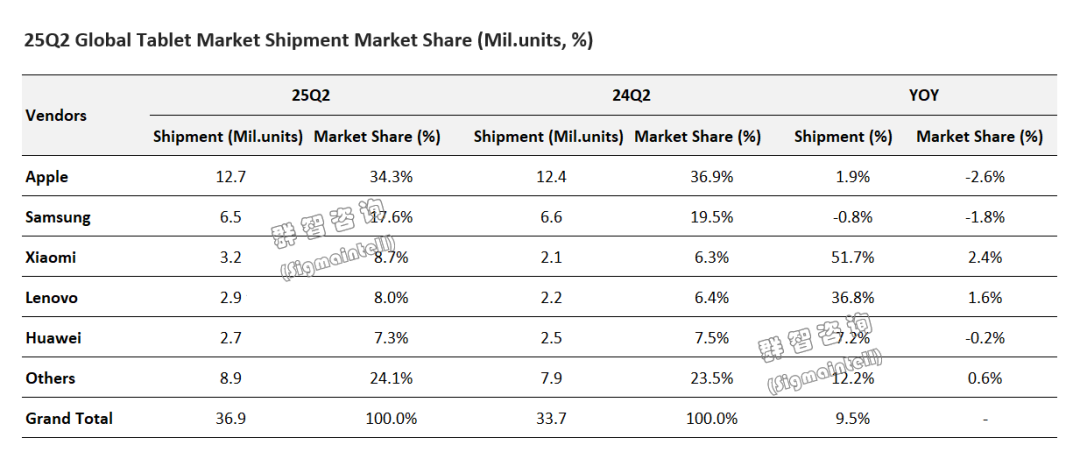
Core Insights - The global tablet shipment reached approximately 36.9 million units in Q2 2025, representing a year-on-year growth of 9.5%, continuing the recovery trend since the second half of 2024 [1][2] - Key drivers of market growth include China's subsidy policies and promotional strategies, the release of new products stimulating demand in high-end and mid-range markets, and the increasing demand in educational and light productivity scenarios [1] Company Summaries Apple - Apple shipped around 12.7 million tablets in Q2 2025, a slight year-on-year increase of 2% [3] - The company accelerated supply chain shifts to mitigate global market volatility risks and intensified promotional efforts in regional markets, particularly in mainland China [3] Samsung - Samsung's tablet shipments were approximately 6.5 million units in Q2 2025, reflecting a minor decline of 1% year-on-year [4] - The company launched new models, Galaxy Tab S10 FE and S10 FE+, which positively impacted the FE series' shipment share, although the A series saw a significant decline due to tariff and supply chain adjustments [4] Xiaomi - Xiaomi's tablet shipments reached about 3.2 million units in Q2 2025, marking a substantial year-on-year growth of 52% [5] - The company launched several new products, including the high-end Xiaomi Pad 7 Ultra and the gaming-focused Redmi K Pad, which contributed to its significant shipment increase [5] Lenovo - Lenovo shipped approximately 2.9 million tablets in Q2 2025, achieving a year-on-year growth of 37% [6] - The company released multiple new products across various market segments, benefiting from China's subsidy policies and strong performance in both domestic and overseas markets [6] Huawei - Huawei's tablet shipments were around 2.7 million units in Q2 2025, with a year-on-year growth of 7% [7] - Despite not launching new products in the first half of the year, Huawei leveraged its brand influence and China's subsidy policies to achieve growth, particularly in the high-end OLED segment [7]

港股收盘(09.10) | 恒指收涨1.01%站上两万六 科网股普遍上扬 云计算概念表现亮眼
智通财经网· 2025-09-10 08:50
Market Overview - The US non-farm employment data has been significantly revised downwards, leading to sustained expectations for interest rate cuts. The Hong Kong stock market has risen again, with the Hang Seng Index breaking the 26,000 mark, reaching a nearly four-year high. The index closed up 1.01% or 262.13 points at 26,200.26, with a total turnover of HKD 288.21 billion [1] Blue Chip Performance - Lenovo Group (00992) led the blue-chip stocks, rising 4.63% to HKD 11.31, contributing 5.88 points to the Hang Seng Index. Huatai Securities expects Lenovo to benefit from strong demand for AI products in the second half of the year, maintaining a buy rating with a target price of HKD 16 [2] - Other notable blue-chip performances include JD Logistics (02618) up 4.45%, Sun Hung Kai Properties (00016) up 4.28%, while Xinyi Solar (00968) and Xiaomi Group-W (01810) saw declines of 2.77% and 2.22%, respectively [2] Sector Highlights - Large technology stocks performed well, with Bilibili rising over 7% and JD up over 3%. Cloud computing stocks also saw gains, with Kingsoft Cloud rising nearly 9% [3] - Oracle's cloud business showed strong performance, with cloud revenue growing 28% year-on-year and cloud infrastructure revenue increasing 55%. The company expects cloud infrastructure revenue to reach USD 18 billion in FY2026, a 77% increase from FY2025 [4] Real Estate Sector - Hong Kong real estate stocks generally rose, with Sun Hung Kai Properties up 4.28% and Hang Lung Properties (00101) up 2.79% [4] - The Hong Kong government is set to release its 2025 policy address, with expectations of further reductions in property stamp duties and measures to attract more mainland visitors [5] Lithium Sector - Lithium stocks faced significant declines, with Ganfeng Lithium (01772) down 7.02% and Tianqi Lithium (09696) down 7.97%. The price of lithium carbonate is expected to fall below RMB 70,000 per ton due to a resurgence of supply surplus [6][5] Popular Stocks - Yunfeng Financial (00376) surged 27.83% after receiving approval to upgrade its securities license to offer virtual asset trading services [7] - Yaojie Ankang-B (02617) reached a new high, rising 27.57% after being included in the Hong Kong Stock Connect list [8] - Longfor Group (03380) rose 9.47% after reaching a revised agreement with creditors regarding offshore debt restructuring [9] - Shandong Molong (00568) increased by 7.92% amid rising oil prices due to geopolitical tensions in the Middle East [10]
恒生指数收涨1.01% 京东物流、联想集团涨超4%
Jin Tou Wang· 2025-09-10 08:39
Market Overview - The Hang Seng Index closed at 26,200.26 points, up 1.01% [1] - The Hang Seng Tech Index rose by 1.27% to 5,902.69 points [1] - The National Enterprises Index increased by 0.93% to 9,328.16 points [1] - The Red Chip Index gained 0.58%, closing at 4,376.55 points [1] Top Gainers - Bilibili-W surged over 7% to a price of 198.000 [2] - Dama Entertainment increased by over 5% to 1.190 [2] - JD Logistics and Lenovo Group both rose over 4%, with JD Logistics at 13.820 [2] - Other notable gainers include Beike-W, Construction Bank, and Agricultural Bank, all rising over 3% [1][2] Top Losers - Tianqi Lithium Industries fell by 7.97% to 39.960 [2] - Ganfeng Lithium dropped by 7.08% to 33.880 [2] - Pop Mart decreased by 4.09% to 276.400 [2] - Other significant decliners include Bosideng and Zhou Hei Ya, both down over 2% [1][2]


联想与伊利共创全球智链生态圈 “AI+”加速产业变革
Zheng Quan Ri Bao Wang· 2025-09-10 08:16
Core Insights - Lenovo and Yili have formed a strategic partnership to create a global intelligent supply chain ecosystem, enhancing Yili's digital transformation from production to consumer services [1][3] Group 1: Supply Chain and Production - Yili's smart factory utilizes automated production lines capable of processing over 7,000 tons of fresh milk daily and filling 40,000 packages per hour, making it the fastest milk production line globally [1] - The supply chain control tower system developed by Lenovo and Yili integrates over 80 supply indicators and 140 promotional product indicators, significantly reducing risks related to raw material expiration, excess inventory, and stockouts [2] - The introduction of a unified VOC (Voice of Customer) intelligent mining management platform allows Yili to close the loop on problem discovery and business improvement, enhancing consumer satisfaction [2] Group 2: Digital Transformation and AI Integration - Yili's digital transformation includes a comprehensive consumer digital platform that supports over 20 mini-programs for purchasing, after-sales, product co-creation, and health consultations [3] - The partnership emphasizes that digitalization is not a solitary endeavor; the integration of AI is expected to accelerate industry transformation and connect various sectors [3][5] - Lenovo's full-stack AI strategy aims to enhance productivity and innovation across personal, enterprise, and urban applications, with a focus on smart decision-making in cities [4] Group 3: Industry Impact and Future Outlook - The collaboration between Lenovo and Yili is seen as a benchmark for AI transformation in China's manufacturing sector, with expectations for continued advancements as the national "Artificial Intelligence +" initiative progresses [5] - Lenovo's intelligent agent matrix provides long-term services for government and enterprise clients, while also catering to small and medium-sized enterprises and individual customers [4] - The Chinese government's policy aims for AI applications to achieve over 70% penetration in key sectors by 2027 and over 90% by 2030, positioning intelligent economy as a crucial growth driver [4]
