LENOVO GROUP(00992)

Search documents
卡不住我们!中国算力省电省钱十大绝招,个个硬核
2 1 Shi Ji Jing Ji Bao Dao· 2025-08-26 12:53
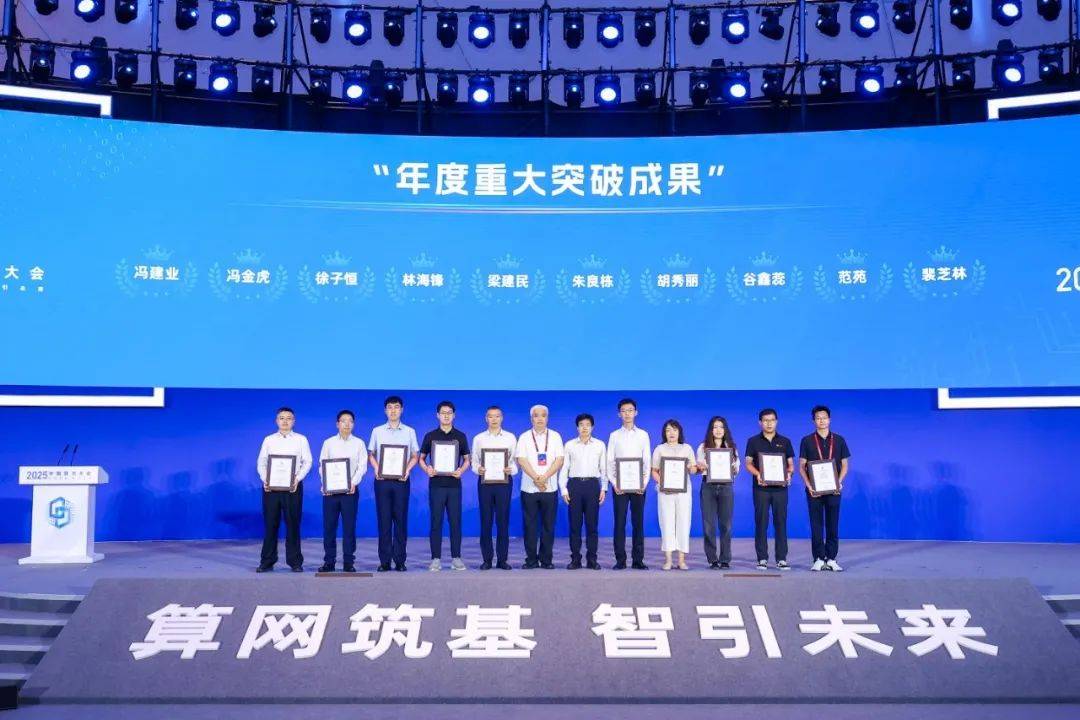
Core Insights - The 2025 China Computing Power Conference showcased significant breakthroughs in computing power, including the "Jiuzhou" computing power optical network developed by China Mobile, achieving 10 EFLOPS, capable of performing 100 trillion calculations in one second [1] - The conference highlighted ten major advancements in China's computing industry, focusing on both core underlying technologies and ecological solutions that enhance efficiency and sustainability [1][2] - These advancements are expected to drive GDP growth by over 12.6 billion yuan, indicating a strong economic impact from the computing power sector [1] Group 1: Major Breakthroughs - China Mobile's "Jiuzhou" optical network is the world's largest 400G all-optical inter-provincial backbone network [1] - Shanxi Qineng's integrated platform for computing and electricity saves 10 million yuan in electricity costs annually and reduces carbon emissions by 100,000 tons [1] - Super Fusion's FusionOne AI solution enables rapid deployment of AI applications, with over 500 projects already implemented [1] Group 2: Collaborative Technologies - China Telecom's "Wide-area Intelligent Computing Lossless Networking Technology" allows efficient collaboration between distant data centers [2] - China Unicom's "Distributed Training and Inference Key Technology" ensures efficient and secure AI training while protecting data privacy [2] - Lenovo's "Comprehensive Large Model Training and Inference Solution" enhances model inference performance by ten times and enables rapid fault recovery [2] Group 3: Ecosystem Development - Alibaba Cloud's heterogeneous GPU cloud platform facilitates collaboration among different brands of domestic GPUs, supporting over 100 major projects [2] - ZTE's intelligent computing supernode system enables large-scale high-speed interconnection of domestic GPU cards, supporting training of models with over one trillion parameters [2] - Shanghai AI Laboratory's DeepLink solution allows large-scale mixed training across provinces, optimizing national computing resources [2][3]



计算机行业周报:Deepseek引领国产AI产业发展-20250826
Tai Ping Yang Zheng Quan· 2025-08-26 12:42
Investment Rating - The report maintains a positive outlook on the computer industry, expecting overall returns to exceed the CSI 300 index by more than 5% in the next six months [27]. Core Insights - The computer industry index rose by 7.93% during the week of August 18-24, 2025, ranking 4th among 31 primary industries, with a year-to-date increase of 28.86%, outperforming the CSI 300 index by 17.60 percentage points [3][22]. - The release of DeepSeek-V3.1 is expected to drive the domestic AI industry, enhancing the capabilities of programming and search agents significantly [4][8]. - DeepSeek-V3.1 features a hybrid reasoning architecture, improved efficiency, and enhanced agent capabilities, marking a significant advancement in AI technology [12][14]. Summary by Sections 1. DeepSeek-V3.1 Release - DeepSeek-V3.1 was officially released on August 21, 2025, featuring a hybrid reasoning architecture that supports both thinking and non-thinking modes with an expanded context of 128K [12]. - The new version shows improved reasoning efficiency, with a score of 88.4 in AIME 2025, compared to 87.5 for the previous model [13]. - Enhanced agent capabilities were achieved through post-training optimization, significantly improving performance in programming and multi-step tasks [14][16]. 2. Market Review - The computer industry index increased by 7.93% in the week of August 18-24, 2025, with a year-to-date increase of 28.86%, outperforming the CSI 300 index by 17.60 percentage points [22]. - The top five companies in terms of weekly gains included Yuyin Co. (+46.2%), Chengmai Technology (+34.92%), and Kexin Information (+33.94%) [24][25]. 3. Investment Recommendations - The report recommends focusing on companies that will benefit from the release of DeepSeek-V3.1, including Haiguang Information, Zhiwei Intelligent, and Lenovo Group [8]. - Application-side recommendations include Kingsoft Office, Yonyou Network, and Saiyi Information, among others [8].




胜蓝股份:联想是公司的客户
Zheng Quan Ri Bao· 2025-08-26 11:44
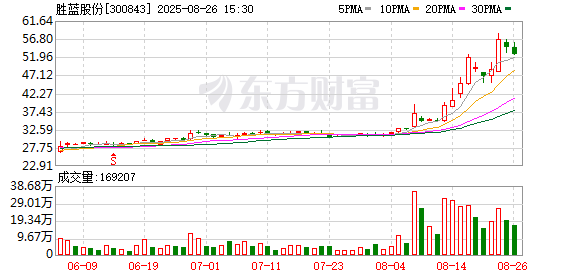
证券日报网讯胜蓝股份8月26日在互动平台回答投资者提问时表示,联想是公司的客户,主要供货消费 类及数通类连接器产品。 (文章来源:证券日报) ...

Omdia:2025第二季度全球智能手机市场微跌0.1% 下半年市场不确定性仍然持续
智通财经网· 2025-08-26 05:53
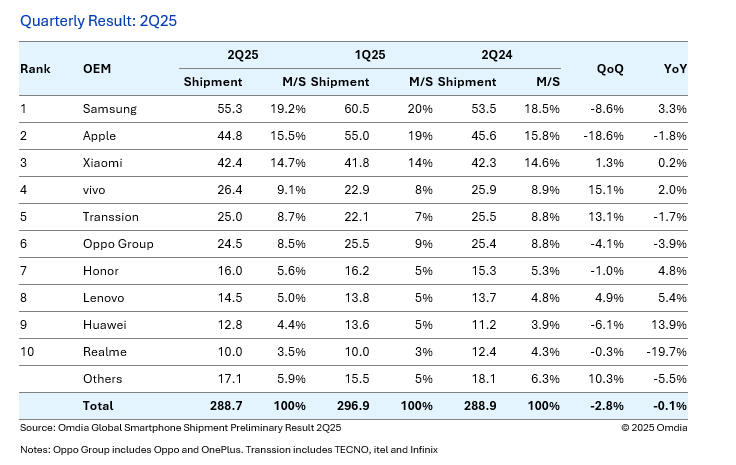
Core Insights - Global smartphone shipments are projected to decline to 288.7 million units in Q2 2025, a decrease of over 8 million units or 2.8% quarter-on-quarter, and a slight year-on-year decrease of 20,000 units or less than 0.1% [1][2] Company Performance - Samsung remains the market leader with shipments of 55.3 million units, holding a market share of 19.2%, despite a quarter-on-quarter decline of 8.6% and a year-on-year increase of 3.3% [2][4] - Apple ranks second with shipments of 44.8 million units and a market share of 15.5%, experiencing a significant quarter-on-quarter decline of 18.6% and a slight year-on-year decrease of 1.8% [2][4] - Xiaomi holds the third position with 42.4 million units shipped, reflecting a minor quarter-on-quarter increase of 1.3% and a year-on-year increase of 0.2% [2][4] - Vivo and Transsion are tied for fifth place, each with a market share of 9%, with Vivo showing a strong quarter-on-quarter growth of 15.1% [2][5] - Honor, Lenovo, and Huawei have shown strong growth, with Huawei achieving a year-on-year increase of 16.0%, reclaiming its position in the Chinese market [5] Market Trends - The smartphone market is facing significant macroeconomic challenges, with a decline in consumer demand post-pandemic and a shift in purchasing behavior [1][5] - Many manufacturers have had to lower production targets to avoid excess inventory, particularly in the U.S. market due to uncertainties surrounding tariffs [1][4] - The introduction of innovative hardware, such as silicon-carbon anode batteries and ultra-thin smartphone designs, is being leveraged to stimulate replacement demand among existing users [6]



联想六足机器狗,亮相粤超足球场
2 1 Shi Ji Jing Ji Bao Dao· 2025-08-26 00:59
Core Insights - Lenovo is leveraging AI technology in sports, exemplified by the introduction of a six-legged robotic dog at the Guangdong Super League opening ceremony, enhancing the event experience [1] - The robotic dog serves multiple roles, including performance, security inspections, and participation in event activities, showcasing Lenovo's commitment to integrating AI into sports [1] - Lenovo has a long-standing presence in the sports technology sector, being a global technology partner for F1 and collaborating with FIFA for upcoming World Cup events [2][3] Group 1 - The six-legged robotic dog, developed by Lenovo, features autonomous environmental perception and decision-making capabilities, enhancing the immersive experience for fans and participants [1] - Lenovo aims to provide a full-chain intelligent solution for sports management, including fan engagement and team management, through AI technology [1] - The company has previously established a high-performance computing system for the Beijing Winter Olympics, significantly improving data update frequency for event services [2] Group 2 - Lenovo's partnership with FIFA will see its products and solutions utilized in the 2026 FIFA World Cup and the 2027 FIFA Women's World Cup, further solidifying its role in sports technology [3] - The strategic collaboration with the Chinese Football Association aims to enhance the operational efficiency of professional leagues through AI-driven initiatives [3] - The introduction of the robotic dog is expected to deepen Lenovo's connection with the sports industry and expand its intelligent technology applications [4]
联想集团(00992):PC业务超预期,全站式AI高速增长
Changjiang Securities· 2025-08-25 09:22
Investment Rating - The investment rating for Lenovo Group is "Buy" and is maintained [6]. Core Insights - Lenovo Group reported a revenue of $18.83 billion for Q1 FY2025/26, representing a year-on-year increase of 22%. The net profit attributable to shareholders was $538 million, up 112% year-on-year. The gross margin was 14.7%, down 1.9 percentage points, while the net profit margin was 2.68%, an increase of 1.11 percentage points. Non-GAAP net profit reached $389 million, reflecting a 22% year-on-year growth [4][8]. Summary by Sections Event Description - On August 14, Lenovo Group released its Q1 FY2025/26 financial results, achieving a revenue of $18.83 billion, a 22% increase year-on-year. The net profit attributable to shareholders was $538 million, marking a 112% increase. The gross margin was 14.7%, down 1.9 percentage points, while the net profit margin increased by 1.11 percentage points to 2.68%. Non-GAAP net profit was $389 million, up 22% year-on-year [4][8]. Business Performance - The IDG (Intelligent Devices Group) business exceeded expectations, with both PC and smartphone sales driving performance. According to IDC, global PC sales grew by 6.5% in Q2 2025, with Lenovo's sales increasing by 15.2%, achieving a market share of 24.6%, a historical high. The smartphone sales growth has outpaced the market for eight consecutive quarters, with a historical high market share outside China, and foldable phone share reaching 51%. The IDG business generated $13.46 billion in revenue, a 17.84% year-on-year increase, with operating profit of $950 million, up 14.73% [8]. ISG and SSG Performance - The ISG (Infrastructure Solutions Group) business saw significant growth, with revenue of $4.29 billion, a 35.77% year-on-year increase, although operating profit was a loss of $86 million. The cloud infrastructure revenue grew by 36%, and AI infrastructure revenue doubled year-on-year. The SSG (Solutions and Services Group) achieved a record revenue of $2.26 billion, up 19.75% year-on-year, with operating profit of $501 million, a 26.43% increase [8]. AI Strategy - Under the hybrid AI strategy, Lenovo aims to provide comprehensive solutions for both personal and enterprise users. In the personal sector, Lenovo is developing various intelligent terminal devices, while in the enterprise sector, it is building AI model factories and platforms. The company is expected to leverage its leadership in AI cloud collaboration, projecting net profits of $1.689 billion, $1.990 billion, and $2.296 billion for FY2026, FY2027, and FY2028 respectively, maintaining a "Buy" rating [8].
京东方独供,联想推ThinkVision P系列商用显示器
WitsView睿智显示· 2025-08-25 09:20
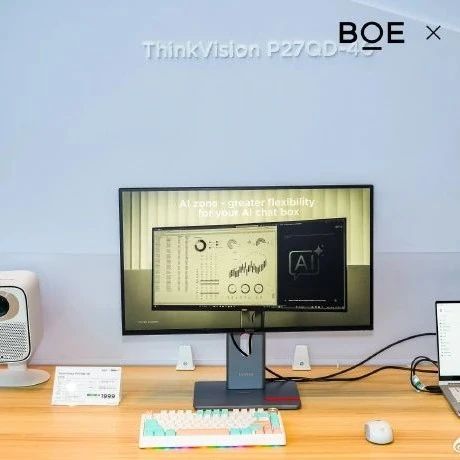
Core Viewpoint - Lenovo has launched the ThinkVision P series commercial monitors, featuring BOE's exclusive Oxide technology, which offers low power consumption, dynamic refresh rates, high color gamut, high contrast, and eye-care benefits [1][2]. Group 1: Product Features - The ThinkVision P series utilizes BOE's Oxide technology to achieve a 24-120Hz adaptive refresh rate, significantly reducing power consumption by over 50% at a low refresh rate of 24Hz [2]. - The monitors provide 98% DCI-P3 color gamut coverage and a high contrast ratio of 2000:1, ensuring superior image quality [2]. - The series incorporates LDFM technology and has received Eye Comfort five-star certification, effectively eliminating screen flicker and significantly filtering blue light damage [2]. Group 2: Manufacturing and Supply Chain - The panels for the ThinkVision P series are produced at BOE's first 8.5-generation all-metal oxide TFT-LCD production line in Nanjing, which has a monthly capacity of 60,000 glass substrates sized 2500mm x 2200mm [2]. - BOE acquired an 80.831% stake in the Nanjing Zhongdian Panda Flat Panel Display Technology Co., Ltd. for 5.591 billion yuan in 2020, integrating this production line into its operations [2]. - BOE has supplied over 50 million high-end display panels to Lenovo, marking a new phase in their collaboration on display technology innovation and sustainable development [3].

走进联想:构建“厚植中国、全球互惠”的新型全球化 | 跨越山海
Di Yi Cai Jing· 2025-08-25 06:39
Core Insights - Lenovo Group serves as a landmark case for the globalization of Chinese enterprises, navigating a new phase of global trade and developing strategies for geopolitical resilience, deeper localization, sustainable growth, and trusted global branding [2][3][4] Group 1: Globalization Journey - Founded in 1984 in Beijing, Lenovo officially began its globalization journey in 2004 with the acquisition of IBM's PC business, which marked a significant milestone in its international expansion [2][3] - Over the past 20 years, Lenovo has transformed from a leading player in the Chinese PC market to the world's top PC manufacturer, maintaining its market leadership [3][4] - Lenovo's innovative spirit has revitalized struggling tech brands like ThinkPad, Motorola, NEC, and Fujitsu, showcasing its ability to turn "negative assets" into key growth drivers [3][4] Group 2: Resilience and Adaptation - Despite global trade disruptions caused by tariff wars, Lenovo maintained its competitiveness and market share through its unique ODM+ end-to-end operational model, achieving resilient growth [3][4] - In the fiscal year 2024/25, Lenovo reported its best-ever performance, with strong momentum continuing into the first quarter of fiscal year 2025/26 [3][4] Group 3: Manufacturing and Localization Strategy - Lenovo's globalization is characterized by a "China + N" manufacturing strategy, with overseas revenue reaching 314.4 billion yuan in 2024, ranking second among Chinese enterprises [6][9] - The company operates in 180 markets globally, employing 72,000 staff and managing a complex supply chain with over 2,000 suppliers [6][9] - Lenovo's manufacturing capabilities are primarily based in China, with 75% of its revenue generated from overseas markets, emphasizing its commitment to local production and delivery [9][11] Group 4: Mergers and Acquisitions - The acquisition of IBM's PC business in 2004 was pivotal for Lenovo, providing essential resources such as brand, technology, and supply chain advantages [16][21] - Lenovo has successfully integrated several well-known brands through acquisitions, including IBM's x86 server business and Motorola Mobility, enhancing its global governance capabilities [21][22] - The company has adopted a localized approach in its acquisitions, ensuring that management teams are composed of local talent to better understand market dynamics [22][45] Group 5: Innovation and AI Integration - Lenovo has diversified its business beyond PCs, with non-PC revenue accounting for 47% of total revenue, driven by its focus on AI and innovation [36][38] - The company has established a robust R&D framework, with over 30,000 patents, to support its long-term competitiveness in the AI era [39][40] - Lenovo's commitment to sustainable development and AI for all reflects its vision for a future where technology benefits society [37][40]

联想发布《2025 AI方案赋能白皮书》 助力行业把握AI发展新机遇
Zheng Quan Ri Bao Wang· 2025-08-25 05:44
Core Insights - Lenovo Group, in collaboration with the Heterogeneous Computing Industry Alliance, released the "2025 AI Empowerment White Paper" at the 2025 China Computing Power Conference, showcasing its deep technological foundation in AI infrastructure and insights into customer needs [1][2] - This white paper is the second released since the establishment of the Heterogeneous Computing Industry Alliance last year, analyzing technological evolution trends and providing actionable solutions for intelligent transformation across various industries [1][2] Summary by Sections - **AI Core Technologies**: The white paper highlights three innovative AI core technologies: reinforcement learning framework optimization, large model training and inference technology, and innovative long-term storage technology for industrial quality inspection in manufacturing [1] - **Lenovo's Heterogeneous Computing Platform**: The large model training and inference technology refers to Lenovo's Wanquan Heterogeneous Computing Platform, which has been upgraded to version 3.0. It includes nine core capabilities covering the entire process of pre-training, post-training, and inference, providing comprehensive AI computing support for enterprise users [2] - **Practical Applications**: The platform has been validated in customer scenarios, such as optimizing the DeepSeek large model for a fund company, resulting in training costs being only 10% of similar models, inference costs reduced to 2%-3%, and an AI substitution rate of 30%-50%. Additionally, Lenovo collaborated with Geely to create a benchmark intelligent computing cluster for the manufacturing industry, achieving cost optimization and smooth business upgrades in hybrid computing scenarios [2]
2025“算力中国”重大成果揭晓 山西秦能“算电协同”技术跻身全国十大突破
Sou Hu Cai Jing· 2025-08-25 04:51
Core Insights - The 2025 China Computing Power Conference was held in Datong, Shanxi, showcasing ten innovative technologies that lead the global computing power industry, including the Shanxi Qineng Integrated Platform for Computing and Electricity [1][3] - The selected achievements demonstrate a leap from following to leading in the computing power industry, highlighting breakthroughs in core technologies and ecological innovation [3][4] Group 1: Key Technologies - The Shanxi Qineng Integrated Platform optimizes the dual-direction scheduling of computing and electricity resources, reducing electricity costs by 5%, carbon emission intensity by 25%, and improving computing efficiency by 30% [3][7] - China Mobile's "Jiuzhou" computing power optical network supports a backbone network with a computing capacity of 10 EFLOPS, expected to drive GDP growth by over 12.6 billion [4] - The FusionOne AI solution has served over 500 projects, achieving rapid deployment of AI applications [4][8] Group 2: Economic Impact - The Shanxi Qineng platform has saved 10 million yuan in electricity costs annually and reduced carbon emissions by 100,000 tons, contributing to a market worth tens of billions in computing and electricity collaboration services [3][4] - The conference highlighted Shanxi's innovative strength in the synergy of computing and energy, promoting a unique development path for the region [4] Group 3: Future Prospects - The promotion of these technologies is expected to further advance the green and intelligent upgrade of China's computing infrastructure, contributing to a new global digital civilization [4][11] - The integration of computing power and energy is seen as a key area for future growth, with significant implications for the digital economy and low-carbon transformation [3][4]