
AGRICULTURAL BANK OF CHINA(01288)

Search documents
低价银行直供房数量激增 ,有银行直供房价低于市价25%
Di Yi Cai Jing· 2025-11-09 14:37
Core Viewpoint - The article highlights a significant increase in the number of properties directly sold by banks, with some properties being offered at prices 25% lower than market value, indicating a shift in asset disposal strategies by financial institutions [1] Group 1: Market Dynamics - Several banks, including Agricultural Bank, China Construction Bank, and Bank of Communications, are accelerating their direct property sales through online platforms, with some banks listing over a thousand properties for sale [1] - The properties being sold are primarily derived from the disposal of non-performing loans, where banks acquire full ownership after borrowers default [1] Group 2: Strategic Implications - The acceleration in property disposals by banks aims to enhance debt recovery rates during a period of adjustment in the real estate market, making direct sales a new strategy for banks to quickly liquidate assets [1]



你的支付优惠用了吗?各大银行加入双十一“狂欢”,算的什么账?
Sou Hu Cai Jing· 2025-11-08 00:51
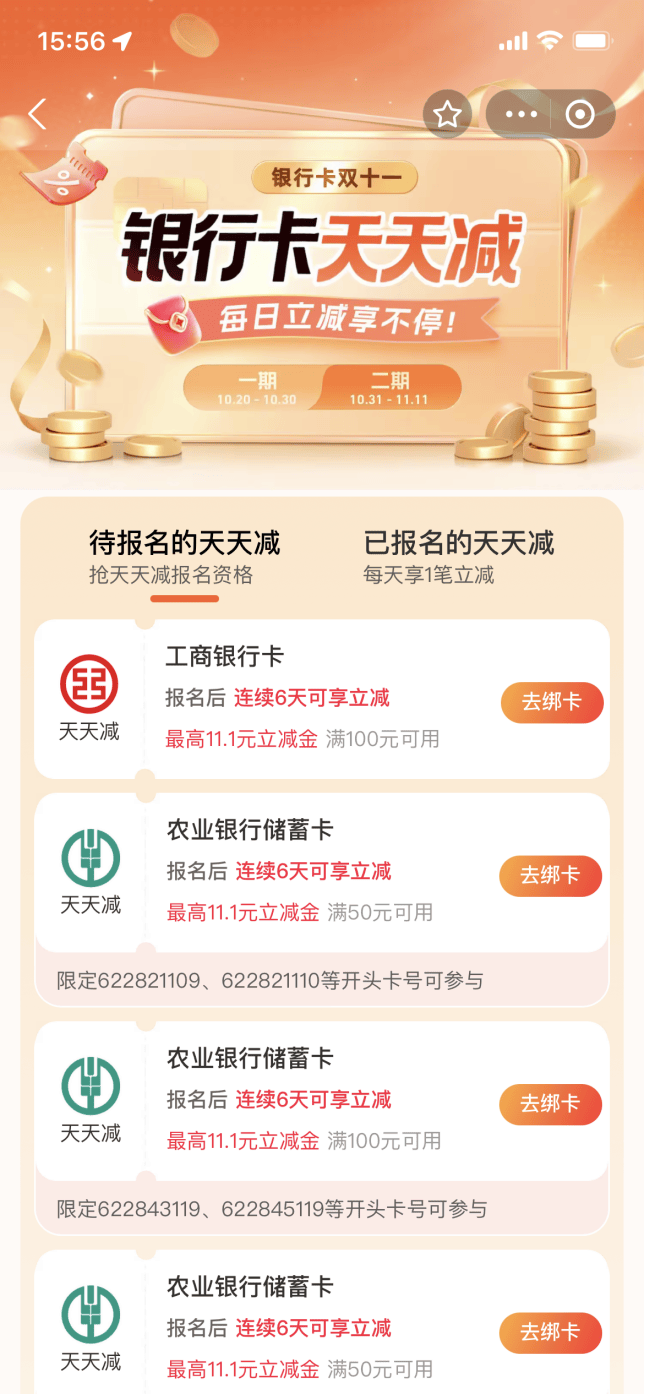
Core Viewpoint - The annual Double Eleven shopping season has officially started, with major commercial banks launching various promotional activities to stimulate consumer spending and boost business before the year-end [1][2]. Group 1: Promotional Activities by Banks - Major banks such as China Construction Bank, Bank of China, Agricultural Bank of China, and others have introduced cashback, discounts, installment benefits, and exclusive offers to attract consumers [1]. - Construction Bank offers a maximum discount of 400 yuan for credit card customers using installment payments on platforms like Alipay and Taobao, while Bank of China provides a random discount of up to 118 yuan for transactions made through Alipay [2]. - Other banks, including China Merchants Bank and Ping An Bank, have also launched various cashback and discount campaigns to engage customers during this shopping season [2]. Group 2: Strategic Insights - Experts suggest that the banks' promotional strategies represent a cost-effective method to acquire and retain customers, activating dormant accounts with low-cost random discounts [5]. - The focus on marketing during peak shopping seasons aims to enhance the usage of bank cards over third-party payment channels, thereby driving growth in credit and debit card transactions [5]. - Recommendations for banks post-Double Eleven include offering temporary credit limit increases and integrating with government consumption voucher programs to enhance customer experience and engagement [5].




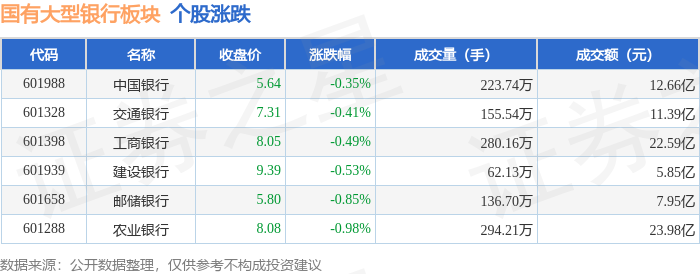
国有大型银行板块11月7日跌0.68%,农业银行领跌,主力资金净流出2.55亿元
Zheng Xing Xing Ye Ri Bao· 2025-11-07 08:37
Core Insights - The state-owned large bank sector experienced a decline of 0.68% on November 7, with Agricultural Bank leading the drop [1] - The Shanghai Composite Index closed at 3997.56, down 0.25%, while the Shenzhen Component Index closed at 13404.06, down 0.36% [1] Market Performance - The closing prices and changes for major state-owned banks are as follows: - Bank of China: 5.64, down 0.35% - Bank of Communications: 7.31, down 0.41% - Industrial and Commercial Bank of China: 8.05, down 0.49% - China Construction Bank: 9.39, down 0.53% - Postal Savings Bank: 5.80, down 0.85% - Agricultural Bank: 8.08, down 0.98% [1] Capital Flow - The state-owned large bank sector saw a net outflow of 255 million yuan from main funds, while retail investors contributed a net inflow of 251 million yuan [1] - The detailed capital flow for individual banks is as follows: - Bank of Communications: Main funds net inflow of 52.52 million yuan, retail net inflow of 34.41 million yuan - Industrial and Commercial Bank: Main funds net outflow of 22.51 million yuan, retail net inflow of 72.97 million yuan - Bank of China: Main funds net outflow of 36.09 million yuan, retail net inflow of 46.71 million yuan - China Construction Bank: Main funds net outflow of 44.38 million yuan, retail net inflow of 16.83 million yuan - Postal Savings Bank: Main funds net outflow of 53.25 million yuan, retail net inflow of 31.40 million yuan - Agricultural Bank: Main funds net outflow of 15.17 million yuan, retail net inflow of 48.80 million yuan [2]

*ST清研(301288.SZ):力合创投与清研创投累计减持1.14%股份

Ge Long Hui A P P· 2025-11-07 08:16
Core Viewpoint - *ST Qingyan (301288.SZ) announced a significant reduction in shareholding by its shareholders, Lihe Venture Capital and Qingyan Venture Capital, indicating a shift in ownership dynamics within the company [1] Shareholding Changes - From November 5 to November 6, 2025, Lihe Venture Capital and Qingyan Venture Capital collectively reduced their holdings by 1,233,300 shares, representing 1.14% of the company's current total share capital (1.16% when excluding repurchased shares) [1] - After this reduction, Lihe Venture Capital, Qingyan Venture Capital, and Lihe Hongxin together hold a total of 8,209,976 shares, which accounts for 7.60% of the company's total share capital (7.72% when excluding repurchased shares) [1]
上市银行大类资产配置跟踪:信贷投放稳健,债券配置灵活性提升
Ping An Securities· 2025-11-07 08:10
Industry Investment Rating - The investment rating for the banking sector is "Outperform" [1] Core Insights - The proportion of corporate loans has increased, while retail demand recovery is being monitored. As of mid-2025, the proportion of corporate loans among listed banks rose by 1.65 percentage points from the end of 2024 to 60.2%. The manufacturing sector's loans accounted for 18.5% of corporate loans, reflecting a recovery in the operations of manufacturing enterprises [3][12] - The flexibility in bond allocation has increased, with bond trading helping to stabilize market fluctuations. In the first half of 2025, listed banks saw a significant decline in other comprehensive income and fair value changes due to interest rate fluctuations. Some banks, primarily state-owned, increased bond trading to enhance investment returns and stabilize net profit growth [3][6] - Asset quality pressure is manageable, with a focus on risks in the retail sector. The overall asset quality remains stable, with the non-performing loan (NPL) ratio for A-share listed banks holding steady at 1.15% as of Q3 2025. However, the average NPL ratio for retail loans increased by 15 basis points to 1.58% compared to the end of 2024 [3][6] Summary by Sections Corporate Loan Structure - The overall asset structure of listed banks shows an increase in loan allocation, with the loan proportion rising by 0.1 percentage points from the end of 2024. State-owned banks increased interbank asset allocation, while small and medium-sized banks focused more on loan issuance [12][19] - Corporate loans remain the primary focus of credit allocation, with corporate loans accounting for 91.1% of all new loans in the first nine months of 2025. Short-term corporate loans made up 33.7% of new corporate loans [17][18] Bond Investment Preferences - The preference for flexible bond allocation has increased, with banks primarily investing in government bonds and central bank bills. The proportion of OCI accounts has risen, indicating a shift towards more flexible investment strategies [6][3] Asset Quality and Risk Monitoring - The asset quality of the banking sector is stable, with a non-performing loan ratio of 1.15% as of Q3 2025. The retail loan sector has shown slight increases in NPL ratios, necessitating ongoing monitoring of risks in this area [3][6]


中国农业银行将在11月8日至次日凌晨实施生产系统维护
Jin Tou Wang· 2025-11-07 03:20
Core Viewpoint - China Agricultural Bank (601288) announced a scheduled maintenance of its production system to enhance service efficiency, which will temporarily affect certain online services [1] Group 1: Service Impact - The maintenance is set to occur from November 8, 2025, at 23:00 to November 9, 2025, at 01:00 [1] - During this period, online corporate and personal credit authorization and credit report inquiry functions will experience one to two service interruptions lasting up to 30 minutes each [1] - The online credit business processing will show an unavailable prompt for credit inquiries [1] Group 2: Customer Communication - The bank expresses apologies for any inconvenience caused and encourages customers to plan their business activities accordingly [1] - Customers are advised to contact the bank's customer service hotline for assistance if needed [1]
中国农业银行大小额支付系统将在11月8日进行系统维护升级
Jin Tou Wang· 2025-11-07 03:20
Core Viewpoint - China Agricultural Bank announced a scheduled system maintenance upgrade for its large and small payment systems on November 8, 2025, which will affect certain transaction capabilities during the maintenance window [1] Summary by Relevant Sections - **System Maintenance Details** - The maintenance will occur from 20:00 to 22:50 on November 8, 2025 [1] - During this period, specific transactions initiated through personal mobile banking, online banking, and super counters will be delayed [1] - **Transaction Impact** - Cross-bank transfer transactions initiated between 20:00 on November 7 and 22:50 on November 8 will experience a 24-hour delay and cannot be canceled during the maintenance window [1] - Transactions initiated between 18:00 and 22:50 on November 8 will have a 2-hour delay and also cannot be canceled during the maintenance [1] - **Other Services** - Other services within the large and small payment systems will not be affected by this maintenance upgrade [1] - **Customer Communication** - The bank expressed apologies for any inconvenience caused and encouraged customers to plan their transactions accordingly [1]
2025年H1中国手机银行APP流量监测报告
艾瑞咨询· 2025-11-07 00:06
Core Insights - The mobile banking app has become a core platform for commercial banks to serve users, optimize experiences, and enhance competitiveness in the context of national digital transformation and financial technology innovation [1] - The integration of AI technology, refined operational strategies, and diversified user demands are reshaping the market landscape and value of mobile banking apps [1] User Flow and Behavior - The user flow of mobile banking apps in China is stabilizing between 650 million to 700 million from 2023 to 2025, indicating a saturated market [2] - The decline in user engagement is evident, with average daily usage time dropping from 4.93 minutes to 2.70 minutes and daily usage frequency decreasing from 4.54 times to 2.86 times [4] Operational Strategies - Refined operations are crucial for banks to break through in a saturated market, focusing on precise user insights and intelligent technology applications [6][7] - AI technology is enhancing refined operations by upgrading interaction experiences, strengthening risk control, expanding diverse scenarios, and improving data operations [9] Rankings and Performance - The top three banks by average monthly active users (MAU) are Agricultural Bank of China (24 million), Industrial and Commercial Bank of China (18.9 million), and China Construction Bank (10.6 million) [11][15] - Among joint-stock commercial banks, China Merchants Bank leads with over 7 million MAU, while other banks like Ping An Bank and CITIC Bank follow closely [16][17] - City commercial banks show strong performance, with Jiangsu Bank leading at 349.6 thousand MAU, and several banks achieving significant growth rates [19][20] Case Studies of Successful Apps - Agricultural Bank of China is integrating financial services with daily life scenarios, achieving a 4.8% growth in MAU [28][29] - China Merchants Bank continues to innovate its app to meet customer needs and leverage AI technology [31] - Beijing Bank is focusing on a digital transformation strategy that combines technology, scenarios, and services [35]

农业银行协助财政部在香港发行40亿美元主权债券
Xin Hua Cai Jing· 2025-11-06 11:06
Core Insights - The issuance of $4 billion sovereign bonds by the Agricultural Bank of China in collaboration with the Ministry of Finance was successfully completed in Hong Kong, indicating strong international market confidence in China's sovereign credit [1] - The bonds included two maturities: $2 billion for 3-year bonds at an interest rate of 3.646% and $2 billion for 5-year bonds at an interest rate of 3.787% [1] - The offering received an overwhelming response with a subscription scale of $118.2 billion, nearly 30 times the issuance amount, reflecting robust confidence in China's long-term economic prospects [1] Summary by Categories Issuance Details - The Agricultural Bank of China acted as a joint lead underwriter for the issuance of $4 billion sovereign bonds [1] - The bonds were split into two categories: 3-year and 5-year, each amounting to $2 billion [1] - The interest rates for the bonds were set at 3.646% for the 3-year bonds and 3.787% for the 5-year bonds [1] Market Reception - The bonds were met with enthusiastic demand, achieving a subscription level of $118.2 billion, which is approximately 30 times the amount issued [1] - This high level of interest signifies the international market's strong recognition of China's sovereign credit [1] Strategic Implications - The issuance serves as a high-quality investment option for the offshore market and signals China's commitment to advancing high-level opening-up to the international community [1] - The Agricultural Bank of China provided essential support through its global sales and professional pricing capabilities, indicating its role in expanding China's sovereign bond international financing channels [1]
农业银行助力财政部发行40亿美元主权债券
Sou Hu Cai Jing· 2025-11-06 10:52
Core Viewpoint - The issuance of $4 billion sovereign bonds by the Agricultural Bank of China in Hong Kong demonstrates strong international market confidence in China's sovereign credit and long-term economic prospects [1] Group 1: Bond Issuance Details - The Agricultural Bank of China acted as a joint lead underwriter for the issuance of $4 billion sovereign bonds on November 5, 2025 [1] - The issuance included two types of bonds: $2 billion for 3-year bonds with an interest rate of 3.646% and $2 billion for 5-year bonds with an interest rate of 3.787% [1] Group 2: Market Reception - The bond issuance received an enthusiastic market response with a subscription scale of $118.2 billion, nearly 30 times the issuance amount [1] - This issuance set a record for the lowest issuance spread in the history of global sovereign dollar bonds, reflecting high recognition of China's sovereign credit [1] Group 3: Implications for Financial Markets - The successful issuance reinforces Hong Kong's status as an international financial center and provides high-quality investment options for the offshore market [1] - It sends a clear signal to the international community about China's commitment to advancing high-level opening-up [1] Group 4: Future Commitment - The Agricultural Bank of China stated its intention to continue fulfilling its responsibilities as a major bank and to assist in broadening international financing channels for Chinese sovereign bonds [1]