AGRICULTURAL BANK OF CHINA(01288)

Search documents
农行河南省分行举办2025年职工运动会
Huan Qiu Wang· 2025-11-06 08:57
Core Viewpoint - The Agricultural Bank of China, Henan Branch, recently held a staff sports meeting aimed at enhancing employee well-being and promoting teamwork, showcasing the spirit of perseverance and unity among its employees [1][3]. Group 1: Event Overview - The sports meeting featured a combination of ball games, athletics, and fun activities, with a total of 12 competition events [3]. - A total of 528 participants from the Henan Branch competed, organized into 8 teams [3]. - The Third Team won the overall championship, and 7 athletes secured championships in various athletic events [3]. Group 2: Objectives and Outcomes - The event was designed to implement a "people-oriented" development philosophy, aimed at enhancing employee physical fitness and promoting a happy work-life balance [3]. - It successfully achieved both sports results and spiritual civilization, emphasizing unity, collaboration, and collective progress [3]. - The Henan Branch plans to leverage the spirit of "faster, higher, stronger, and more united" from the sports meeting to drive high-quality development and enhance its service capabilities [3].



从“城市附属”到城乡融合
Jin Rong Shi Bao· 2025-11-06 03:05
Core Insights - Tianjin has a strong necessity and relative advantages in developing urban agriculture, driven by the high demand for quality and safe agricultural products from its population of over 35 million in the Beijing-Tianjin-Hebei urban agglomeration [1] - The city is the only one among seven major grain sales areas to receive an excellent rating in land protection assessments, ensuring a nearly 70% self-sufficiency rate in staple food production [1] - The "14th Five-Year Plan" emphasizes modernizing agriculture and rural areas, with a focus on upgrading urban agriculture [1] Financial Support and Innovation - Financial institutions are innovating to support urban agriculture, addressing the mismatch between traditional business models and the needs of new agricultural operators [4][5] - Tianjin Rural Commercial Bank launched the "Land Certificate Loan" to facilitate financing for farmers like Yao Xingyong, who faced funding gaps due to expanded planting [5] - The bank's innovative approach includes using land transfer contracts to streamline loan applications, significantly reducing the time required for approval [5] Agricultural Efficiency and Resource Utilization - High-standard farmland construction projects in Tianjin are supported by long-term loans from agricultural banks, enhancing land efficiency and addressing issues like soil salinization [6][8] - The construction of high-standard farmland has led to the transformation of 6,000 acres, with an additional 1,000 acres of new arable land created [8] - The integration of land resources and the promotion of mechanized farming are essential for improving agricultural productivity in urban areas [11] Modernization and Market Adaptation - Villages are adapting to market demands by modernizing agricultural practices, such as the establishment of standard planting gardens and advanced greenhouse facilities [12][13] - Financial support from banks has been crucial in enabling these transformations, with loans provided for infrastructure improvements and long-term agricultural projects [12][13] - The focus on high-quality agricultural products aligns with changing consumer preferences, leading to increased market recognition and sales through online platforms and community group purchases [13]
泰国财政部:泰国农业银行本月将回购债务。
Xin Lang Cai Jing· 2025-11-06 02:25
Core Points - The Thai Ministry of Finance announced that the Agricultural Bank of Thailand will repurchase debt this month [1] Company Summary - The Agricultural Bank of Thailand is taking proactive measures to manage its debt obligations by initiating a debt repurchase [1]
前三季度上市银行稳健运行
Jin Rong Shi Bao· 2025-11-06 02:06
Group 1: Overall Performance of the Banking Sector - The A-share listed banks have reported a steady performance in their operations for the first three quarters of the year, showcasing resilience and emerging highlights in the banking industry [1] Group 2: Support for Urban-Rural Integration and Regional Development - The banking sector is actively supporting the national strategy for urban-rural integration and regional coordinated development, with financial resources being allocated to key areas [2] - Industrial and Commercial Bank of China (ICBC) has reported a loan balance of nearly 3.5 trillion yuan in the new urbanization sector and over 5 trillion yuan in agricultural loans, with significant investments in poverty alleviation counties [2] - Agricultural Bank of China has increased its loan balance in key rural revitalization counties to 481.2 billion yuan, reflecting a growth rate of 10.21%, and in poverty-stricken counties to 2.52 trillion yuan, with a growth rate of 10.66% [3] Group 3: High-Level Opening Up - The banking sector is contributing to high-level opening up, which is a strategic choice to enhance national security and respond to external uncertainties [4] - Bank of China has been actively involved in the Belt and Road Initiative, maintaining a leading position in the issuance of panda bonds and offshore RMB bonds, with a global custody scale of 4.8 trillion yuan [5] - Construction Bank has enhanced its international competitiveness and supported high-level opening up, with cross-border e-commerce settlement exceeding 400 billion yuan [5] Group 4: Digital Transformation - The banking industry is undergoing a significant digital transformation, which is essential for current financial institutions [6] - Bank of Communications is focusing on strengthening digital infrastructure and enhancing service quality through technology, achieving a monthly active user count of over 53 million for its mobile banking app [7] - Postal Savings Bank is leveraging digital technology to improve operational efficiency and customer experience, enhancing its resource integration and smart-driven capabilities [8]



险资三季度加码银行股 国有大行成布局重点
Zhong Guo Zheng Quan Bao· 2025-11-05 20:08
Core Viewpoint - Insurance capital is increasingly investing in the banking sector, particularly in state-owned banks, due to the high dividend yields that align with their investment needs [1][2][3] Group 1: Insurance Capital Increases in State-Owned Banks - Insurance capital has significantly increased its holdings in major state-owned banks, with Postal Savings Bank and China Construction Bank being the primary targets for investment [1] - Ping An Life has increased its stake in Postal Savings Bank by 2.189 billion shares, making it the second-largest shareholder [1] - New China Life Insurance has also increased its holdings in China Construction Bank by 8.8 million shares, becoming its fifth-largest shareholder [1] Group 2: Entry of Insurance Capital in Other Major Banks - For the first time, insurance capital appears in the top ten shareholders of Industrial and Commercial Bank of China and Agricultural Bank of China, with China Life Insurance and Ping An Life becoming significant shareholders [2] - Insurance capital has also been active in the Hong Kong market, frequently increasing stakes in H-shares of state-owned banks [2] Group 3: Attractive Features of Banking Stocks - The six major banks have shown stable profit growth, with a total net profit of 1.07 trillion yuan in the first three quarters, alongside improved asset quality [2] - The low valuation and high dividend yield of banking stocks align well with the asset allocation needs of insurance capital, making them a core investment area [3] Group 4: Future Outlook for Insurance Capital Investment - Industry experts predict that insurance capital will increase its market presence and allocation in banking stocks due to favorable policy environments [3] - The implementation of new accounting standards in early 2026 will likely enhance the demand for stable, low-volatility stocks, further solidifying the preference for banking stocks among insurance capital [4]

银行行业2026年度投资策略:“稳健锚”与“增长帆”,从红利重估到能力定价
KAIYUAN SECURITIES· 2025-11-05 15:17
Core Views - The report emphasizes the importance of stable high-dividend assets in a low-interest-rate environment, highlighting the scarcity of such assets as a key investment opportunity [4][12] - It discusses the regulatory cycle and the reduction of potential credit risks through local debt resolution, reinforcing the concept of a "stable anchor" for banks [4][15] - The economic transformation from land credit to technology and consumption-driven growth is seen as providing a "growth sail" for banks, particularly in corporate deepening and wealth management [4][18] Policy Background and Investment Context - The low interest rate environment and asset scarcity highlight the attractiveness of stable high-dividend assets, with bank stocks favored for their strong performance stability and high dividend yields [4][12] - The ongoing resolution of local government debt is expected to reduce systemic credit risks, thereby solidifying banks' "stable anchor" [4][15] - The shift towards technology and consumption is anticipated to enhance banks' growth potential, particularly in wealth management and corporate services [4][18] Deep Revaluation of "Stable Anchor" - Bottom Line of Value - The report identifies the stability of earnings, attractiveness of dividends, and sustainability of payouts as key components of dividend value [5] - It notes that the expansion of bank balance sheets and the potential recovery of net interest margins are crucial for long-term value [5] - Enhanced investment capabilities in financial markets and asset circulation are highlighted as factors contributing to banks' stability [5] "Growth Sail" Capability Breakthrough - Elasticity of Value - The report emphasizes the importance of stable and high risk-adjusted return on capital (RAROC) for banks, which reflects their efficiency in capital usage [6] - It points out the advantages of wealth attributes and customer base, as well as strong non-performing asset management capabilities [6] - The ability to adjust and manage financial market investments effectively is seen as a significant strength for banks [6] Medium to Long-term Incremental Capital Drivers - Good Wind with Favorable Conditions - The report suggests a potential trend shift in insurance capital allocation towards bank equities, with a target dividend yield of 3.5%-4% seen as a reasonable baseline [7] - It notes that actively managed equity funds are currently underweight in bank stocks, while asset management companies (AMCs) are accelerating their investments in this sector [7] Investment Recommendations: Hold "Stable Anchor" and Raise "Growth Sail" - The report recommends a foundational allocation in large state-owned banks, with H-shares offering better value than A-shares, particularly for Agricultural Bank and Industrial and Commercial Bank [8] - Core allocations should focus on banks that combine stability with strong wealth management capabilities, such as China Merchants Bank and CITIC Bank [8] - For flexible allocations, it suggests high-quality regional banks with unique characteristics in specific areas or business lines, such as Jiangsu Bank and Chongqing Bank [8] Dividend Value Analysis - The report indicates that the operating income of listed banks grew by 0.91% year-on-year in the first three quarters of 2025, with net profit growth of 1.48% [28] - It highlights the significant performance differentiation among banks, with state-owned banks showing stable revenue growth while smaller banks face challenges [28][30] - The report notes that the dividend sustainability of banks is influenced by profitability, dividend policies, and capital considerations, with larger banks maintaining a more stable dividend distribution [41][43]


10月6家银行收到超千万罚单,有行长任职资格罕见被否
21世纪经济报道· 2025-11-05 11:29
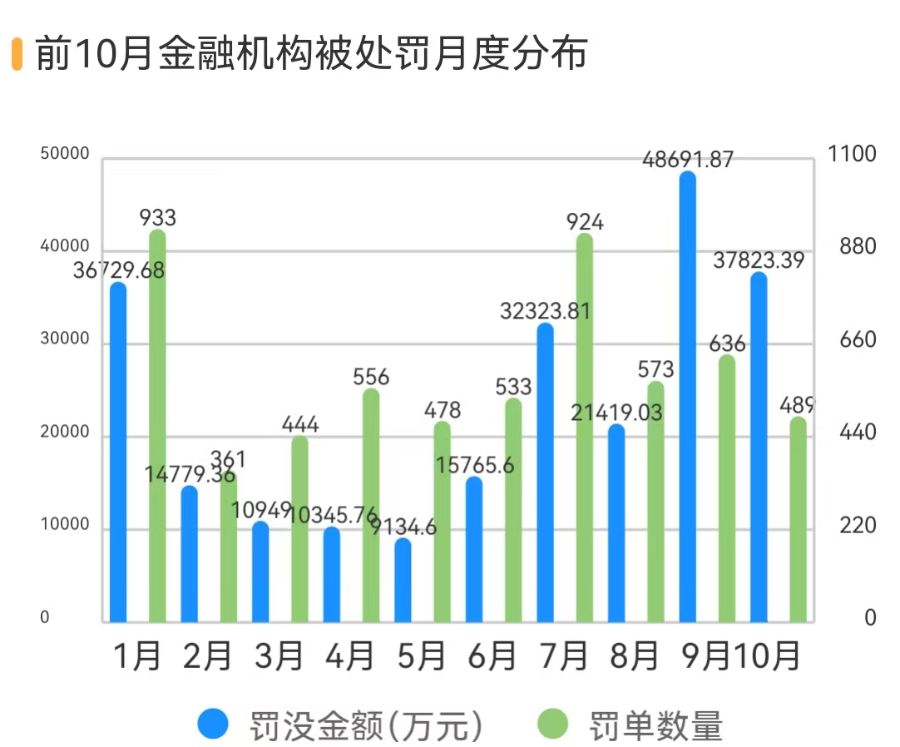
Core Viewpoint - In October, financial institutions received 489 fines, a year-on-year decrease of 2.59%, but the total penalty amount reached 378 million yuan, a significant increase of 223.08% compared to the previous year [2]. Group 1: Penalty Overview - The number of fines in October decreased significantly compared to the first three months of the year, but the total penalty amount remains high, with October being the second highest this year after September [4]. - Regulatory bodies such as the National Financial Supervision Administration, the People's Bank of China, the China Securities Regulatory Commission, and the State Administration of Foreign Exchange all issued fewer fines in October [7]. - Banks received a total of 310 fines, a month-on-month decrease of 24.39%, while insurance companies received 108 fines, down 16.92%, and securities firms received 16 fines, down 42.86% [9]. Group 2: Major Fines - In October, six fines exceeded 10 million yuan, with the largest fine against a bank for issues related to corporate governance, loans, interbank transactions, bills, asset quality, and non-performing asset management [12]. - The largest fine was against the Bank of China, amounting to 97.9 million yuan, for various management failures [13]. - Other significant fines included China Minsheng Bank (28.62 million yuan), Agricultural Bank of China (27.2 million yuan), and Ping An Bank (18.8 million yuan) for similar management issues [14]. Group 3: Compliance Cases - Five Mining Securities was criticized for publishing incorrect coupon rates and issuance results during a bond issuance process, failing to comply with relevant regulations [15][16]. - Tianjin Investment Futures was ordered to rectify its operations due to ineffective risk isolation between its brokerage and proprietary trading businesses, leading to significant losses [17]. - A rare case occurred where the qualification of a bank president was denied due to non-compliance with regulatory requirements, highlighting increased scrutiny on corporate governance in small and medium-sized banks [18]. Group 4: Compliance Characteristics - There was a more than double increase in fines for illegal loan issuance, with 19 fines issued in October, reflecting a year-on-year increase of 111.11% [21]. - Fines related to internal control management also increased, with 32 fines issued in October, a month-on-month increase of 52.38% [23]. Group 5: Penalty Rankings - China Agricultural Development Bank had the highest penalty amount in the third quarter and continued to lead in October [27]. - Zhongcheng Trust received the largest penalty among non-bank institutions in October, with a fine of 6.6 million yuan for various violations [29].
10月6家银行收到超千万罚单 行长任职资格罕见被否
2 1 Shi Ji Jing Ji Bao Dao· 2025-11-05 09:25
Core Insights - In October, financial institutions received 489 fines, a year-on-year decrease of 2.59%, but the total penalty amount reached 378 million yuan, a significant increase of 223.08% compared to the previous year [1][3] Summary by Categories Penalty Overview - The number of fines issued in October decreased compared to the first three months of the year, but the total penalty amount remains substantial, with October being the second highest for penalties this year, following September [1][3] Institution-Specific Penalties - Banks received 310 fines, a month-on-month decrease of 24.39% - Insurance companies received 108 fines, a month-on-month decrease of 16.92% - Securities firms received 16 fines, a month-on-month decrease of 42.86% - Futures and private equity fines also decreased, while insurance asset management companies remained stable compared to the previous month [5] Major Fines - Six fines in October exceeded 10 million yuan, with the largest fines against banks for issues related to corporate governance, loans, interbank transactions, and asset quality management [8][9] Compliance Cases - Five major compliance cases were highlighted, including: 1. Wenkang Securities faced criticism for issuing incorrect bond rates and results due to improper management of the issuance process [10] 2. Jintou Futures was ordered to rectify its operations after significant losses due to ineffective risk management [11] 3. A rare case of a bank president's qualification being denied due to non-compliance with regulatory requirements [13] Compliance Trends - There was a notable increase in penalties for improper loan issuance, with 19 fines issued, reflecting a year-on-year increase of 111.11% [14] - Penalties related to internal control management also rose, with 32 fines issued, a month-on-month increase of 52.38% [15] Penalty Rankings - China Agricultural Development Bank had the highest penalty amount in October, continuing its trend from the third quarter [18] - Zhongcheng Trust received the largest penalty among non-bank institutions, totaling 6.6 million yuan for various compliance violations [21]

港股通央企红利ETF天弘(159281)涨0.00%,成交额6631.78万元
Xin Lang Cai Jing· 2025-11-05 09:08
Core Points - The Tianhong CSI Hong Kong Stock Connect Central State-Owned Enterprises Dividend ETF (159281) closed at a 0.00% change on November 5, with a trading volume of 66.32 million yuan [1] - The fund was established on August 20, 2025, with an annual management fee of 0.50% and a custody fee of 0.10% [1] - As of November 4, the fund's total shares stood at 225 million, with a total size of 231 million yuan [1] - Over the past 20 trading days, the fund's cumulative trading amount reached 1.192 billion yuan, with an average daily trading amount of 59.60 million yuan [1] - The current fund manager is He Yuxuan, who has managed the fund since its inception, achieving a return of 2.46% during the tenure [1] Holdings Summary - The top holdings of the Tianhong CSI Hong Kong Stock Connect Central State-Owned Enterprises Dividend ETF include: - COSCO Shipping Holdings (0.85% holding, 218,000 shares, market value of 2.9175 million yuan) [2] - Orient Overseas International (0.40% holding, 10,500 shares, market value of 1.3717 million yuan) [2] - China Foreign Transport (0.33% holding, 270,000 shares, market value of 1.1396 million yuan) [2] - China National Petroleum (0.32% holding, 162,000 shares, market value of 1.0973 million yuan) [2] - CITIC Bank (0.32% holding, 175,000 shares, market value of 1.1136 million yuan) [2] - CNOOC (0.29% holding, 58,000 shares, market value of 1.0041 million yuan) [2] - China Shenhua Energy (0.29% holding, 30,500 shares, market value of 982,600 yuan) [2] - China People's Insurance Group (0.29% holding, 164,000 shares, market value of 1.0107 million yuan) [2] - China Unicom (0.28% holding, 104,000 shares, market value of 952,800 yuan) [2] - Agricultural Bank of China (0.27% holding, 189,000 shares, market value of 933,900 yuan) [2]


【百强透视】南向资金“爆买”!港股仍获青睐,哪些方向值得看好
Sou Hu Cai Jing· 2025-11-04 23:48
Core Viewpoint - The Hong Kong stock market has shown remarkable resilience and growth in 2025, with the Hang Seng Index increasing over 30% year-to-date as of November 3, 2025, and the Hang Seng Tech Index rising nearly 33%, outperforming the Nasdaq [2][4]. Market Performance - The Hang Seng Index experienced a significant drop of over 13% in early April due to trade tensions but quickly recovered, demonstrating strong market resilience [2]. - As of November 3, 2025, the average daily trading volume for the Hang Seng Index reached a record high of 257.943 billion HKD, the highest since 1969 [2]. - The average daily trading volume for the Hang Seng Tech Index also hit a new high of 79.729 billion HKD since its inception in 2020 [4]. Capital Flows - There has been a substantial inflow of passive overseas funds into the Hong Kong market, with over 26.9 billion USD flowing in since the beginning of the year, doubling compared to the same period last year [6]. - Despite a net outflow of over 9.7 billion USD from active overseas funds, the outflow has slowed significantly, particularly in the second half of the year [6]. - As of September 2025, the proportion of overseas active funds allocated to the Chinese market reached a year-to-date high of 7.2% [6]. Southbound Capital - Southbound capital has significantly contributed to the Hong Kong market, with net purchases through the Stock Connect mechanism reaching nearly 807.9 billion HKD in 2024, a year-on-year increase of over 150% [10]. - By November 3, 2025, the cumulative inflow of southbound capital exceeded 1.26 trillion HKD, setting a new annual record since the Stock Connect's inception [10]. - The daily trading volume of southbound capital has increased from approximately 25% of the main board's trading volume at the end of 2024 to around 30% [10]. Sector Performance - The financial sector has been the primary beneficiary of southbound capital inflows, with technology and energy sectors also performing strongly [13]. - Notable stocks such as Tencent Holdings, Agricultural Bank of China, and Alibaba have seen significant price increases, with Tencent rising over 52% and Alibaba soaring 96% year-to-date [14]. Future Outlook - Analysts remain cautiously optimistic about the Hong Kong market, with expectations of continued inflows and a favorable environment for sectors like renewable energy, innovative pharmaceuticals, and AI technology [15][16]. - The valuation of Hong Kong stocks is considered attractive compared to global peers, providing potential for further upward movement [16]. - The upcoming "Hong Kong 100 Strong" selection will focus on companies in cutting-edge fields such as 5G, innovative pharmaceuticals, and artificial intelligence, reflecting current industry trends [17].