
AGRICULTURAL BANK OF CHINA(01288)

Search documents
有广度、有厚度、有温度!农行平顶山分行多维发力托起幸福“夕阳红”
Sou Hu Cai Jing· 2025-09-04 04:47
Core Viewpoint - The development of pension finance is a crucial measure to actively respond to population aging and enhance the accessibility of pension services, with Agricultural Bank of China Pingdingshan Branch focusing on creating a distinctive pension finance bank that enhances financial accessibility and satisfaction for the elderly [1]. Group 1: Comprehensive Pension Financial System - The company is constructing a comprehensive pension financial system by focusing on the "three pillars" and actively engaging with relevant departments to optimize the "social bank direct connection" system [1]. - It aims to improve the full-process service of pension insurance funds, deepen cooperation in annuity business, and provide a range of products and services for corporate employees' pension security [1]. - The company is dynamically optimizing personal pension service plans and promoting exclusive financial products to expand the third pillar of pension security [1]. Group 2: Wealth Management and Product Supply - The company emphasizes wealth management by building an open, full-category wealth management product shelf that balances asset liquidity and yield [2]. - It is enhancing the promotion of insurance trust and family trust services for pension asset management, preservation, and inheritance [2]. - The introduction of home decoration installment services for elderly families aims to improve their living environment with differentiated fee rate discounts [2]. Group 3: Elderly-Friendly Services - The company is advancing "elderly-friendly renovations" to enhance service experiences at its branches, creating benchmark branches for elderly-friendly services [2]. - It is implementing a "three-in-one" service model that includes in-branch, door-to-door, and online services, ensuring a comprehensive approach to customer service [3]. - The company is developing a large-font mobile banking version to meet the digital financial needs of elderly customers [3].

中期分红队伍持续壮大
Jin Rong Shi Bao· 2025-09-04 03:03
Core Viewpoint - The recent announcements of interim dividend plans by A-share listed banks highlight a trend towards increased shareholder returns, with a total proposed dividend amount exceeding 200 billion yuan from major state-owned banks and several joint-stock banks [1][4]. Group 1: State-Owned Banks - Six major state-owned banks have announced their interim dividend plans for 2025, with a total proposed dividend amount exceeding 200 billion yuan [1]. - Industrial and Commercial Bank of China leads with a proposed dividend of 1.414 yuan per 10 shares, totaling 503.96 billion yuan [1]. - Other state-owned banks, including Agricultural Bank of China, Bank of China, China Construction Bank, Bank of Communications, and Postal Savings Bank, have proposed dividends of 418.23 billion yuan, 352.50 billion yuan, 486.05 billion yuan, 138.11 billion yuan, and 147.72 billion yuan respectively [1]. Group 2: Joint-Stock Banks - Several joint-stock banks, including China Merchants Bank, CITIC Bank, Minsheng Bank, Ping An Bank, and Huaxia Bank, have confirmed their interim dividend plans for 2025 [1][2]. - China Merchants Bank announced its first interim profit distribution plan since its listing, with a cash dividend amounting to 35% of its net profit attributable to ordinary shareholders for the first half of 2025 [1][2]. - CITIC Bank plans to increase its interim dividend payout ratio to 30.7%, enhancing investor return expectations [2]. Group 3: New Participants in Interim Dividends - New entrants to the interim dividend group include Ningbo Bank, Changsha Bank, Su Nong Bank, and Jiangyin Bank, indicating a growing trend among listed banks to adopt interim dividends [2][4]. - Su Nong Bank announced its first interim dividend plan, proposing a cash dividend of 0.9 yuan per 10 shares, totaling 1.82 billion yuan [2][3]. Group 4: Overall Market Trends - A total of 23 A-share listed banks implemented interim dividends in 2024, distributing over 250 billion yuan, with the number of banks participating expected to increase in 2025 [4]. - The push for interim dividends is seen as a response to regulatory guidance aimed at enhancing shareholder returns and stabilizing market expectations [5].


商业银行“降成本”举措显效
Jin Rong Shi Bao· 2025-09-04 03:03
Core Insights - Major commercial banks in China have shown solid performance in managing costs and optimizing asset-liability structures, contributing to stable growth in operating results [1][4] - In the first half of 2025, 42 A-share listed banks achieved operating income exceeding 2.9 trillion yuan, a year-on-year increase of over 1%, and a net profit of 1.1 trillion yuan, up 0.8% year-on-year [1] - Several banks, including Industrial and Commercial Bank of China (ICBC), Agricultural Bank of China (ABC), China Construction Bank (CCB), and Postal Savings Bank of China (PSBC), reported net profits exceeding 100 billion yuan [1] Cost Management - Construction Bank reported a cost-to-income ratio of 23.72%, a decrease of 0.43 percentage points year-on-year, highlighting effective cost management [1] - PSBC achieved a significant reduction in its cost-to-income ratio by 5.15 percentage points through various cost control measures [1] - Bank of China reported a cost-to-income ratio of 25.11%, emphasizing its focus on reducing costs and improving efficiency [2] Asset-Liability Management - Agricultural Bank of China has focused on controlling key expenses and reducing flexible costs to save on expenditures [3] - Several banks, including ICBC and CCB, have successfully lowered their deposit interest rates, with ICBC's rate decreasing by 26 basis points and CCB's by 32 basis points [4] - Postal Savings Bank's self-operated deposit interest rate fell by 20 basis points to around 1.1%, indicating a trend of decreasing funding costs [4] Revenue Generation - Shanghai Pudong Development Bank reported a cost reduction of over 140 million yuan through effective management of rental costs and the disposal of idle properties [3] - China Everbright Bank has focused on optimizing its funding costs and increasing high-quality deposits, leading to stable profit growth [5][6] - Zhejiang Merchants Bank saw its deposit interest rate decrease by 31 basis points to 1.88%, while its total deposits grew by 7.47% year-on-year [4]

A股上市银行成绩单亮眼
2 1 Shi Ji Jing Ji Bao Dao· 2025-09-03 22:06
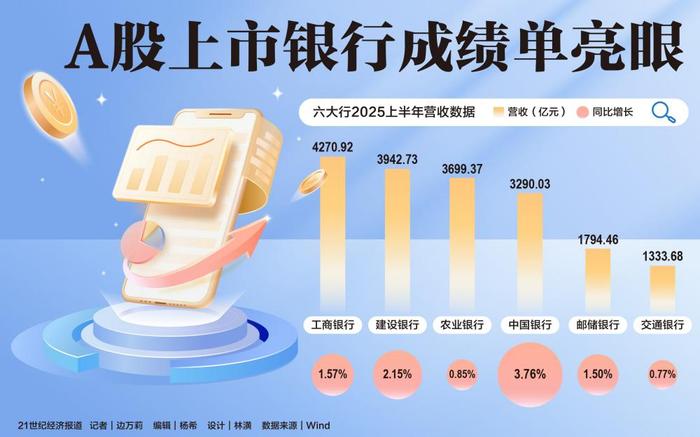
Core Insights - The banking sector in A-shares has shown resilience with a total revenue of 2.92 trillion yuan and a net profit of 1.1 trillion yuan for the first half of 2025, reflecting a year-on-year growth of 1% and 0.8% respectively [1][3] - The non-performing loan (NPL) ratio stands at 1.15%, indicating a slight improvement from the previous quarter [1][10] - The number of banks distributing mid-year dividends has increased to 18, with over half of them maintaining a dividend payout ratio of 30% or more [1][11] Revenue and Profit Growth - A-shares listed banks achieved a total revenue of 2.92 trillion yuan, marking a 1% increase year-on-year, while net profit reached 1.1 trillion yuan, up 0.8% [3][4] - Among the major banks, Industrial and Commercial Bank of China (ICBC) led with a revenue of 4270.92 billion yuan, showing a growth of 1.57% [3] - 30 out of 42 listed banks reported positive revenue growth, with 12 banks showing a reduced decline in revenue growth rates [3][4] Asset Quality and Loan Growth - The total assets of A-shares listed banks reached 321.33 trillion yuan, a 6.35% increase from the previous year [8] - Loans and advances amounted to 179.44 trillion yuan, reflecting an increase of approximately 13.4 trillion yuan or 8.07% [8][9] - The NPL ratio decreased by 1 basis point, with 25 banks showing a year-on-year decline in NPL ratios [10] Diversification of Income Sources - Non-interest income grew by 6.97% year-on-year, with significant contributions from investment income, which increased by 23.46% [6][7] - Banks are shifting towards a more diversified income structure, reducing reliance on traditional interest margins [6][7] - For instance, the non-interest income of China Bank surged by 26.43%, becoming a key driver of revenue growth [6] Dividend Distribution - The total cash dividends from the six major state-owned banks reached 2046.57 billion yuan, with ICBC leading at approximately 503.96 billion yuan [11][12] - Several banks, including China Merchants Bank and Jiangyin Bank, implemented mid-year dividends for the first time [11][12] - The dividend payout ratios for banks such as Shanghai Bank and CITIC Bank have also seen increases, reflecting strong performance [11][12]

A股近六成上市银行上半年中间业务收入同比增长
Zheng Quan Ri Bao Zhi Sheng· 2025-09-03 16:40
Core Viewpoint - The intermediary business income of A-share listed banks in China has shown improvement in the first half of 2025, becoming a crucial area for banks to transform and develop amid narrowing net interest margins [1][4]. Group 1: Overall Performance - In the first half of 2025, the total net income from fees and commissions of 42 listed banks reached 409.53 billion yuan, an increase of 3.06% compared to the same period last year [1]. - Out of the 42 listed banks, 25 reported positive growth in net income from fees and commissions, with three banks experiencing growth rates exceeding 100% and nine banks exceeding 10% [2]. Group 2: Performance by Bank Type - Among the six major state-owned banks, Bank of China and China Construction Bank both saw their fee and commission income grow by over 4%, while Agricultural Bank of China and Postal Savings Bank of China reported growth exceeding 10% [2]. - In the joint-stock banks category, four out of nine banks reported positive growth in net income from fees and commissions, with CITIC Bank achieving 16.91 billion yuan (up 3.38%), Industrial Bank at 13.08 billion yuan (up 2.59%), Huaxia Bank at 3.10 billion yuan (up 2.55%), and Minsheng Bank at 9.69 billion yuan (up 0.41%) [2]. Group 3: Notable Performers - Some city commercial banks and rural commercial banks exhibited significant growth in their fee and commission income, with Changshu Bank reporting a remarkable increase of 637.77% to 142 million yuan, followed by Ruifeng Bank with a 274.07% increase to 54 million yuan, and Zhangjiagang Bank with a 140% increase to 61 million yuan [3]. Group 4: Future Outlook - Analysts predict that the growth trend in intermediary business income is likely to continue in the second half of 2025, driven by supportive macroeconomic policies and increasing demand for high-yield products among residents [4]. - The focus for banks will be on expanding non-interest income, particularly in wealth management and other light-capital businesses, to optimize their income structure [4][6].


上市银行大洗牌
Sou Hu Cai Jing· 2025-09-03 16:19
Group 1 - The number of listed banks in China has decreased from 60 to 57, with Jinzhou Bank, Jiutai Rural Commercial Bank, and Shengjing Bank announcing their exit from the market [3] - As of June 30, 2025, Agricultural Bank of China remains the second-largest bank in China with total assets of 46.86 trillion, surpassing China Construction Bank's 44.43 trillion [5] - Jiangsu Bank and Ningbo Bank have risen to the 1st and 3rd positions among city commercial banks, with total assets of 4.79 trillion and 3.47 trillion respectively, overtaking Beijing Bank and Shanghai Bank [7] Group 2 - Eight banks have achieved a total asset growth rate exceeding 10%, with Jiangsu Bank leading at an impressive 21.16% [9] - 32 banks have a total asset growth rate below 5%, indicating a slowdown in growth for many institutions [10] - Two banks, Bohai Bank and Minsheng Bank, are in a shrinking state, with total assets decreasing by 1.09% and 0.59% respectively [11] Group 3 - Nine banks have achieved double-digit loan growth, with Xi'an Bank leading at 22.75% [13] - Twelve banks have also seen double-digit growth in financial investments, with Jiangsu Bank again at the top with 23.38% [13] - The competitive landscape among city commercial banks is intensifying, with frequent changes in the rankings of the top 10 banks [14]



中银增长混合A:2025年上半年利润1438.13万元 净值增长率1.21%
Sou Hu Cai Jing· 2025-09-03 14:55
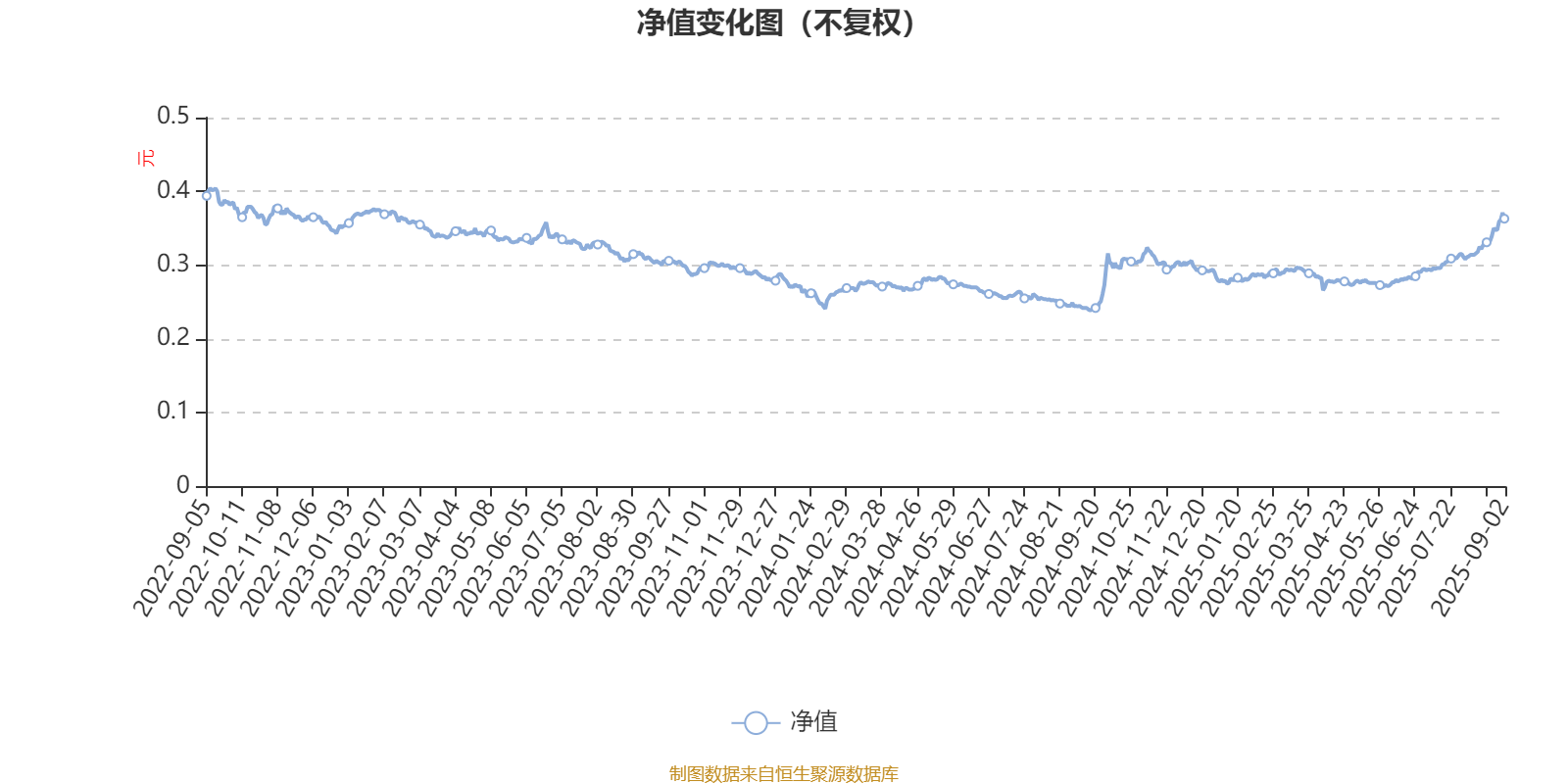
Core Viewpoint - The AI Fund Zhongyin Growth Mixed A (163803) reported a profit of 14.38 million yuan for the first half of 2025, with a weighted average profit per fund share of 0.0032 yuan, and a net asset value growth rate of 1.21% during the same period [2]. Fund Performance - As of September 2, the fund's unit net value was 0.363 yuan, with a fund size of 1.306 billion yuan [2][32]. - The fund's performance over different time frames includes a three-month net value growth rate of 33.62%, a six-month growth rate of 26.14%, a one-year growth rate of 48.49%, and a three-year growth rate of -7.14% [6][28]. Market Outlook - The fund manager anticipates that U.S. economic policies under Trump will stabilize, leading to a weakening economy but avoiding recession, with monetary easing expected to continue [2]. - Domestically, the fund expects to meet annual growth targets, with a focus on improving the quality of growth through structural adjustments and risk prevention [2]. Investment Strategy - The fund remains optimistic about market conditions, driven by factors such as lower risk-free rates and increased equity asset allocation by residents and non-bank institutions [3]. - Key sectors of interest include AI and innovative pharmaceuticals, as well as liquidity-driven sectors like non-bank financials and small-cap stocks [3]. Valuation Metrics - As of June 30, 2025, the fund's weighted average price-to-earnings (P/E) ratio was approximately 16.32, significantly lower than the industry average of 29.05 [12]. - The weighted average price-to-book (P/B) ratio was about 1.81, compared to the industry average of 2.22 [12]. Shareholder Composition - As of June 30, 2025, the fund had 75,000 shareholders holding a total of 4.447 billion shares, with individual investors comprising 100% of the ownership [35].



金融中报观|银行零售业务梯队格局背后,谁在领跑,谁在补课
Bei Jing Shang Bao· 2025-09-03 14:17
Core Insights - The competitive landscape of retail banking in A-shares is becoming clearer as the 2025 mid-year reports are disclosed, revealing a distinct tiered structure in retail AUM (Assets Under Management) [1][2] - The first tier consists of major state-owned banks and China Merchants Bank, all exceeding 16 trillion yuan in retail AUM, while the second tier includes joint-stock banks and some leading city commercial banks [1][2] - The retail business performance is mixed, with many banks facing pressure on retail revenue and net profit, highlighting a structural issue of profit growth without revenue increase [1][6] Tiered Structure of Retail AUM - The first tier banks, including Industrial and Commercial Bank of China (ICBC) and Agricultural Bank of China (ABC), lead with AUM exceeding 16 trillion yuan, with ICBC at over 24 trillion yuan and ABC at 23.68 trillion yuan [2][3] - China Construction Bank (CCB) and Postal Savings Bank of China also show strong performance, with CCB managing over 22 trillion yuan and Postal Savings Bank at 17.67 trillion yuan [2] - China Merchants Bank, known as the "king of retail," has a retail AUM of 16.03 trillion yuan, reflecting a 7.39% increase from the previous year [2] Second Tier Performance - The second tier banks have retail AUM ranging from 1 trillion to 6 trillion yuan, with notable growth from banks like Bank of Communications at 5.79 trillion yuan and Industrial Bank at 5.52 trillion yuan [3] - Joint-stock banks are active in this tier, with CITIC Bank and Shanghai Pudong Development Bank also showing significant growth in retail AUM [3] Third Tier Characteristics - The third tier banks have retail AUM mostly below 1 trillion yuan, with Nanjing Bank and Shanghai Rural Commercial Bank showing notable growth rates of 14.25% and 3.99% respectively [4] - Regional banks are leveraging local advantages to deepen market penetration, but face challenges in competing with larger banks [5] Retail Profitability Challenges - The retail banking sector is undergoing significant adjustments, with a shift in customer demand towards diversified financial solutions, which raises the bar for product innovation and service customization [6] - Leading banks like ICBC and China Merchants Bank are showing resilience, with ICBC's net profit rising by 46.05% despite a slight revenue decline [6][7] - However, some banks, including ABC and Ping An Bank, are experiencing declines in both revenue and net profit, indicating a challenging environment [7] Asset Quality Concerns - The retail banking sector is facing challenges in asset quality, particularly in personal loans, with rising non-performing loan (NPL) ratios reported by several banks [9][10] - For instance, China Merchants Bank's retail loan NPL ratio increased to 1.04%, while Chongqing Rural Commercial Bank's rose to 2.04% [9] - Some banks, like Ping An Bank and Industrial Bank, have managed to improve their asset quality through refined risk management practices [10] Strategic Recommendations - Analysts suggest that banks, especially smaller ones, should focus on enhancing their support for small and micro enterprises and optimizing financial resource allocation to uncover new growth points [8] - There is a call for banks to improve their digital capabilities and customer experience to better compete with larger institutions [8]


半年新增15万高净值客户 私人银行成中收增长动力
2 1 Shi Ji Jing Ji Bao Dao· 2025-09-03 11:10
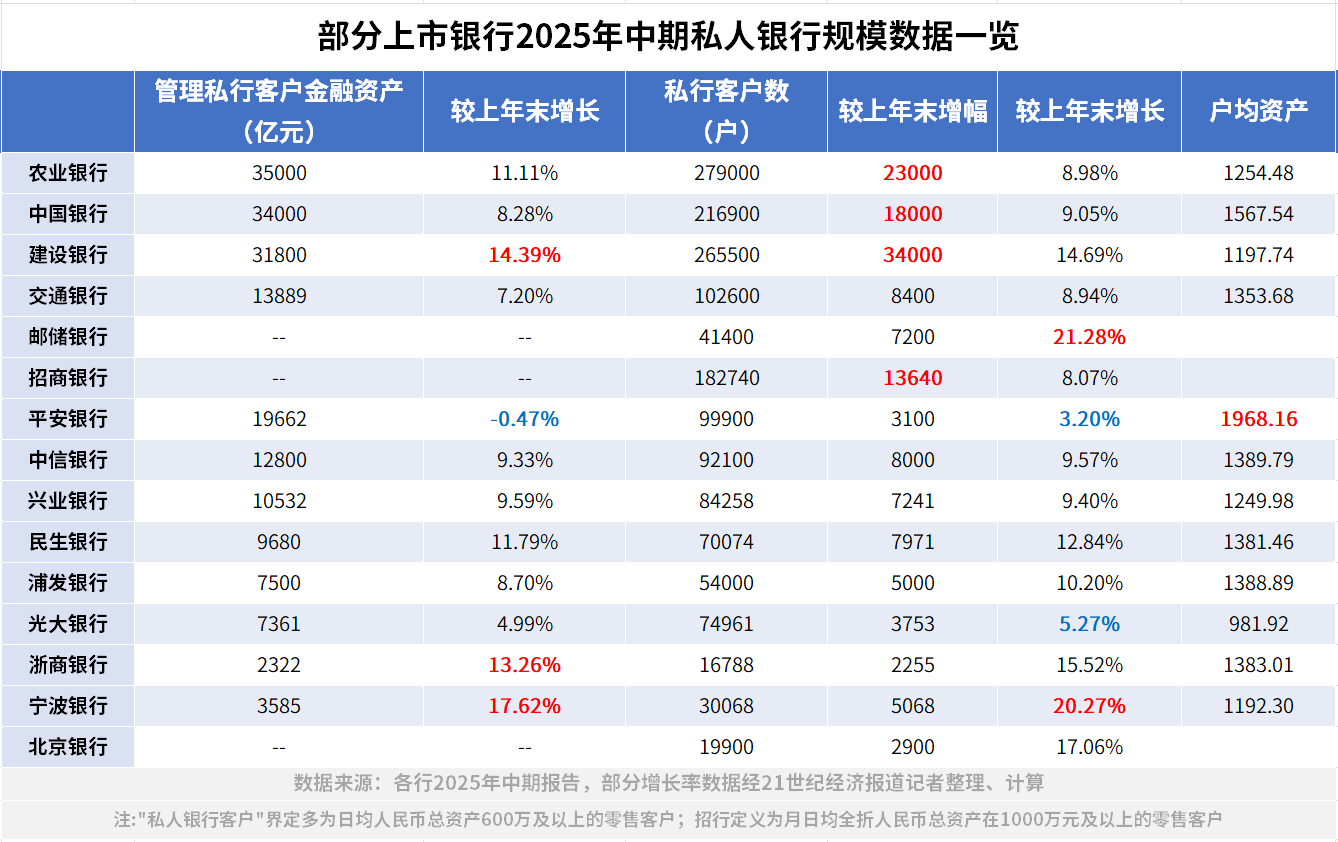
Core Insights - The private banking sector has shown robust growth in the first half of 2025, with many banks reporting double-digit increases in both client numbers and assets under management (AUM) despite a complex economic environment [1][2][5] - The total number of private banking clients across 15 banks exceeded 1.63 million, with an increase of nearly 150,000 clients, reflecting a growth rate of over 10% [1] - Major banks like Agricultural Bank and China Bank have maintained significant AUM, with Agricultural Bank reaching 3.5 trillion yuan, marking an 11.11% increase year-on-year [2][4] Private Banking Growth - The private banking industry is experiencing steady expansion, with major banks leading the market due to their strong client bases and resource networks [2][5] - Agricultural Bank's AUM reached 3.5 trillion yuan, with a client increase of 23,000 to 279,000, while China Bank followed closely with 3.4 trillion yuan AUM and 216,900 clients [2][4] - Construction Bank reported a 14.39% increase in AUM, reaching 3.18 trillion yuan, and a 14.69% rise in client numbers [2][4] Client Quality and Asset Management - Despite the growth in client numbers and AUM, average assets per client have generally declined, indicating a shift from rapid expansion to a focus on deeper client engagement [5][6] - Only Agricultural Bank and Industrial Bank reported increases in average client assets, while other banks experienced varying degrees of decline [5] Strategic Focus Areas - Banks are increasingly focusing on high-net-worth clients, family trusts, retirement finance, and enhancing private banking centers to differentiate themselves in a competitive market [1][6][8] - For instance, Citic Bank is enhancing its services for ultra-high-net-worth clients, while Everbright Bank is targeting family-oriented and female clients [7][8] Family Trusts and Lifecycle Services - Family trusts have become a key area for private banking, with significant growth reported in this segment; Everbright Bank's family trust assets grew by 56.12% year-on-year [8] - Agricultural Bank has launched a retirement finance management center, adding 12,000 clients and managing 1.3 trillion yuan in assets [8] Private Banking Centers and Revenue Generation - The establishment of private banking centers has accelerated, with Construction Bank setting up 248 centers and China Bank 205 centers, contributing to improved client retention and AUM [9][10] - Private banking is increasingly driving middle-income revenue, with Beijing Bank reporting a 16.89% increase in product sales, boosting its middle-income revenue by 17.77% [10]
半年新增15万高净值客户,私人银行成中收增长动力
2 1 Shi Ji Jing Ji Bao Dao· 2025-09-03 11:01
Core Insights - The private banking sector has shown robust growth in the first half of 2025, with many banks reporting double-digit increases in both client numbers and assets under management (AUM) despite a complex economic environment [1][2][5] - The total number of private banking clients across 15 banks exceeded 1.63 million, with an increase of nearly 150,000 clients, reflecting a growth rate of over 10% [1] - Major banks like Agricultural Bank and China Bank have AUM exceeding 3 trillion yuan, while Industrial Bank has crossed the 1 trillion yuan mark for the first time [1][4] Client and AUM Growth - Agricultural Bank's AUM reached 3.5 trillion yuan, growing by 11.11%, with client numbers increasing by 23,000 to 279,000 [2][4] - China Bank's AUM stood at 3.4 trillion yuan with 216,900 clients, while Construction Bank reported a 14.39% increase in AUM, reaching 3.18 trillion yuan and 265,500 clients [2][4] - The overall expansion of private banking clients and AUM indicates a strong performance among large banks, which continue to dominate the market [2][5] Performance of Listed Banks - Among listed banks, the performance varied, with some banks like Ping An Bank experiencing a slight decline in AUM by 0.47% [4] - Industrial Bank reported a significant increase in private banking clients, reaching 92,100, with AUM at 1.28 trillion yuan [5] - Regional banks like Ningbo Bank and Beijing Bank also showed impressive growth, with Ningbo Bank's AUM increasing by 17.62% [5][4] Focus on High-Net-Worth Clients - The industry is shifting from rapid expansion to a more refined approach, focusing on high-net-worth clients and family trusts [1][8] - Banks are implementing differentiated services for ultra-high-net-worth clients, with some banks reporting a 40.96% increase in such clients [8][9] - Family trusts have become a key area of development, with banks like Everbright Bank and China Bank reporting significant growth in this segment [9] Wealth Management and Revenue Growth - Private banking is increasingly contributing to banks' middle-income revenue, with Beijing Bank reporting a 16.89% increase in product sales, boosting its middle-income revenue by 17.77% [10] - Construction Bank noted that over 60% of its fee income comes from wealth management and related services, indicating a strategic focus on enhancing its advisory capabilities [11] - The establishment of private banking centers is accelerating, with banks like Construction Bank and China Bank expanding their networks to improve client retention and service quality [10]
