AGRICULTURAL BANK OF CHINA(01288)

Search documents
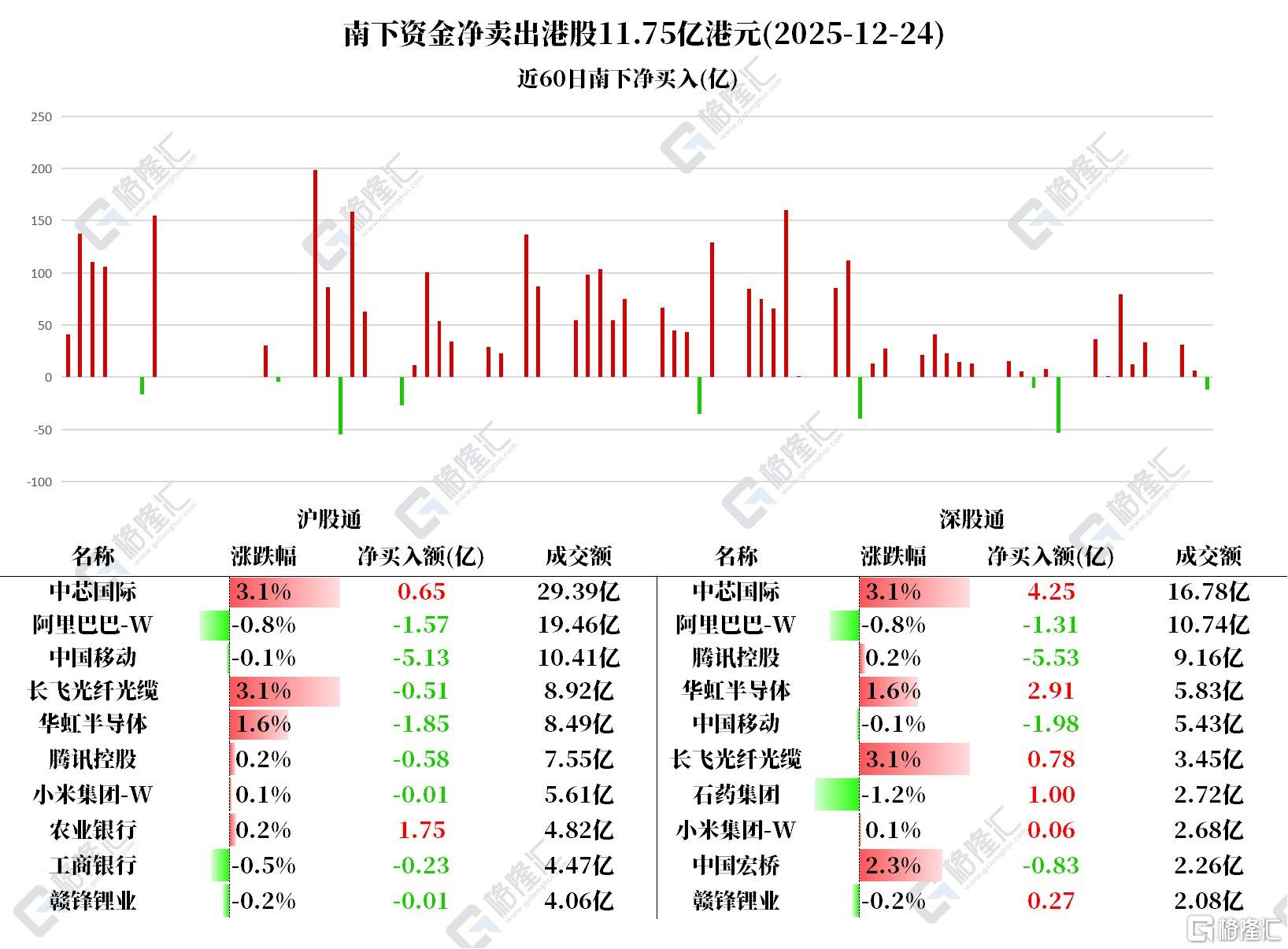
资金动向 | 北水抛售港股近12亿港元,加仓中芯国际、农业银行
Ge Long Hui· 2025-12-24 11:49
Group 1 - Semiconductor company SMIC has implemented a price increase of approximately 10% on certain production capacities due to rising demand from mobile applications and AI, as well as increased raw material costs [4] - Agricultural Bank is expected to see a narrowing of net interest margin to around 4 basis points by 2026, marking the first annual decline in single digits since 2022, which may lead to improved revenue and net profit growth for listed banks [4] - Pharmaceutical company Stone Pharmaceutical has received approval from the National Medical Products Administration of China to conduct clinical trials for its drug Daratumumab injection [4] Group 2 - Tencent Holdings will hold a board meeting on March 18, 2026, to approve the annual performance for the year ending December 31, 2025, and consider the distribution of a final dividend, if any [5] Group 3 - Recent trading data shows net buying of SMIC at 490 million, Agricultural Bank at 174 million, and Stone Pharmaceutical at 100 million, while net selling of China Mobile reached 710 million, Tencent Holdings at 611 million, and Alibaba-W at 288 million [1][3]


Ping An Asset Management Co., Ltd.增持农业银行4405万股 每股作价约5.49港元
Zhi Tong Cai Jing· 2025-12-24 11:47
Group 1 - Ping An Asset Management Co., Ltd. increased its stake in Agricultural Bank of China (601288) by acquiring 44.05 million shares at a price of HKD 5.4892 per share, totaling approximately HKD 242 million [1] - Following the acquisition, the total number of shares held by Ping An Asset Management is approximately 7.69 billion, representing a holding percentage of 25.01% [1]
Ping An Asset Management Co., Ltd.增持农业银行(01288)4405万股 每股作价约5.49港元
智通财经网· 2025-12-24 11:42
Core Viewpoint - Ping An Asset Management Co., Ltd. has increased its stake in Agricultural Bank of China (stock code: 01288) by acquiring 44.05 million shares at a price of HKD 5.4892 per share, totaling approximately HKD 242 million, resulting in a new holding of about 7.69 billion shares, which represents 25.01% of the bank's total shares [1] Summary by Category - **Investment Activity** - Ping An Asset Management has purchased an additional 44.05 million shares of Agricultural Bank of China [1] - The acquisition price was set at HKD 5.4892 per share, leading to a total investment of around HKD 242 million [1] - **Shareholding Structure** - Following this transaction, Ping An's total shareholding in Agricultural Bank of China has reached approximately 7.69 billion shares [1] - The new shareholding percentage stands at 25.01% of the bank's total shares [1]
农行新质行首站启航,走进广东看金融赋能“智耕智造”
新浪财经· 2025-12-24 11:16
Group 1 - The article highlights the transformation of production through new productive forces, showcasing how technology, such as drones in agriculture and robots in manufacturing, is reshaping the landscape of production [2] - The first episode of "Sailing China: Agricultural Bank's New Quality Journey" features insights from Guangzhou XAG Technology's unmanned farms and Shunde Jiateng Robotics' intelligent workshops, illustrating the shift from "one person managing thousands of acres" to reality and enabling materials to "run autonomously" [2] - Agricultural Bank of China has transitioned from being a "funding supporter" to an "industry builder," providing financial support ranging from 200 million yuan in R&D credit to 30 million yuan in credit support, along with customized agricultural machinery installment plans and comprehensive technology financial services [2]

智通港股通活跃成交|12月24日
智通财经网· 2025-12-24 11:01
Group 1 - On December 24, 2025, SMIC (00981), Alibaba-W (09988), and China Mobile (00941) were the top three companies by trading volume in the Southbound Stock Connect, with transaction amounts of 2.939 billion, 1.946 billion, and 1.041 billion respectively [1][2] - In the Shenzhen-Hong Kong Stock Connect, SMIC (00981), Alibaba-W (09988), and Tencent Holdings (00700) also ranked as the top three companies by trading volume, with transaction amounts of 1.678 billion, 1.074 billion, and 0.916 billion respectively [1][2] Group 2 - In the Southbound Stock Connect, the top ten active trading companies included SMIC (00981) with a net buying amount of 65.43 million, while Alibaba-W (09988) and China Mobile (00941) had net selling amounts of 1.57 billion and 513 million respectively [2] - In the Shenzhen-Hong Kong Stock Connect, SMIC (00981) had a net buying amount of 425 million, while Alibaba-W (09988) and Tencent Holdings (00700) recorded net selling amounts of 1.31 billion and 553 million respectively [2]
南向资金 | 中国移动遭净卖出7.11亿港元




Di Yi Cai Jing· 2025-12-24 09:49
南向资金今日净卖出11.75亿港元,中国移动、腾讯控股、阿里巴巴-W分别遭净卖出7.11亿港元、6.11亿 港元、2.88亿港元。净买入方面,中芯国际、农业银行、华虹半导体净买入额位列前三,分别获净买入 4.91亿港元、1.75亿港元、1.06亿港元。 (本文来自第一财经) ...
个人信用修复“免申即享”落地 多家国有大行火速响应
2 1 Shi Ji Jing Ji Bao Dao· 2025-12-24 08:08
Core Viewpoint - The People's Bank of China has introduced a new policy for one-time credit repair, allowing eligible individuals to have their overdue information not displayed in the financial credit information database, marking a shift towards a dual focus on both punishment and repair in the credit system [1][15] Group 1: Policy Overview - The policy, effective from December 22, 2025, features an "automatic enjoyment" mechanism, significantly lowering the barriers and operational costs for credit repair [2][16] - It covers various personal credit products, including mortgages, consumer loans, and credit cards, without requiring individuals to apply actively [1][15][19] - Eligible overdue information must meet three criteria: it must have occurred between January 1, 2020, and December 31, 2025, the overdue amount must not exceed 10,000 RMB, and the debt must be fully repaid by March 31, 2026 [5][20] Group 2: Implementation by Banks - Major state-owned banks, including ICBC, ABC, CCB, BOC, and others, quickly responded to the policy by optimizing service measures to ensure effective implementation [7][21] - Banks have enhanced their systems for credit report inquiries and established risk monitoring mechanisms to facilitate the policy's rollout [21][22] - Specific channels for customer inquiries and corrections have been set up by various banks to ensure quick responses to any issues [22] Group 3: Clarification on Debt Repayment - Full repayment of overdue debts requires borrowers to settle both historical overdue amounts and current monthly payments [24][25] - Banks emphasize the importance of confirming the final repayment amount with financial institutions to avoid issues with policy eligibility [25] Group 4: Balancing Rights and Risk - The new policy aims to balance individual rights protection with financial risk prevention, encouraging overdue borrowers to repay their debts and helping banks recover non-performing assets [12][26] - The policy is seen as a significant opportunity for banks to enhance their service quality and better assess borrowers' creditworthiness [27] Group 5: Economic Impact - The credit repair policy is expected to stimulate demand for personal credit products, potentially boosting the lending market [13][27] - However, the overall improvement in credit demand will require support from fiscal and real estate policies due to the current economic environment [14][27] Group 6: Distinction from Debt Forgiveness - The credit repair policy is distinct from debt forgiveness, as it requires full repayment of overdue loans before any credit record corrections are made [28]


陈昌柱:我所经历的二十载信贷之路
Jing Ji Guan Cha Wang· 2025-12-24 06:11
Core Insights - The article reflects on the evolution of China's banking sector and economic landscape over the past 25 years, highlighting the shift in credit allocation from traditional sectors to emerging industries and infrastructure projects. Group 1: Historical Context - In 2005, the Chinese economy was in a stable growth phase, coinciding with the career start of a banking professional who witnessed significant economic events, including the 2008 financial crisis and subsequent policy responses [1][2]. - The 2008 financial crisis led to a drastic reduction in orders for export-oriented manufacturing firms, with some experiencing order declines of over 50% [3]. - The Chinese government introduced a 4 trillion yuan stimulus package in late 2008 to stabilize the economy, prompting banks to shift from a cautious lending approach to a more accommodative one [4]. Group 2: Credit Policy Shifts - Post-crisis, banks significantly increased credit availability, focusing on infrastructure and manufacturing, with loan approval processes becoming more efficient [5][6]. - The real estate sector experienced a rapid recovery due to the stimulus measures, with sales rebounding sharply by March 2009 [7]. - By 2010, the real estate market was subject to tightening regulations to mitigate risks, leading banks to prioritize projects that met specific housing demand criteria [8]. Group 3: Structural Adjustments - The supply-side structural reform initiated in 2016 aimed to address overcapacity in traditional industries, leading to a reevaluation of credit policies and a focus on supporting viable enterprises [12][13]. - The banking sector began to actively support high-potential industries, including technology and high-end manufacturing, as part of the new development strategy [15]. - Innovative financial products, such as unsecured loans for tech startups, were introduced to meet the unique needs of emerging industries [14]. Group 4: Future Directions - The emphasis on high-quality development has led banks to align their lending strategies with national priorities, focusing on strategic emerging industries and infrastructure projects [2][15]. - Continuous research into industry trends and policies is deemed essential for banks to effectively allocate financial resources and support economic transformation [15].

农业银行取得表空间存储容量估算方法专利
Sou Hu Cai Jing· 2025-12-24 00:54
Group 1 - The core point of the article is that Agricultural Bank of China has obtained a patent for a method and device for estimating storage capacity in a database, with the patent granted under announcement number CN114579575B and the application date being March 2022 [1] - Agricultural Bank of China was established in 1986 and is located in Beijing, primarily engaged in monetary financial services [1] - The registered capital of Agricultural Bank of China is approximately 34.998 billion RMB [1] Group 2 - According to data analysis from Tianyancha, Agricultural Bank of China has invested in 16 enterprises and participated in 5,000 bidding projects [1] - The bank holds 1,308 trademark registrations and 5,000 patent records, along with 119 administrative licenses [1]
扛稳中央企业责任 更好服务河南发展——习近平对中央企业工作作出的重要指示在驻豫央企中引发热烈反响
He Nan Ri Bao· 2025-12-24 00:00
Group 1 - Central enterprises in Henan province express strong commitment to align with President Xi Jinping's directives, focusing on enhancing core functions and competitiveness to contribute to local development and modernization efforts [1][2][3] - China Unicom's Henan branch aims to leverage its advantages in technology and innovation, particularly in AI and low-altitude economy, to support the province's economic goals and establish itself as a world-class technology service provider [1] - Agricultural Bank of China emphasizes its role in supporting high-quality development in Henan, focusing on modern agriculture, ecological protection, urban construction, and inclusive finance to enhance social welfare [2] Group 2 - Sinopec's Henan branch plans to utilize its industry chain advantages and energy supply capabilities to transition towards a comprehensive energy service provider, focusing on oil, gas, and new energy [3] - China Yituo, a key player in the agricultural machinery industry, commits to advancing core technology and high-end intelligent agricultural equipment to ensure national food security during the 14th Five-Year Plan [4] - Companies like Xuchang Transformer and China Railway Engineering Equipment are dedicated to technological innovation and international market expansion, aiming to enhance their product quality and global competitiveness in their respective fields [4]