
AGRICULTURAL BANK OF CHINA(01288)

Search documents
探寻利率方向(5):为何市场不谈论“资产荒”了?
GF SECURITIES· 2025-12-14 14:29
Investment Rating - The report assigns a "Buy" rating for the banking sector, indicating an expected performance that will exceed the market by more than 10% over the next 12 months [41]. Core Insights - The report discusses the concept of "asset scarcity," which is explained through two perspectives: the mismatch between supply and demand for funds, and the insufficient supply of quality assets that meet investors' risk and return preferences. It argues that the traditional supply-demand imbalance does not adequately explain the phenomenon of asset scarcity [5][13]. - The report identifies three dimensions of asset scarcity: macro, meso, and micro. It emphasizes that the bond market is primarily concerned with the micro-level aspects of asset scarcity [5][16]. - To alleviate macro-level asset scarcity, the report suggests increasing credit issuance and fiscal efforts, enhancing liquidity management by the central bank, and guiding non-bank funds back to banks to lower residents' yield expectations on non-bank assets [20][23]. - At the meso level, the report highlights the importance of fiscal and monetary growth rates, suggesting that credit and fiscal efforts should be strengthened while avoiding capital idling [23][24]. - The micro-level analysis focuses on the expectations of institutions regarding asset-liability expansion and actual expansion, noting that there is often a mismatch between liabilities and suitable assets [25][29]. Summary by Sections Section 1: Asset Scarcity Exploration - The report explores why the market has shifted its focus away from "asset scarcity," attributing this to a lack of significant asset-liability gaps in the real economy and the nature of interest rates as contractual [5][13]. - It discusses the macroeconomic factors influencing asset scarcity, including the expected decline in bond market yields and economic forecasts [16][18]. Section 2: Financial Institutions' Asset-Liability Management - The report provides a detailed analysis of financial institutions' liabilities, emphasizing the need for a balance between asset expansion and government debt supply [25][29]. - It projects that by 2026, the demand for government bonds will increase by 1.5 trillion yuan compared to 2025, indicating a growing need for asset allocation in the banking sector [25][29]. Section 3: Insurance Sector Analysis - The report estimates that the insurance sector will face a net increase in asset-liability mismatch of 1.28 trillion yuan by 2026, driven by the expiration of high-yield non-standard investments and continuous growth in premium income [30][29]. Section 4: Expected Returns and Market Dynamics - The report highlights the compression of asset-liability yield spreads due to rigid liabilities and flexible asset yields, which contributes to the practical aspect of asset scarcity for enterprises and theoretical scarcity for residents [35][29]. - It suggests that banks should lower the rigid costs of liabilities and guide non-bank entities to adjust their yield expectations [35][29].



跨境流动性跟踪20251214:出口韧性累积蓄水池,联储鸽派降息助推资金回流
GF SECURITIES· 2025-12-14 14:15
Investment Rating - The industry investment rating is "Buy" [2] Core Views - The report highlights the resilience of exports, which has created a liquidity reservoir, and the dovish interest rate cuts by the Federal Reserve are expected to facilitate capital inflow [1][17] Summary by Sections Cross-Border Liquidity Outlook - In the first eleven months of the year, China's cumulative trade surplus reached 7.7 trillion yuan, exceeding 1 trillion USD for the first time in history. In November alone, the trade surplus was 792.6 billion yuan, reflecting significant resilience [17] - The high trade surplus has led to an accumulation of currency waiting to be settled, providing ample backup for domestic liquidity. The release of this liquidity will depend on exchange rate and interest rate trends. With the Fed's dovish rate cuts driving a weaker USD, a continued inflow of cross-border funds is expected to support domestic liquidity until Q1 of next year, although short-term fluctuations may occur due to currency purchase limits at year-end [17] Interest Rate and Currency Trends - The report notes that the USD index has dropped significantly by 0.6%, influenced by recent employment data and the Fed's dovish stance. The employment market in the U.S. has shown signs of cooling, with job openings and hiring numbers declining, while layoffs have increased to the highest level since January 2023 [14] - The interest rate differential between China and the U.S. has widened, with the 10-year U.S. Treasury yield rising by 5 basis points, while the 10-year Chinese government bond yield slightly decreased by 1 basis point. This widening differential reflects market reactions to expectations of interest rate changes in Japan [15] Company Valuation and Financial Analysis - The report provides a detailed valuation and financial analysis of key banks, all rated as "Buy." For instance, Industrial and Commercial Bank of China (ICBC) has a target price of 8.58 yuan, while China Construction Bank has a target price of 11.16 yuan. Other banks like Agricultural Bank of China and Bank of China also show favorable valuations with target prices of 8.61 yuan and 6.64 yuan respectively [6]
银行角度看11月社融:金融总量增长平稳,结构分化延续
ZHONGTAI SECURITIES· 2025-12-14 12:10
Investment Rating - The industry investment rating is "Overweight (Maintain)" [2] Core Viewpoints - The report indicates that the total social financing (社融) in November increased by 2.49 trillion yuan, which is 159.7 billion yuan more than the same period last year, exceeding the consensus expectation of 2.02 trillion yuan [5][8] - The cumulative social financing for the first eleven months shows a year-on-year growth of 8.5%, maintaining the same growth rate as in October [5][8] - The report highlights a structural differentiation in financing, with trust loans, bond financing, and unendorsed bank acceptance bills showing significant year-on-year increases, while credit and government bonds experienced declines [5][9] Summary by Sections Social Financing Situation - In November, social financing increased by 2.49 trillion yuan, with a year-on-year increase of 159.7 billion yuan, surpassing expectations [5][8] - The cumulative social financing for the first eleven months shows an 8.5% year-on-year increase, consistent with October's growth rate [5][8] Credit Situation - The report notes that the credit supply is lower than in previous years, with November's new RMB loans amounting to 405.3 billion yuan, which is 116.3 billion yuan less than the same month last year [5][12] - The credit balance grew by 6.4% year-on-year, with a slight decline in growth rate compared to the previous month [12] Liquidity and Deposit Situation - The report indicates that M1 growth has slowed, while M2 and M1's differential has slightly expanded [19] - In November, RMB deposits increased by 1.4 trillion yuan, which is 760 billion yuan less than the same period last year, with a year-on-year growth rate of 7.7% [21] Investment Recommendations - The report suggests a shift in the investment logic for bank stocks from "pro-cyclical" to "weak-cyclical," indicating that during periods of economic stagnation, high dividend yields from bank stocks will remain attractive [24] - Two main investment lines are recommended: regional banks with strong certainty and large banks with high dividend yields [24]



A股上市银行密集派发中期分红,总额超2600亿元引关注
Huan Qiu Wang· 2025-12-14 02:53
Group 1 - The core viewpoint of the article highlights that as of December 13, 26 A-share listed banks have disclosed their mid-term or quarterly dividend plans for 2025, surpassing the 24 banks that did so in the same period of 2024, with total dividends expected to exceed 260 billion yuan [1][3] - The banks disclosing dividend plans include 6 large state-owned banks, 6 joint-stock banks, and 14 small and medium-sized banks, with the six major state-owned banks expected to contribute over 200 billion yuan in cash dividends [3] - Industrial and Commercial Bank of China leads with an estimated dividend of approximately 50.4 billion yuan, followed by China Construction Bank, Agricultural Bank of China, Bank of China, Postal Savings Bank of China, and Bank of Communications [3] Group 2 - Joint-stock banks such as Industrial Bank and CITIC Bank are expected to have mid-term dividends exceeding 10 billion yuan, while China Everbright Bank and Minsheng Bank are projected to exceed 5 billion yuan [3] - Some small and medium-sized banks, like Shanghai Bank and Nanjing Bank, also show significant dividend amounts, with several banks like Industrial Bank and Ningbo Bank introducing mid-term dividend plans for the first time [3] - The increase in dividend frequency among commercial banks is a response to the new "National Nine Articles" aimed at promoting multiple dividends per year for listed companies, enhancing the connection between company profits and investor returns [3] Group 3 - More frequent dividends can directly enhance shareholder satisfaction, allowing investors to share in the banks' operational success in a timely manner [4] - Stable cash returns align well with the investment needs of long-term funds such as social security funds, pension funds, and insurance capital, helping to attract these funds for long-term holding [4] - The positioning of banks as dividend-oriented can create a virtuous cycle of attracting long-term capital, enhancing stock price stability, and reducing abnormal price fluctuations caused by short-term speculation [4]



4 张表看信用债涨跌(12/8-12/12)
SINOLINK SECURITIES· 2025-12-13 13:06
Report Summary 1. Core Viewpoint Among AA-rated urban investment bonds with the highest discount rates, "25 Gaomi 01" had the largest deviation in valuation price; among the top 50 bonds with the largest net price declines, "24 SDIC MTN002" had the largest deviation; among the top 50 bonds with the largest net price increases, "23 Vanke MTN002" had the largest deviation; among the top 50 Tier 2 and perpetual bonds with the largest net price increases, "25 ABC Tier 2 Capital Bond 01B(BC)" had the largest deviation [2]. 2. Summary by Directory Discount - Leading AA Urban Investment Bonds (Subject Rating) - The report listed 40 AA-rated urban investment bonds with high discount rates, including "25 Gaomi 01" with a 4.27-year remaining term, a valuation price deviation of -0.28%, a valuation net price of 105.07 yuan, and a valuation yield of 3.93% [4]. Top 50 Bonds with the Largest Net Price Declines - The report presented 50 bonds with significant net price drops, such as "24 SDIC MTN002" with a 28.76-year remaining term, a valuation price deviation of -0.40%, a valuation net price of 98.10 yuan, and a valuation yield of 2.58% [6]. Top 50 Bonds with the Largest Net Price Increases - It included 50 bonds experiencing substantial net price increases. For example, "23 Vanke MTN002" had a 0.42-year remaining term, a valuation price deviation of 2.30%, a valuation net price of 16.85 yuan, and a valuation yield of 1067.74% [9]. Top 50 Tier 2 and Perpetual Bonds with the Largest Net Price Increases - The report listed 50 Tier 2 and perpetual bonds with large net price increases, like "25 ABC Tier 2 Capital Bond 01B(BC)" with a 9.53-year remaining term, a valuation price deviation of 0.29%, a valuation net price of 96.65 yuan, and a valuation yield of 2.50% [13].

东莞个人信用报告自助查询服务实现32个镇街全覆盖
Nan Fang Du Shi Bao· 2025-12-13 11:02
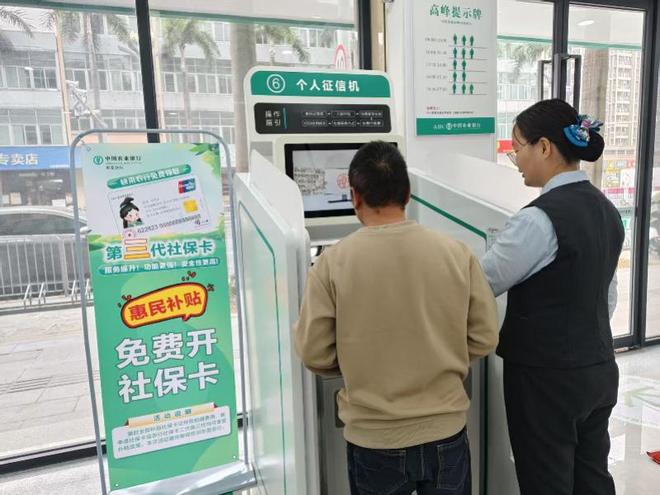
Core Viewpoint - The launch of self-service credit report query machines in three branches of Agricultural Bank in Dongguan marks the extension of personal credit report services to all 32 towns and streets in the city, enhancing convenience for residents [1][3]. Group 1: Service Expansion - The new self-service machines are strategically placed in three previously underserved towns, significantly reducing the need for residents to travel to other areas for credit report inquiries [3]. - A total of 54 query points in Dongguan are now equipped with self-service devices, allowing residents to obtain detailed credit reports in under one minute without the need for forms or queues [3]. Group 2: Technological Integration - The self-service machines support original ID card reading and facial recognition, streamlining the process for users [3]. - Residents can utilize the "Guangdong Credit Appointment" WeChat mini-program to locate nearby query points, make appointments, and receive navigation assistance [3]. Group 3: Future Plans - The People's Bank of China Dongguan Branch aims to enhance public awareness of the new credit report query channels and will continue to optimize the layout based on foot traffic at various query points [5]. - The initiative aligns with the bank's commitment to serve the real economy and improve the business environment in Dongguan [5].
工行、建行、农行、中行集体表态
21世纪经济报道· 2025-12-13 03:43
Core Viewpoint - The article discusses the key directions set for the financial system in China for 2026, emphasizing the importance of risk prevention, strong regulation, and promoting high-quality development in the banking sector [1][4]. Group 1: Key Directions for 2026 - The four major state-owned banks have aligned on three core directions: maintaining centralized leadership from the Party, focusing on their main responsibilities, and ensuring the balance between development and safety [4][6]. - The banks emphasize the need to enhance party building and ensure that central policies are effectively implemented [4][5]. Group 2: Focus Areas for Financial Support - The banks plan to deepen their financial support in key areas such as expanding domestic demand, technological innovation, and support for small and micro enterprises [5][6]. - Specific strategies include increasing financial resources for manufacturing, regional coordination, and green development initiatives [5][10]. Group 3: Risk Management - All four banks prioritize the prevention and resolution of financial risks, with a focus on stabilizing asset quality and ensuring overall risk control [6][9]. - They aim to address risks in key areas such as real estate and local government debt while maintaining a commitment to not allowing systemic risks to emerge [6][9]. Group 4: Differentiated Strategies - Each bank has defined its unique focus areas: ICBC positions itself as a leader in supporting domestic markets, CCB emphasizes digital transformation, Bank of China leverages its cross-border financial advantages, and ABC focuses on rural revitalization [9][10]. - These differentiated strategies aim to enhance their respective roles in supporting national economic goals and addressing specific market needs [9][10].
四大行集体表态!传达学习中央经济工作会议精神
2 1 Shi Ji Jing Ji Bao Dao· 2025-12-12 23:05
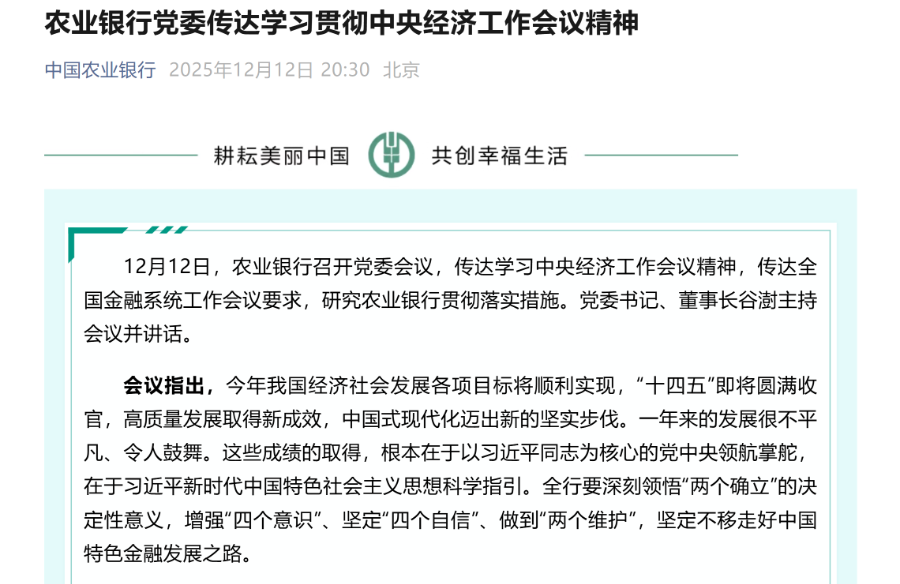
Core Viewpoint - The national financial system work conference outlined the core directions for the financial system's work in 2026, emphasizing the importance of risk prevention, strong regulation, and promoting high-quality development [1][3]. Group 1: Core Directions for 2026 - The four major state-owned banks have reached a consensus on three core directions: maintaining centralized leadership from the Party, focusing on their main responsibilities, and ensuring the balance between development and safety [3][6]. - The banks emphasized the significance of understanding and implementing the "two establishments" and "two safeguards" to ensure effective execution of central policies [3][4]. Group 2: Focus on Main Responsibilities - The banks aim to enhance financial support in key areas such as expanding domestic demand, technological innovation, and support for small and micro enterprises [4][5]. - Agricultural Bank of China (ABC) plans to align with new policies and projects to boost consumption and stabilize investment through significant credit allocations [5][9]. - The banks are committed to improving financial services for the real economy, particularly in areas like green finance and support for small and micro enterprises [4][5]. Group 3: Risk Prevention and Management - All four banks prioritize the prevention and resolution of financial risks, with a focus on maintaining asset quality and managing various risks effectively [6][7]. - The banks are dedicated to ensuring that systemic risks do not occur, particularly in sectors like real estate and local government debt [7][8]. Group 4: Differentiated Work Focus - Each bank has defined its unique focus areas: Industrial and Commercial Bank of China (ICBC) emphasizes its role as a mainstay in the market, while China Construction Bank (CCB) focuses on digital transformation [8][9]. - Bank of China (BOC) aims to leverage its cross-border financial advantages to enhance global competitiveness and support international trade [9]. - ABC is committed to strengthening rural financing and supporting the high-quality development of rural economies [9].
金融赋能强根基 绘就发展新图景
Jing Ji Ri Bao· 2025-12-12 22:24
Core Viewpoint - China Agricultural Bank's Jieyang Branch has been deeply integrated with local development for over 30 years, providing precise and efficient financial services to empower the real economy, rural revitalization, and livelihood security, thus becoming a financial backbone for regional high-quality development [1][2] Group 1: Empowering the Real Economy - The bank has established a comprehensive financing service system for major projects, offering tailored solutions for specific industries, which supports the "one industry, one plan" approach for industrial clusters [1] - Credit support has been directed towards traditional manufacturing sectors such as stainless steel, textiles, and footwear, with a special service plan for technology-oriented small and micro enterprises [1] - The loan coverage for specialized and innovative enterprises has increased to 43.3% [1] Group 2: Rural Revitalization - A four-tier service system has been developed, covering branches, sub-branches, townships, and villages, with an average daily balance of agricultural loans reaching 12.3 billion yuan, ranking among the industry leaders [1] - Unique products like "Agricultural Leading Loans" and "Grain Planting Loans" have been launched, with a net increase of 530 million yuan in rural industry loans by the end of November 2025 [1] - The bank has implemented a "Party Building + Finance + Technology" model, establishing 192 "Credit Villages" and completing records for 40,000 farming households [1] Group 3: Expanding Inclusive Financial Services - The bank has maintained its commitment to inclusive finance by organizing various public welfare activities and collaborating with local departments to create a micro-financing platform [2] - The balance of inclusive loans has surpassed 7 billion yuan, with a total credit of 9.17 billion yuan granted to 3,568 small and micro enterprises, leading the industry in key metrics [2] - The financing cost for inclusive small and micro enterprises has decreased by 43 basis points compared to 2024 [2]
农业银行大宗交易成交219.57万股 成交额1695.08万元
Zheng Quan Shi Bao Wang· 2025-12-12 15:45
12月12日农业银行大宗交易一览 | 成交量 (万股) | 成交金额 (万元) | 成交价格 (元) | 相对当日 收盘折溢价 (%) | 买方营业部 | 卖方营业部 | | --- | --- | --- | --- | --- | --- | | 219.57 | 1695.08 | 7.72 | 0.00 | 国泰海通证券股份有限公司总部 | 机构专用 | 注:本文系新闻报道,不构成投资建议,股市有风险,投资需谨慎。 进一步统计,近3个月内该股累计发生3笔大宗交易,合计成交金额为2450.08万元。 证券时报•数据宝统计显示,农业银行今日收盘价为7.72元,下跌2.65%,日换手率为0.18%,成交额为 44.49亿元,全天主力资金净流出6.18亿元,近5日该股累计下跌1.28%,近5日资金合计净流出7.73亿 元。 两融数据显示,该股最新融资余额为9.68亿元,近5日减少1.32亿元,降幅为12.01%。 据天眼查APP显示,中国农业银行股份有限公司成立于1986年12月18日,注册资本34998303.3873万人 民币。(数据宝) (原标题:农业银行大宗交易成交219.57万股 成交额1695.0 ...