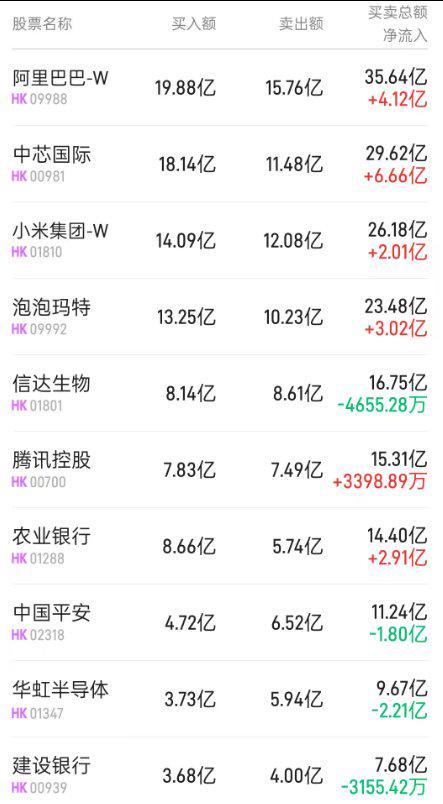
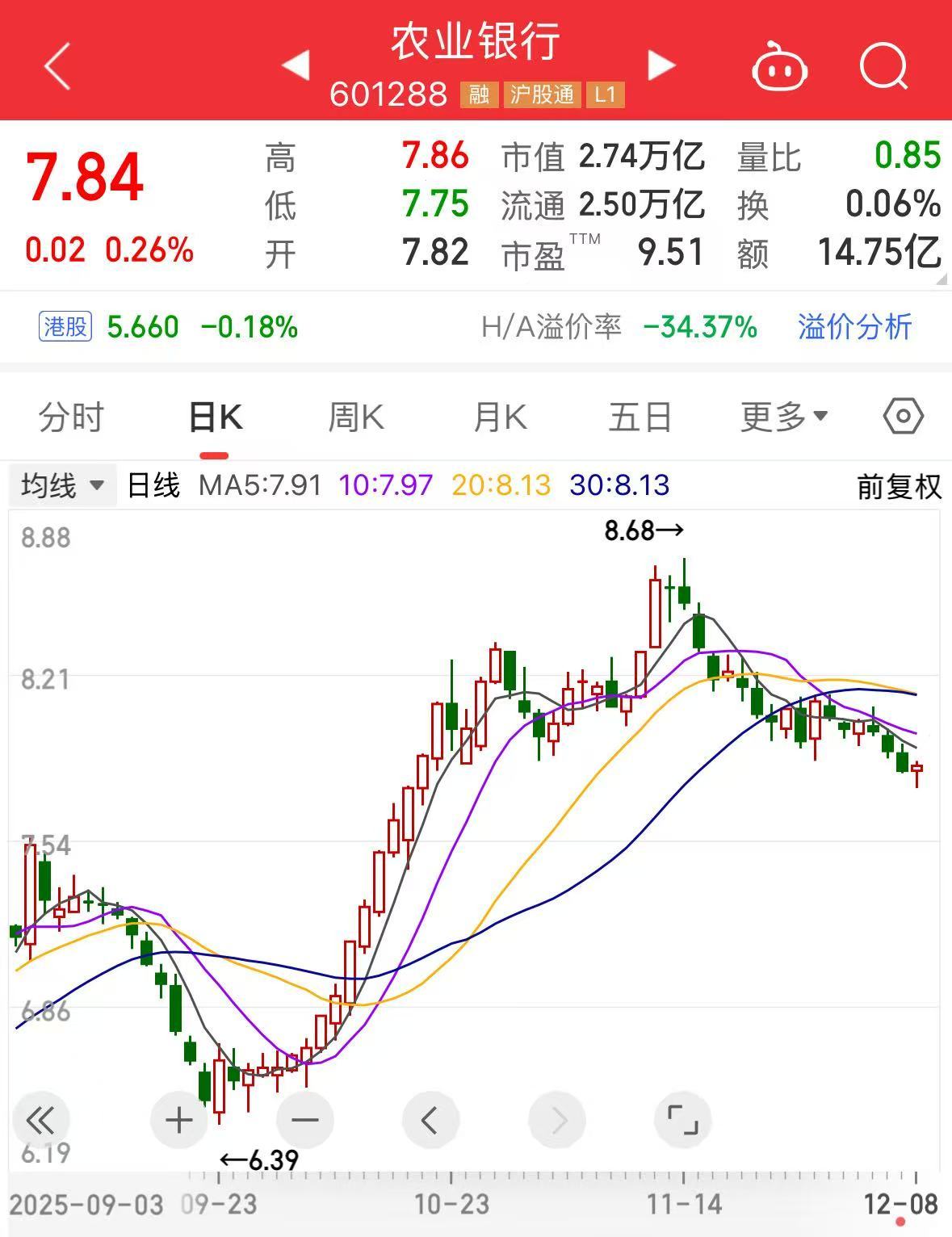
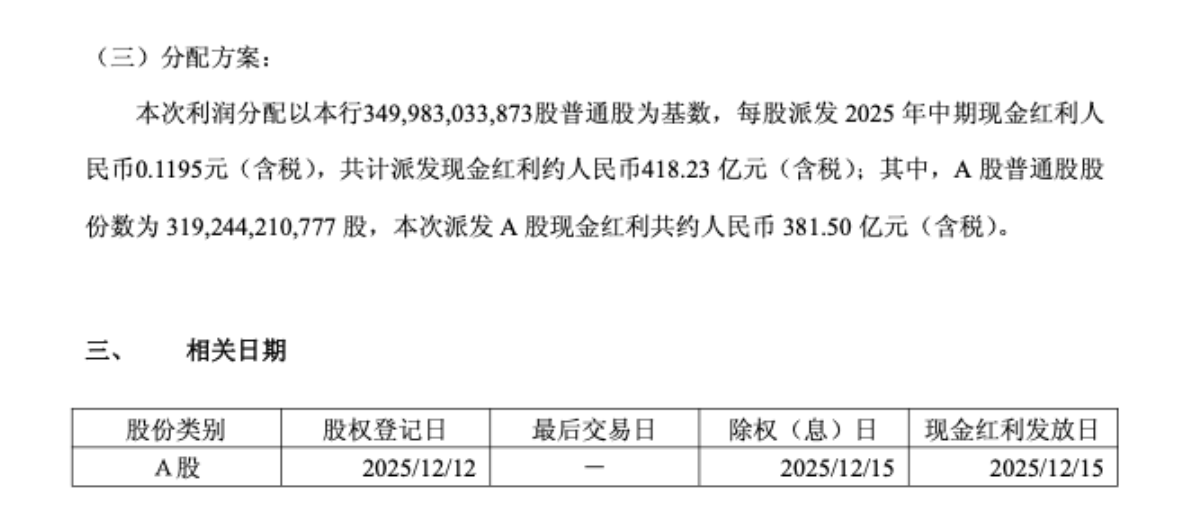
AGRICULTURAL BANK OF CHINA(01288)
Search documents
股市下跌,银行股逆势上涨!新“宇宙行”农行狂涨5%总市值2.55万亿
第一财经· 2025-09-04 14:18
Core Viewpoint - The article highlights the significant rise of Agricultural Bank of China (ABC) in the A-share market, surpassing Industrial and Commercial Bank of China (ICBC) in total market capitalization, marking a shift in the banking sector dynamics amid a broader market downturn [2][4][6]. Market Performance - On September 4, the A-share market experienced a downturn, with the Shanghai Composite Index falling by 1.25% to 3765.88 points, and the ChiNext Index dropping by 4.25% to 2776.25 points [2]. - In contrast, ABC's stock price increased by 5.17%, reaching a total market capitalization of 2.55 trillion yuan, exceeding ICBC's 2.49 trillion yuan by approximately 667 billion yuan [2][6]. - Year-to-date, ABC's stock has surged by 47%, leading the gains among listed banks, with a total market value increase of over 720 billion yuan [2][6]. Sector Analysis - The banking sector showed resilience, with 24 bank stocks closing in the green, and the overall banking sector market capitalization reaching approximately 14.64 trillion yuan [5][6]. - Other major banks also saw positive movements, with Postal Savings Bank rising by 2.9% and ICBC and China Bank increasing by 1.34% and 1.26%, respectively [5]. Valuation and Investment Trends - As of September 4, ABC's price-to-book (PB) ratio stood at 0.98, indicating it is among the most attractively valued banks in the A-share market [12]. - The article notes that insurance capital has been a significant force in the recent bank stock rally, with major players like Ping An Life frequently increasing their stakes in banks [11][12]. - The median dividend yield for A-share listed banks remains above 4%, with major state-owned banks announcing cash dividends exceeding 200 billion yuan based on their mid-year profits [12]. Future Outlook - Analysts predict continued improvement in banking performance indicators in the second half of the year, driven by fiscal tools and a recovering economy, although asset quality will depend on the real economy's recovery [13]. - The article suggests that while there has been a market style shift away from high-dividend assets, the resilience shown in bank earnings could stabilize performance and dividend expectations [13].
农业银行登顶A股总市值王座背后:县域金融与非息收入发力 业绩增速领跑六大行
Mei Ri Jing Ji Xin Wen· 2025-09-04 14:06
Core Viewpoint - Agricultural Bank of China (ABC) has achieved a remarkable turnaround, becoming the leader in A-share market capitalization among Chinese banks, with a stock price increase of over 40% year-to-date, surpassing Industrial and Commercial Bank of China (ICBC) [2][3][6] Market Performance - As of September 4, 2025, ABC's stock closed at 7.52 CNY per share, marking a 5.17% increase and a new historical high [2][3] - ABC's total market capitalization reached approximately 2.55 trillion CNY, overtaking ICBC's 2.49 trillion CNY [2][6] - Year-to-date, ABC's stock price has surged by 46.9%, while ICBC's has only increased by 13.66% [3][4] Strategic Success Factors - ABC's success is attributed to its "volume compensates for price" strategy, which focuses on expanding interest-earning assets, particularly in rural lending, to maintain revenue growth amid industry-wide margin pressures [2][10][14] - The bank's net profit for the first half of 2025 was 1,399.43 billion CNY, a 2.53% year-on-year increase, leading among the six major state-owned banks [10][13] Asset Quality and Risk Management - ABC has maintained a stable asset quality, with a non-performing loan ratio of 1.28%, a historical low, and a provision coverage ratio of 297.81%, the highest among state-owned banks [13][20] - The bank's total assets reached 43.24 trillion CNY by the end of 2024, with an 8.44% growth rate, ranking second among state-owned banks [13] County-Level Financial Strategy - ABC has established a comprehensive county-level financial network with 2.29 million outlets, 56.6% of which are located in rural areas, creating a competitive advantage [15] - By the end of 2024, the bank's county-level loan balance was 9.85 trillion CNY, contributing significantly to its interest income [18] Non-Interest Income Growth - Non-interest income has become a crucial growth driver, with investment income reaching 231.53 billion CNY in the first half of 2025, a 52.54% increase year-on-year [19] - The bank's strategy to diversify its income sources is particularly important in a low-interest-rate environment [19] Future Outlook - ABC's management anticipates that net interest margins will stabilize in the second half of 2025, supported by effective loan structure optimization and cost management [14][20] - The bank's current price-to-book ratio stands at 0.98, with a dividend yield exceeding 3.2%, indicating attractive valuation prospects [20]
规模大增!银行发力消费贷,存量客户也可享受贴息
Guo Ji Jin Rong Bao· 2025-09-04 13:21
Core Viewpoint - The personal consumption loan business is becoming a key focus for many banks as they aim to boost consumer spending, with significant growth observed in the first half of 2025, particularly among state-owned banks and city commercial banks [1][2][3]. Group 1: Growth in Personal Consumption Loans - Over half of the banks reported an increase in personal consumption loan amounts, with 25 out of 37 banks showing growth [2]. - Notably, 14 banks increased their consumption loan amounts by over 5 billion yuan, while 11 banks achieved double-digit growth compared to the beginning of the year [2]. - Major state-owned banks like China Construction Bank, Agricultural Bank of China, Bank of Communications, and Bank of China saw increases exceeding 50 billion yuan, with amounts of 862.99 billion yuan, 626.86 billion yuan, 555.38 billion yuan, and 508.67 billion yuan respectively [3]. Group 2: Policy Impact on Consumption Loans - The implementation of the personal consumption loan subsidy policy on September 1 has further stimulated consumer interest, with many banks quickly launching their first subsidy transactions [1][4]. - The process for applying for loan subsidies is straightforward, allowing new customers to complete applications online, and existing customers can also benefit from the subsidy [4]. - The subsidy policy is expected to lower effective interest rates on loans, thereby stimulating consumer demand and enhancing consumption willingness [4]. Group 3: Future Outlook - Experts predict that personal consumption loans and business loans will tap into potential credit demand from residents, supported by favorable fiscal policies [1][3]. - By the end of June 2025, the total personal consumption loan scale is estimated to be around 12.5 trillion yuan, with the potential to generate an additional 1 trillion yuan in credit demand annually [5]. - New policy financial tools are expected to be introduced in the second half of the year, potentially injecting 500 billion yuan to stimulate approximately 4 trillion yuan in credit growth [6].
上半年银行新增15万高净值客户,“科学家”正在成为新宠?
Di Yi Cai Jing· 2025-09-04 13:04
Group 1 - The high-net-worth client segment is a focal point for retail banking, with significant competition among commercial banks to capture this valuable market [1][4] - As of June 2025, 15 banks reported private banking data, with a total client base exceeding 1.63 million, marking a growth of nearly 150,000 clients or over 10% since the beginning of the year [1] - The four major state-owned banks have crossed the 3 trillion yuan mark in assets under management (AUM), with Industrial Bank entering the "trillion club" for the first time [1][2] Group 2 - The four major state-owned banks collectively have 864,000 private banking clients, with Agricultural Bank leading in AUM at 3.5 trillion yuan, and a client base of over 279,000 [2] - China Construction Bank reported a remarkable AUM growth of 14.39% to 3.18 trillion yuan, with a client increase of 34,000, marking a 14.69% rise [2] - Postal Savings Bank, despite not disclosing AUM, saw a client growth of over 21%, reaching 41,400 clients, indicating a strong potential for future AUM increases [2] Group 3 - Joint-stock banks are experiencing a stark contrast in performance, with China Merchants Bank leading in client growth among joint-stock banks, while Ping An Bank reported a slight decline in AUM [3] - The AUM for CITIC Bank and Industrial Bank grew by 9.33% and 9.59%, respectively, indicating steady growth in the joint-stock sector [3] - Regional banks like Ningbo Bank and Beijing Bank demonstrated strong growth, with AUM increases of 17.62% and 17.06%, respectively [3] Group 4 - The private banking sector in China is characterized by a concentration of leading banks and differentiated competition, with smaller banks adopting unique strategies to capture market share [4] - The shift in client demographics is evident, with a growing number of new high-net-worth clients entering the market, while the growth of ultra-high-net-worth clients is slowing [5][6] Group 5 - The focus on new client segments, such as scientists and tech entrepreneurs, is reshaping the private banking landscape, with banks redefining their target client profiles [7] - Private banking is becoming a key driver for retail banking transformation, providing stability and high value-added services amid traditional retail banking challenges [7][8] - The demand for non-financial services among private banking clients is creating new opportunities for banks to enhance customer engagement and service offerings [8]
农行年内涨出一个中国神华,如何解释背后力量和逻辑?
Di Yi Cai Jing· 2025-09-04 12:46
Core Viewpoint - The A-share market experienced a significant downturn on September 4, with technology stocks declining sharply while bank stocks saw a resurgence, particularly Agricultural Bank of China, which surpassed Industrial and Commercial Bank of China in market capitalization, becoming the new "universe bank" [1][3]. Market Performance - The Shanghai Composite Index fell by 1.25% to 3765.88 points, while the ChiNext Index dropped by 4.25% to 2776.25 points [1]. - Agricultural Bank of China saw a 5.17% increase in stock price, reaching a market capitalization of 2.55 trillion yuan, surpassing Industrial and Commercial Bank of China by over 660 billion yuan [1][3]. Year-to-Date Stock Performance - Agricultural Bank of China led the A-share market with a year-to-date stock price increase of 47%, resulting in a market capitalization growth of approximately 7219 billion yuan [4]. - Other major banks showed lower increases, with Industrial and Commercial Bank of China up by 13.54% and Postal Savings Bank of China up by 18.03% [4]. Market Capitalization Rankings - As of the latest closing, the top five banks by market capitalization are Agricultural Bank of China, Industrial and Commercial Bank of China, China Construction Bank, Kweichow Moutai, and China Mobile [3]. - The market capitalization of Agricultural Bank of China has increased significantly, comparable to the market cap of a major company like China Shenhua [4]. Stock Distribution and Valuation - The share distribution among major banks varies, with Agricultural Bank of China having 91% of its total shares in A-shares, while Industrial and Commercial Bank of China has 76% [5][6]. - As of September 4, Agricultural Bank of China and Chengdu Bank had price-to-book ratios of 0.98 and 0.93, respectively, indicating relatively low valuations compared to other banks [11]. Investment Trends - The recent performance of bank stocks has attracted significant attention from institutional investors, particularly insurance funds, which have been increasing their holdings in major banks [10]. - The overall dividend yield for A-share listed banks remains above 4%, with major state-owned banks announcing cash dividends exceeding 200 billion yuan based on their half-year profits [11].
新“宇宙行”诞生!农业银行股价再创新高,总市值首超工行
Hua Er Jie Jian Wen· 2025-09-04 12:18
农业银行股价周四再创新高,推动其A+H股总市值首次超越工商银行,成为中国新的"宇宙行"。这一历史性变化,标志着银行板块估值修复与资 金配置逻辑的阶段性成果,也反映出市场对银行股"低估值+高分红"价值的重新评估。 9月4日,农业银行A股盘中一度达到7.55元/股的历史新高,收盘报7.52元/股,涨幅5.17%,H股报5.4港元/股,涨1.5%。Wind数据显示,按A+H股 综合市值计算,农业银行总市值2.55万亿元,首次反超工商银行,后者市值现为2.49万亿元。此前8月6日,农行A股市值已超越工商银行,首次成 为A股市值冠军。 不过,如果按照总股本*现价计算,农业银行市值为2.63万亿元,仍略低于工商银行的2.69万亿元。 今年以来,银行板块整体走强,农业银行表现尤为突出。Wind数据显示,年初至今,农业银行A股涨幅超44%,H股涨超30%;同期工商银行A股 涨幅超13%,H股涨超17%。A股价格相较H股存在较高溢价,反映出内地投资者对银行股的偏好提升。 8月6日,农业银行A股市值首次超越工商银行,登上A股市值冠军宝座。不到一个月,A+H股总市值也实现反超,显示资金对农行的持续青睐。 业绩与资产质量稳健 农业银 ...
险资最新重仓股出炉!这一行业受青睐
Zhong Guo Zheng Quan Bao - Zhong Zheng Wang· 2025-09-04 12:17
Group 1 - The core viewpoint of the articles indicates that insurance capital (险资) is increasingly favoring bank stocks, with significant holdings in various sectors, particularly banking, transportation, and telecommunications [1][3][5]. - As of the end of Q2 2025, insurance capital held a total of 730 stocks, with a combined holding of 61.919 billion shares valued at 628.985 billion yuan, showing an increase in both quantity and market value compared to Q1 [3][5]. - Among the top ten heavy holdings of insurance capital, six are bank stocks, including Minsheng Bank, Pudong Development Bank, and Zhejiang Bank, highlighting a strong preference for the banking sector [3][4]. Group 2 - Insurance capital is expected to continue optimizing its equity investment structure, focusing on high-dividend stocks and new productive forces in the upcoming quarters [2][8]. - In Q2, insurance capital increased its holdings in several key stocks, including CITIC Bank, Beijing-Shanghai High-Speed Railway, and China Telecom, with significant increases in share quantities [6][7]. - The insurance sector is actively seeking investment opportunities in high-dividend and innovative sectors, with a focus on technology innovation, advanced manufacturing, and new consumption [8].
大涨5%、总市值2.55万亿!农行年内涨出一个中国神华
Di Yi Cai Jing· 2025-09-04 11:57
Core Viewpoint - Agricultural Bank of China has surpassed Industrial and Commercial Bank of China in total market capitalization, becoming the new "universe bank" in the A-share market, marking a significant shift in the banking sector dynamics [1][3][4]. Market Performance - On September 4, the A-share market saw a decline, with the Shanghai Composite Index dropping by 1.25% to 3765.88 points, while Agricultural Bank's stock rose by 5.17%, reaching a total market value of 2.55 trillion yuan, exceeding ICBC's 2.49 trillion yuan by approximately 667 billion yuan [1][3]. - Year-to-date, Agricultural Bank's stock price has increased by 47%, leading among listed banks, with a market value increase of over 721.9 billion yuan [4][8]. Comparative Analysis - As of the latest data, Agricultural Bank's A-share price-to-book ratio (PB) stands at 0.98, making it one of the more attractively valued banks in the market, while the median dividend yield for A-share listed banks remains above 4% [8][9]. - Other major banks have shown varied performance, with Postal Savings Bank up 18.03% and ICBC up 13.54% year-to-date, while China Construction Bank and Bank of China have seen lower increases of 9.58% and 6.55%, respectively [2][4]. Investor Sentiment - The recent rally in bank stocks is attributed to increased interest from institutional investors, including insurance funds, which have been actively purchasing shares in major banks [7][9]. - Despite discussions about a potential end to the bank stock rally due to market style shifts, analysts believe that the underlying fundamentals and improved earnings outlook will support continued interest in bank stocks [9].
分红井喷,制造业追随高股息阵营
和讯· 2025-09-04 11:32
Core Viewpoint - The A-share market is experiencing a record wave of mid-term cash dividends, driven by policy guidance, corporate financial optimization, and changing market preferences, which helps stabilize the market and boost investor confidence in the short term, while establishing a sustainable dividend mechanism in the long term [2][11]. Group 1: Mid-term Dividend Trends - As of August 31, 818 A-share companies announced cash dividend plans for the first and second quarters, an increase of 141 companies compared to the previous year, with total cash dividends reaching 649.7 billion yuan, reflecting a payout ratio of 31.97% [2]. - The number of companies participating in mid-term dividends has significantly increased from 102 in 2022 to 677 in 2024, indicating a new high for mid-term dividends this year [2]. - The total payout amount this year has risen over 22% compared to last year's 531.2 billion yuan, setting a new record [2]. Group 2: Industry Contributions - Traditional high-dividend sectors such as finance, telecommunications, and energy continue to play a significant role, with state-owned enterprises contributing 71% of the total dividend amount [5]. - China Mobile leads the dividend payout with 54.082 billion yuan, followed by Industrial and Commercial Bank of China and China Construction Bank with 50.4 billion yuan and 48.61 billion yuan, respectively [5]. - The banking sector has shown remarkable performance, with the six major state-owned banks planning to distribute nearly 204.7 billion yuan in dividends, accounting for nearly one-third of the total payout [5]. Group 3: Factors Driving Dividend Growth - The surge in mid-term dividends is attributed to multiple factors, including regulatory policy support, strong corporate performance, and changing market conditions [8][10]. - The "New National Nine Articles" issued in April 2024 emphasizes enhancing cash dividend regulations for listed companies, encouraging higher dividend payouts and more frequent distributions [10]. - Over 60% of companies that disclosed mid-term dividend plans reported a year-on-year increase in net profit, indicating strong corporate performance supporting dividend capabilities [10]. Group 4: Cultural Shift in Investment - The growing dividend culture is shifting investor focus from merely seeking stock price appreciation to valuing cash dividend capabilities, leading to a deeper understanding of company fundamentals and dividend policies [12]. - The increase in dividends and buybacks is promoting a healthier investment ecosystem in the A-share market, transitioning from a focus on financing to a balance between financing and investor returns [12]. - Despite the progress, A-shares still lag behind mature markets in dividend frequency, with expectations that quarterly dividends may become a norm for some companies in the near future [13][14].
中期分红井喷:央企压舱,制造业扩围
Sou Hu Cai Jing· 2025-09-04 11:11
Core Viewpoint - The mid-term dividend trend in A-shares is driven by policy guidance, corporate financial optimization, and changing market preferences, contributing to market stability and investor confidence [2][8]. Group 1: Dividend Trends - As of August 31, 818 A-share companies announced cash dividend plans, an increase of 141 companies compared to the previous year, with total cash dividends reaching 649.7 billion yuan and an overall payout ratio of 31.97% [2]. - The number of companies declaring mid-term dividends has significantly increased from 102 in 2022 to 677 in 2024, marking a new high [2]. - The total cash dividend amount this year exceeded 531.2 billion yuan from last year, representing a growth of over 22% [2]. Group 2: Industry Contributions - Traditional high-dividend sectors such as finance, telecommunications, and energy continue to dominate, with state-owned enterprises contributing 71% of the total dividend amount [3]. - China Mobile leads the dividend payout with 54.082 billion yuan, followed by Industrial and Commercial Bank of China and China Construction Bank with 50.4 billion yuan and 48.61 billion yuan, respectively [3]. - The banking sector has been particularly prominent, with the six major state-owned banks planning to distribute nearly 204.7 billion yuan in dividends, accounting for almost one-third of the total [3]. Group 3: Corporate Behavior and Investor Sentiment - More manufacturing companies, such as CRRC and Changan Automobile, have begun to announce mid-term dividends, indicating a broader distribution of dividend practices beyond traditional sectors [5]. - Companies implementing mid-term dividends signal stable operations and strong cash flow, enhancing investor trust [4]. - The trend towards more frequent dividends reflects a shift in investor focus from mere stock price appreciation to cash dividend capabilities [10]. Group 4: Regulatory and Market Dynamics - Regulatory policies, such as the "New National Nine Articles," have emphasized the importance of cash dividends, encouraging companies to enhance their dividend policies [8]. - Over 60% of companies that disclosed mid-term dividend plans reported a year-on-year increase in net profit, indicating strong underlying performance [9]. - The increasing presence of institutional investors has heightened the demand for stable cash flows, pressuring companies to improve their dividend offerings [9]. Group 5: Future Outlook - There is a growing expectation that the frequency of dividends in A-shares will increase, with some companies potentially adopting quarterly dividend distributions similar to those in mature markets [11]. - The evolving dividend culture is expected to transform the investment landscape, promoting a balance between financing and investor returns [10].