NCI(01336)

Search documents
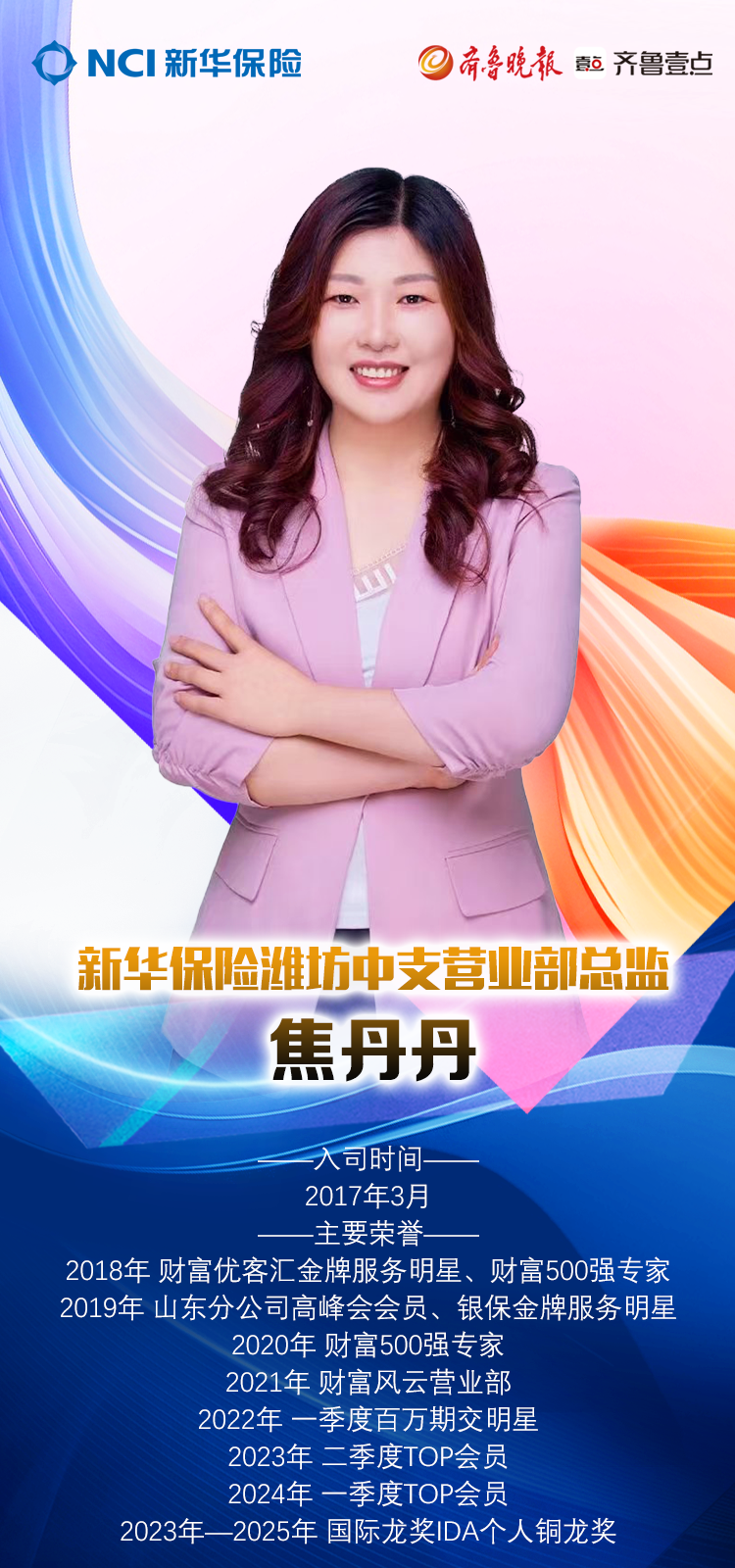
新华保险潍坊中支营业部总监焦丹丹:真诚塑服务 专业赢未来
Qi Lu Wan Bao· 2025-08-18 06:47
Core Insights - The article highlights the journey of Jiao Dandan, a successful insurance manager at Xinhua Insurance, showcasing her dedication to customer service and professional growth [1][5][10] Group 1: Career Development - Jiao Dandan transitioned from sales to the insurance industry in March 2017, attracted by the flexible working hours that allowed her to balance family and career [5] - Initially struggling to secure clients, she persevered and improved her skills, leading to her promotion to branch manager in September 2019 [5][7] - She achieved significant recognition, including the IDA Copper Dragon Award for two consecutive years in 2023 and 2024, and set ambitious goals for her future performance [7] Group 2: Customer Service - Over her eight-year career, Jiao Dandan has served 1,052 clients and handled 35 claims, totaling 1.56 million yuan in claims [1][10] - She emphasizes the importance of lifelong customer service, building trust through her genuine personality and professional expertise [10] - Jiao Dandan's approach to client interactions has led to numerous referrals and repeat business, demonstrating her effectiveness in client relationship management [10] Group 3: Team Building - Jiao Dandan actively engages in team activities, providing detailed customer needs analysis to help her colleagues understand client requirements better [9] - She serves as a mentor to her team, offering professional advice to enhance their financial planning capabilities [9]


2Q25保险资金运用分析:股票余额环比增长8.9%,基金配置比例持续下降
ZHONGTAI SECURITIES· 2025-08-18 06:10
Investment Rating - The report maintains an "Overweight" rating for the insurance sector, indicating a positive outlook for the industry over the next 6 to 12 months [2]. Core Insights - The insurance sector's total investment balance reached 36.23 trillion yuan by the end of Q2 2025, with a year-on-year growth rate of 17.4%, marking the fifth consecutive quarter of improvement [5]. - The asset allocation shows a continued increase in bond investments, with a slight slowdown in growth, while stock allocations have improved for five consecutive quarters [5][6]. - The report highlights that the insurance industry is not as negatively impacted as the market perceives, with valuations reflecting the pressures on both assets and liabilities [5]. Summary by Sections Industry Overview - The total market capitalization of the insurance industry is approximately 32,643.28 billion yuan, with a circulating market value of 32,637.15 billion yuan [2]. Investment Allocation - By the end of Q2 2025, the allocation of insurance funds was as follows: bank deposits (8.6%), bonds (51.1%), stocks (8.8%), securities investment funds (4.8%), long-term equity investments (7.9%), and other non-standard assets (18.2%) [5][6]. - The bond allocation has increased, but the growth rate has shown signs of slowing down, while stock allocation has seen a consistent rise [5]. Performance Metrics - The year-on-year growth rates for original premiums, net assets, and total assets as of June 2025 were 5.3%, 23.4%, and 16.1%, respectively, indicating improved operational performance [5]. - The solvency ratios for property and life insurance companies were reported at 240.6% and 196.6%, respectively, showing a recovery trend [5][18]. Investment Recommendations - The report suggests focusing on companies such as New China Life Insurance, Ping An Insurance, China Life Insurance, AIA, China Pacific Insurance, and China People’s Insurance, as they are expected to benefit from the current market conditions [5].


非银金融行业周报:重视保险公司举牌同业的信号意义-20250817
Shenwan Hongyuan Securities· 2025-08-17 14:41
Investment Rating - The report maintains a "Positive" outlook on the non-bank financial industry, indicating an expectation for the sector to outperform the overall market [3][6]. Core Insights - The insurance sector has shown a significant increase, with the Shenwan Insurance II Index rising by 3.20%, outperforming the CSI 300 Index by 0.83 percentage points. Notably, Ping An Insurance has increased its stake in China Pacific Insurance (H) and China Life Insurance (H), triggering regulatory notifications [3][6]. - The report highlights a resurgence in insurance companies' acquisitions of peers, with 32 announcements made in 2024, the highest since 2016. As of August 14, 2025, 14 insurance institutions have made 24 acquisition announcements, involving 20 listed companies [3][6]. - The report emphasizes the positive implications of declining long-term interest rates and the entry of long-term capital into the market, suggesting a favorable environment for insurance companies [3][6]. Summary by Sections Market Review - The CSI 300 Index closed at 4,202.35 with a weekly change of +2.4%, while the non-bank index closed at 2,079.34 with a change of +6.5%. The brokerage, insurance, and diversified financial sectors reported changes of +8.2%, +3.2%, and +4.5%, respectively [6][10]. Non-Bank Industry Insights - The report notes that as of August 15, 2025, the 10-year government bond yield was 1.75%, with a weekly increase of 2.62 basis points. The insurance sector's performance is closely tied to these interest rate movements [13][19]. - The report also mentions that the average daily trading volume in A-shares has increased significantly, indicating a robust market environment for brokers [19][39]. Investment Recommendations - For the insurance sector, the report recommends focusing on undervalued stocks, specifically China Life (H), China Pacific Insurance, New China Life, Ping An, China Property & Casualty, and China Re [3][6]. - In the brokerage sector, the report suggests three investment themes: strong comprehensive institutions benefiting from improved competition, brokers with significant earnings elasticity, and firms with strong international business capabilities [3][6].



2025Q2保险业资金运用数据点评:保险资金加速入市,上半年股票投资净增量超6400亿
CMS· 2025-08-17 04:34
Investment Rating - The report maintains a "Recommended" rating for the insurance industry, indicating a positive outlook for the sector's fundamentals and expected performance relative to market benchmarks [2][6][7]. Core Insights - The insurance industry's fund utilization scale surpassed 36 trillion yuan in Q2 2025, with a net increase of over 1.3 trillion yuan in the quarter, reflecting strong growth driven by premium income and asset value appreciation [5][7]. - The allocation structure of insurance funds has become more pronounced, with bond and stock proportions reaching new highs, indicating a shift towards a "barbell" investment strategy [5][7]. - Regulatory measures have accelerated the entry of insurance funds into the stock market, with the stock allocation reaching a record high of 8.8% by the end of Q2 2025, supported by policy adjustments aimed at promoting long-term investments [5][7]. Summary by Sections Industry Scale - As of Q2 2025, the total market capitalization of stocks held by insurance companies is approximately 670.62 billion yuan, with a circulating market value of about 641.38 billion yuan [2]. Fund Utilization - The total fund utilization balance for insurance companies reached 36.23 trillion yuan by the end of Q2 2025, marking an 8.9% increase year-to-date and a 3.7% increase from Q1 2025 [5][7]. - The bond allocation exceeded 51%, the highest level in recent years, while bank deposits and non-standard investments were reduced [5][7]. Equity Investment - The stock balance for life and property insurance companies reached 3.07 trillion yuan, with a net increase of 640.6 billion yuan in the first half of 2025, indicating a strong commitment to equity investments [5][7]. - The report highlights a resurgence in insurance companies' stake acquisitions in peer firms, with 27 instances recorded in 2025, reflecting confidence in the sector's recovery and long-term value [5][7]. Investment Recommendations - The report suggests individual stock recommendations including China Pacific Insurance, New China Life Insurance, and Ping An Insurance, while also advising attention to China Life Insurance, China Taiping Insurance, and China Property & Casualty Insurance for their long-term investment value [7].

入市加速,险资系私募证券基金增至7家
Zheng Quan Shi Bao· 2025-08-16 11:50
Group 1 - The core viewpoint of the news is the approval of China Pacific Insurance Asset Management Co., Ltd. to establish a private fund management company, marking progress in the long-term investment pilot program for insurance funds [1][2] - The pilot program allows insurance companies to invest in private securities funds primarily targeting the secondary market for stocks, with a focus on long-term holdings [2][3] - The establishment of the new private fund management company increases the total number of insurance-related private fund management companies to seven [4] Group 2 - The newly approved private fund management company, Renbao Qiyuan Huizhong, will issue funds to China Pacific Life Insurance to raise insurance capital for investment in the capital market [3][4] - The pilot program has seen a total of 6 insurance-related private securities investment funds enter the operational phase, with specific funds like the Honghu Fund series and Taikang Stable Fund already established [5][7] - The total amount approved for the long-term investment pilot program has reached 222 billion yuan, with various insurance companies participating, including China Life, Xinhua Insurance, and others [7]
入市加速!险资系私募证券基金增至7家
券商中国· 2025-08-16 10:29
Core Viewpoint - The recent approval of the establishment of the "Renbao Qiyuan Huizhong" private fund management company marks significant progress in the pilot program for long-term investment of insurance funds, increasing the total number of insurance-related private fund companies to seven [1][4]. Summary by Sections Progress of Long-term Investment Pilot - The pilot program allows insurance companies to establish private securities funds primarily investing in the stock market for long-term holding [3]. - The first batch of approvals in October 2023 included China Life and Xinhua Insurance, jointly investing 50 billion yuan to establish a company fund, which has been fully invested [2][3]. - The second batch includes several companies with varying investment amounts, such as 100 billion yuan from Renbao Insurance and its asset management [2][3]. Establishment of Private Fund Companies - The total number of insurance-related private fund management companies has reached seven, with the latest addition being "Renbao Qiyuan Huizhong" [4][5]. - Other companies include "Guofeng Xinghua," "Taikang Stable," "Taibao Zhiyuan," "Hengyi Chiying," and "Yangguang Hengyi" [4][5]. Operational Status of Funds - Six insurance-related private securities investment funds are currently operational, including various funds managed by Guofeng Xinghua and Taikang Stable [6][8]. - The first pilot fund, "Honghu Zhi Yuan," has a total scale of 500 billion yuan, which has been fully invested as of March 2024 [6][7]. Benefits of Long-term Investment Pilot - The pilot program is expected to enhance the efficiency of insurance fund utilization and improve asset-liability matching under new accounting standards, with a total pilot amount of 222 billion yuan across three batches [9].
智通港股解盘 | 恒指调整难掩个股火爆 旗手发力背后的逻辑
Zhi Tong Cai Jing· 2025-08-15 13:40
Market Overview - Hong Kong stock market opened lower and closed down 0.98% due to concerns over the upcoming US-Russia summit, while A-shares surged, with the Shanghai Composite Index returning to around 3700 points and a trading volume exceeding 2.2 trillion yuan, marking the 29th trading day in A-share history to surpass 2 trillion yuan [1][5] - The anticipated US-Russia summit is expected to yield limited results, with no plans for signed agreements, and discussions likely to focus on underlying strategies rather than public outcomes [2][3] Sector Focus - The banking sector in Hong Kong is underperforming, primarily due to a perceived lack of value compared to insurance stocks, which are increasingly favored by institutional investors [3] - The sentiment in the market remains positive, with over ten stocks in the Hong Kong Stock Connect rising more than 10%, particularly in the robotics sector, driven by upcoming events like the World Humanoid Robot Games [4] - The semiconductor and AI-related sectors are experiencing significant growth, with companies like Hongteng Precision rising over 33% due to their involvement in NVIDIA's supply chain [5] Individual Company Highlights - Xiexin Technology has entered a strategic partnership with Taibao Asset Management, aiming to explore tokenization solutions for real-world assets and develop compliant digital asset products [10][12] - The solar industry is showing signs of recovery, with significant price increases in photovoltaic glass and a reduction in production, indicating a potential shift towards better market conditions [7][8] - GCL-Poly Energy has secured a procurement contract for silicon materials worth up to 450 million yuan, reflecting the ongoing demand and price increases in the solar component market [10][11]

智通港股52周新高、新低统计|8月15日



智通财经网· 2025-08-15 08:47
Key Points - As of August 15, a total of 133 stocks reached their 52-week highs, with notable performers including 瑞港建设 (RuiGang Construction) at 94.74%, 力劲科技 (LiJing Technology) at 60.74%, and 派格生物医药-B (PAG Biopharma-B) at 39.18% [1] - The highest closing prices were recorded for 瑞港建设 at 0.260, 力劲科技 at 6.790, and 派格生物医药-B at 32.000 [1] - Other significant stocks that reached new highs include FIT HON TENG at 5.970 (26.04%), 远大中国 at 0.153 (25.81%), and 百心安-B at 6.060 (25.60%) [1] - The report also highlights stocks that reached their 52-week lows, with 今海医疗科技 (JinHai Medical Technology) dropping to 0.890 (-49.45%) and 恒泰裕集团 (HengTai Yu Group) at 0.014 (-12.50%) [4] - The overall market trend indicates a mix of strong performers and struggling stocks, reflecting varying investor sentiments across different sectors [1][4]
中证香港200动量指数报4085.10点,前十大权重包含新华保险等
Jin Rong Jie· 2025-08-15 08:23
Core Points - The China Securities Hong Kong 200 Momentum Index has shown significant growth, with a 9.16% increase over the past month, 27.36% over the past three months, and 43.18% year-to-date [1][2] - The index reflects the overall performance of securities listed on the Hong Kong Stock Exchange, utilizing various investment strategies for its composition [1][2] Index Composition - The top ten holdings of the China Securities Hong Kong 200 Momentum Index include: - Kangfang Biotech (5.96%) - Sihuan Pharmaceutical (3.1%) - Kingdee International (2.82%) - China Tower (2.77%) - CITIC Securities (2.71%) - New China Life Insurance (2.66%) - WuXi AppTec (2.5%) - People's Insurance Group of China (2.49%) - Sea Group (2.23%) - Leapmotor (2.2%) [1][2] Sector Allocation - The sector distribution of the index holdings is as follows: - Healthcare: 21.71% - Financials: 19.35% - Information Technology: 12.79% - Communication Services: 9.97% - Consumer Discretionary: 8.87% - Industrials: 8.60% - Materials: 6.74% - Consumer Staples: 5.15% - Utilities: 3.46% - Real Estate: 3.37% [2] Index Adjustment - The index samples are adjusted biannually, with changes implemented on the next trading day following the second Friday of June and December [2]
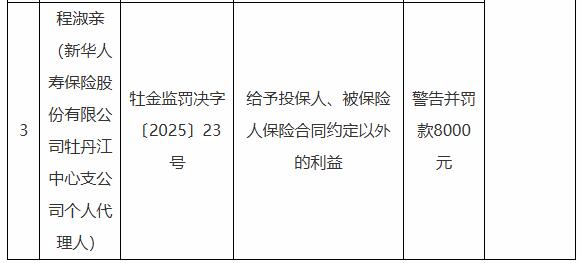
新华保险牡丹江中支代理人被罚 给予投保人合同外利益
Zhong Guo Jing Ji Wang· 2025-08-15 05:57
Group 1 - The National Financial Supervision Administration of China issued a penalty decision against Cheng Shuqin, an individual agent of Xinhua Life Insurance Co., Ltd., for providing benefits outside the insurance contract terms to policyholders and insured individuals [1] - Cheng Shuqin received a warning and was fined 8,000 yuan by the Mudanjiang Financial Supervision Bureau [1]