NCI(01336)

Search documents
委托医护人员卖保险?新华保险再度被罚
Guan Cha Zhe Wang· 2025-10-23 08:14
Core Viewpoint - Xinhua Insurance is facing significant compliance issues, highlighted by recent fines and systemic violations, despite reporting impressive profit growth in 2024 [1][2][5] Regulatory Violations - Xinhua Insurance's Fuzhou branch was fined 208,000 yuan for two major violations: false financial records and improper marketing by medical personnel [2][5] - Since 2024, the company has received at least 30 fines totaling over 8 million yuan, with violations occurring across 15 provinces [1][5] Financial Performance - In 2024, Xinhua Insurance reported a net profit of 26.2 billion yuan, a year-on-year increase of over 200%, but its core insurance premium income growth was the lowest among major insurers at only 2.8% [1][6] - The company's total investment income surged to 79.7 billion yuan, a 251.6% increase from 2023, indicating a heavy reliance on investment returns rather than core business growth [6][7] Management and Governance Issues - The company is experiencing significant leadership turmoil, with former chairman Li Quan dismissed for serious violations, reflecting deeper governance issues [1][7] - Systemic issues include widespread data falsification and improper commission practices, undermining the company's operational integrity [5][6] Industry Implications - As the third-largest life insurance company in China, Xinhua Insurance is expected to lead in regulatory compliance and sustainable development, yet it faces challenges in aligning its growth strategies with compliance requirements [7]

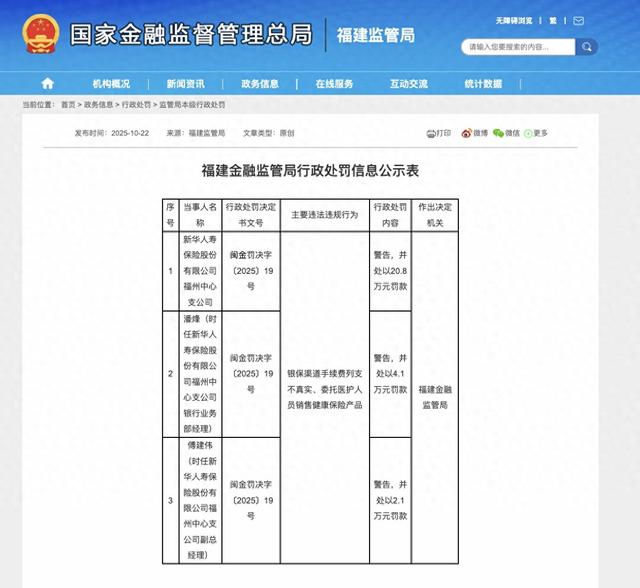
因银保渠道手续费列支不真实等问题,新华人寿福州中支被罚20.8万元
Zhong Guo Neng Yuan Wang· 2025-10-23 06:51
Core Points - Xinhua Life Insurance Co., Ltd. Fuzhou Branch was penalized for false reporting of insurance channel fees and for entrusting medical personnel to sell health insurance products, resulting in a warning and a fine of 208,000 yuan [1] - Pan Yong, the former manager of the bank business department at Xinhua Life Insurance Co., Ltd. Fuzhou Branch, received a warning and a fine of 41,000 yuan for similar violations [1] - Fu Jianwei, the former deputy general manager of the same branch, was also warned and fined 21,000 yuan for the same issues [1] Summary by Category Company Actions - Xinhua Life Insurance Co., Ltd. Fuzhou Branch was fined for untruthful reporting of fees related to the bank insurance channel [2] - The company was involved in the improper practice of allowing medical personnel to sell health insurance products [1][2] Individual Penalties - Pan Yong was penalized with a fine of 41,000 yuan for his role in the violations [1] - Fu Jianwei faced a fine of 21,000 yuan for similar misconduct [1]
险企执行新会计准则倒计时,怎么看?
CAITONG SECURITIES· 2025-10-23 05:59
Report Industry Investment Rating No information provided in the report. Core Viewpoints - Listed insurance companies have implemented new accounting standards (IFRS 17 and IFRS 9) since 2023, while non - listed ones will implement them in 2026. It is estimated that after the remaining insurance companies implement the new standards in 2026, the re - classification scale of financial assets of affected insurance companies may account for about 20% [3][62]. - After the implementation of the new standards, more insurance assets may be classified into the FVTPL category, increasing the profit volatility of insurance companies. Insurance companies are more cautious about bank capital bonds and increase the allocation of ultra - long bonds. The proportion of insurance funds invested in bonds is rising [3][5][63]. Summary According to the Table of Contents 1. New Accounting Standards Gradually Implemented - IFRS 9 adjusts the classification of financial assets from "four - category" to "three - category": FVTPL, FVOCI, and AC. More assets may be classified into FVTPL, making insurance company profits more volatile. Insurance companies have an incentive to allocate more assets to AC or FVOCI [9][10]. - IFRS 17 changes the discount rate for traditional insurance reserves. Insurance companies can use the OCI option to reduce profit fluctuations, which may lead to significant differences in net profit under the old and new standards [12]. - From the operating data of insurance companies that have implemented the new standards in advance, there is an increase in net profit and a decrease in net assets [16]. - Among bond - issuing insurance companies, the financial investment of those that have implemented the new standards accounted for 74.4% of the total as of the end of 2024. It is estimated that the proportion of financial asset re - classification of the remaining insurance companies in 2026 may be about 20% [3][62]. 2. Changes in Insurance Institution Behavior 2.1 Insurance Asset Allocation Observation - As of the end of Q2 2025, the balance of insurance funds in use was 36.23 trillion yuan, with life insurance companies accounting for 90% [23]. - The proportion of bonds in the asset allocation of life and property insurance is increasing. As of the end of Q2 2025, the bond proportion of life insurance increased from 41% to 52%, with a balance of 16.9 trillion yuan; that of property insurance increased from 21% to 40%, with a balance of 0.95 trillion yuan [25]. - The investment proportion of life and property insurance in stocks is relatively stable, but the growth rate has accelerated since Q1 last year. In Q2 this year, the cumulative year - on - year growth rates of stock investment were 47.9% and 42.8% respectively [31]. 2.2 Insurance Secondary Market Observation 2.2.1 Bank - to - Bank - As of the end of August 2025, the total bond custody scale of insurance institutions in CCDC and SHCHE was 5033.311 billion yuan. Interest - rate bonds accounted for 77.9%, with local bonds accounting for 49.3% [34]. - Insurance has been increasing its allocation of local bonds. As of the end of August this year, the net increase in local bond custody was 3776 billion yuan, approaching last year's level. Insurance has been reducing its holdings of commercial bank bonds since March last year [39][58]. 2.2.2 Exchange - As of the end of September, the scale of corporate bonds held by insurance in SSE and SZSE was 931.8 billion yuan and 181.6 billion yuan respectively. After Q2 this year, the allocation of credit bonds by insurance has increased [52]. 3. Understanding the Impact of the New Standards - Insurance institutions will further increase their demand for ultra - long bonds due to stable premium income growth, the "Second - Generation Solvency" regulations guiding the passive allocation of fixed - income assets, and increased liability - side volatility under the new insurance contract standards [55]. - Under the new financial tool accounting standards, insurance will be more cautious about bank secondary and perpetual bonds that do not pass SPPI and are included in FVTPL [58]. 4. Summary - In 2026, after the remaining insurance companies implement the new accounting standards, the re - classification scale of financial assets of affected insurance companies may account for about 20% [3][62]. - After the implementation of the new standards, insurance company profits may become more volatile. Insurance will be more cautious about bank capital bonds and increase the allocation of ultra - long bonds. The proportion of bonds in insurance asset allocation is rising [5][63].



智通港股通资金流向统计(T+2)|10月23日



智通财经网· 2025-10-22 23:33
Core Insights - The top three companies with net inflows from southbound funds are China Mobile, Zijin Mining International, and InnoCare Pharma-B, with net inflows of 570 million, 494 million, and 457 million respectively [1] - The top three companies with net outflows are Alibaba-W, Innovent Biologics, and the Tracker Fund of Hong Kong, with net outflows of -1.758 billion, -494 million, and -450 million respectively [1] - In terms of net inflow ratios, E Fund Hang Seng ESG, GX Hang Seng Technology, and China Taiping lead the market with ratios of 99.40%, 75.71%, and 62.07% respectively [1] Net Inflow Rankings - The top net inflow stocks include: - China Mobile (00941) with a net inflow of 570 million and a closing price of 86.400, up 1.29% [2] - Zijin Mining International (02259) with a net inflow of 494 million and a closing price of 139.900, down 5.35% [2] - InnoCare Pharma-B (09606) with a net inflow of 457 million and a closing price of 340.000, up 1.74% [2] Net Outflow Rankings - The top net outflow stocks include: - Alibaba-W (09988) with a net outflow of -1.758 billion and a closing price of 161.900, up 4.86% [2] - Innovent Biologics (01801) with a net outflow of -494 million and a closing price of 86.100, down 0.86% [2] - Tracker Fund of Hong Kong (02800) with a net outflow of -450 million and a closing price of 26.520, up 2.55% [2] Net Inflow Ratio Rankings - The top net inflow ratio stocks include: - E Fund Hang Seng ESG (03039) with a net inflow ratio of 99.40% and a closing price of 3.898, up 2.96% [3] - GX Hang Seng Technology (02837) with a net inflow ratio of 75.71% and a closing price of 7.315, up 3.10% [3] - China Taiping (00966) with a net inflow ratio of 62.07% and a closing price of 16.750, up 2.13% [3]
上市险企三季报接连预喜 投资收益成核心驱动因素
Zhong Guo Zheng Quan Bao· 2025-10-22 20:16
Core Viewpoint - The insurance companies in China, including China Life, New China Life, and China Pacific Insurance, have announced significant profit growth for the first three quarters of the year, driven by strong investment returns and new business value growth [1][2][3] Group 1: Performance Forecast - China Life expects a net profit of 156.79 billion to 177.69 billion yuan for the first three quarters, representing a year-on-year increase of 50% to 70% [1] - New China Life anticipates a net profit of 29.99 billion to 34.12 billion yuan, with a year-on-year growth of 45% to 65% [2] - China Pacific Insurance forecasts a net profit growth of 40% to 60% for the same period [2] Group 2: Investment Returns - Investment returns have been a key factor in the profit growth of these insurance companies, with China Life highlighting its increased equity investments and optimized asset allocation [2][3] - New China Life emphasizes its long-term capital strategy and the positive impact of a recovering capital market on its investment returns [3] - China Pacific Insurance has also benefited from an improved asset allocation structure, which has amplified the positive effects of market growth [3] Group 3: New Business Value (NBV) - The new business value for listed insurance companies has seen rapid growth, supported by strong sales through bank insurance channels and improved value rates [4] - Analysts expect the NBV to continue growing by over 10% for the year, aided by a shift towards floating yield products and a decrease in liability costs [4][5] - The insurance market is experiencing a synchronized supply and demand dynamic, with companies capitalizing on the window before interest rate adjustments to boost new policy sales [5]
从“人海战术”到价值驱动的转型升级之路:中国个险渠道三十年
Soochow Securities· 2025-10-22 13:24
Investment Rating - Maintain "Buy" rating for the insurance sector [1] Core Insights - The individual insurance channel in China has undergone significant transformation over the past 30 years, evolving from a "mass recruitment" strategy to a focus on value-driven growth [2][9] - The current phase emphasizes quality improvement over mere scale expansion, with a notable decline in the number of agents from 912 million in 2019 to 264 million by the end of 2024, a reduction of 71.1% [2][39] - The report highlights the importance of professional, technological, and service upgrades as key directions for the future of the individual insurance channel [2][39] Summary by Sections 1. Individual Insurance as a Pillar Channel - The individual insurance channel is defined as the direct sale of insurance products to consumers through personal agents, which can be categorized into exclusive and independent agents [7][8] - The development of the individual insurance channel began in 1992 with the introduction of the agent system by AIA, marking a shift from group insurance sales to individual marketing [11][14] 2. Development Stages of Individual Insurance Channel - The individual insurance channel has experienced four main stages: 1. Introduction and Initial Phase (1992-2002) 2. Intensified Competition with Bank Insurance (2003-2014) 3. Rapid Expansion Phase (2015-2019) 4. Quality Transformation Phase (2020-Present) [9][10] 3. Current Challenges and Future Directions - The individual insurance channel faces several challenges, including the need for professionalization and technological integration to enhance service quality [2][39] - The report suggests that the future of the individual insurance channel will not rely on a single sales channel but will embrace a multi-channel approach [2][39]

践行金融报国,守护万家幸福:新华保险冠名高铁列车,以中国速度传递保险温度
Qi Lu Wan Bao· 2025-10-22 12:25
Core Viewpoint - The collaboration between Xinhua Insurance and China High-Speed Rail represents a strategic partnership that enhances brand visibility and aligns with national development goals, showcasing the company's commitment to high-quality growth and public service [3][9]. Group 1: Brand Development and Strategy - Xinhua Insurance integrates its development with national strategies, focusing on high-quality growth and the "Transportation Strong Nation" initiative [3][7]. - The company launched a nationwide campaign featuring high-speed trains named after its brand, enhancing its visibility during peak travel seasons [3][4]. Group 2: Brand Impact and Reach - Over a 90-day operational period, Xinhua Insurance's branded high-speed trains completed approximately 3,600 trips, covering nearly 200 cities and achieving over 284 million kilometers in total distance [4]. - The campaign successfully reached around 25 million target audiences, resulting in nearly 160 million brand exposures, significantly boosting brand influence and competitiveness [4]. Group 3: Innovative Marketing Approaches - Xinhua Insurance employed a multi-dimensional marketing strategy, utilizing immersive media displays and interactive experiences on high-speed trains to showcase its brand and services [11][13]. - The company organized launch events and interactive activities in major cities, enhancing public engagement and brand storytelling [11][13]. Group 4: Social Responsibility and Future Outlook - Xinhua Insurance emphasizes its role in supporting national strategies and enhancing public welfare, positioning itself as a protector of people's well-being and a contributor to social harmony [7][15]. - The company aims to continue leveraging its expertise in financial services to contribute to China's modernization and economic development [15].

新华保险(601336) - 新华保险关于召开2025年第三季度业绩说明会的公告
2025-10-22 09:15
A股证券代码:601336 A股证券简称:新华保险 编号:2025-057号 H股证券代码: 01336 H股证券简称:新华保险 新华人寿保险股份有限公司关于 召开2025年第三季度业绩说明会的公告 新华人寿保险股份有限公司董事会及全体董事保证本公告内容不存 在任何虚假记载、误导性陈述或者重大遗漏,并对其内容的真实性、准 确性和完整性承担法律责任。 重要内容提示: 一、业绩说明会类型 四、投资者参加方式 投 资 者 可 于 2025 年 10 月 31 日 8:30-9:30 登 录 网 络 直 播 平 台 (https://s.comein.cn/6jpvizuc)观看业绩说明会,公司将在网络直播平台上及时 1 会议召开时间:2025 年 10 月 31 日(星期五)8:30-9:30 会议召开方式:网络直播 网络互动地址:https://s.comein.cn/6jpvizuc (一)会议召开时间:2025 年 10 月 31 日(星期五)8:30-9:30 (二)会议召开方式:网络直播 (三)网络互动地址:https://s.comein.cn/6jpvizuc 回答投资者的提问。 五、联系人及咨询办法 ...
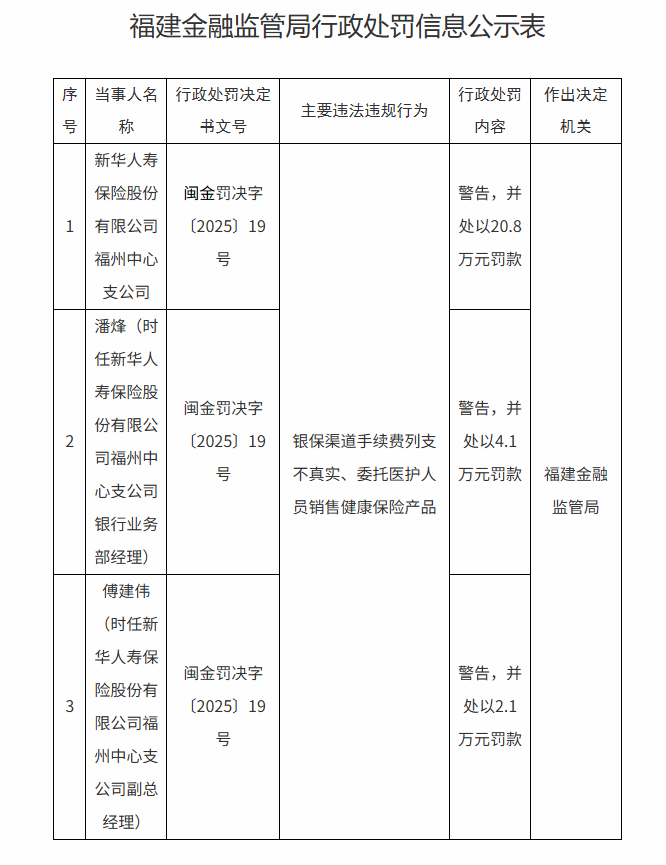
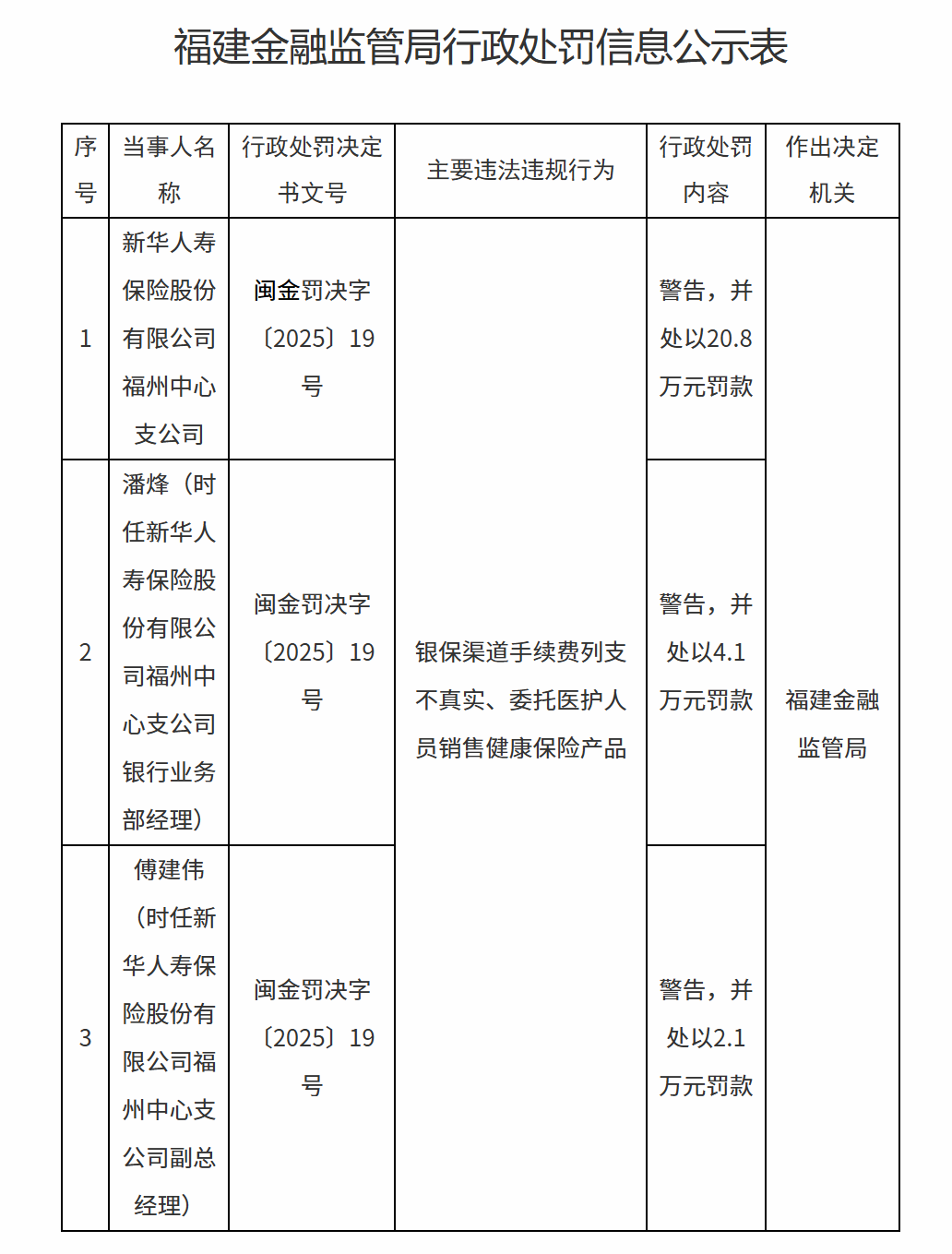
新华保险福州中心支公司被罚款20.8万元 因手续费列支不真实等2项违规
Feng Huang Wang Cai Jing· 2025-10-22 09:10
| 序 | 当事人名 | 行政处罚决定 | 主要违法违规行为 | 行政处罚 | 作出决定 | | --- | --- | --- | --- | --- | --- | | 를 | 称 新华人寿 | 书文号 | | 内容 | 机关 | | | 保险股份 | 闽金罚决字 | | 警告,并 | | | 1 | 有限公司 | (2025) 19 | | 处以20.8 | | | | 福州中心 | 를 | | 万元罚款 | | | | 支公司 | | | | | | | 潘烽(时 寿保险股 份有限公 | | | | | | | 任新华人 | | | | | | | | 闽金罚决字 | | 警告,并 | | | 2 | | (2025) 19 | 银保渠道手续费列支 | 处以4.1 | | | | 司福州中 | 를 | 不真实、委托医护人 | 万元罚款 | 福建金融 | | | 心支公司 | | | | | | | 银行业务 | | 员销售健康保险产品 | | 监管局 | | | 部经理) | | | | | | 3 | 傅建伟 险股份有 | 闽金罚决字 | | 警告,并 处以2.1 | | | | (时任新 | | ...
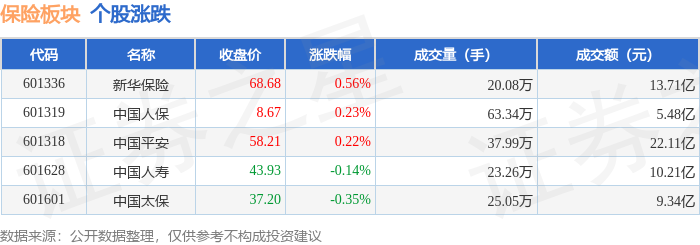
保险板块10月22日涨0.03%,新华保险领涨,主力资金净流出2.59亿元
Zheng Xing Xing Ye Ri Bao· 2025-10-22 08:19
Core Insights - The insurance sector experienced a slight increase of 0.03% on October 22, with Xinhua Insurance leading the gains [1] - The Shanghai Composite Index closed at 3913.76, down 0.07%, while the Shenzhen Component Index closed at 12996.61, down 0.62% [1] Insurance Sector Performance - Xinhua Insurance (601336) closed at 68.68, up 0.56% with a trading volume of 200,800 shares and a transaction value of 1.371 billion [1] - China Pacific Insurance (601601) closed at 37.20, down 0.35% with a trading volume of 250,500 shares and a transaction value of 934.7 million [1] - China Life Insurance (601628) closed at 43.93, down 0.14% with a trading volume of 232,600 shares and a transaction value of 1.021 billion [1] - China Ping An (601318) closed at 58.21, up 0.22% with a trading volume of 379,900 shares and a transaction value of 2.211 billion [1] - China Reinsurance (601319) closed at 8.67, up 0.23% with a trading volume of 633,400 shares and a transaction value of 548 million [1] Capital Flow Analysis - The insurance sector saw a net outflow of 259 million from institutional investors, while retail investors contributed a net inflow of 253 million [1] - Xinhua Insurance had a net inflow of 75.31 million from institutional investors, but a net outflow of 73.70 million from retail investors [2] - China Ping An experienced a significant net outflow of 168 million from institutional investors, while retail investors contributed a net inflow of 172 million [2] - China Life Insurance and China Pacific Insurance also saw net outflows from institutional investors, with retail investors offsetting some of these losses [2]