PICC(01339)

Search documents
高盛:中国人民保险集团长期目标为股东提供可持续股息增长 目标价6.8港元
Zhi Tong Cai Jing· 2026-01-20 02:04
Group 1 - Goldman Sachs has assigned a "Neutral" rating for China People's Insurance Group (01339) H-shares and a "Sell" rating for PICC (601319.SH) A-shares, with a 12-month target price of HKD 6.8 and CNY 6.5 respectively [1] - For China Pacific Insurance (02328), Goldman Sachs has given a "Buy" rating, with a 12-month target price of HKD 19.7 based on return on equity valuation [1] - The management team of China People's Insurance Group emphasized the focus on improving cost efficiency in non-auto insurance and expects the underwriting environment for new energy vehicle insurance to improve further [1] Group 2 - The sales performance of life insurance products during the New Year period has met the company's expectations, and it is anticipated that the sales contribution from long-term premium products will lead to margin expansion [1] - The long-term goal of PICC is to provide sustainable per-share dividend growth for shareholders, with a commitment to consider the dividend payout ratio [1]
中国人民保险集团(01339.HK):1月19日南向资金增持567.2万股
Sou Hu Cai Jing· 2026-01-19 19:20
Group 1 - The core viewpoint of the article highlights that southbound funds have increased their holdings in China People's Insurance Group (01339.HK) by 5.67 million shares on January 19, with a total net increase of 15.13 million shares over the last five trading days [1] - Over the past 20 trading days, there have been 15 days of net reductions in holdings by southbound funds, totaling a decrease of 116 million shares [1] - As of now, southbound funds hold 2.563 billion shares of China People's Insurance Group, accounting for 29.36% of the company's total issued ordinary shares [1] Group 2 - China People's Insurance Group Co., Ltd. is primarily a holding company that provides insurance products, including property insurance, health insurance, life insurance, reinsurance, Hong Kong insurance, and pension insurance [1] - The property insurance business includes products for both companies and individuals, such as motor vehicle insurance, agricultural insurance, property insurance, and liability insurance [1] - The health insurance business focuses on health and medical insurance products, while the life insurance segment includes various life insurance products such as participating, whole life, annuity, and universal life insurance [1]


保险巨头盯上了50万亿到期存款
Xin Lang Cai Jing· 2026-01-19 07:37
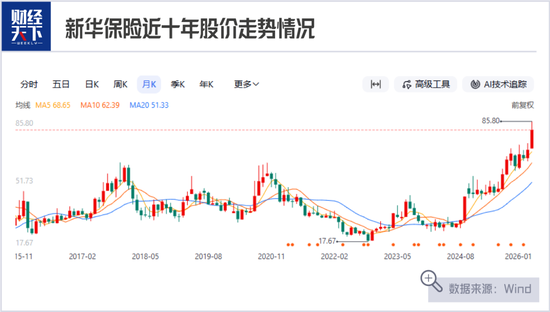
Core Viewpoint - The insurance sector is experiencing a significant rebound at the beginning of 2026, with insurance stocks rising sharply and sales of insurance products improving due to low deposit rates and favorable market conditions [1][19]. Group 1: Stock Performance - Insurance stocks have seen substantial gains, with New China Life leading with a 17.78% increase as of January 16, 2026. The top five listed insurance companies have all recorded double-digit growth over the past three months, with increases ranging from 10.32% to 23.83% [2][20]. - Historical data indicates that since 2014, there have been five notable bullish trends in the insurance sector, with stock market performance being a key catalyst for these trends [2][20]. Group 2: Sales Performance - The insurance industry is witnessing a resurgence in sales, with reports of significant premium collections, such as one company surpassing 3 billion yuan in first-year premium within four days after New Year [5][23]. - The total insurance premium income in China reached 5.76 trillion yuan by November 2025, marking an increase of 400 billion yuan from the previous year [5][23]. Group 3: Product Trends - The rise in sales is attributed to the popularity of participating insurance products, which combine protection and investment features. These products have become attractive due to their lower guaranteed rates and the current low-interest environment [6][24]. - Major insurance companies are focusing on participating insurance products, with new offerings featuring guaranteed rates around 1.75% and projected returns between 3.5% and 3.9% [7][25]. Group 4: Investment Performance - The total investment income of listed insurance companies reached 887.5 billion yuan in the first three quarters of 2025, reflecting a year-on-year increase of 35.64% [10][28]. - The investment strategies of insurance companies have shifted towards equities, with significant increases in stock and equity fund investments, particularly for companies like China Life and Ping An [12][30]. Group 5: Future Outlook - Analysts express optimism about the continued strength of insurance stocks in 2026, driven by robust premium growth and improved business quality, alongside favorable investment conditions [16][34]. - However, challenges remain, particularly regarding the long-term risks associated with interest rate spreads and the need for insurance companies to diversify their product offerings and improve customer satisfaction [16][35].



高盛:对人保评级“中性” 目标价6.8港元
Jin Rong Jie· 2026-01-19 06:37
Group 1 - Goldman Sachs rates China People's Insurance Group (01339.HK) as "Neutral" for H-shares and "Sell" for A-shares, with a 12-month target price of HKD 6.8 and CNY 6.5 respectively [1] - Goldman Sachs gives China Pacific Insurance (02328.HK) a "Buy" rating, with a 12-month target price of HKD 19.7 based on return on equity valuation method [1]
大行评级丨高盛:对中国人保评级“沽售”,目标价6.5元
Ge Long Hui A P P· 2026-01-19 06:30
格隆汇1月19日|高盛对中国人民保险集团(1339.HK)H股及人保(601319.SH)A股的评级分别为"中 性"和"沽售",基于分类加总估值法给出的12个月目标价为6.8港元和6.5元人民币。该行对中国财险 (2328.HK)给予"买入"评级,基于股东权益回报率估值法给出的12个月目标价为19.7港元。 MACD金叉信号形成,这些股涨势不错! ...
国际知名投行最新研判:保险股再迎“戴维斯双击”!
Xin Lang Cai Jing· 2026-01-19 06:29
Core Viewpoint - The insurance sector is poised for strategic investment opportunities due to the growth in net assets and investment returns, supported by shifts in resident savings towards insurance assets, alongside favorable policies [1][9]. Group 1: Performance Metrics - The insurance index is projected to rise by 31.31% in 2025, outperforming other financial sectors such as banking (12.04%) and brokerage (4.05%) [1]. - Individual stocks like New China Life, Ping An, China Pacific Insurance, China Life, and China Property & Casualty are expected to see significant increases in their stock prices, with respective gains of 46.03%, 35.87%, 26.6%, 21.21%, and 10.39% in 2025 [1]. - The A-share insurance sector is anticipated to maintain strong performance into 2026, with continued growth in the liability side and improved investment returns on the asset side [1]. Group 2: Liability Side Developments - The transformation of participating insurance products is enhancing competitiveness, attracting funds due to their "guaranteed + floating" return characteristics amid declining bank deposit rates [2][10]. - The ongoing shift in resident deposits and the reduction in large bank certificates of deposit are expected to further expand the growth of the insurance liability side [2][11]. - The demand for pension and health protection is driving the appeal of insurance products, which are expected to capture a larger share of resident savings and fixed-income investments [2][12]. Group 3: Asset Side Strategies - Insurers are increasing their allocation to equity assets due to pressure on interest margins and the challenges of bond yields not covering the costs of new premium inflows [5][14]. - The need for higher investment returns is pushing insurers to enhance their equity investment capabilities, especially as the industry transitions to a full-scale transformation of participating insurance by 2027 [5][15]. - The long-term trend indicates a significant increase in the proportion of equity investments within insurance portfolios, driven by the need for better returns [5][15]. Group 4: Policy Environment - Regulatory policies since September 2024 have encouraged insurance capital to enter the market, with expectations of substantial annual inflows into A-shares [7][16]. - The introduction of structural easing policies aims to optimize asset allocation and reduce capital requirements for insurance companies, supporting long-term market stability [7][16]. - The focus on nurturing patient capital and guiding long-term investments is expected to stabilize the capital market, with a particular emphasis on technology sectors for potential high returns [8][17].

青岛监管局同意中国人保健康青岛分公司中央商务区营销服务部变更营业场所
Jin Tou Wang· 2026-01-19 03:31
一、同意中国人民健康保险股份有限公司青岛分公司中央商务区营销服务部将营业场所变更为:青岛市 李沧区书院路37-02号1楼123室。 二、中国人民健康保险股份有限公司应按照有关规定及时办理变更及许可证换领事宜。 2026年1月12日,国家金融监督管理总局青岛监管局发布批复称,《关于中国人民健康保险股份有限公 司青岛分公司中央商务区营销服务部迁址的请示》(青岛人保健康发〔2025〕68号)收悉。经审核,现批 复如下: ...
衍生品新规释放积极信号,关注板块发布业绩预增机遇
GF SECURITIES· 2026-01-18 10:26
Core Insights - The report highlights that new regulations in derivatives are expected to release positive signals for the non-bank financial sector, with a focus on companies likely to announce performance increases [1][5]. Group 1: Market Performance - As of January 16, 2026, the Shanghai Composite Index closed at 4101.91, down 0.45%, while the Shenzhen Component Index rose by 1.14% to 14281.08 [10]. - The average daily trading volume in the Shanghai and Shenzhen markets reached 3.47 trillion yuan, an increase of 21.50% month-on-month [5]. Group 2: Industry Dynamics and Weekly Commentary Insurance Sector - Listed insurance companies are expected to continue high growth, with improvements in long-term interest rate spreads anticipated [12][16]. - As of January 12, 2026, the total scale of private equity securities investment funds by insurance capital reached 184.5 billion yuan, with 11 funds established [16]. - The report suggests focusing on companies such as China Ping An, China Life, and New China Life for potential investment opportunities [16]. Securities Sector - The China Securities Regulatory Commission (CSRC) emphasized stability and quality improvement in its 2026 work meeting, aiming to prevent market volatility and enhance internal stability [17][18]. - The CSRC's new derivatives regulations aim to standardize the market, encourage risk management, and improve the income structure of brokerage firms [25][26]. - The report indicates that the derivatives market is expected to grow significantly, with the scale of over-the-counter derivatives increasing from 0.32 trillion yuan in 2015 to 2.38 trillion yuan in 2023, reflecting a compound annual growth rate of 29% [26]. Group 3: Key Company Valuations and Financial Analysis - China Ping An (601318.SH) has a current price of 66.33 yuan, with a target value of 85.17 yuan, indicating a buy rating [6]. - New China Life (601336.SH) is rated as a buy with a current price of 82.09 yuan and a target value of 94.21 yuan [6]. - China Life (601628.SH) is also rated as a buy, with a current price of 47.52 yuan and a target value of 55.47 yuan [6].
应对降雪低温天气,人保财险北京分公司已接车险报案363件
Bei Jing Shang Bao· 2026-01-18 08:52
Group 1 - The core viewpoint of the article highlights the proactive measures taken by the company to ensure customer safety and efficient claims processing during the snowfall in Beijing starting January 17 [1] Group 2 - The company has initiated a self-service rapid reporting channel that operates 24 hours to receive customer claims [1] - A quick rescue service has been activated to provide timely assistance to affected vehicles [1] - The company has collaborated with a thousand repair institutions to ensure the promptness of vehicle rescue services [1] - An online quick compensation service for minor personal injuries has been launched to provide direct support to customers [1] Group 3 - The company has prepared 200 rescue vehicles to ensure adequate rescue capabilities during the snowfall [1] - In case of concentrated orders in specific areas, the company will activate a cross-regional service scheduling mechanism to enhance service capacity [1] - As of January 18 at 11 AM, there were 363 car insurance claims reported, with 39 rescue operations dispatched, representing an approximate 20% increase in claims compared to normal days [1] - The claims were primarily concentrated in the Chaoyang, Haidian, and Daxing districts [1]
中华财险九江中支被罚 未严格执行经备案的保险条款等
Zhong Guo Jing Ji Wang· 2026-01-18 06:58
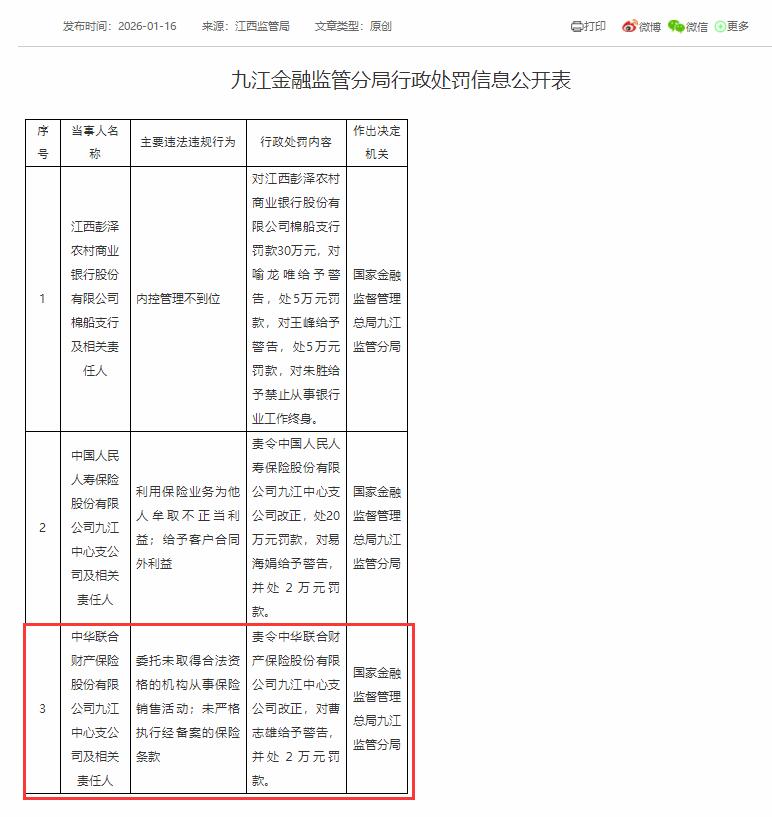
Group 1 - The National Financial Supervision Administration's Jiujiang Regulatory Bureau has issued administrative penalties against China United Property Insurance Co., Ltd. Jiujiang Branch for engaging unqualified institutions in insurance sales activities and failing to strictly implement the approved insurance terms [1][3] - The Jiujiang Regulatory Bureau has ordered China United Property Insurance Co., Ltd. Jiujiang Branch to rectify its practices and has imposed a fine of 20,000 yuan on the responsible person, Cao Zhixiong, along with a warning [1][3] - The penalties reflect ongoing regulatory scrutiny in the insurance sector, emphasizing compliance with legal qualifications and adherence to approved insurance terms [1][3]