
HUA HONG SEMI(01347)

Search documents
异动盘点1204 | 资本界金控跌创历史新低,澳达控股复牌暴涨超200%;热门中概股普跌,美股机器人概念股强劲拉升
贝塔投资智库· 2025-12-04 04:05
Group 1 - The core viewpoint of the articles highlights significant stock movements in the Hong Kong and US markets, driven by company announcements and strategic partnerships [1][2][5][6][7]. Group 2 - Gilead Sciences-B (01672) saw a nearly 9% increase after announcing a share buyback plan, utilizing up to 300 million HKD for repurchases [1]. - OSL Group (00863) rose nearly 2% as it plans to offer compliant digital asset trading services in Europe by Q1 2026 [1]. - Gako Science-B (01167) increased over 5% following a 125 million RMB payment from Haisheng Capital, enhancing its cash reserves for oncology therapy development [1]. - Zhida Technology (02650) surged over 4%, reaching a new high, after signing a sales order exceeding 100 million RMB with Saudi Controls Ltd for a five-year collaboration [2]. - Capital界金控 (00204) fell over 40%, marking a historical low, with a cumulative decline exceeding 80% for the week [2]. - Semiconductor stocks performed well, with Huahong Semiconductor (01347) up 3.18%, Shanghai Fudan (01385) up 2.79%, and SMIC (00981) up 1.86% [2]. - Pacific Shipping (02343) rose nearly 5% as the Baltic Dry Index reached 2845 points, a 9.42% increase, marking the largest rise since October 2025 [3]. - Aoda Holdings (09929) resumed trading with a surge of over 200%, following a major share sale involving 1.5 billion shares at a price of 0.11 HKD per share [4]. - Robotics stocks saw significant gains, with Dechang Motor Holdings (00179) up 9.11% and Sanhua Intelligent Control (02050) up 9.06% [4]. - Ansem Semiconductor (ON.US) rose 11.01% after announcing a strategic partnership with Innosec to advance GaN technology applications [5]. - The Nasdaq Golden Dragon Index fell 1.38%, with notable declines in popular Chinese stocks like Xpeng Motors (XPEV.US) down 4.02% and Alibaba (BABA.US) down 1.89% [5]. - Microchip Technology (MCHP.US) increased by 12.17% after raising its revenue and earnings per share forecasts due to strong booking performance [6]. - Bitcoin-related stocks saw gains, with Iren Ltd (IREN.US) up 6.91% and Coinbase (COIN.US) up 5.19% [6]. - The robotics sector in the US experienced a boost, with Richtech Robotics (RR.US) up 18.54% and iRobot (IRBT.US) up 73.85% amid government support for the industry [7].


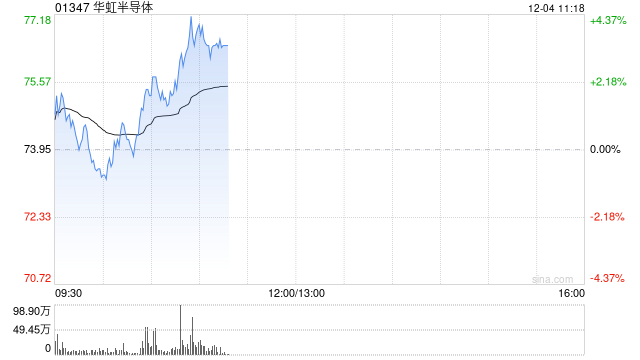
港股异动 芯片股涨幅居前 华虹半导体(01347)盘中涨超4% 中芯国际(00981)涨近3%
Jin Rong Jie· 2025-12-04 04:04
Group 1 - Semiconductor stocks are performing well, with Huahong Semiconductor rising by 3.45% to HKD 76.5, Shanghai Fudan increasing by 2.63% to HKD 39.78, and SMIC up by 1.86% to HKD 68.45 [1] - Moore Threads announced that its stock will be listed on the Shanghai Stock Exchange's Sci-Tech Innovation Board on December 5, 2025 [1] - Muxi Co., Ltd. confirmed its IPO pricing at CNY 104.66 per share, resulting in a market capitalization of CNY 41.8 billion [1] Group 2 - Shanghai Securities reported that the global wafer foundry industry revenue is expected to grow by 22.1% year-on-year in 2025, driven by AI and electric vehicles [1] - CITIC Securities projects that the Chinese AI chip market size will increase from USD 35-40 billion in 2025 to 7-9 times that amount by 2030, with growth rates surpassing the global average [1] - The domestic production rate of AI chips in China is anticipated to rise from 30-40% in 2025 to 60-70% by 2030 [1]

港股异动 | 芯片股涨幅居前 华虹半导体(01347)盘中涨超4% 中芯国际(00981)涨近3%
Zhi Tong Cai Jing· 2025-12-04 03:21
Group 1 - Semiconductor stocks are performing well, with Huahong Semiconductor rising by 3.45% to HKD 76.5, Shanghai Fudan increasing by 2.63% to HKD 39.78, and SMIC up by 1.86% to HKD 68.45 [1] - Moore Threads announced that its stock will be listed on the Shanghai Stock Exchange's Sci-Tech Innovation Board on December 5, 2025 [1] - Muxi Co., Ltd. revealed its IPO pricing at CNY 104.66 per share, resulting in a market capitalization of CNY 41.8 billion [1] Group 2 - Shanghai Securities reported that the global wafer foundry industry revenue is expected to grow by 22.1% year-on-year in 2025, driven by AI and electric vehicles [1] - CITIC Securities forecasts that the Chinese AI chip market size will increase from USD 35-40 billion in 2025 to 7-9 times that amount by 2030, with growth rates surpassing the global average [1] - The domestic production rate of AI chips in China is projected to rise from 30-40% in 2025 to 60-70% by 2030 [1]
芯片股涨幅居前 华虹半导体盘中涨超4% 中芯国际涨近3%
Zhi Tong Cai Jing· 2025-12-04 03:20
Group 1 - Semiconductor stocks are performing well, with Huahong Semiconductor rising by 3.45% to HKD 76.5, Shanghai Fudan increasing by 2.63% to HKD 39.78, and SMIC up by 1.86% to HKD 68.45 [1] - Moore Threads announced that its stock will be listed on the Shanghai Stock Exchange's Sci-Tech Innovation Board on December 5, 2025 [1] - Muxi Co., Ltd. confirmed its IPO pricing at CNY 104.66 per share, resulting in a market capitalization of CNY 41.8 billion [1] Group 2 - Shanghai Securities reported that the global wafer foundry industry revenue is expected to grow by 22.1% year-on-year in 2025, driven by AI and electric vehicles [1] - CITIC Securities projected that the Chinese AI chip market size will increase from USD 35-40 billion in 2025 to 7-9 times that amount by 2030, with growth rates surpassing the global average [1] - The domestic production rate of AI chips in China is anticipated to rise from 30-40% in 2025 to 60-70% by 2030 [1]
芯片股早盘涨幅居前 华虹半导体及中芯国际均涨逾3%
Xin Lang Cai Jing· 2025-12-04 03:19
Core Viewpoint - Semiconductor stocks are experiencing significant gains in early trading, indicating positive market sentiment towards the sector [1][2]. Group 1: Stock Performance - Hua Hong Semiconductor (01347) has risen by 3.45%, trading at HKD 76.50 [1][2]. - Shanghai Fudan (01385) has increased by 2.79%, with a current price of HKD 39.84 [1][2]. - SMIC (00981) has seen a rise of 1.86%, currently priced at HKD 68.45 [1][2].
华虹公司涨2.09%,成交额4.89亿元,主力资金净流入683.90万元
Xin Lang Zheng Quan· 2025-12-04 02:34
Core Viewpoint - Huahong Semiconductor has shown significant stock performance with a year-to-date increase of 131.63%, despite recent fluctuations in the short term [2] Group 1: Stock Performance - As of December 4, Huahong's stock price rose by 2.09% to 107.64 CNY per share, with a trading volume of 489 million CNY and a turnover rate of 1.13%, resulting in a total market capitalization of 186.86 billion CNY [1] - The stock has experienced a 1.05% increase over the last five trading days, a 15.42% decrease over the last 20 days, and a 38.19% increase over the last 60 days [2] Group 2: Financial Performance - For the period from January to September 2025, Huahong achieved a revenue of 12.583 billion CNY, representing a year-on-year growth of 19.82%, while the net profit attributable to shareholders decreased by 56.52% to 251 million CNY [3] Group 3: Shareholder and Institutional Holdings - As of September 30, 2025, the number of Huahong's shareholders increased by 30.97% to 49,000, with an average of 0 circulating shares per shareholder [3] - The company has distributed a total of 258 million CNY in dividends since its A-share listing [4] - Notable institutional shareholders include Galaxy Innovation Mixed A and Jiashi Shanghai Stock Exchange Science and Technology Innovation Board Chip ETF, with the latter reducing its holdings by 427,700 shares [4]
港股通(深)净买入17.32亿港元
Zheng Quan Shi Bao Wang· 2025-12-03 15:16
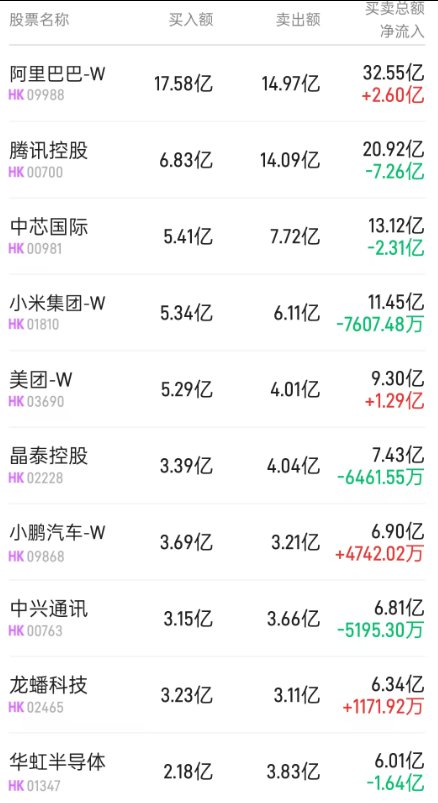
Core Viewpoint - The Hang Seng Index fell by 1.28% to close at 25,760.73 points on December 3, with a net inflow of HKD 2.279 billion through the southbound trading channel [1][3]. Group 1: Market Activity - The total trading volume for the southbound trading on December 3 was HKD 66.132 billion, with a net buy of HKD 2.279 billion [1]. - The Shanghai Stock Exchange's southbound trading accounted for HKD 39.050 billion in trading volume, with a net buy of HKD 0.548 billion, while the Shenzhen Stock Exchange had a trading volume of HKD 27.082 billion and a net buy of HKD 1.732 billion [1]. Group 2: Active Stocks - In the Shanghai Stock Exchange's southbound trading, Alibaba-W had the highest trading volume at HKD 32.55 billion, followed by Tencent Holdings and SMIC with HKD 20.92 billion and HKD 13.12 billion respectively [1]. - In terms of net buy amounts, Alibaba-W led with a net buy of HKD 2.60 billion, despite its stock price dropping by 2.17% [1]. - Tencent Holdings experienced the highest net sell amount of HKD 7.26 billion, with a closing price decrease of 0.97% [1]. Group 3: Shenzhen Stock Exchange Activity - In the Shenzhen Stock Exchange's southbound trading, Alibaba-W also topped the trading volume with HKD 23.90 billion, followed by Xiaomi Group-W and Tencent Holdings with HKD 16.21 billion and HKD 14.74 billion respectively [2]. - Xiaomi Group-W had the highest net buy amount of HKD 9.46 billion, despite a closing price drop of 1.18% [2]. - SMIC recorded the highest net sell amount of HKD 1.88 billion, with a closing price decrease of 2.11% [2].





北水动向|北水成交净买入22.79亿 内资继续抛售芯片股 加仓小米(01810)超8亿港元
Zhi Tong Cai Jing· 2025-12-03 10:22
Group 1 - Northbound capital recorded a net purchase of 22.79 billion HKD in the Hong Kong stock market on December 3, with net purchases of 5.48 billion HKD from the Shanghai Stock Connect and 17.32 billion HKD from the Shenzhen Stock Connect [1] - The most net purchased stocks included Xiaomi Group-W (01810), Alibaba-W (09988), and Meituan-W (03690), while the most net sold stocks were Tencent (00700), SMIC (00981), and Hua Hong Semiconductor (01347) [1] Group 2 - Xiaomi Group-W (01810) saw a net purchase of 8.7 billion HKD, with over 500,000 cars delivered since April 3, 2024, and November deliveries exceeding 40,000 units [3] - Alibaba-W (09988) received a net purchase of 4.27 billion HKD, with its AI product "Qianwen App" achieving a monthly active growth rate of 149.03% [3] - Meituan-W (03690) had a net purchase of 2.97 billion HKD, with expectations of reduced losses in its food delivery business and a focus on high-value orders [3] Group 3 - Longpan Technology (02465) received a net purchase of 1.17 billion HKD, signing a long-term procurement agreement for lithium iron phosphate cathode materials worth approximately 4.5 to 5.5 billion CNY [4] - ZTE Corporation (00763) faced a net sell-off of 59.73 million HKD, with its nubia M153 phone being an engineering sample for industry professionals [4] - Northbound capital continued to sell semiconductor stocks, with Hua Hong Semiconductor and SMIC experiencing net sales of 66.36 million HKD and 419 million HKD, respectively [4] Group 4 - XPeng Motors-W (09868) recorded a net purchase of 59.29 million HKD, while Tencent (00700) faced a net sell-off of 732 million HKD [5]
北水动向|北水成交净买入22.79亿 内资继续抛售芯片股 加仓小米超8亿港元
智通财经网· 2025-12-03 10:03
Group 1: Market Overview - Northbound capital recorded a net purchase of HKD 22.79 billion on December 3, with HKD 5.48 billion from the Shanghai Stock Connect and HKD 17.32 billion from the Shenzhen Stock Connect [1] - The most purchased stocks included Xiaomi Group-W (01810), Alibaba-W (09988), and Meituan-W (03690) [1] - The most sold stocks were Tencent (00700), SMIC (00981), and Hua Hong Semiconductor (01347) [1] Group 2: Stock Performance - Alibaba-W (09988) saw a net inflow of HKD 4.27 billion, driven by the launch of its AI app, which achieved a monthly active growth rate of 149.03% [4] - Xiaomi Group-W (01810) received a net purchase of HKD 8.7 billion, with over 500,000 cars delivered since April 3, 2024, and a share buyback of HKD 1.02 billion for 2.5 million shares [3][5] - Meituan-W (03690) had a net inflow of HKD 2.97 billion, with expectations of reduced losses in its food delivery business and a significant share purchase by JPMorgan [5] Group 3: Notable Transactions - Dragon Power Technology (02465) received a net purchase of HKD 1.17 billion, signing a long-term procurement agreement for lithium iron phosphate materials worth approximately HKD 4.5-5.5 billion [5] - ZTE Corporation (00763) faced a net sell-off of HKD 59.73 million, with reports of a new AI phone prototype being developed [5][6] - Northbound capital continued to sell semiconductor stocks, with Hua Hong Semiconductor and SMIC experiencing net sell-offs of HKD 66.36 million and HKD 419 million, respectively [6]
华虹公司(688347) - 港股公告:证券变动月报表
2025-12-03 08:30
股份發行人及根據《上市規則》第十九B章上市的香港預託證券發行人的證券變動月報表 截至月份: 2025年11月30日 狀態: 新提交 致:香港交易及結算所有限公司 公司名稱: 華虹半導體有限公司(於香港註冊成立的有限公司) 呈交日期: 2025年12月3日 I. 法定/註冊股本變動 不適用 FF301 第 1 頁 共 10 頁 v 1.1.1 FF301 II. 已發行股份及/或庫存股份變動 | 1. 股份分類 | 普通股 | 股份類別 | 不適用 | | 於香港聯交所上市 (註1) | 是 | | | --- | --- | --- | --- | --- | --- | --- | --- | | 證券代號 (如上市) | 01347 | 說明 | | | | | | | | | 已發行股份(不包括庫存股份)數目 | | 庫存股份數目 | | 已發行股份總數 | | | 上月底結存 | | | 1,328,093,768 | | 0 | | 1,328,093,768 | | 增加 / 減少 (-) | | | 155,728 | | | | | | 本月底結存 | | | 1,328,249,496 | ...