3SBIO(01530)

Search documents
三生制药(01530)上涨2.06%,报31.72元/股
Jin Rong Jie· 2025-08-14 02:40
Core Viewpoint - Sangfor Pharmaceuticals is a leading biopharmaceutical company in China, focusing on the research, development, production, and sales of innovative drugs, with a strong market presence in various therapeutic areas [1][2]. Group 1: Company Overview - Sangfor Pharmaceuticals' stock price increased by 2.06% to 31.72 CNY per share, with a trading volume of 632 million CNY as of 10:23 on August 14 [1]. - The company has approximately 30 marketed products and 31 products under development, leading in market share across various therapeutic areas [1]. - Sangfor possesses comprehensive R&D and CDMO capabilities covering the entire lifecycle of biopharmaceuticals, with six global production bases [1]. - The CDMO capacity reached 76,000 liters in 2023, supported by a network of over 2,600 medical representatives for academic promotion [1]. Group 2: Financial Performance - As of the 2024 annual report, Sangfor Pharmaceuticals reported total revenue of 9.108 billion CNY and a net profit of 2.09 billion CNY [2].
中华交易服务香港生物科技指数上涨4.39%,前十大权重包含三生制药等
Jin Rong Jie· 2025-08-13 14:12
Core Insights - The CESHKB index has shown significant growth, with a year-to-date increase of 102.54% [1] - The index reflects the overall performance of biotechnology companies listed in Hong Kong [1] Group 1: Index Performance - The CESHKB index rose by 4.39% to 9474.11 points, with a trading volume of 17.473 billion [1] - Over the past month, the index has increased by 16.18%, and over the last three months, it has surged by 61.71% [1] Group 2: Index Composition - The CESHKB index is compiled by China Securities Index Co., Ltd. under the commission of China Securities Trading Service Co., Ltd. [1] - The index is based on a reference date of December 12, 2014, with a base point of 2000.0 [1] Group 3: Top Holdings - The top ten weighted stocks in the CESHKB index include: - CanSino Biologics (13.59%) - Innovent Biologics (9.6%) - WuXi Biologics (8.91%) - 3SBio (8.66%) - BeiGene (8.33%) - WuXi AppTec (7.12%) - Kintor Pharmaceutical (4.95%) - Zai Lab (4.42%) - Genscript Biotech (3.92%) - Ascletis Pharma (3.91%) [1] Group 4: Market and Industry Overview - The CESHKB index is entirely composed of companies listed on the Hong Kong Stock Exchange, with a 100% representation in the healthcare sector [2]
近15日连续“吸金”累计超10亿,港股创新药50ETF(513780)午盘涨超3%,“医保双目录”申报药品亮相
Sou Hu Cai Jing· 2025-08-13 05:56
Group 1 - The Hong Kong stock market showed strong performance on August 13, with the Hang Seng Index rising by 1.88% and the Hang Seng Tech Index increasing by 2.35%, particularly driven by the healthcare sector [1] - The Hong Kong Innovative Drug 50 ETF (513780) closed up by 3.38% with a turnover rate exceeding 18% and a transaction volume of over 400 million yuan, indicating strong investor interest [1] - Notably, the Hong Kong Innovative Drug 50 ETF (513780) experienced a net inflow of 1.07 billion yuan over the past 15 trading days, and it has gained over 92% year-to-date as of August 12 [1] Group 2 - The National Healthcare Security Administration announced the preliminary review results for the 2025 medical insurance directory and commercial insurance innovative drug directory, with 534 drugs passing the basic medical insurance directory review and 121 drugs passing the commercial insurance innovative drug directory review [2] - High-priced innovative drugs, including CAR-T therapies, are seeking inclusion in the commercial insurance innovative drug directory, indicating a push for diversified payment methods for innovative drugs [2] - Analysts suggest that the rise of innovative drugs is sustainable, recommending attention to companies with rich pipeline layouts, high-potential single innovative drugs, and leading technology platforms in the sector [2]



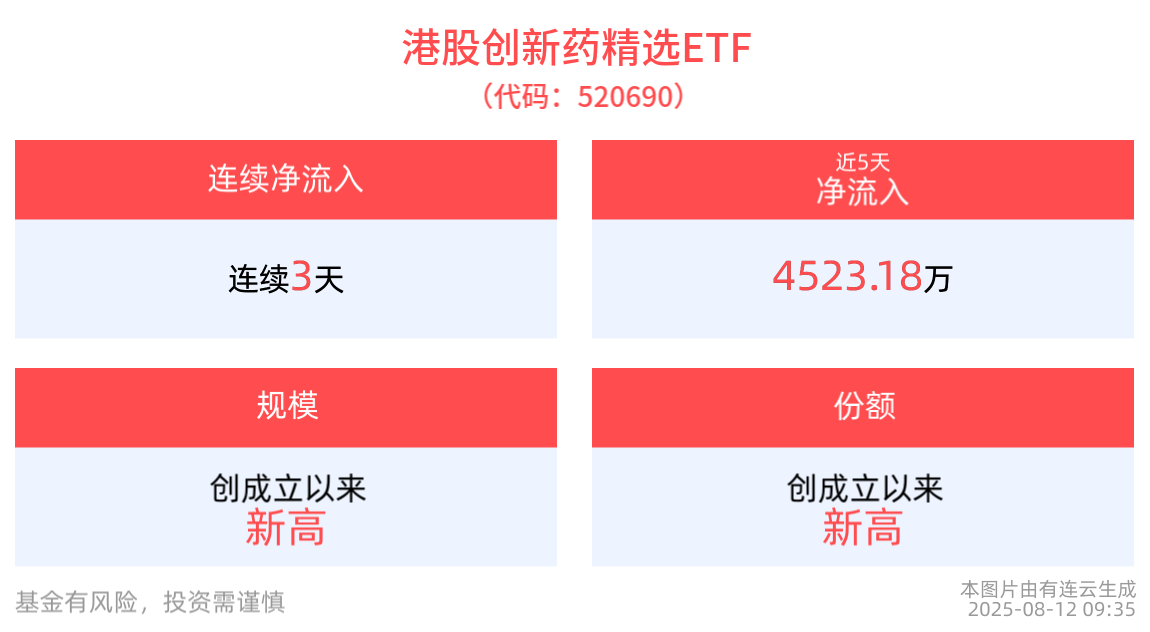
港股创新药精选ETF(520690)连续3天获资金净流入,晶泰控股领涨超7%,预计中期综合收益同比增加至少约387%
Xin Lang Cai Jing· 2025-08-12 02:13
Group 1 - The Hang Seng Hong Kong Stock Connect Innovative Drug Selection Index (HSSCPB) increased by 0.02%, with notable stock performances including Jingtai Holdings (02228) up 7.38% and Fosun Pharma (02196) up 6.00% [3] - The Hong Kong Innovative Drug Selection ETF (520690) rose by 0.52%, reaching a latest price of 0.97 yuan, with a trading volume of 240.45 million yuan and a turnover rate of 0.62% [3] - Jingtai Holdings announced an expected comprehensive income of no less than 500 million yuan for the six months ending June 30, 2025, representing an increase of at least 387% compared to the same period in 2024 [3] Group 2 - The Hong Kong Innovative Drug Selection ETF reached a new high in scale at 385 million yuan and a new high in shares at 399 million [4] - The ETF has seen continuous net inflows over the past three days, with a maximum single-day net inflow of 22.93 million yuan, totaling 42.28 million yuan [4] - The ETF's management fee is 0.50% and the custody fee is 0.10%, which are among the lowest in comparable funds [5] Group 3 - The HSSCPB index aims to reflect the performance of Hong Kong-listed companies involved in innovative drug research, development, and production [5] - The top ten weighted stocks in the HSSCPB index account for 78.05% of the total index weight, including companies like BeiGene (06160) and WuXi Biologics (02269) [5]


三生制药(01530)上涨2.01%,报30.46元/股
Jin Rong Jie· 2025-08-11 05:28
Core Viewpoint - Sangfor Pharmaceuticals (01530) is a leading biopharmaceutical company in China, focusing on the research, production, and sales of innovative drugs, with a strong market presence in various therapeutic areas [1][2]. Group 1: Company Overview - Sangfor Pharmaceuticals has approximately 30 listed products and 31 products in development, with core products leading in market share across different therapeutic areas [1]. - The company possesses comprehensive R&D and CDMO capabilities covering the entire lifecycle of biopharmaceuticals, with six global production bases [1]. - As of 2023, the CDMO capacity reached 76,000 liters, supported by a network of over 2,600 medical representatives for extensive academic promotion [1]. Group 2: Financial Performance - As of the 2024 annual report, Sangfor Pharmaceuticals reported total revenue of 9.108 billion yuan and a net profit of 2.09 billion yuan [2].
MSCI指数调整新纳入14只股票 中国资产或迎增量资金
Cai Jing Wang· 2025-08-11 03:10
Group 1 - MSCI announced the results of its index review for August 2025, including the addition of 14 stocks to the MSCI China Index and the removal of 17 stocks, effective after the market close on August 26 [1] - The adjustment reflects a significant increase in the inclusion of Hong Kong stocks, indicating strong recent performance in sectors such as technology, innovative pharmaceuticals, and new consumption [1] - Following the index changes, related stocks are expected to attract more incremental capital [1] Group 2 - Standard & Poor's maintained China's sovereign credit rating at "A+" with a stable outlook as of August 7 [1] - Several foreign institutions, including Deutsche Bank, Swiss Pictet Asset Management, Lobo Investment, and Legg Mason, have expressed positive views or overweight positions on Chinese assets recently [1]
三生制药(01530)下跌2.88%,报29.0元/股
Jin Rong Jie· 2025-08-11 02:25
Core Viewpoint - Sanofi Pharmaceutical is a leading biopharmaceutical company in China, focusing on the research, production, and sales of innovative drugs, with a significant market presence in various therapeutic areas [1][2]. Group 1: Company Overview - Sanofi Pharmaceutical has approximately 30 listed products and 31 products in development, with core products leading in market share across various therapeutic areas [1]. - The company possesses comprehensive R&D and CDMO capabilities covering the entire lifecycle of biopharmaceuticals, with six production bases globally [1]. - As of 2023, the CDMO capacity reached 76,000 liters, supported by a network of over 2,600 medical representatives for extensive academic promotion [1]. Group 2: Financial Performance - For the year ending 2024, Sanofi Pharmaceutical reported total revenue of 9.108 billion yuan and a net profit of 2.09 billion yuan [2].
“公募女神”基金赚翻了!她们买了这些股票
Zheng Quan Shi Bao· 2025-08-10 09:10
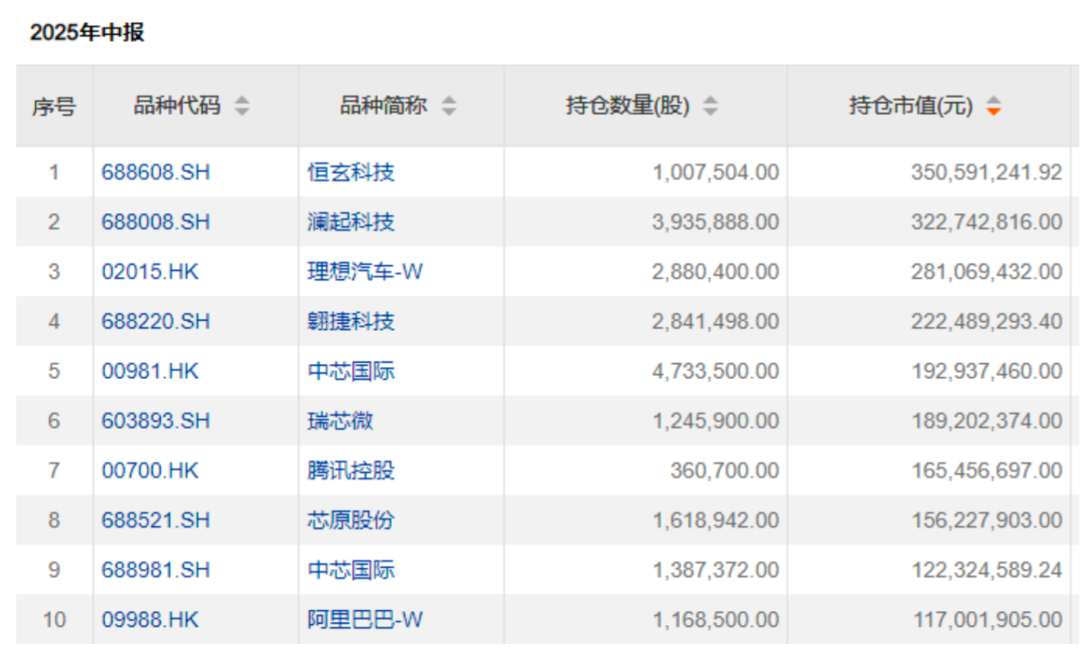
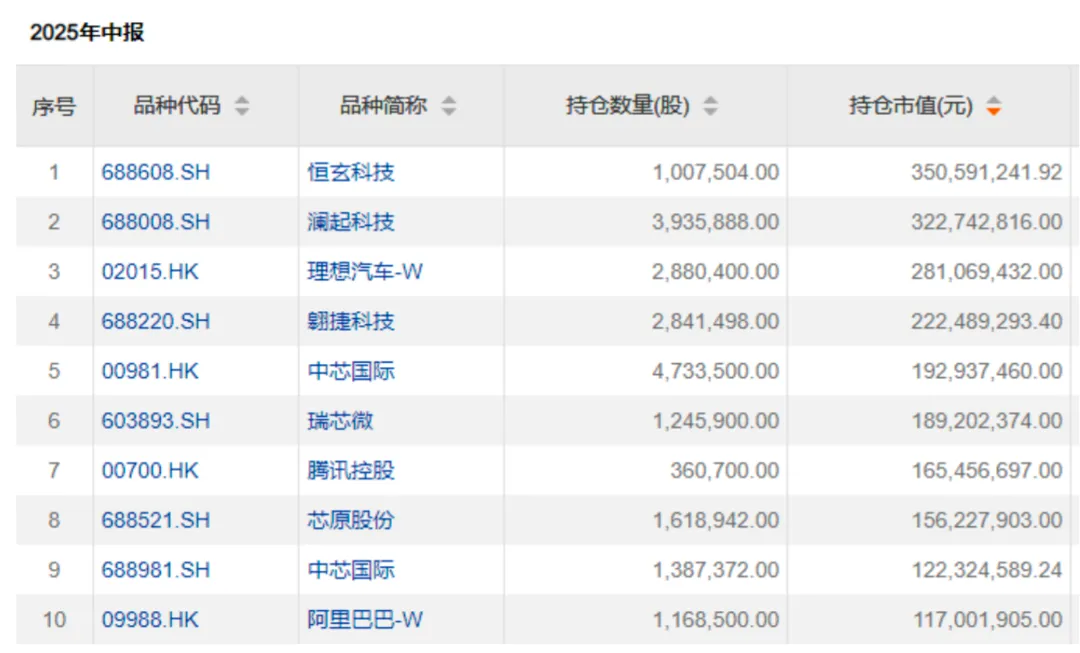
Group 1 - Central European Fund announced that its two funds, the Central European Science and Technology Innovation Fund and the Central European Medical Innovation Fund, will be subject to subscription limits starting August 11 [1] - The Central European Science and Technology Innovation Fund, managed by Shao Jie, has achieved a return rate of 132.55% since inception, with an annualized return of 14.79% for Class A shares and 39.66% with an annualized return of 13.11% for Class C shares [1] - The Central European Medical Innovation Fund, managed by renowned fund manager Ge Lan, has a return rate of 68.74% for Class A shares and 60.24% for Class C shares since inception, with annualized returns of 8.45% and 7.59% respectively [1] Group 2 - The Central European Science and Technology Innovation Fund focuses on the technology innovation industry, with significant investments in sectors such as smart vehicles, advanced manufacturing processes, self-developed chip IP, and next-generation smart terminals [2] - The top ten holdings of the Central European Science and Technology Innovation Fund include companies like Hengxuan Technology, Lanke Technology, and Ideal Automotive, with the largest holding being Hengxuan Technology valued at approximately 350.59 million yuan [2] - The Central European Medical Innovation Fund primarily invests in stocks related to medical innovation, with a focus on innovative pharmaceuticals and medical devices [2] Group 3 - The top ten holdings of the Central European Medical Innovation Fund include companies such as Sanofi Pharmaceutical, Kelun Pharmaceutical, and WuXi AppTec, with the largest holding being Sanofi Pharmaceutical valued at approximately 729.52 million yuan [4] - Other funds managed by notable managers have also reported strong performance, with year-to-date returns of 84.56% for ICBC Credit Suisse's QDII fund and 82.59% for Great Wall Fund's health-related funds [5][6]




行业周报:二代IO升级迭代,PD-1/VEGF三抗加速推进-20250810
KAIYUAN SECURITIES· 2025-08-10 09:05
Investment Rating - The industry investment rating is "Positive" (maintained) [1] Core Views - The report highlights the acceleration of PD-(L)1/VEGF and PD-(L)1/IL-2 dual antibodies, confirming the trend of upgrading single antibodies to multi-target therapies [5][14] - As of August 8, 2025, there are 32 PD-(L)1 tri-antibodies in clinical and preclinical stages globally, with 16 being PD-(L)1/VEGF tri-antibodies [5][14] - The report emphasizes the potential of PD-1/VEGF/IL-2 tri-target combination therapies to exhibit superior synergistic treatment effects [30][39] Summary by Sections Section 1: PD-(L)1 Dual Antibody Upgrades - The report notes the upgrade of PD-(L)1 dual antibodies, with 6 PD-(L)1/VEGF tri-antibodies entering clinical trials [5][14] - Multiple PD-(L)1/VEGF tri-antibodies show superior preclinical efficacy compared to competitors [6][16] - The PD-1/VEGF/IL-2 tri-target combination is expected to demonstrate enhanced synergistic treatment effects [30][39] Section 2: Market Performance - In the second week of August, the pharmaceutical and biotechnology sector declined by 0.84%, underperforming the CSI 300 index by 2.07 percentage points [41][46] - The medical consumables sector showed the largest increase, while the medical research outsourcing sector experienced the largest decline [46][47] Section 3: Recommended and Benefiting Companies - Recommended companies in pharmaceuticals and bioproducts include: Heng Rui Medicine, East China Pharmaceutical, Sanofi, and others [8] - CXO companies include WuXi AppTec, Tigermed, and others [8] - Companies in medical devices include Mindray Medical, United Imaging, and others [8]


“公募女神”基金赚翻了,她们买了这些股票
Zheng Quan Shi Bao· 2025-08-10 08:44
Group 1 - The core point of the news is that China Universal Asset Management has announced a subscription limit for two of its funds, the China Universal Science and Technology Innovation Fund and the China Universal Medical Innovation Fund, starting from August 11, to protect existing investors and maintain stable operations [1] - The China Universal Science and Technology Innovation Fund, managed by Shao Jie, has achieved a return rate of 132.55% since inception, with an annualized return of 14.79% for Class A shares and 39.66% with an annualized return of 13.11% for Class C shares [1] - The China Universal Medical Innovation Fund, managed by renowned fund manager Ge Lan, has a return rate of 68.74% for Class A shares and 60.24% for Class C shares since inception, with annualized returns of 8.45% and 7.59% respectively [1] Group 2 - The China Universal Science and Technology Innovation Fund focuses on the technology innovation industry, with significant investments in sectors such as smart vehicles, advanced manufacturing processes, and self-developed chip IP [2] - The top ten holdings of the China Universal Science and Technology Innovation Fund include companies like Hengxuan Technology, Lanyin Technology, and Tencent Holdings, with total market values ranging from approximately 117 million to 350 million yuan [2] - The China Universal Medical Innovation Fund primarily invests in stocks related to medical innovation, with a focus on innovative pharmaceuticals and medical devices [2][4] Group 3 - The top ten holdings of the China Universal Medical Innovation Fund include companies such as Sanofi Pharmaceutical and WuXi AppTec, with market values ranging from approximately 324 million to 729 million yuan [4] - Other funds managed by different companies, such as ICBC Credit Suisse and Great Wall Fund, have also reported high returns this year, with notable investments in similar sectors [5][6]