
INNOVENT BIO(01801)

Search documents
港股收盘(02.09) | 恒指收涨1.76%重返两万七 AI产业链强势反弹 智谱(02513)飙升36%创新高
智通财经网· 2026-02-09 08:48
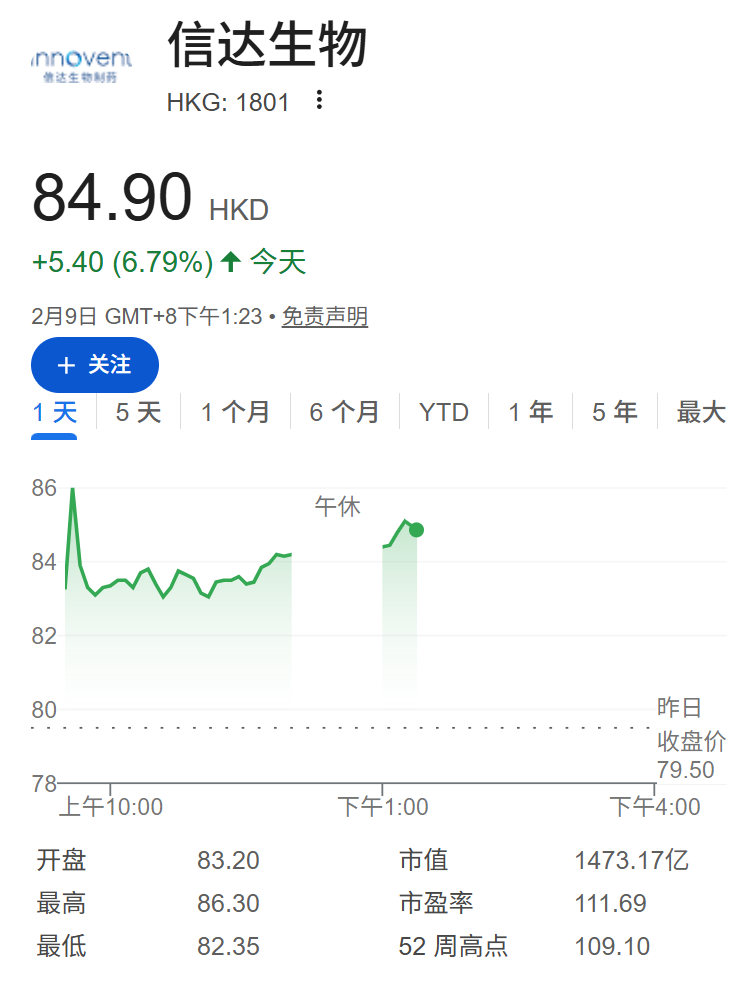
Market Overview - The Hong Kong stock market experienced a strong rebound, with the Hang Seng Index closing at 27,027.16 points, up 1.76% or 467.21 points, and a total trading volume of 255.14 billion HKD [1] - The Hang Seng Tech Index rose 1.34% to 5,417.6 points, while the Hang Seng China Enterprises Index increased by 1.52% to 9,168.33 points [1] - Analysts from Galaxy Securities noted a significant "Spring Festival effect" in the market, driven by optimistic sentiment and early capital allocation [1] Blue-Chip Stocks Performance - Innovent Biologics (01801) led the blue-chip stocks, surging 7.42% to 85.4 HKD, contributing 15.57 points to the Hang Seng Index [2] - The company announced a strategic partnership with Eli Lilly to advance global R&D in oncology and immunology, receiving an upfront payment of 350 million USD and potential milestone payments up to 8.5 billion USD [2] - Other notable blue-chip movements included Pop Mart (09992) up 5.76%, Zijin Mining (02899) up 5.58%, while China Telecom (00728) and China Mobile (00941) saw declines of 2.96% and 2.12%, respectively [2] Sector Highlights - Major technology stocks showed positive performance, with Baidu rising over 3%, Tencent up over 2%, and Alibaba increasing by 1.87% [3] - AI application stocks were particularly strong, with Zhipu AI soaring over 36% to a new high [3] - The gold sector rebounded significantly, with spot gold returning to 5,000 USD per ounce, leading to gains in gold stocks [3][6] AI and Technology Developments - Recent financial reports from Meta, Amazon, Google, and Microsoft indicated a potential capital expenditure of 660 billion USD in AI infrastructure this year [4] - Zhipu AI's stock rose 36.22% to 276.8 HKD, reflecting strong market interest in AI applications [4] - The Chinese government is focusing on building a national computing power interconnection node system, which may further stimulate the AI sector [4] New Market Entrants - Lanqi Technology (06809) debuted with a remarkable 63.72% increase, closing at 175 HKD, following its IPO pricing at 106.89 HKD per share [9] - The company specializes in integrated circuit design for cloud computing and AI infrastructure [9] - Additionally,兆易创新 (03986) saw an 11.43% rise to 314 HKD, supported by its inclusion in the Hong Kong Stock Connect program and positive earnings forecasts [10]
信达生物:与礼来达成全球战略合作,创新管线全球化进程将加速-20260209
CSC SECURITIES (HK) LTD· 2026-02-09 08:24
Investment Rating - The report assigns a "Buy" rating for the company, indicating a potential upside of 15% to less than 35% [2][4]. Core Insights - The company has entered into a global strategic collaboration with Eli Lilly to accelerate the global development of innovative drugs in oncology and immunology. The company will lead the research and development from drug discovery to clinical concept verification in China, retaining all rights in Greater China while Eli Lilly obtains exclusive rights outside this region [4][5]. - The company expects a revenue increase of 45% in 2025, projecting total product revenue of approximately RMB 11.9 billion, with Q4 alone expected to generate around RMB 3.3 billion, reflecting a year-over-year growth of over 60% [5]. - The company has a strong pipeline with 13 commercialized oncology products, and the collaboration with Eli Lilly is expected to enhance its research capabilities and market position [5]. Financial Summary - The company forecasts net profits of RMB 354 million in 2025, RMB 1.427 billion in 2026, and RMB 2.404 billion in 2027, with significant year-over-year growth rates of 304% and 68.4% for 2026 and 2027, respectively [7][9]. - Earnings per share (EPS) are projected to be RMB 0.20 in 2025, RMB 0.82 in 2026, and RMB 1.39 in 2027, with corresponding price-to-earnings (P/E) ratios of 346X, 86X, and 51X [7][9]. - The total revenue is expected to grow from RMB 6.206 billion in 2023 to RMB 20.063 billion by 2027, indicating a robust growth trajectory [9].
股价涨6.92%!信达生物与礼来88.5亿美元战略合作落地,加速中国创新药全球化
Jin Rong Jie· 2026-02-09 08:11
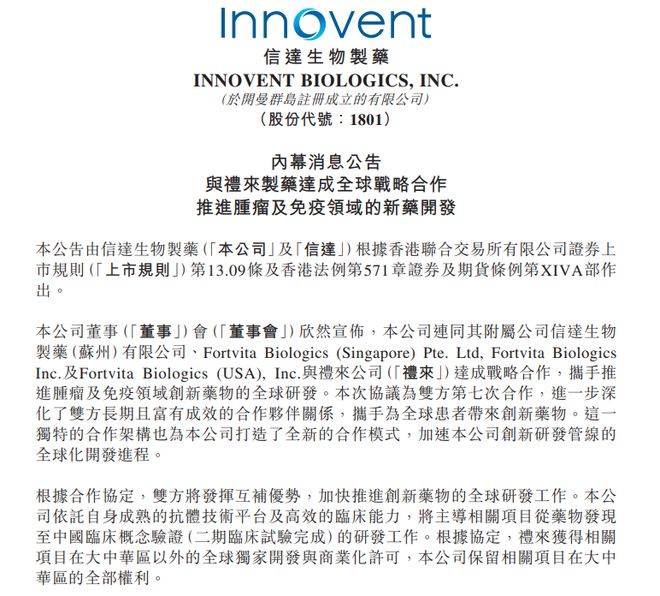
Core Insights - Chinese innovative biopharmaceutical company Innovent Biologics (01801.HK) has announced a global strategic collaboration with Eli Lilly to advance the global development of innovative drugs in oncology and immunology, marking their seventh collaboration since 2015 [1][3] Group 1: Collaboration Details - The partnership aims to leverage complementary strengths to accelerate the global development of innovative drugs, with Innovent leading the research from drug discovery to clinical concept verification in China, while Eli Lilly will have exclusive global development and commercialization rights outside Greater China [3] - Innovent will receive an upfront payment of $350 million, with potential milestone payments totaling up to $8.5 billion if all development, regulatory, and commercialization milestones are achieved [3] Group 2: Financial Performance and Market Position - Innovent has established a high-quality technology platform covering the entire cycle of biopharmaceutical development, with 18 products approved for market, 4 new drug molecules in Phase III or pivotal clinical studies, and 15 new drug candidates in clinical research [4] - Recent revenue forecasts indicate that Innovent expects approximately 11.9 billion yuan in product revenue for 2025, representing a 45% year-on-year increase, with Q4 revenue projected at around 3.3 billion yuan, showing over 60% growth year-on-year [4] - The collaboration with Eli Lilly further solidifies Innovent's position in the global innovative drug sector, following a previous $11.2 billion partnership with Takeda in October 2025 [4]

港股评级汇总:中信建投维持泡泡玛特增持评级
Xin Lang Cai Jing· 2026-02-09 07:12
Group 1: Bubble Mart (泡泡玛特) - Citic Jiantou maintains an "Accumulate" rating for Bubble Mart, highlighting the company's "one strong, multiple strong" IP structure, with Labubu's influence solidified and new IPs like Xingxingren and Crybaby driving high growth [1] Group 2: MGM China (美高梅中国) - Haitong International maintains a "Buy" rating for MGM China, reporting a 21.4% year-on-year increase in total revenue for Q4 2025, with adjusted EBITDA rising 29.5% to HKD 2.75 billion, driven by strong performance from MGM Cotai and precise targeting of high-end customers [2] - CICC also maintains an "Outperform" rating for MGM China, noting adjusted EBITDA of HKD 2.753 billion for Q4 2025, up 29% year-on-year, significantly exceeding market expectations, despite a brand fee increase expected to impact net profit by about 14% [4] - Citic Securities maintains an "Accumulate" rating for MGM China, indicating that the company's performance exceeded expectations, with net income and adjusted EBITDA recovering to pre-pandemic levels, supported by strong performances from MGM Macau and MGM Cotai [7] Group 3: Yum China (百胜中国) - Haitong International maintains a "Buy" rating for Yum China, reporting a 9% year-on-year revenue increase for Q4 2025 and a 24% increase in adjusted net profit, with same-store sales growing for three consecutive quarters and restaurant profit margins improving by 0.7 percentage points to 13.0% [3] Group 4: Innovent Biologics (信达生物) - CICC maintains an "Outperform" rating for Innovent Biologics, projecting product revenue of RMB 11.9 billion for 2025, a 45% year-on-year increase, with seven new products included in the 2026 medical insurance catalog [5] Group 5: Swire Properties (太古地产) - CICC maintains an "Outperform" rating for Swire Properties, noting significant recovery in luxury retail operations in mainland China, with retail sales in Shanghai and Beijing increasing by 49.6% and 11.2% respectively [6] Group 6: Meituan (美团) - Citic Securities maintains a "Buy" rating for Meituan, announcing a plan to acquire Dingdong Maicai for USD 717 million, which is expected to strengthen its East China front warehouse network and bring in HKD 170 million in adjusted net profit post-integration [8] Group 7: Kuaishou (快手) - Citic Jiantou maintains a "Buy" rating for Kuaishou, highlighting the launch of its AI video model 3.0, which supports 15-second generation and intelligent scene segmentation, with commercial growth expected to reach USD 240 million in ARR by 2025 [10] Group 8: Huiju Technology (汇聚科技) - Citic Jiantou maintains a "Buy" rating for Huiju Technology, emphasizing its deep ties with leading CSPs like Google and the benefits from the upgrade of optical modules, projecting a revenue increase of 82.1% year-on-year for H1 2025 [10]




高盛:信达生物(01801)与礼来(LLY.US)深化长期合作关系料被低估 予“买入”评级
智通财经网· 2026-02-09 07:02
Core Viewpoint - Goldman Sachs has issued a report stating that Innovent Biologics (01801) announced a milestone payment from Eli Lilly (LLY.US) and a tiered royalty based on net sales outside of China, indicating a positive outlook for the company [1] Group 1: Company Performance - Goldman Sachs believes that Innovent Biologics is currently undervalued, considering the high implied weighted average cost of capital (12%) in the market [1] - The firm has assigned a "Buy" rating to Innovent Biologics and set a target price of HKD 102.85 based on risk-adjusted discounted cash flow analysis [1] Group 2: Market Position and Prospects - Innovent Biologics is expected to maintain its leading position in the Chinese biotechnology sector, attributed to its extensive pipeline of novel molecules targeting next-generation immuno-oncology [1] - The company has received encouraging preliminary data for IBI363 (a PD-1/IL-2α bispecific antibody), which shows differentiated drug properties in immunotherapy/cold tumors [1] - Innovent's strong commercialization capabilities and deep collaboration with global partners, particularly Eli Lilly, are also highlighted as key strengths [1]

信达生物(01801):与礼来达成全球战略合作,创新管线全球化进程将加速
CSC SECURITIES (HK) LTD· 2026-02-09 06:49
Investment Rating - The report assigns a "Buy" rating for the company, indicating a potential upside of 15% to less than 35% [2][4]. Core Insights - The company has entered into a global strategic collaboration with Eli Lilly to accelerate the global development of innovative drugs in oncology and immunology. The company will lead the research from drug discovery to clinical concept verification in China, while Eli Lilly will have exclusive rights outside Greater China [4][5]. - The company is expected to achieve a revenue increase of 45% in 2025, with projected total product revenue of approximately RMB 11.9 billion. The fourth quarter alone is anticipated to generate around RMB 3.3 billion, reflecting a year-over-year growth of over 60% [5]. - The company has a strong pipeline with 13 commercialized oncology products, and the collaboration with Eli Lilly is expected to enhance its research capabilities and market position [5]. Financial Summary - The company is projected to achieve net profits of RMB 354 million in 2025, RMB 1.427 billion in 2026, and RMB 2.404 billion in 2027, reflecting significant year-over-year growth of 304% and 68.4% respectively [7][9]. - Earnings per share (EPS) are expected to be RMB 0.20 in 2025, RMB 0.82 in 2026, and RMB 1.39 in 2027, with corresponding price-to-earnings (P/E) ratios of 346X, 86X, and 51X [7][9]. - The total revenue is forecasted to grow from RMB 6.206 billion in 2023 to RMB 20.063 billion in 2027, indicating a robust growth trajectory [9].
港股恒生指数、恒生科技指数午后双双涨超2%,涨超泡泡玛特(09992.HK)涨近7%,信达生物(01801.HK)涨6.4%,紫金矿业(02899.HK...
Jin Rong Jie· 2026-02-09 06:49
Group 1 - The Hang Seng Index and the Hang Seng Tech Index both rose over 2% in the afternoon session [1] - Pop Mart (09992.HK) saw an increase of nearly 7% [1] - Innovent Biologics (01801.HK) rose by 6.4% [1] - Zijin Mining (02899.HK) experienced a rise of over 5% [1]

Innovent Biologics Strikes Partnership Deal With Eli Lilly
WSJ· 2026-02-09 05:57
Chinese drugmaker Innovent Biologics and Eli Lilly plan to target cancer and immune system diseases under the partnership. ...

3.5亿首付款、总额达85亿美元!信达生物与礼来合作布局肿瘤免疫新药研发
Hua Er Jie Jian Wen· 2026-02-09 05:55
Core Viewpoint - Eli Lilly will pay 350 million USD in advance to Chinese biopharmaceutical company Innovent Biologics for a collaboration to jointly develop new drugs in the fields of oncology and immunology, marking a significant recognition of Chinese companies' innovation capabilities by multinational pharmaceutical firms [1]. Group 1: Collaboration Details - Innovent Biologics could receive up to 8.5 billion USD in milestone payments, indicating a shift from traditional drug licensing models to a partnership that starts from scratch to create new drugs [1]. - The agreement does not specify the number of drugs involved, but it represents a new model of collaboration between Chinese biotech firms and multinational pharmaceutical companies [5]. - Innovent will be responsible for drug development from the concept stage to completing Phase II clinical trials in China, leveraging its strong antibody technology platform and efficient clinical execution capabilities [6]. Group 2: Market Impact - Following the announcement, Innovent's Hong Kong stock rose by 8.6% on the following Monday, reflecting positive market sentiment [2]. - The collaboration is the seventh partnership established by Innovent, with previous collaborations focusing on cancer, diabetes, and obesity treatments [6]. Group 3: Industry Trends - A report from JPMorgan indicates that by 2025, outbound licensing transactions from China are expected to reach a historical high, with total advance payments of at least 6 billion USD and potential transaction values reaching 1200 billion USD [8]. - Innovent currently has 16 products on the market, with 2 new drug applications under regulatory review, 4 assets in Phase III or pivotal clinical trials, and 15 molecules in early clinical stages [8].
大行评级丨高盛:信达生物与礼来深化长期合作关系,评级“买入”
Ge Long Hui· 2026-02-09 05:51
Group 1 - Core viewpoint: Goldman Sachs reports that Innovent Biologics has entered into a strategic collaboration with Eli Lilly to advance global R&D of innovative drugs in oncology and immunology [1] - The collaboration terms include an upfront payment of $350 million, milestone payments that could reach up to $8.5 billion, and tiered royalties based on net sales outside of China [1] - Goldman Sachs believes Innovent Biologics will maintain its leading position in China's biotechnology sector due to its extensive pipeline of novel molecules targeting next-generation immuno-oncology, along with encouraging preliminary data [1] Group 2 - The report highlights the differentiated drug characteristics of IBI363, a PD-1/IL-2α biased bispecific antibody, in immunotherapy and cold tumors [1] - Innovent Biologics is noted for its strong commercialization capabilities and deep collaboration with global partners, particularly Eli Lilly [1] - Considering the current market's implied weighted average cost of capital at 12%, Goldman Sachs views the stock as undervalued and assigns a "Buy" rating with a target price of HKD 102.85 [1]