
INNOVENT BIO(01801)

Search documents
China’s Cabinet Accelerates Drug Approvals, Boosts Green and Cross-Border Trade
Stock Market News· 2025-12-31 12:08
Core Insights - China's State Council has announced a significant acceleration in the review and approval process for breakthrough therapeutic drugs, indicating strong government support for pharmaceutical innovation and potentially faster market access for novel treatments [2][7] - The Cabinet is committed to promoting green trade and facilitating cross-border e-commerce, aiming to enhance China's global trade footprint with a focus on sustainability and digital platforms [3][7] - Comprehensive measures for facilitating overall cross-border trade were discussed, reflecting a governmental push to reduce friction and improve efficiency in international commerce [4][7] Pharmaceutical Sector - The acceleration in the review and approval process for therapeutic drugs is expected to benefit domestic biotech and pharmaceutical companies, streamlining their path from development to commercialization [2][7] - Companies such as BeiGene (BGNE) and Innovent Biologics (1801.HK) may see substantial boosts due to reduced time-to-market for innovative medicines [2] Trade and E-commerce - The promotion of green trade aligns with global environmental initiatives and is likely to stimulate demand for eco-friendly products and technologies [3] - Major platforms like Alibaba (BABA) and JD.com (JD) are expected to be empowered in their international operations due to the emphasis on cross-border e-commerce [3] - The initiative aims to drive growth in environmentally friendly exports and imports while expanding the reach and efficiency of online international commerce [7]


新版药品目录将于明日施行,新增“创新药”供给保障如何
Di Yi Cai Jing Zi Xun· 2025-12-31 09:21
Group 1: New Drug Listings - The new National Medical Insurance Drug List will add 114 drugs, including 50 innovative drugs, increasing the total to 3,253 drugs [1] - The Commercial Health Insurance Innovative Drug List will include 19 drugs, with 5 being CAR-T therapies [1] Group 2: Local Production Strategies - Companies like Innovent Biologics are optimistic about the market entry of their drug, "Tislelizumab," which is now covered by the national insurance [2] - Fosun Pharma has adopted different production strategies for its drugs, including "raw material reserves and flexible production" for "Luwomeitini" and a dual strategy of "short-term imports and long-term localization" for "Tianapano" [3] - Marubeni Pharma has localized production for its drugs, ensuring stable supply through hospital access and dual-channel pharmacies [3] Group 3: Accessibility Enhancements - Companies are adjusting inventory, pricing, and reimbursement information for new innovative drugs in line with national negotiation policies [4] - The "dual-channel" system allows patients to access drugs through designated medical institutions and retail pharmacies, ensuring quick prescription flow [4] - National Pharmaceutical Holdings is assisting drug companies in pricing and insurance coding for newly introduced innovative drugs in Shanghai [4] Group 4: Hospital Integration and Evaluation - Hospitals are considering various factors for integrating innovative drugs, including overall insurance funding and clinical efficacy assessments [5] - Shanghai Zhongshan Hospital is adopting a principle of "as much as possible" for including new innovative drugs in their formulary [5] - Research and monitoring of adverse reactions for newly added innovative drugs are being emphasized to ensure safety and efficacy in clinical settings [5]
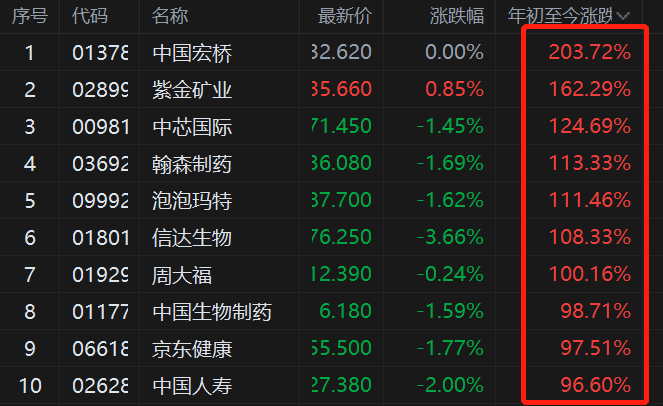
25年恒指累涨近28%:中国宏桥暴涨203.72%居成份股榜首,近10只个股翻倍
Ge Long Hui A P P· 2025-12-31 06:39
Core Insights - The Hong Kong stock market closed 2025 with the Hang Seng Index rising by 27.77%, marking its best annual performance since 2017 [1] - Among the constituents of the Hang Seng Index, China Hongqiao surged by 203.72%, leading the gains, followed by Zijin Mining at 162.29%, and SMIC at 124.69% [1][2] Group 1: Performance Highlights - China Hongqiao's stock price reached 32.620 with a year-to-date increase of 203.72% [2] - Zijin Mining's stock price was 35.660, reflecting a year-to-date rise of 162.29% [2] - SMIC's stock price stood at 71.450, with a year-to-date increase of 124.69% [2] - Hansoh Pharmaceutical increased by 113.33% year-to-date, with a stock price of 36.080 [2] - Pop Mart's stock price was 37.700, showing a year-to-date rise of 111.46% [2] - Innovent Biologics saw a year-to-date increase of 108.33%, with a stock price of 76.250 [2] - Chow Tai Fook's stock price was 12.390, reflecting a year-to-date increase of 100.16% [2] - China Biologic Products had a stock price of 6.180, with a year-to-date rise of 98.71% [2] - JD Health's stock price was 55.500, showing a year-to-date increase of 97.51% [2] - China Life's stock price stood at 27.380, with a year-to-date increase of 96.60% [2] Group 2: Sector Analysis - The performance of the top stocks reflects four main themes: cyclical resources, hard technology, innovative pharmaceuticals, and niche consumption [1] - Stocks like China Hongqiao and Zijin Mining benefited from global inflation and industrial demand [1] - SMIC represents the core of domestic substitution and technological self-reliance [1] - Companies like Hansoh and Innovent are being valued for genuine innovation and international pricing [1] - Niche consumption sectors, represented by Pop Mart, Chow Tai Fook, and JD Health, demonstrate strong vitality even in a weak recovery environment [1]



减肥神药的护城河在塌房?三大平台多家药企或正卷入残酷价格战
Hua Er Jie Jian Wen· 2025-12-30 15:01
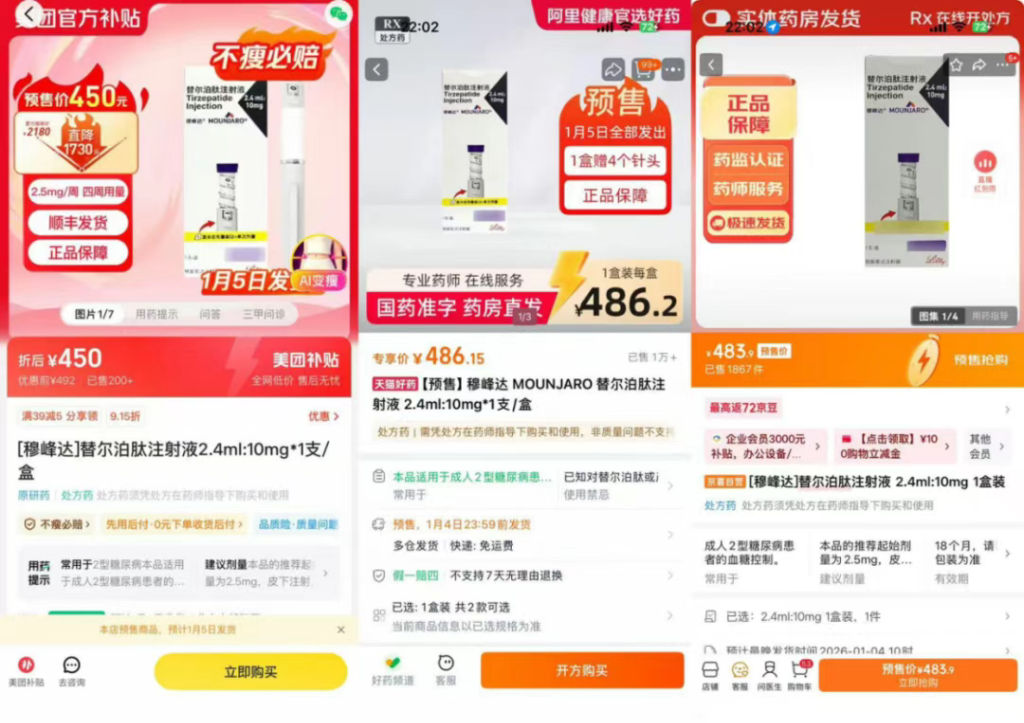
Core Insights - Novo Nordisk's long-acting GLP-1 drug, semaglutide, gained significant market attention after its launch four years ago, leading to the company surpassing LVMH to become the highest-valued listed company in Europe in 2023 [1] - However, with Eli Lilly's introduction of the more effective GLP-1/GIP dual-target weight loss drug, tirzepatide, Novo Nordisk has seen its market value decline by over 60% since July of last year [2] - A price war has erupted among major internet platforms for weight loss drugs, significantly impacting market dynamics [3][5] Pricing Dynamics - The price of tirzepatide on Meituan has dropped to 450 yuan for the 10mg specification, undercutting prices on Alibaba and JD.com by several tens of yuan [4][9] - The price drop is attributed to tirzepatide's recent inclusion in the medical insurance directory, which has disrupted the pricing structure in the outpatient market [5][16] - The entry of tirzepatide into the insurance system has established a price anchor, leading to competitive pricing strategies among e-commerce platforms [18] Competitive Landscape - Domestic GLP-1 drug manufacturers, such as Innovent Biologics with its dual-target drug, mazhitide, are facing increased pressure as their prices remain significantly higher than tirzepatide [6][23] - The market is becoming increasingly saturated, with at least 10 companies pursuing semaglutide listings and around 10 more in clinical trials for similar drugs [6] - The competitive environment is expected to intensify, with predictions of a "price avalanche" for single-target GLP-1 drugs in the next two years [24] Market Trends - The price of semaglutide has already dropped below 200 yuan, with some listings as low as 175 yuan, marking a drastic reduction from its initial price [25] - The expiration of semaglutide's core compound patent in 2026 is expected to further increase competition, with numerous companies preparing to launch their versions [25] - Eli Lilly is advancing its GLP-1/GCG/GIP tri-target weight loss drug, Retatrutide, which is anticipated to be the first of its kind approved by 2026 [26] Future Outlook - The future of domestic GLP-1 drugs is uncertain, particularly for mazhitide, which has not undergone head-to-head trials against tirzepatide [23] - Market analysts suggest that Innovent may need to adopt flexible pricing strategies to remain competitive [23] - The ongoing competition and the introduction of new products may limit the viability of existing players in the GLP-1 market [28]


从Biotech到Biopharma:信达生物的高质量发展“三级跳”
Cai Jing Wang· 2025-12-30 03:38
Core Insights - The announcement of Innovent Biologics being included in the Hang Seng Index marks a significant milestone, as it becomes the first Chinese innovative pharmaceutical company to transition from Biotech to Biopharma under the Hong Kong Stock Exchange's 18A system [1] - This achievement aligns with the company's recognition as "Annual High-Quality Development Listed Company" in the 2025 New Consumption and New Economy Awards [3] Group 1: Market Position and Financial Performance - Innovent Biologics has transitioned from a story-driven early biotech firm to a stable investment asset, supported by 18 commercialized innovative drugs and a complete industry chain from R&D to production [4] - The company's revenue has surged from 1 billion yuan in 2019 to 9.4 billion yuan in 2024, representing an 840% increase over five years, with expectations to exceed 10 billion yuan in 2025 [4] - The inclusion in the Hang Seng Index is expected to attract billions of dollars in passive capital inflow, optimizing the investor structure and reducing stock price volatility [4] Group 2: Product Development and Innovation - Innovent's mature products, such as Sintilimab, continue to provide stable cash flow, while new products like MaShidu Peptide strengthen its market position in the weight management sector [5] - The company has achieved significant milestones in R&D, with its MaShidu Peptide being the first globally approved dual-target receptor agonist for GCG/GLP-1, addressing specific health issues in Chinese patients [6] - Innovent's innovative capabilities are further demonstrated by its IL-23p19 monoclonal antibody showing strong efficacy in clinical trials for psoriasis, and the introduction of China's first IGF-1R antibody for thyroid eye disease [6] Group 3: Globalization and Strategic Partnerships - Innovent's globalization strategy has evolved from licensing to co-development, exemplified by a landmark $11.4 billion global strategic partnership with Takeda Pharmaceuticals [7] - The partnership adopts a "Co-Co" model, allowing Innovent to participate deeply in global clinical design and commercialization processes, marking a shift from traditional licensing agreements [7] - This collaboration signifies a critical step for Chinese pharmaceutical companies to engage in high-standard international platforms, enhancing their global competitiveness [8] Group 4: Overall Impact and Future Outlook - Innovent Biologics' journey from a local lab to a prominent player in the Hang Seng Index illustrates a successful model for the sustainable development of China's biopharmaceutical industry [9] - The company's integrated approach of capital, product strength, and globalization serves as a promising template for future growth and stability in the sector [9]

【报告】医药生物行业定期报告:从供需看,中国创新药能从海外分成多少钱?(附下载)
Xin Lang Cai Jing· 2025-12-29 13:40
Group 1: Market Overview - The CITIC Pharmaceutical Index increased by 1.2% during the week of June 3-6, 2025, outperforming the CSI 300 Index by 0.3 percentage points, ranking 16th among CITIC's primary industry classifications [1] - Year-to-date, the CITIC Pharmaceutical and Biotechnology Index has risen by 8.3%, surpassing the CSI 300 Index by 9.9 percentage points, ranking 5th among CITIC's industry classifications [1] - The top five performing stocks for the week included Yiming Pharmaceutical (+33.09%), Wanbangde (+32.59%), Anglikang (+30.28%), Xinnowei (+21.36%), and Haichen Pharmaceutical (+20.93%) [1] Group 2: Patent Cliff and Market Opportunities - By 2037, 27 blockbuster drugs with projected sales exceeding $4 billion in 2024 will face patent expiration, creating a market opportunity of over $240 billion for new entrants [2][12] - China is positioned as a core player in global innovative drug supply, leveraging its technological platforms and research efficiency, with the highest number of clinical pipelines in cell therapy, ADC, and bispecific antibodies [2][21] - The projected revenue from licensing agreements for Chinese projects from 2020 to 2025 is estimated to generate approximately $8.2 billion in net profit, translating to a potential market capitalization increase of $81.7 billion based on a 10x PE ratio [2] Group 3: Investment Recommendations - Focus on authorized blockbuster products with overseas clinical progress, including companies like Kangfang Biotech, Kelun Biotech, and Sanofi [2] - Potentially significant products for licensing out include Innovent Biologics, CSPC Pharmaceutical Group, and Zai Lab [2] - Companies with approved products showing strong commercialization performance include BeiGene, Kingsoft Biotech, and Hutchison China MediTech [2] Group 4: Mid to Long-term Investment Strategy - The investment strategy emphasizes three main lines: innovation, recovery, and policy support [4] - The innovation line focuses on biopharmaceuticals with competitive advantages in international markets and companies with second growth curves in pharmaceuticals [4] - The recovery line anticipates a rebound in medical device tenders and consumer healthcare, while the policy line supports high-dividend companies and encourages mergers and acquisitions [4]



从“借船出海”到“造船远航”:2025药企出海十大关键词
Xi Niu Cai Jing· 2025-12-29 09:34
Core Insights - The article discusses the transformation of Chinese pharmaceutical companies from merely selling products to actively participating in global value chains, with a significant increase in outbound licensing deals reaching over $100 billion by November 2025, a 75% increase year-on-year [3][4]. Group 1: Major Transactions - In 2024, major deals like Hengrui's $5 billion GLP-1 product and a $12.5 billion upfront payment from Pfizer to 3SBio for a dual antibody drug highlight the trend of billion-dollar collaborations becoming standard [4][6]. - Hengrui's partnership with GSK for $12.5 billion includes not only current products but also options for 11 early-stage projects, indicating a shift towards long-term strategic partnerships [4][10]. Group 2: Licensing Strategies - Chinese companies are moving from "one-off sales" to retaining rights in core markets while sharing rights in other regions, allowing them to benefit from both local and global markets [5][6]. - The new strategy involves keeping rights for the Greater China region while sharing development costs and rights for other markets, enhancing long-term revenue potential [6][10]. Group 3: Innovative Drug Categories - Antibody-drug conjugates (ADCs) and dual antibodies are emerging as key areas for Chinese companies, with significant deals reflecting their growing importance in the global market [6][7]. - The shift from traditional cancer drugs to innovative metabolic drugs like GLP-1 is notable, with companies like FOSUN and Hansoh making substantial deals in this area [14][15]. Group 4: Independent Global Expansion - Companies are increasingly opting for "self-driven" global expansion rather than simply licensing out, as seen with Kangfang Biopharma's approach to leading its own global clinical trials [8][9]. - This strategy, while riskier, offers higher potential returns compared to traditional licensing agreements [9]. Group 5: Platform-Based Collaborations - The trend is shifting from selling individual products to offering entire R&D platforms, as demonstrated by Hengrui's collaboration with GSK, which includes options for future projects [10][11]. - This model allows companies to monetize their ongoing research capabilities, enhancing their value proposition to partners [10][11]. Group 6: Regulatory and Pricing Developments - The introduction of a drug pricing registration system by China's National Healthcare Security Administration is expected to alleviate concerns about domestic pricing affecting global pricing strategies [12][13]. - This regulatory change has led to increased foreign investment in Chinese R&D, with a 28% year-on-year growth in 2025 [13]. Group 7: Market Valuation Changes - The market's evaluation criteria for Chinese innovative drug companies have shifted from focusing on generic drug revenues to assessing the value of outbound pipelines and global clinical progress [19][21]. - The average price-to-earnings ratio for innovative drug companies in China has risen significantly, reflecting a revaluation of their market potential [21].

中国创新药 2025 “破圈”全球
Guo Ji Jin Rong Bao· 2025-12-29 03:13
Core Insights - 2025 marks a pivotal year for China's innovative pharmaceuticals, with a significant increase in international collaborations and licensing agreements, indicating a shift from a pharmaceutical giant to a stronghold in the industry [1][3] - The total amount of outbound licensing agreements exceeded $100 billion, with upfront payments reaching $8.1 billion, showcasing a transition to multi-layered cooperation models [1][3] - China's biopharmaceutical market remains the second largest globally, with innovative drugs accounting for approximately 30% of global research, reflecting a critical leap from following to competing on a global scale [1][3] Internationalization - The internationalization of China's pharmaceutical industry saw explosive growth in 2025, highlighted by a surge in business development (BD) transactions and the popularity of "A+H" listings [3][4] - The total amount of outbound licensing for innovative drugs reached over $100 billion, a 75% increase from 2024, indicating a shift from merely selling products to actively engaging in global markets [3][4] - Notable BD transactions include significant agreements between major Chinese pharmaceutical companies and international firms, such as a $12.5 billion deal between Hengrui Medicine and GSK [3][4] Innovation - In 2025, advancements in cutting-edge technologies such as antibody-drug conjugates (ADC) and dual antibodies have shown promising results in cancer treatment [7][8] - The third-generation ADC technology has become mainstream, with significant efficacy demonstrated in treating solid tumors [7] - The dual antibody sector continues to lead, with Chinese companies achieving remarkable results in clinical trials, such as a 91% improvement in progression-free survival compared to existing treatments [8] Policy Support - The policy support for innovative drugs in China has reached unprecedented levels, with a notable increase in the number of approved innovative drugs [10][11] - The National Medical Products Administration approved 69 innovative drugs in 2025, a 44% increase from the previous year, covering various therapeutic areas [10] - The payment system for innovative drugs has been significantly upgraded, enhancing accessibility and affordability for patients [10][11] Mergers and Acquisitions - The pharmaceutical sector has seen a surge in mergers and acquisitions, with over 400 transactions announced globally, totaling approximately $111 billion, marking a 50% increase from 2024 [13][14] - Domestic mergers also showed strong activity, with significant deals indicating a shift towards quality improvement and resource consolidation among leading companies [13][14] - The trend reflects a transition from scale expansion to enhancing quality and efficiency, with companies focusing on high-value clinical pipelines [14]

信达生物(01801.HK)达伯欣获国家药监局批准上市
Jin Rong Jie· 2025-12-29 02:04
Core Viewpoint - Innovent Biologics (01801.HK) announced that its drug, Dabrusin® (Ipilimumab N01 injection), has been approved by the National Medical Products Administration (NMPA) in China for use in neoadjuvant therapy in patients with resectable stage IIB-III microsatellite instability-high (MSI-H) or mismatch repair deficient (dMMR) colorectal cancer when combined with Sintilimab [1] Group 1 - Dabrusin® is the first domestically approved anti-CTLA-4 monoclonal antibody in China [1] - It is also the first anti-CTLA-4 monoclonal antibody globally approved for neoadjuvant therapy in colorectal cancer [1] - The combination therapy significantly improves the pathological complete response rate for MSI-H/dMMR colorectal cancer patients [1]
信达生物:达伯欣 (伊匹木单抗N01注射液)获国家药监局批准联合信迪利单抗用于结肠癌新辅助治疗
Zhi Tong Cai Jing· 2025-12-28 23:42
Core Viewpoint - Innovent Biologics (01801) announced that its drug, IBI310 (Ipilimumab N01 injection), has received approval from the National Medical Products Administration (NMPA) in China for use in neoadjuvant therapy for patients with resectable stage IIB-III microsatellite instability-high (MSI-H) or mismatch repair-deficient (dMMR) colorectal cancer, in combination with Sintilimab [1] Group 1 - IBI310 is the first domestically approved anti-CTLA-4 monoclonal antibody in China [1] - It is also the first anti-CTLA-4 monoclonal antibody globally approved for neoadjuvant treatment of colorectal cancer [1] - The combination therapy with Sintilimab significantly improves the pathological complete response rate for MSI-H/dMMR colorectal cancer patients [1]