
XIAOMI(01810)

Search documents
马斯克点赞Kimi新架构,17岁高中生作者一战成名;字节原计划推出的豆包AI眼镜或不会上市;蚂蚁董事长井贤栋向上海交大捐赠1.3亿丨邦早报
创业邦· 2026-03-18 00:16
Group 1 - The article highlights a breakthrough in AI research by a team led by a 17-year-old student, which has garnered attention from tech leaders including Elon Musk. The new architecture, "Attention Residuals," significantly improves training efficiency for large models [2] - Ant Group's chairman, Jing Xiandong, donated 130 million yuan to Shanghai Jiao Tong University to support the "AI Future Foundation" [4] - Xiaomi's founder, Lei Jun, addressed the impact of the early discontinuation of the first-generation SU7 model on sales, while also announcing a brand ambassador for Xiaomi Auto [6] Group 2 - Didi's AI ride-hailing assistant, Xiao Di, has launched its v1.0 version, supporting over 90 service tags and enhancing user experience in complex travel scenarios [10] - ByteDance's planned launch of its AI glasses has been delayed, with insiders indicating that the first-generation product is unlikely to be released due to a lack of market differentiation [12] - Tencent Music reported a total revenue of 32.9 billion yuan for the year, with a 15.8% year-on-year growth, and announced a cash dividend of approximately 368 million USD [13] Group 3 - OpenAI is preparing for an IPO, potentially by the end of this year, focusing on enterprise-level business [18] - Nvidia's CEO, Jensen Huang, discussed collaborations with Chinese automakers, emphasizing the unified architecture for sensors and computing platforms [12] - Audi's global CEO denied rumors of a merger between its two Chinese joint ventures, stating that the current partnership model is beneficial [19]





生物基产业解读②:奔驰/宝马/小米押注! 生物基材料进入供应链了?
DT新材料· 2026-03-17 16:04
Core Insights - The automotive industry is undergoing a transformation towards low-carbon and sustainable practices, driven by both policy and consumer demand for environmentally friendly materials [5][9]. Group 1: Opportunities for Bio-based Materials - Bio-based materials are transitioning from niche applications to mainstream use in automotive interiors, driven by regulatory requirements and consumer preferences [8]. - The EU's new regulations mandate that 25% of plastics used in new cars must come from recycled materials, and by 2025, at least 35% of interior materials must be bio-based [9]. - Market research indicates that 85% of car buyers consider the environmental impact of interior materials, with a willingness to pay a 5%-10% premium for bio-based options [9]. - Advances in production techniques and raw material innovations are reducing the costs of bio-based materials, making them competitive with traditional petroleum-based materials [9]. Group 2: Leading Automotive Companies Adopting Bio-based Materials - Mercedes-Benz has introduced animal-free interiors using materials like spider silk protein and plant-based proteins [10]. - BMW is collaborating with Swiss bio-manufacturing firm Bcomp to utilize natural fiber-reinforced materials and is exploring the use of coffee grounds in automotive parts [10]. - Xiaomi's YU7 model features a seat surface made from "rice leather," derived from corn stalks, showcasing the application of bio-based materials [10]. - Volkswagen has used biodegradable and recyclable Biosteel fibers in its concept car, VISION EQXX [11]. - Volvo's EX30 incorporates natural fiber composite materials from Bcomp, and the company has invested in Bcomp's funding round [11]. - Hyundai is partnering with UNCAGED Innovations to use high-performance bio-based leather in its vehicles [11]. - Ford has integrated bio-based materials into various components, including seat cushions and dashboards [12]. - Chery is developing bio-based interior products in collaboration with Fengyuan Bio [13]. - McLaren's W1 supercar features tires made from over 50% bio-based and recyclable materials [14]. Group 3: Accelerating Low-Carbon Transition - Chinese automotive parts manufacturers are increasingly entering the global supply chain of luxury brands, driven by the need to comply with stringent EU environmental regulations [16]. - The upcoming Bio-based Conference in Shanghai aims to facilitate discussions on policy trends and the development of bio-based automotive materials [17].



雷军再回应停售第一代SU7:确实对前三个月销售产生了影响,但我们不想背刺老用户
新华网财经· 2026-03-17 07:54
Core Viewpoint - Xiaomi's founder Lei Jun discussed the challenges and achievements of Xiaomi's automotive development, emphasizing the importance of not undermining existing users while transitioning to the new generation of the SU7 model [1]. Group 1: New Generation SU7 Launch - The new generation SU7 is set to officially launch on March 19 at 19:00 [4]. - The new model has undergone significant upgrades in safety, driving control, intelligent experience, and luxury feel, taking over two years for its design [1]. Group 2: Safety Features and Specifications - The new SU7 features a 2200MPa ultra-strong steel embedded roll cage and comes standard with 9 airbags, including 2 additional side airbags for the rear [5]. - In terms of battery safety, it incorporates a 1500MPa anti-scratch bottom beam and a bulletproof coating on the underside [5]. - The vehicle will be equipped with Xiaomi's Super Motor V6s Plus across all variants [5]. Group 3: Sales and Production Insights - Xiaomi's automotive sales reached 39,000 units in January, with the YU7 model accounting for approximately 97% of total sales [6]. - The last unit of the first generation SU7 was delivered on February 13, marking the end of its production to prepare for the new generation [7]. - The first generation SU7 had a total delivery exceeding 381,000 units by February 2026, with a target of 550,000 units for 2026 and over 410,000 units for 2025 [8].

每日投资策略:科技股反弹,恒指有望摆脱颓势-20260317
Guodu Securities Hongkong· 2026-03-17 01:55
Group 1: Market Overview - The Hang Seng Index experienced a rebound, closing up 368 points or 1.45%, indicating a potential recovery from recent geopolitical pressures [2][3] - The technology sector outperformed the market, with notable gains from major companies such as Tencent (+2%), Alibaba (+1.1%), and Meituan (+3.1%) [3] Group 2: Macro & Industry Dynamics - UBS predicts that the MSCI China Index is expected to outperform global markets by 5% this year, with a target of reaching 100 points by year-end, representing a potential increase of approximately 20% from current levels [6] - The Chinese economy's lower reliance on imported oil and the resilience of Chinese assets are highlighted as factors contributing to this positive outlook [6] - In February, the housing prices in 70 major cities in China fell by 3.2% year-on-year, marking the largest decline in eight months, although the monthly decline narrowed to 0.3% [7] Group 3: Company News - FWD Group reported record profits last year and expressed confidence in maintaining growth momentum, with plans to invest in business and talent [9] - Kwan Tai Group announced a significant increase in net profit by 1.7 times, with a total profit of 4.402 billion HKD for the year ending December 2025 [10] - Q Technology reported a net profit of 1.494 billion RMB, a year-on-year increase of 4.35 times, driven by a nearly 30% increase in revenue [12]




中国资产深夜大涨,美股科技股普涨,半导体集体拉升,国际油价大跳水
21世纪经济报道· 2026-03-16 23:14
Market Performance - The US stock market saw all three major indices rise, with the Dow Jones up 0.83%, the Nasdaq up 1.22%, and the S&P 500 up 1.01% [1] - Major European indices also closed higher, with Germany's DAX 30 up 0.5% and the UK's FTSE 100 up 0.55% [1] Technology Sector - Major tech stocks experienced significant gains, with META rising 2.33%, Amazon nearly 2%, and Nvidia up 1.63%, reaching an intraday high of 4.31% [2] - Nvidia's CEO Jensen Huang raised the revenue forecast to $1 trillion by 2027 during the GTC conference, where new chip architecture was announced [3] - The Philadelphia Semiconductor Index rose by 1.96%, with notable increases in stocks like SanDisk (over 6%), Western Digital (over 5%), and Micron Technology (3.68%) [3] Chinese Tech Stocks - The Nasdaq Golden Dragon China Index increased by 0.95%, with significant gains in popular Chinese stocks such as BYD (up 8.2%), Xiaomi (5.4%), and Li Auto (5.3%) [3] Commodity Prices - Gold and silver prices declined, with spot gold fluctuating around $5000 and silver around $80 per ounce [3] - International oil prices fell sharply, with WTI crude oil futures closing at $93.50 per barrel (down 5.28%) and Brent crude at $100.21 per barrel (down 2.84%) [5] Cryptocurrency Market - The cryptocurrency market showed strength, with Bitcoin surpassing $74,000 (up 3.63%) and Ethereum rising over 9% to $2361 [6]



南下资金净买入腾讯、阿里和比亚迪
Ge Long Hui· 2026-03-16 10:34
Group 1 - Southbound funds recorded a net sell of HKD 1.25 billion in Hong Kong stocks on March 16, with notable net purchases in Tencent Holdings (HKD 2.287 billion), Alibaba-W (HKD 706 million), BYD Company (HKD 586 million), and Geely Automobile (HKD 442 million) [1] - The net sell was primarily driven by the iShares Asia 50 ETF, which saw a net sell of HKD 3.574 billion, and Xiaomi Group-W with HKD 844 million [1][3] - Southbound funds have consistently net bought China National Offshore Oil Corporation (CNOOC) for four consecutive days, totaling HKD 3.38424 billion [1] Group 2 - Tencent Holdings experienced a price increase of 2.0% with a net buy of HKD 4.21 billion, while Alibaba-W saw a 1.1% increase with a net buy of HKD 3.55 billion [3] - BYD Company had a significant price increase of 7.8% with a net buy of HKD 4.37 billion, and Geely Automobile increased by 3.6% with a net buy of HKD 4.42 billion [3] - The overall trading volume for the stocks mentioned indicates a mixed performance, with some stocks like Xiaomi Group-W and SMIC showing negative net buy figures [3]


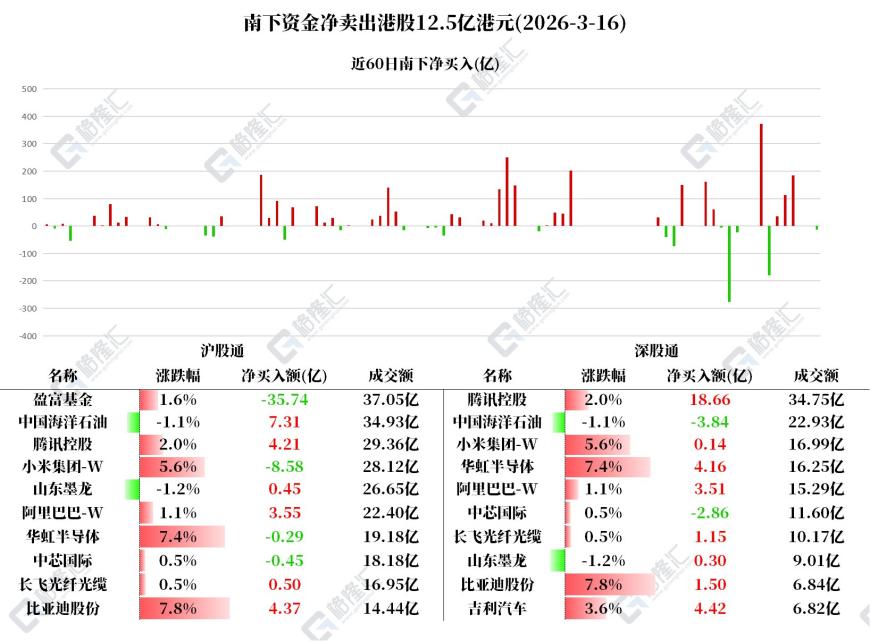
图解丨南下资金净买入腾讯、阿里和比亚迪
Ge Long Hui A P P· 2026-03-16 10:01
Group 1 - Southbound funds recorded a net sell of HKD 1.25 billion in Hong Kong stocks today [1] - Notable net purchases included Tencent Holdings at HKD 2.287 billion, Alibaba-W at HKD 706 million, BYD Company at HKD 586 million, Geely Automobile at HKD 442 million, Hua Hong Semiconductor at HKD 387 million, China National Offshore Oil Corporation at HKD 347 million, and Yangtze Optical Fibre and Cable at HKD 165 million [1] - Significant net sells were observed in the Tracker Fund of Hong Kong at HKD 3.574 billion, Xiaomi Group-W at HKD 844 million, and Semiconductor Manufacturing International Corporation at HKD 330 million [1] Group 2 - Southbound funds have continuously net bought China National Offshore Oil Corporation for four consecutive days, totaling HKD 3.38424 billion [2]
港股新能源车企股震荡走高,比亚迪股份涨超7%
Mei Ri Jing Ji Xin Wen· 2026-03-16 06:16
Group 1 - The core viewpoint of the article highlights the upward trend in Hong Kong's new energy vehicle stocks, with significant gains observed among major companies in the sector [1] Group 2 - BYD Company Limited (01211.HK) experienced a rise of over 7% [1] - Xiaomi Group (01810.HK) and NIO Inc. (09866.HK) both saw increases of over 5% [1] - Other companies such as Geely Automobile Holdings Limited (00175.HK), Great Wall Motors (02333.HK), Seres (09927.HK), and Li Auto Inc. (02015.HK) also followed suit with gains [1]

行业点评报告:OpenClaw热潮加速端侧Agent渗透,推理算力需求激增
KAIYUAN SECURITIES· 2026-03-16 06:15
Investment Rating - The industry investment rating is "Positive" (maintained) [1] Core Insights - OpenClaw, an open-source AI agent framework, has gained significant popularity since its release, becoming the most popular open-source project on GitHub as of February 2026. It offers capabilities such as local-first operation, autonomous tool invocation, cross-application execution, and continuous online operation, making it highly appealing to users [4] - The demand for inference computing power is expected to grow exponentially due to the characteristics of Agent AI, which include autonomous task execution and multi-agent concurrency. The daily token consumption in China surged from 100 billion in early 2024 to over 30 trillion by June 2025, reflecting a growth of over 300 times in just one and a half years [5] - OpenClaw is penetrating various devices, including PCs, smartphones, and wearables, transforming the role of AI from a conversational agent to an executor. This shift is expected to create new application scenarios and product categories in the end-side AI market [6] Summary by Sections OpenClaw Development - OpenClaw has seen rapid adoption among major domestic companies, with multiple products and solutions being released based on its code. Notable companies include Tencent, Huawei, Alibaba, and Xiaomi, which are integrating OpenClaw into their cloud services and applications [4] Token Consumption and Inference Demand - The workflow of "plan-execute-feedback-replan" in Agent AI has led to a shift from linear to exponential growth in token consumption. A single task can consume tens of thousands to millions of tokens, indicating a significant increase in demand for inference capabilities [5] End-Side AI Transformation - The modular architecture of OpenClaw allows for comprehensive session management and memory systems, enabling it to autonomously manage various software applications. This evolution is expected to redefine the capabilities of end-side AI and lead to the development of more intelligent personal AI assistants [6] Investment Recommendations - The report suggests focusing on the AI inference computing power supply chain, including segments like chips, complete machines, liquid cooling, and power supplies. Recommended stocks include Haiguang Information, Lingyi Technology, and Dongshan Precision, among others [7]






国内各大模型厂商布局Agent项目,争夺下一代应用入口
HUAXI Securities· 2026-03-16 05:41
Group 1 - Major domestic AI model manufacturers are launching Agent projects to compete for the next generation of application entry points, with various products introduced by companies like Zhiyuan AI, Tencent, MiniMax, Huawei, Xiaomi, Alibaba, ByteDance, and Kimi [1][9][10][11][12][13][15][16] - Zhiyuan AI's AutoClaw, launched on March 10, is the first local version of OpenClaw, featuring over 50 mainstream skills and integration with messaging tools [9][10] - Tencent's WorkBuddy, released on March 9, is a full-scenario AI agent that is deeply compatible with OpenClaw skills and allows remote operation without cloud deployment [10] - MiniMax's MaxClaw, launched on February 26, is a cloud-based AI assistant that supports mobile platforms and various expert skills [10] - Huawei's Xiaoyi Claw, currently in beta, is based on the HarmonyOS and supports document editing and email replies with multiple personality options [11] - Xiaomi's miclaw is in limited testing and integrates deeply with MIUI for a seamless experience across its ecosystem [12] - Alibaba's CoPaw, launched on February 14 and open-sourced on February 28, supports both local and cloud deployment and allows for secondary development [13][14] - ByteDance's ArkClaw and Coze, launched on March 9, provide a SaaS version that integrates with the Feishu ecosystem and offers a community for developers [15] - Kimi's KimiClaw, launched on February 16, is a cloud-based AI agent service with a vast skill library and personal cloud storage [16] Group 2 - The investment recommendation emphasizes the "AI+" logic catalyzing valuation optimization in Hong Kong stocks, with a focus on internet, technology, and emerging consumer sectors [2] - Beneficiaries in the internet and technology sector include Alibaba-W, Tencent Holdings, Kuaishou-W, and Meituan-W, which are embracing AI and increasing capital expenditures [2] - In the domestic consumption sector, companies like Maogeping, Mixue Group, Laopu Gold, Pop Mart, Tongcheng Travel, Ctrip Group-S, and Xiaocaiyuan are highlighted as having strong growth potential [2] Group 3 - The Hong Kong stock market saw the Hang Seng Index decline by 1.13%, while the Hang Seng Technology Index rose by 0.62% and the Chinese Enterprises Index increased by 0.50% [18][19] - The energy sector was the best-performing industry this week, with a gain of 6.25%, while the financial sector experienced the largest decline at 4.36% [19] - Among the top gainers in the Hong Kong Stock Connect, companies like Kexin Pharmaceutical-B and China Xuyang Group saw significant increases, while companies like Haotian International Investment faced substantial declines [22]
