
LI AUTO-W(02015)

Search documents
LI AUTO(LI) - 2025 Q4 - Earnings Call Transcript
2026-03-12 13:02
Financial Data and Key Metrics Changes - Total revenues in Q4 2025 were RMB 28.8 billion, down 35% year-over-year but up 5.2% quarter-over-quarter [17] - Vehicle sales contributed RMB 27.3 billion, down 36.1% year-over-year and up 5.4% quarter-over-quarter, primarily due to lower vehicle deliveries [17] - Gross profit for Q4 was RMB 5.1 billion, down 42.8% year-over-year but up 14.8% quarter-over-quarter, with a vehicle margin of 16.8% compared to 19.7% in the same period last year [18] - Operating expenses were RMB 5.6 billion, up 5.8% year-over-year and down 1.3% quarter-over-quarter [19] - Net income for Q4 was RMB 20.2 million, a significant decrease from RMB 3.5 billion in the same period last year [21] Business Line Data and Key Metrics Changes - The company is focusing on improving store rollout quality and strengthening day-to-day store operations, with a new store partner program launched to enhance sales efficiency [6][7] - The new Li L9 lineup is set to launch in Q2 2026, featuring significant technological upgrades aimed at regaining leadership in the flagship SUV segment [8][9] Market Data and Key Metrics Changes - The Li L8's Net Promoter Score (NPS) has increased by over 20%, ranking number one in NPS among all large SUVs according to J.D. Power [11] - Orders for the Li L8 have increased by 33% compared to February and 179% compared to January, indicating a recovery in demand [11] Company Strategy and Development Direction - The company is transitioning from a smart EV company to an embodied AI company, with a focus on technology and product innovation [12] - R&D spending totaled RMB 11.3 billion in 2025, with approximately 50% allocated to AI-related initiatives, which will continue in 2026 [13] - The company aims to enhance its competitive positioning through a combination of supply chain collaboration, long-term agreements, and rational pricing strategies [43][44] Management's Comments on Operating Environment and Future Outlook - Management acknowledges the challenges in profitability across the auto retail industry but emphasizes the importance of developing capable store managers to drive sales [8] - The company expects deliveries in Q1 2026 to be between 85,000 and 90,000 vehicles, with total revenue projected between RMB 20.4 billion and RMB 21.6 billion [22][23] Other Important Information - The company is committed to maintaining a direct sales model to ensure consistent service quality and a unified pricing strategy [27] - The new store partner program aims to empower store managers with decision-making power and profit-sharing, enhancing accountability and operational efficiency [28] Q&A Session Summary Question: Plans for channel optimization and store closures - Management clarified that the rumor about closing 100 stores is false, emphasizing a focus on quality over quantity in store operations [26] Question: Details on the new product launch and pricing strategy - The all-new Li L9 is set to launch in Q2 2026, with a focus on technological advancements and competitive pricing [32] Question: Sales volume target for 2026 and balancing volume with margins - The company aims for a 20% year-on-year growth in 2026, supported by a direct sales model and the launch of new L-series products [38] Question: Strategy to address raw material cost inflation - The company is strengthening supply chain collaboration and driving end-to-end cost optimizations to manage raw material cost pressures [41][42] Question: Consideration of share buybacks - Management acknowledged that share buybacks are a tool to enhance shareholder value but currently has no additional information to disclose [47] Question: Guidance for R&D expenses in 2026 - R&D expenses are expected to remain around RMB 12 billion, with AI-related initiatives accounting for about half of the cost [48] Question: Details on Li i6 and Li i8 orders and production ramp-up - The company has resolved supply chain bottlenecks for the Li i6 and expects steady monthly sales of around 20,000 units [52]

LI AUTO(LI) - 2025 Q4 - Earnings Call Transcript
2026-03-12 13:00
Financial Data and Key Metrics Changes - Total revenues in Q4 2025 were RMB 28.8 billion, down 35% year-over-year but up 5.2% quarter-over-quarter [17] - Vehicle sales contributed RMB 27.3 billion, down 36.1% year-over-year and up 5.4% quarter-over-quarter, primarily due to lower vehicle deliveries [17] - Gross profit for Q4 was RMB 5.1 billion, down 42.8% year-over-year but up 14.8% quarter-over-quarter [18] - Vehicle margin decreased to 16.8% from 19.7% year-over-year and increased from 15.5% in the prior quarter [18] - Operating expenses were RMB 5.6 billion, up 5.8% year-over-year and down 1.3% quarter-over-quarter [19] - Net income for Q4 was RMB 20.2 million, compared to RMB 3.5 billion in the same period last year [21] - Cash position at year-end was RMB 101.2 billion, with net cash provided by operating activities at RMB 3.5 billion [22] Business Line Data and Key Metrics Changes - The company is focusing on improving store rollout quality and strengthening day-to-day store operations [5] - The new store partner program launched in March aims to empower store managers with decision-making power and profit sharing [6] - The Li L9 lineup is set to launch in Q2 2026, featuring significant technological upgrades [8][10] Market Data and Key Metrics Changes - Li L8 orders increased by 33% compared to February and 179% compared to January, indicating a recovery in demand [11] - The company expects deliveries in Q1 2026 to be between 85,000 and 90,000 vehicles [22] Company Strategy and Development Direction - The company is transitioning from a smart EV company to an embodied AI company, focusing on technology and product innovation [12] - R&D spending in 2025 totaled RMB 11.3 billion, with approximately 50% allocated to AI-related initiatives [13] - The company aims to enhance its sales efficiency and organization vitality through a direct sales model [5] Management's Comments on Operating Environment and Future Outlook - Management acknowledged the challenges in profitability across the auto retail industry and emphasized the importance of developing capable store managers [7] - The company anticipates a competitive year in 2026, with a goal of 20% year-on-year growth [39] - Management expressed confidence in overcoming supply constraints and improving delivery lead times [11] Other Important Information - The company plans to maintain a balanced approach to pricing for new models, considering raw material costs and R&D investments [45] - The restructuring of R&D has been completed, aiming to enhance collaboration and efficiency in product development [66] Q&A Session Summary Question: Plans for channel optimization and store partner mechanism - Management clarified that the rumor about closing 100 stores is false and emphasized a focus on quality over quantity in store operations [27][28] Question: Launch timeline and pricing strategy for new products - The all-new Li L9 is set to launch in Q2 2026, with a focus on technological advancements and competitive pricing [31][32] Question: Sales volume target for 2026 and balancing volume with margins - The company aims for a 20% year-on-year growth in 2026, supported by a direct sales model and new product launches [39] Question: Impact of raw material cost inflation - Management outlined strategies to manage cost pressures, including long-term agreements with suppliers and end-to-end cost optimizations [43][45] Question: Share buyback plans - Management acknowledged that share buybacks are a tool to enhance shareholder value but provided no specific plans at this time [49] Question: R&D expense guidance for 2026 - R&D expenses are expected to remain around RMB 12 billion, with half allocated to AI-related initiatives [51] Question: Details on Li i6 and Li i8 orders and production ramp-up - The company reported strong order momentum for Li i6 and resolved supply chain bottlenecks, expecting stable monthly sales [55]
理想汽车,去年净利暴跌85%!
Xin Lang Cai Jing· 2026-03-12 12:36
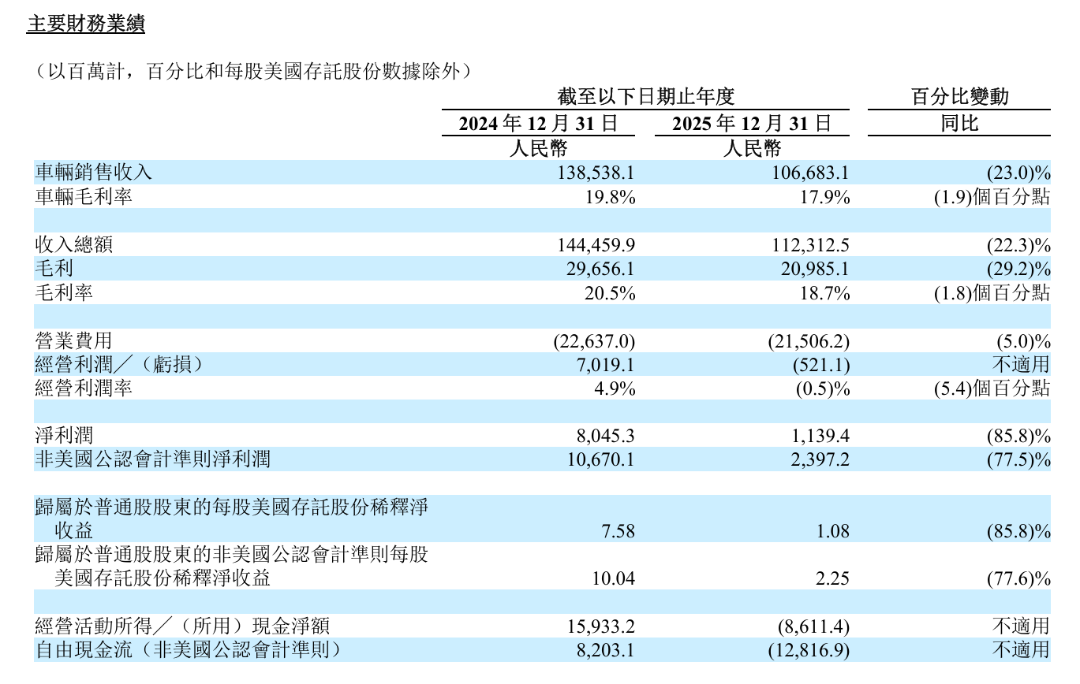
理想汽车发布2025年业绩,全年收入总额同比减少22.3%,净利润同比减少85.8%,全年交付量同比下滑18.82%。 来源|读创财经 编辑|靳恩琦 责编|朱峰 3月12日盘后,理想汽车(港股代码:02015)发布截至2025年12月31日止季度及全年的未经审计财务业绩。 数据显示,2025年第四季度,理想汽车收入总额为288亿元,同比减少35%;净利润为2020万元,上年同期为35亿元。 2025年全年,理想汽车收入总额为1123亿元,同比减少22.3%;净利润为11亿元,同比减少85.8%;毛利率为18.7%,与2024年的20.5%相比有所下滑。 | | 截至以下日期止年度 | | 百分比變動 | | --- | --- | --- | --- | | | 2024年12月31日 | 2025年12月31日 | 同比 | | | 人民幣 | 人民幣 | | | 車輛銷售收入 | 138.538.1 | 106.683.1 | (23.0)% | | 車輛毛利率 | 19.8% | 17.9% | (1.9)個百分點 | | 收入總額 | 144.459.9 | 112.312.5 | (22.3)% | ...

理想汽车神话破灭,净利润暴跌90%
Xin Lang Cai Jing· 2026-03-12 11:53
Core Viewpoint - Li Auto, once a leader in the new energy vehicle sector, has faced significant declines in both revenue and profit in 2025, raising concerns about its future competitiveness in a rapidly evolving market [3][5][10]. Financial Performance - In Q4 2025, Li Auto reported revenue of 28.775 billion RMB, a 35.0% year-over-year decrease, with a net profit of only 274 million RMB, down 93.2% [3][4]. - For the entire year of 2025, the company achieved revenue of 112.3 billion RMB, a decline of 22.3%, and a net profit of 1.1 billion RMB, down 85.8% [3][4]. - Vehicle sales revenue in Q4 2025 was 27.252 billion RMB, reflecting a 36.1% year-over-year drop [4]. Sales and Market Position - Li Auto delivered 406,000 vehicles in 2025, marking an 18.81% decline and making it the only major new energy vehicle manufacturer to experience negative growth [5][8]. - Competitors such as NIO and Xpeng saw significant growth, with NIO increasing by 40.7% and Xpeng by 125.94% in the same period [8][10]. Competitive Challenges - The company faces intense competition from brands like Huawei and Xiaomi, which have introduced advanced technologies and features that challenge Li Auto's market position [5][10]. - In the high-end market, Li Auto's L9 model sold only 1,200-1,300 units in February 2026, while Huawei's AITO M9 sold 3,085 units, indicating a significant competitive disadvantage [8][10]. Strategic Shifts - Li Auto is transitioning from its traditional "range extender" model to larger battery systems and faster charging capabilities, aiming to adapt to changing consumer preferences [10][26]. - The company plans to introduce a new generation of vehicles with larger batteries and advanced fast-charging technology, expected to launch in mid-2026 [27][28]. Organizational Changes - In response to internal challenges, Li Auto has reverted to a startup management model, which may improve decision-making efficiency but also risks team instability due to frequent organizational changes [21][22]. - Key personnel changes have occurred, including the departure of several senior executives, which may impact the company's strategic direction [22]. Future Outlook - Li Auto is exploring share buybacks as a potential strategy to stabilize its stock price, which has reached historical lows [24][25]. - The company is also investing in AI technology, with plans to integrate self-developed AI chips into future models, reflecting a shift towards a more technology-driven approach [30][31].

理想汽车-W2025年度净利润为11亿元,同比减少85.8%
Zhi Tong Cai Jing· 2026-03-12 11:20
理想汽车-W(02015)发布公告,2025年第四季度,车辆销售收入为273亿元(人民币,下同),较2024年第 四季度的426亿元减少36.1%,较2025年第三季度的259亿元增加5.4%。收入总额为288亿元,较2024年 第四季度的443亿元减少35.0%,较2025年第三季度的274亿元增加5.2%。净利润为2020万元,而2024年 第四季度的净利润为35亿元,2025年第三季度的净亏损为6.244亿元。 2025年,车辆销售收入为1067亿元,较2024年的1385亿元减少23.0%。收入总额为1123亿元,较2024年 的1445亿元减少22.3%。净利润为11亿元,较2024年的80亿元减少85.8%。 公司于2026年1月和2月分别交付了27,668辆和26,421辆汽车。截至2026年2月28日,在全国,公司于160 个城市拥有539家零售中心,于223个城市运营548家售后维修中心及授权服务中心,并已投入使用4,054 座理想超充站,配备22,447个充电桩。 理想汽车董事长兼首席执行官李想先生表示:"经过2025年的主动战略调整,四季度以来我们在组织效 率、供应能力和销售体系方面开始 ...
穿透财报,读懂理想汽车看似“不聪明”的选择
Jin Rong Jie· 2026-03-12 11:16
Core Insights - In 2025, the Chinese automotive industry is undergoing significant changes, with a shift in competition from battery size and features to intelligence and technological depth [1] - Li Auto has reported resilient financial results, achieving annual revenue of 112.3 billion yuan and a net profit of 1.1 billion yuan, marking three consecutive years of over 100 billion yuan in revenue and profitability [1] - The company has a cash reserve of 101.2 billion yuan, the highest among new energy vehicle companies, and has invested a record 11.3 billion yuan in R&D, with 50% allocated to AI [1] Financial Performance - Li Auto delivered 406,000 vehicles in 2025, with revenue growth slowing and net profit declining compared to previous years [4] - The fourth quarter saw a delivery of 109,000 vehicles, a 17.1% increase quarter-on-quarter, and revenue of 28.8 billion yuan, a 5.2% increase [5] Strategic Transformation - 2025 marks a pivotal year for Li Auto as it transitions from a traditional automotive company to an embodied intelligence enterprise, involving a comprehensive restructuring of its organizational framework, R&D system, product definition, and sales services [4] - The R&D organization has been restructured into teams focused on foundational models, software, and hardware, addressing the challenges of disjointed development [4] R&D Investment - Li Auto's R&D investment reached 11.3 billion yuan in 2025, with a 25.3% year-on-year increase in the fourth quarter, despite many companies reducing R&D spending [7] - The investment supports the development of a complete embodied intelligence technology foundation, including the self-developed Mahe 100 chip, which will begin mass production in Q2 2025 [8] Product Development - The new generation Li Auto L9, set to launch in Q2 2025, represents the first comprehensive realization of the company's three-year technology investments [9][10] - The L9 features advanced 3D spatial perception technology and is equipped with two self-developed Mahe 100 chips, providing significantly higher computing power compared to competitors [12] Market Positioning - Li Auto's proactive transformation, despite short-term growth slowdowns, aims to establish a robust technological foundation for future growth [14] - The upcoming launch of the new generation L9 will serve as a critical test for the effectiveness of this transformation [14]

全年营收1123亿元!理想汽车2025年财报出炉,全新理想L9计划二季度上市
Mei Ri Jing Ji Xin Wen· 2026-03-12 11:14
Group 1 - The core viewpoint of the article highlights that Li Auto's financial performance in 2025 shows a significant decline compared to 2024, despite some positive signals in Q4 2025 [2] - In 2025, Li Auto's total revenue was 112.3 billion yuan, a year-on-year decrease of 22.3%, and the overall gross margin narrowed from 20.5% in 2024 to 18.7% [2] - The company recorded an operating loss of 5.21 billion yuan in 2025, compared to an operating profit of 7 billion yuan in the previous year, influenced by reduced revenue and a slight increase in R&D expenses to 11.3 billion yuan [2] Group 2 - Despite a significant drop in non-GAAP net profit from 10.7 billion yuan in the previous year to 2.4 billion yuan, Li Auto maintained a strong balance sheet with cash reserves of 101.2 billion yuan as of December 31, 2025 [2] - For Q1 2026, Li Auto provided cautious guidance, expecting vehicle deliveries between 85,000 and 90,000 units, a year-on-year decrease of 3.1% to 8.5%, and total revenue between 20.4 billion and 21.6 billion yuan, a year-on-year decrease of 16.7% to 21.3% [3] - To overcome short-term growth challenges, Li Auto is focusing on an upcoming product cycle and ecosystem expansion, with the new Li L9 set to launch in Q2 2026 featuring comprehensive upgrades in power systems, intelligent driving, and chassis technology [3]
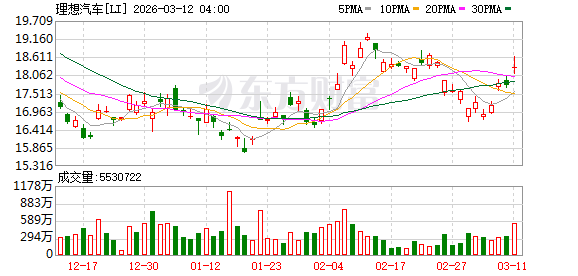
Li Auto Posts Mixed Earnings. Why the Stock Is Falling.
Barrons· 2026-03-12 10:54
Core Viewpoint - Li Auto shares experienced a decline in premarket trading despite reporting mixed results for the fourth quarter [1] Group 1: Financial Performance - The company posted mixed fourth-quarter results, indicating variability in performance metrics [1]
理想汽车2025年营收1123亿元,全新一代理想L9将于2026年二季度上市
Jin Rong Jie· 2026-03-12 10:52
Core Insights - Li Auto has achieved over 100 billion yuan in revenue for three consecutive years and has been profitable for the same duration [1] - In 2025, Li Auto reported a total revenue of 112.3 billion yuan and a net profit of 1.1 billion yuan, with cash reserves reaching 101.2 billion yuan by the end of the reporting period [1] - The company's R&D expenditure reached a record high of 11.3 billion yuan, with 50% allocated to AI-related investments [1] Financial Performance - In Q4 2025, Li Auto generated revenue of 28.8 billion yuan, resulting in a net profit of 20.2 million yuan [1] - For Q1 2026, the company expects vehicle deliveries to range between 85,000 to 90,000 units, translating to projected revenue of 20.4 billion to 21.6 billion yuan [1] Product Development - Li Auto announced that the new generation of the Li L9 will officially launch in Q2 2026 [1]
理想汽车2025年四季度营收288亿元
Bei Jing Shang Bao· 2026-03-12 09:33
北京商报讯(记者 蔺雨葳)3月12日,理想汽车发布的财报显示,2025年四季度营收288亿元,同比下 降35%;净利润2020万元,同比下降99.4%。2025年全年营收1123亿元,同比下降22.3%;净利润11.39 亿元,同比下降85.8%。 ...