LI AUTO-W(02015)

Search documents
港股新能源车企股震荡走高,小米集团(01810.HK)涨超5%,奇瑞汽车(09973.HK)、比亚迪股份(01211.HK)、吉利汽车(00175.HK)、理想汽车(02015.HK)、赛力斯(09927.HK)等个股跟涨。
Jin Rong Jie· 2026-03-19 02:41
Group 1 - The core viewpoint of the article highlights a significant rise in the stock prices of electric vehicle companies in the Hong Kong market, with Xiaomi Group (01810.HK) increasing by over 5% [1] - Other notable companies that experienced stock price increases include Chery Automobile (09973.HK), BYD Company (01211.HK), Geely Automobile (00175.HK), Li Auto (02015.HK), and Seres (09927.HK) [1]





苹果CEO库克现身成都,不久前否认退休传闻;钉钉直播相机项目已暂停;微信正灰测折叠发图新功能;奇瑞汽车战略入局可控核聚变丨邦早报
创业邦· 2026-03-19 00:09
Group 1 - Apple CEO Tim Cook was spotted in Chengdu, denying retirement rumors and attending a special event for Apple's 50th anniversary [3] - Tencent's CEO Ma Huateng discussed the "shrimp" application concept, emphasizing its potential to integrate AI into various scenarios beyond traditional ChatBot applications [5] - Tencent's QClaw AI assistant announced a version update, enhancing its capabilities and expanding its internal testing [5] Group 2 - Chery Automobile announced a strategic entry into controllable nuclear fusion, aiming to harness fusion energy for long-term human use [9] - Tencent reported a record high in R&D investment of 857.5 billion yuan and capital expenditure of 792 billion yuan for 2025, with a 13% year-on-year revenue growth [9] - Ideal Auto's L series models have stopped accepting new orders as the company prepares to launch new versions [9] Group 3 - Baidu appointed He Jingzhou to lead the integration of large models with search and recommendation services, enhancing the application of cutting-edge technologies [10] - NetEase denied rumors of mass layoffs involving AI, stating that recent personnel changes were part of normal business adjustments [10] - NVIDIA's CEO Jensen Huang highlighted OpenClaw as a significant advancement in human-AI interaction, predicting it to be the next ChatGPT [10] Group 4 - GAC Group established a Powertrain Business Unit to integrate its core power business, aiming for a more agile and innovative operational model [10] - Elon Musk is negotiating a settlement with the SEC regarding undisclosed Twitter stock purchases prior to his acquisition offer [10] - Faraday Future announced a stock purchase plan for executives and employees, allowing them to defer part of their salaries for stock acquisition [10] Group 5 - Germany plans to significantly increase AI computing power by 2030, aiming to become a leading data center hub in Europe [10] - Warner Bros. Discovery's CEO David Zaslav is set to gain over $667.2 million from the sale of the company to Paramount [10] - Samsung's union announced a total strike in May, which is expected to impact chip production, particularly DRAM and NAND flash memory [10] Group 6 - Buick launched its first pure electric MPV, priced at 489,900 yuan, featuring advanced charging and driving assistance technologies [18] - ByteDance's security team released safety guidelines for OpenClaw and introduced ByteClaw for internal resource management [20] - China's semiconductor industry is projected to see an investment of approximately 784.1 billion yuan in 2025, reflecting resilience amid global industry adjustments [20]





Li Auto Stock Down 2% Since Breakeven Q4 Earnings Release
ZACKS· 2026-03-18 19:50
Core Insights - Li Auto reported breakeven earnings for Q4 2025, a decline from the previous year's EPS of $0.45, and missed the Zacks Consensus Estimate of earnings of $0.05 [1][8] - Revenues decreased to $4.1 billion from $6.1 billion in the year-ago quarter, primarily due to lower vehicle deliveries, and also missed the Zacks Consensus Estimate of $4.3 billion [1][3] Vehicle Deliveries and Sales - The company delivered 109,194 vehicles in Q4 2025, down from 158,696 units in Q4 2024 [2][8] - Vehicle sales amounted to $3.9 billion compared to $6.1 billion in the prior year, with a vehicle margin of 16.8%, down from 19.7% [3][8] Profitability Metrics - Gross profit for Q4 was $733.7 million, down from $1.2 billion in the corresponding quarter of 2024, with a gross margin of 17.8% compared to 20.3% a year ago [3][4] - Operating expenses increased to $797 million from $721.6 million in Q4 2024, resulting in a loss from operations of $63.3 million, contrasting with income from operations of $507.4 million a year ago [4] Cash Flow and Financial Position - Net cash provided by operating activities was $503.5 million, down from approximately $1.2 billion in Q4 2024, with free cash flow at $352.9 million compared to about $830.1 million in the same quarter last year [5] - As of December 31, 2025, Li Auto had cash and equivalents totaling $14.5 billion, with long-term borrowings of $471.8 million [5] Future Outlook - For Q1 2026, Li Auto expects vehicle deliveries between 85,000 and 90,000 units, indicating a year-over-year decline of 8.5% to 3.1%, with total revenues projected between $2.9 billion and $3.1 billion [6]
美股异动 | 理想汽车(LI.US)跌逾4% 芯片涨价带来成本挑战
智通财经网· 2026-03-18 15:18
Core Viewpoint - Li Auto (LI.US) has seen a decline of over 4%, closing at $17.21, amid warnings from multiple automotive CEOs regarding rising chip prices and associated cost challenges [1] Industry Summary - Automotive manufacturers are facing significant cost pressures due to recent increases in the prices of metals and storage chips, as reported by HSBC [1] - The rise in storage chip prices is expected to add between 1,000 to 3,000 yuan to the cost structure of electric vehicles, directly impacting profitability [1] - In addition to chips, fluctuations in the prices of lithium and other raw materials for power batteries are further exacerbating cost pressures for the industry [1]
李想与詹锟对话自动驾驶下一步怎么走完整图文版/视频版
理想TOP2· 2026-03-18 13:25
Core Viewpoint - The article discusses the challenges and advancements in the field of autonomous driving, emphasizing the transition from rule-based systems to end-to-end AI systems, and the importance of 3D understanding in developing effective AI models for real-world applications [1][3][5]. Group 1: Autonomous Driving Development - The development of autonomous driving has been slow due to reliance on rule-based systems that require extensive manual tuning and experience [1][5]. - The shift to end-to-end AI systems marks a significant improvement, allowing for more rapid iterations and advancements in autonomous driving technology [1][5]. - Current AI systems still lack the level of intelligence comparable to humans, necessitating further advancements in multi-modal inputs and outputs to achieve a more complete understanding of the physical world [3][5]. Group 2: Importance of Pre-training - Pre-training is identified as a crucial foundation for AI development, as it allows for the compression of extensive training into more efficient models [7][8]. - The lack of effective pre-training in understanding 3D environments is a significant barrier to developing robust AI systems capable of real-world applications [8][20]. - The article highlights the need for a 3D visual encoder and decoder to enhance the AI's understanding of spatial relationships and improve its performance in physical environments [9][10]. Group 3: Technological Challenges - The transition to a 3D Vision Transformer (3D ViT) requires substantial computational power, with estimates suggesting a tenfold increase in computational requirements compared to 2D learning [21][22]. - The development of 3D ViT is contingent upon advancements in chip technology and the ability to conduct large-scale pre-training to extract meaningful 3D features [15][19]. - Key challenges include constructing a multi-modal thinking framework that integrates physical world understanding with action-oriented reasoning [33][36]. Group 4: Future Applications and Market Potential - The company aims to create a user experience in autonomous driving that feels natural and intuitive, akin to having a personal driver [37]. - The potential market for autonomous driving and related technologies is vast, with estimates suggesting a total addressable market in the hundreds of trillions [50]. - The company is focused on leveraging AI to enhance productivity and capabilities across its workforce, aiming for significant revenue growth through innovative applications of AI technology [51][52].

理想汽车发布下一代自动驾驶基础模型MindVLA-o1,向具身智能通用模型进化
Yang Zi Wan Bao Wang· 2026-03-18 11:46
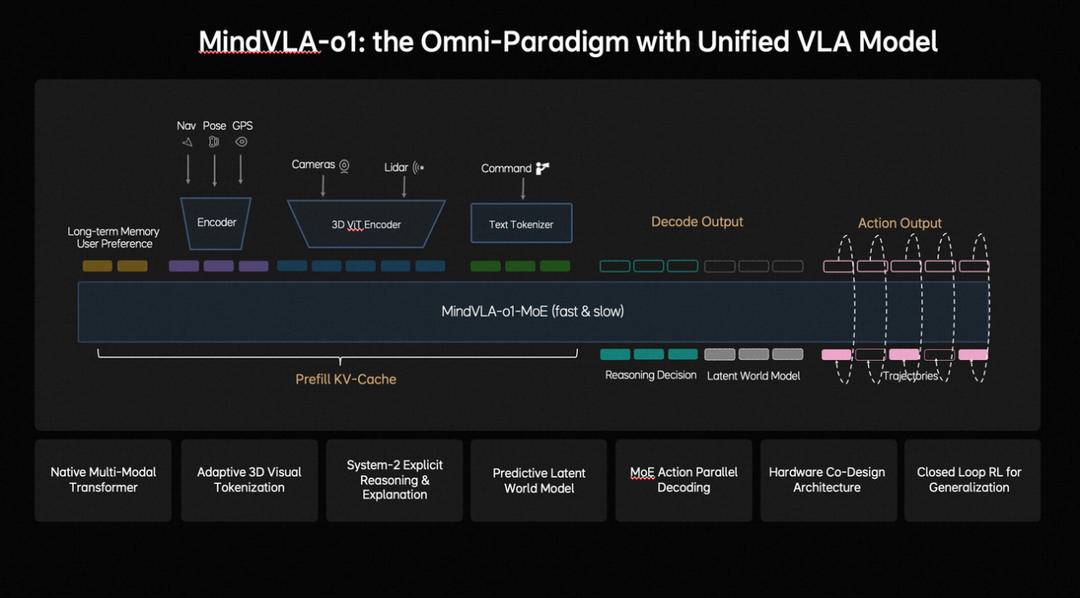
Core Viewpoint - Li Auto has officially launched its next-generation autonomous driving foundational model, MindVLA-o1, which integrates visual, language, and action capabilities to evolve into a general intelligent agent for the physical world [1][13]. Group 1: Model Innovations - MindVLA-o1 is built on five technological innovations aimed at enhancing autonomous driving capabilities [3]. - The model employs a 3D ViT Encoder for spatial understanding, utilizing LiDAR point clouds to guide the model in comprehending real-world structures [5]. - It incorporates a predictive latent world model for deeper reasoning, allowing the model to simulate future scenarios and align decision-making with multi-modal reasoning [6]. - The model generates high-precision trajectories through a unified behavior generation framework, optimizing for stability and adherence to vehicle dynamics [7]. - A closed-loop reinforcement learning framework enables continuous optimization and large-scale scene generation, significantly improving training efficiency and reducing costs [9]. - The model's deployment efficiency is enhanced through a co-design approach between software and hardware, drastically reducing architecture exploration time [11]. Group 2: Future Directions - MindVLA-o1 is part of a broader AI framework that includes components for data processing, multi-modal modeling, controllable world modeling, and reinforcement learning infrastructure, forming a complete feedback loop for autonomous action and learning [13]. - The framework is not limited to automotive applications but can also be extended to robotics and other physical systems, positioning Li Auto as a leader in embodied intelligence [15]. - The company aims to continue investing in cutting-edge research and core technology development to build a comprehensive AI system focused on physical world intelligence [15].
高盛:下调理想汽车-W评级至“中性” 降目标价至74港元
Zhi Tong Cai Jing· 2026-03-18 06:37
Core Viewpoint - Goldman Sachs reports that Li Auto-W (02015) has met expectations for Q4 2025 performance, but the guidance for Q1 2026 and full-year sales and gross margin is below expectations [1] Group 1: Financial Performance - Li Auto's Q4 2025 performance aligns with expectations, but the guidance for Q1 2026 and the full year is disappointing [1] - Goldman Sachs has lowered the target price for Li Auto from HKD 93 to HKD 74 and downgraded the rating from "Buy" to "Neutral" [1] Group 2: Sales and Profitability Forecast - The firm anticipates that Li Auto will experience two consecutive quarters of expanded net losses, with sluggish sales growth and pressured vehicle gross margins [1] - The decline in performance is attributed to a lack of new model launches, rising raw material and memory costs, and an increased proportion of low-margin models [1] Group 3: Revised Projections - Following Li Auto's Q4 2025 results, Goldman Sachs has revised its sales forecasts for 2026 to 2028 down by 5% to 22% [1] - The gross margin forecast has been adjusted down by 0.4 to 1.0 percentage points due to lower-than-expected guidance for Q1 2026 and the full year, along with reduced sales and revenue [1] - Consequently, the net profit forecast has been reduced by 21% to 34% [1]
高盛:下调理想汽车-W(02015)评级至“中性” 降目标价至74港元
智通财经网· 2026-03-18 06:32
Core Viewpoint - Goldman Sachs released a report indicating that Li Auto-W (02015) reported Q4 2025 results in line with expectations, but the guidance for Q1 2026 and the full year is below expectations, leading to a target price reduction from HKD 93 to HKD 74 and a rating downgrade from "Buy" to "Neutral" [1] Group 1: Financial Performance - Li Auto's Q4 2025 performance met expectations, but the guidance for Q1 2026 and the full year is disappointing [1] - Goldman Sachs anticipates that Li Auto will experience two consecutive quarters of expanded net losses due to weak sales growth and pressure on vehicle gross margins [1] Group 2: Sales and Margin Forecasts - Sales forecasts for 2026 have been reduced by 5% to 22%, based on management's lower-than-expected sales guidance and a slowdown in the launch of refreshed models [1] - Gross margin forecasts have been lowered by 0.4 to 1.0 percentage points due to the disappointing guidance for Q1 2026 and the full year, along with reduced sales and revenue [1] Group 3: Profitability Adjustments - Net profit forecasts have been cut by 21% to 34% as a result of the revised sales and margin expectations [1]
301428,20%涨停!两大板块大涨!
证券时报· 2026-03-18 04:21
Market Overview - The A-share market showed mixed performance on March 18, with the communication and electronics sectors experiencing significant gains, becoming the highlights of the morning session [1][4]. - By the close of the morning session, the Shanghai Composite Index fell by 0.40%, while the Shenzhen Component Index rose by 0.05%, the ChiNext Index increased by 0.89%, and the Sci-Tech Innovation Index gained 0.6% [4]. Sector Performance - The communication sector led the gains with an increase of nearly 3%, featuring stocks like Century Hengtong (301428) hitting the daily limit with a 20% rise, and Pingzhi Information (300571) soaring nearly 15% [4][5]. - The electronics sector also saw a rise of over 1.4%, with multiple stocks reaching their daily limit, including Aohong Electronics and Aosikang [6][7]. - Other sectors such as computers and defense industries also showed strong performance, while oil, steel, and real estate sectors faced declines [8]. ETF Market - The ETF market remained stable overall, but the ChiNext Composite ETF (159287) experienced a sharp decline of over 18% upon resuming trading [2][10]. - This ETF had previously shown strong performance, closing with a 20% increase the day before its drop [12]. Company Highlights - Notable stocks in the communication sector included: - Century Hengtong (301428) at 39.79, up 19.99% - Pingzhi Information (300571) at 33.77, up 14.98% - Ruisi Kanda (603803) at 13.13, up 9.97% [5]. - In the electronics sector, key performers included: - Lian Dong Technology (301369) at 150.78, up 13.20% - Anlu Technology (688107) at 33.00, up 12.63% - Aibisen (300389) at 19.65, up 11.33% [7].




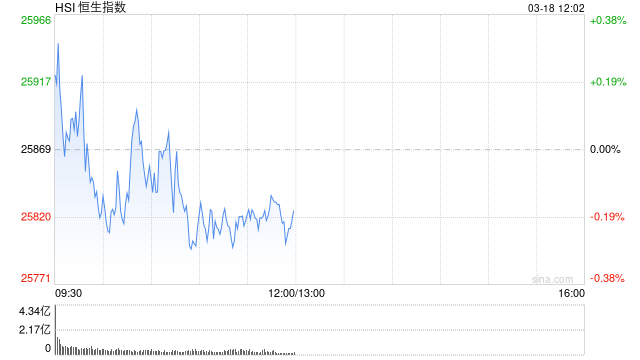
港股午评:恒指跌0.17% 科指跌0.81% 汽车股普跌 石油股下挫 理想汽车跌超6%
Xin Lang Cai Jing· 2026-03-18 04:02
Market Overview - The Hong Kong stock market indices collectively declined, with the Hang Seng Index falling by 0.17% to 25,824.70 points, the Hang Seng Tech Index down by 0.81%, and the National Enterprises Index decreasing by 0.61% [1][9]. Sector Performance - The technology sector saw mixed results, with Bilibili rising by 4% while Kuaishou and Xiaomi both dropped over 1% [1][9]. - The semiconductor sector performed well, highlighted by a more than 10% increase in Zhaoyi Innovation [1][9]. - The automotive sector experienced a pullback, with Li Auto declining over 6% [1][5][12]. - Oil stocks fell, with CNOOC down more than 3% [1][8][12]. Semiconductor Insights - UBS noted that the current storage cycle is influenced by HBM taking up DRAM capacity and AI driving up storage value weight. Traditional price acceleration methods for predicting market peaks have low accuracy, with operating profit being a more effective leading indicator. Historically, stock prices peak in 90% of cases in sync with or ahead of profit peaks. UBS expects the current profit peak to occur in Q3 2027, suggesting a potential continuation of the semiconductor stock rally until Q2 2027 [2][10]. Automotive Sector Challenges - Automotive companies, including NIO, Li Auto, and Xiaomi, have warned about cost challenges due to rising chip prices. Chery's high-end brand announced a price increase for its ET5 model by 5,000 yuan, and there are reports of upcoming price adjustments for the Zeekr 007GT model, with increases expected between 5,000 to 8,000 yuan [5][11]. Oil Market Dynamics - Morgan Stanley warned that the current $55 price differential is due to regional inventory surplus and policy interventions, which do not reflect the true global supply tightness. If the Strait of Hormuz remains blocked, Brent and WTI prices are expected to realign upwards towards Middle Eastern spot prices [8][12].