VANKE(02202)

Search documents
万科美元债创新低,每1美元面值跌2美分至15美分
Mei Ri Jing Ji Xin Wen· 2026-01-09 07:56
Group 1 - Vanke's US dollar bonds hit a record low, with a decline of 2 cents to 15 cents per dollar face value [1]
中国固定收益研究:中资美元债券2025年市场回顾
Bank of China Securities· 2026-01-09 07:18
Report Industry Investment Rating No relevant content provided. Core Viewpoints - In 2025, Chinese USD corporate bonds delivered high - single - digit returns (6.87%), showing overall resilience but slightly underperforming the broader Asia ex - Japan USD corporate bond universe (7.47%) due to the Vanke onshore debt maturity extension talks at year - end [4][5][6]. - Chinese IG bonds performed marginally stronger than HY bonds. The decline in sub - 10 - year US Treasury yields supported Chinese IG bonds, and their spread tightening outpaced that of HY bonds [4][15][24]. - The issuance volume in the Chinese USD bond primary market rebounded in 2025, but the net issuance was still deeply negative due to large - scale maturities, redemptions, and buybacks [4][39][40]. Summaries by Related Catalogs Performance Analysis - Chinese corporate bonds had a total return of 6.87% in 2025, lower than the 7.47% of the Asia ex - Japan corporate bond index and 7.75% of the iBoxx Global USD Corporate Bond Index [5][6]. - The iBoxx USD China IG Index posted a 6.87% total return, outperforming Chinese HY bonds but trailing the 7.51% return of the Asia ex - Japan IG index. Chinese HY bonds had a 6.70% return, significantly below the 9.38% of the Asia ex - Japan USD HY index [7][10][14]. Market Analysis - In 2025, the decline in sub - 10 - year US Treasury yields supported Chinese IG bonds. The Fed cut rates in September, October, and December and restarted balance - sheet expansion in December [15][19]. - By year - end, 2 - year, 5 - year, and 10 - year Treasury yields declined by 77bps, 66bps, and 40bps respectively, while the 30 - year yield edged up 6bps, steepening the yield curve [16][19]. - In 2026, the actual number of Fed rate cuts may exceed expectations due to a potentially more dovish voting committee [17][19]. Spread Analysis - Chinese IG bond spreads tightened by 24bps to 47bps in 2025, driven by negative net issuance and strong investor demand. Chinese HY bond spreads tightened by 16bps [24][25][28]. High - Yield Financing Environment - Some HY industrial and property developers returned to the primary market in 2025 with over - subscriptions, but Vanke's onshore bond extension affected other HY property developers' offshore refinancing [30][33]. - The government focused on stabilizing the property market. Developers' operations continued to diverge, and the sector was in a bottoming - out phase. Quality SOE and central SOE property bonds are preferred [31][33]. - Chinese developers' default resolution and restructuring deepened, and creditors shifted focus to more sophisticated claims protection [32][33]. Sector Performance - In IG, tech, property, and AMC bonds had returns over 8% as spreads narrowed. Central SOE perpetual and bank senior bonds had lower returns. In non - defaulting HY, HY industrial bonds had 15.9% returns, and HY property bonds had 8.8% returns despite the Vanke incident. Bank AT1 bonds underperformed with 5.5% returns [37][41]. - In the broader Asia ex - Japan credit market, bank, basic materials, and consumer services sectors had total returns above 8% [38][41]. Issuance Review - In 2025, the Chinese USD bond primary market issuance volume rebounded to US$101.7bn (+23% YoY). Excluding restructuring issuances, new issuance rose 6% YoY to US$81.1bn. Net issuance was deeply negative due to US$155.5bn of maturities, redemptions, and buybacks [4][39][42]. - Chinese issuers' activity in the Asia ex - Japan USD bond market increased slightly, accounting for 47% of total issuance volume compared to 43% in 2024. Non - Chinese Asia ex - Japan issuers' issuance volume grew 7.6% to US$116.4bn [40][42]. - Monthly issuance peaks were in February, May, September, and November, supported by financial and sovereign issuers. IG non - financial corporates' issuance was sensitive to USD interest rates. Rated HY bond volume increased, with non - property issuers dominant. Unrated bonds mainly came from LGFVs, small - scale leasing companies, and property restructuring [44][46]. - In 2025, issuance was mainly under 4 years (76.3%), but demand for longer - term funding emerged. The industrial sector became the largest issuer group (41%), overtaking the financial sector (32.7%). Property sector issuance was 22.4%, mainly for debt restructuring. LGFV issuance decreased to 29.8%. SOEs dominated new issuance (72%), and non - SOE issuers' proportion rose to 28% [45][47].
郁亮“到龄退休”,35年万科生涯如何“告别”
Xin Lang Cai Jing· 2026-01-09 06:28
Core Viewpoint - The resignation of Yu Liang marks the end of a significant 35-year career at Vanke, a company he helped grow into China's first real estate firm with over 100 billion yuan in sales. His departure raises questions about the future direction of the company amidst ongoing industry challenges [1][9]. Group 1: Career Milestones - Yu Liang joined Vanke in 1990 during a critical transition period for the company, which was shifting from diversified operations to a focus on real estate [2]. - He played a key role in Vanke's initial public offering in 1991 and was instrumental in securing financing for the company's early national expansion [2]. - Under his leadership, Vanke achieved a sales target of over 100 billion yuan in 2010, becoming the first Chinese real estate company to do so [3]. Group 2: Strategic Initiatives - Yu Liang introduced the "5986 model" during the 2008 financial crisis, which emphasized rapid project turnover to mitigate market downturns, resulting in a sales increase to 478.7 billion yuan that year [3]. - He initiated a transformation of Vanke from a traditional residential developer to a "city service provider," expanding into commercial real estate, property services, and logistics [3][5]. Group 3: Challenges and Responses - The "Baowan Battle" in 2015 posed significant challenges to Vanke's management stability, leading to concerns about the company's governance and operational continuity [4]. - In response to declining sales and profits in 2021, Yu Liang acknowledged management issues and emphasized the need for a more focused strategy to navigate the competitive landscape [7][8]. - Vanke's reported net profit loss of 450 billion yuan in 2024 prompted a strategic shift to streamline operations and focus on core business areas [8]. Group 4: Future Outlook - Yu Liang's departure has led to increased scrutiny of Vanke's future direction and governance, similar to the discussions that followed the exit of the company's founder, Wang Shi [9].
郁亮挥别万科:未竟的化债之路谁来扛起
Guan Cha Zhe Wang· 2026-01-09 06:14
Core Viewpoint - The retirement of Yu Liang marks a significant transition for Vanke, as he has been a pivotal figure in the company's evolution over the past 35 years, leading it through various phases of growth and challenges [2][6][15]. Group 1: Yu Liang's Career and Contributions - Yu Liang submitted his resignation due to reaching retirement age, effective January 8, 2026, after 35 years with Vanke [2]. - He joined Vanke in 1990 when the real estate sector was not yet a popular investment, and he played a crucial role in the company's shift towards real estate specialization [3]. - Initially not the chosen successor by Wang Shi, Yu Liang's strategic thinking and financial acumen eventually led to his appointment as CEO in 2001, succeeding Yao Mumin [4][5]. - Under his leadership, Vanke achieved significant milestones, including becoming the first real estate company to surpass 200 billion yuan in sales in 2014 [6]. Group 2: Market Position and Strategic Shifts - Yu Liang's tenure saw Vanke's sales grow from 35 billion yuan in 2004 to over 600 billion yuan by 2018, with a compound annual growth rate of 36% during a three-year period [7]. - He introduced the concept of the "Silver Age" for the real estate industry, indicating a shift from rapid growth to a more cautious approach [7]. - Despite achieving record sales, Yu Liang warned of the need to "survive" during market downturns, a sentiment that became increasingly relevant as the industry faced challenges [8]. Group 3: Financial Challenges and Debt Issues - Vanke's financial performance deteriorated significantly in recent years, with a 45.7% drop in net profit in 2021, marking the third decline in 31 years [8]. - The company faced a substantial loss of 49.48 billion yuan in 2024, primarily due to high land acquisition costs and increased debt interest expenses [8]. - Vanke's debt situation became critical, with the company needing to restructure its debts and facing a peak repayment period in the coming years [13][14].
年均超7亿平方米住房改善需求涌现 房地产行业进入“产品确定性时代”
Xin Hua Cai Jing· 2026-01-09 05:50
Core Insights - The current stock of housing that meets the "good house" standard is less than 5%, with an annual demand for housing improvement projected to reach 700 million to 1 billion square meters, indicating a shift towards a "product certainty era" in the industry [1] - The real estate sector is transitioning from quantity expansion to quality enhancement, making product strength the core competitive advantage for companies in this new development phase [1] - The current housing prices are at a low point, while product standards have reached historical highs, presenting an optimal time for buying and upgrading homes, with expectations for the next five years to be the "year of products" in Chinese real estate [1] Industry Trends - According to the latest report by CRIC, leading real estate companies are excelling in product strength by focusing on safety, comfort, sustainability, and intelligence, as reflected in the "2025 China Real Estate Enterprise Product Strength TOP 100" rankings [2] - The rankings include traditional categories such as top enterprises and products, along with new categories like "Top 10 Good House Enterprises" and "Top 20 Good House Works," showcasing the industry's focus on quality [2] - Despite challenges such as market saturation and structural declines in purchasing power, the relationship between good products and sales is not direct, necessitating a deep integration of market analysis, customer insights, and product refinement to overcome these challenges [2] Product Development - CRIC's CEO highlighted the importance of selecting unique market opportunities, with projects like Shenzhen Bay and Shanghai Gao Fu achieving strong sales due to their prime locations [3] - Emphasizing product uniqueness and differentiation is crucial, as seen in projects like Zhengzhou Jinmao and Puyang Zhuyou, which have achieved competitive advantages through differentiated offerings [3] - The industry is expected to evolve by 2026 from a focus on individual product competition to a more integrated approach involving product, customer research, and operational strategies [3]




郁亮时代谢幕,万科还有硬仗要打
3 6 Ke· 2026-01-09 05:47
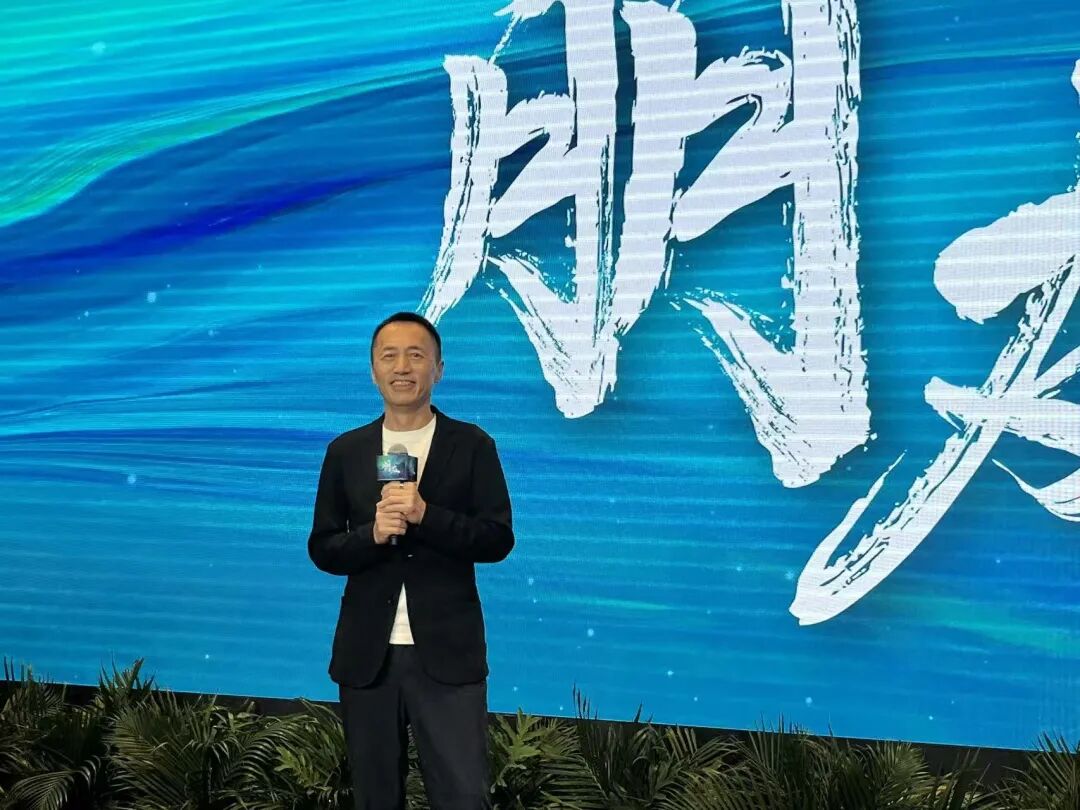
2015年12月22日,郁亮迎来50岁生日。那一年,万科总部的空气并不轻松,"宝万之争"正胶着。资本在门外叩击,公司治理的边界被反复拉扯,王石被媒 体称为"门口的野蛮人"所逼宫。 生日当天,王石写下七个字相赠:"郁亮,风雨见彩虹。" 从财务官到掌舵者,"没有王石就没有郁亮" 1988年,刚从北京大学国际经济学系毕业的郁亮,怀揣着南下闯荡的理想,进入深圳外贸集团工作。两年后,这名25岁的年轻人转身走进万科,开启了一 段长达35年的职业旅程。 彼时的万科,正处于筹备上市的关键阶段。郁亮被安排在证券与投资相关岗位,很快展现出突出的专业能力。1991年,万科成功登陆资本市场,成为深圳 证券交易所第二家上市公司,股票代码000002.SZ,企业治理随之进入规范化阶段。 两年后,风雨渐歇。 深圳地铁以664亿元入股万科,成为第一大股东,控制权之争落幕。也是在这一年,郁亮正式走到台前,接棒出任万科董事会主席。创始人退居幕后,职 业经理人完成接管,这被视为中国房地产公司治理史上的一个标志性时刻。 时间再向前走十年。 当郁亮年满60岁,行业的凛冬再度降临。万科一边与债权人反复博弈,一边也在重新校准自身的生存姿态。 在这样的节点 ...

郁亮退休辞职,但万科没有感谢
Xin Lang Cai Jing· 2026-01-09 05:18
Core Viewpoint - Vanke is facing significant challenges with a debt burden of over 362.93 billion yuan, and the recent retirement of its long-serving chairman, Yu Liang, marks a pivotal transition in the company's leadership and strategy [1][14]. Group 1: Leadership Changes - Yu Liang has retired from all positions at Vanke as of January 8, 2025, after 36 years with the company, starting from the securities department to becoming the chairman [1][16][18]. - Unlike previous high-level resignations at Vanke, the announcement of Yu Liang's retirement did not include any expressions of gratitude for his contributions, which is considered unusual [3][4][19]. - Yu Liang's departure signifies the end of the "Yu Liang era" and the transition to a new phase under the influence of state-owned enterprises [14][29]. Group 2: Financial Situation - As of the end of Q3 2025, Vanke's total interest-bearing debt reached 362.93 billion yuan, with 151.39 billion yuan due within one year, while cash reserves stood at only 65.68 billion yuan, resulting in a cash-to-short-term debt ratio of 0.43, significantly below the safety line [14][29]. - Vanke is facing imminent debt obligations, with nine bonds maturing in 2025, of which seven are domestic bonds, and the approval rate for the extension plan of "22 Vanke MTN004" was only 20.2% [14][29]. - Despite receiving nearly 30 billion yuan in financial support from its major shareholder, Shenzhen Metro Group, Vanke continues to struggle with debt pressures and has been downgraded to "junk" status by international rating agencies [14][29].
36年长跑落幕,郁亮“挥别”万科
Huan Qiu Lao Hu Cai Jing· 2026-01-09 03:37
Group 1 - The core point of the news is the retirement of Vanke's executive vice president, Yu Liang, after 36 years with the company, marking a significant leadership change [1] - Yu Liang held 7.3949 million shares of Vanke, valued at over 36 million yuan based on the closing price on January 8 [1] - During his tenure, Yu Liang led Vanke through significant growth, increasing sales from 6.3 billion yuan in 2001 to over 529.9 billion yuan in 2017, while establishing key operational principles [1] Group 2 - Vanke is currently facing a decline in performance, with projected revenues decreasing from 503.84 billion yuan in 2022 to 343.176 billion yuan in 2024, and a shift from profit to loss with net profits dropping to -49.478 billion yuan in 2024 [2] - In the first three quarters of 2025, Vanke reported a revenue of 161.39 billion yuan, a year-on-year decrease of 26.6%, and a net loss of 28.02 billion yuan, a decline of 83% [2] - The company is under significant debt pressure, with approximately 21.798 billion yuan in outstanding domestic debt and a notable short-term repayment gap due to 151.39 billion yuan of debt maturing within a year against only 65.68 billion yuan in cash [3]
清退部分万村房源,万科泊寓何去何从
3 6 Ke· 2026-01-09 02:55
Core Insights - The article discusses the ongoing issues faced by Shenzhen's rental management company, "泊寓," particularly related to its "万村计划" project, which has led to significant tenant relocations due to unpaid rent by the managing company [1][2][4]. Group 1: Company Operations - "泊寓" is currently in the process of withdrawing from certain properties, primarily those associated with the "万村计划," due to severe rent discrepancies, with an estimated 30,000 to 40,000 units affected [2][4]. - The company has provided tenants with three options: renew their lease directly with the landlord, relocate to another "泊寓" property with incentives, or terminate their lease with compensation [3][4]. - "万村计划" was initiated by Shenzhen Vanke in 2016, aiming to upgrade and manage urban village properties, with a total of 70,000 to 80,000 units signed by the end of 2018 [4][10]. Group 2: Financial Performance - "泊寓" reported a net profit of 31.94 million yuan in 2024, but incurred a loss of 88.81 million yuan from January to November 2025, primarily due to the "万村计划" properties entering a rent increase cycle [7][9]. - The company has been facing challenges due to a rental model that requires continuous payments to landlords, leading to financial strain when rental prices are not adjusted accordingly [7][11]. - As of September 2025, "泊寓" managed 280,000 units across 29 cities, with 204,000 units operational, marking a significant scale in the centralized apartment sector [9][12]. Group 3: Market Dynamics - The rental market in Shenzhen has seen an increase in supply, prompting "泊寓" to implement limited price adjustments to maintain occupancy rates [8]. - The company has shifted towards a light-asset model, collaborating with local governments and enterprises to enhance operational efficiency and reduce dependency on Vanke [11][12]. - "泊寓" has also engaged in asset securitization to convert some of its heavy assets into liquid capital, indicating a strategic pivot in its operational approach [12].
万科:郁亮因到龄退休 辞任董事、执行副总裁
Huan Qiu Wang· 2026-01-09 02:21
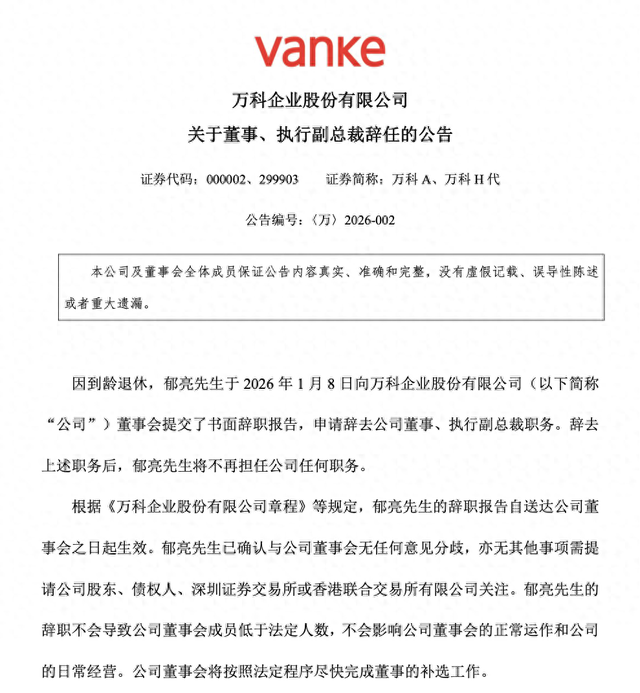
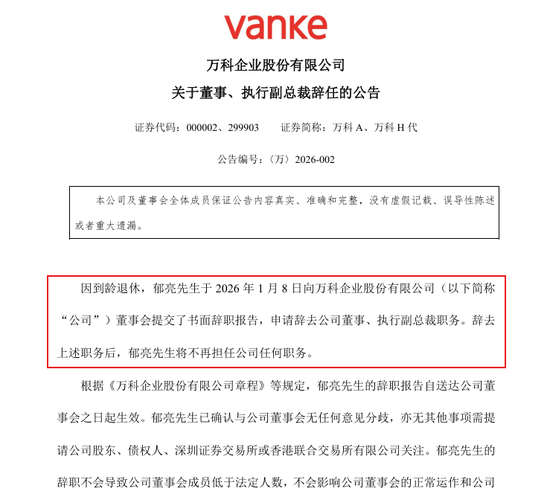
来源:环球网 【环球网综合报道】1月8日,万科企业股份有限公司发布关于董事、执行副总裁辞任的公告。 公告显示,因到龄退休,郁亮于2026年1月8日向万科企业股份有限公司董事会提交了书面辞职报告,申 请辞去公司董事、执行副总裁职务。辞去上述职务后,郁亮将不再担任公司任何职务。 万科表示,根据《万科企业股份有限公司章程》等规定,郁亮的辞职报告自送达公司董事会之日起生 效。郁亮已确认与公司董事会无任何意见分歧,亦无其他事项需提请公司股东、债权人、深圳证券交易 所或香港联合交易所有限公司关注。郁亮的辞职不会导致公司董事会成员低于法定人数,不会影响公司 董事会的正常运作和公司的日常经营。公司董事会将按照法定程序尽快完成董事的补选工作。 图源:万 科 ...