PING AN OF CHINA(02318)

Search documents
中国平安人寿保险股份有限公司增持中国人寿(02628)858.3万股 每股作价约34.36港元
智通财经网· 2026-02-09 11:29
智通财经APP获悉,香港联交所最新资料显示,2月3日,中国平安人寿保险股份有限公司增持中国人寿 (02628)858.3万股,每股作价34.3596港元,总金额约为2.95亿港元。增持后最新持股数目约为7.48亿 股,最新持股比例为10.04%。 ...


港股9日涨1.76% 收报27027.16点
Xin Hua Wang· 2026-02-09 09:40
Market Performance - The Hang Seng Index rose by 467.21 points, an increase of 1.76%, closing at 27,027.16 points [1] - The H-share Index increased by 136.95 points, closing at 9,168.33 points, a rise of 1.52% [1] - The Hang Seng Tech Index gained 71.4 points, closing at 5,417.6 points, up by 1.34% [1] - The total turnover on the main board was 255.14 billion HKD [1] Blue Chip Stocks - Tencent Holdings increased by 2.28%, closing at 560 HKD [1] - Hong Kong Exchanges and Clearing rose by 2.7%, closing at 418.6 HKD [1] - HSBC Holdings saw a rise of 3.34%, closing at 139.3 HKD [1] - China Mobile decreased by 2.12%, closing at 78.5 HKD [1] Local Hong Kong Stocks - Cheung Kong Holdings rose by 1.7%, closing at 46.62 HKD [1] - Sun Hung Kai Properties increased by 3.46%, closing at 131.5 HKD [1] - Henderson Land Development rose by 2.5%, closing at 32.78 HKD [1] Chinese Financial Stocks - Bank of China increased by 0.86%, closing at 4.7 HKD [1] - China Construction Bank rose by 1.38%, closing at 8.08 HKD [1] - Industrial and Commercial Bank of China increased by 0.46%, closing at 6.52 HKD [1] - Ping An Insurance saw a rise of 4.89%, closing at 73 HKD [1] - China Life Insurance increased by 3.98%, closing at 35.04 HKD [1] Oil and Petrochemical Stocks - China Petroleum & Chemical Corporation decreased by 0.37%, closing at 5.33 HKD [1] - China National Petroleum Corporation fell by 1.29%, closing at 9.16 HKD [1] - CNOOC Limited saw a slight decrease of 0.08%, closing at 24 HKD [1]




智通AH统计|2月9日
智通财经网· 2026-02-09 08:17
Core Insights - The article highlights the top and bottom AH premium rates for various stocks, indicating significant discrepancies between H-shares and A-shares [1] Group 1: Top AH Premium Rates - Northeast Electric (00042) has the highest AH premium rate at 831.03%, with H-share priced at 0.290 HKD and A-share at 2.25 CNY [1] - Zhejiang Shibao (01057) follows with a premium rate of 347.33%, H-share at 5.810 HKD and A-share at 21.7 CNY [1] - Sinopec Oilfield Service (01033) ranks third with a premium rate of 304.44%, H-share at 0.900 HKD and A-share at 3.04 CNY [1] Group 2: Bottom AH Premium Rates - Contemporary Amperex Technology (03750) has the lowest AH premium rate at -13.97%, with H-share priced at 513.500 HKD and A-share at 368.82 CNY [1] - China Merchants Bank (03968) has a premium rate of -3.80%, H-share at 49.220 HKD and A-share at 39.53 CNY [1] - Heng Rui Medicine (01276) shows a minimal premium rate of -0.35%, with H-share at 69.050 HKD and A-share at 57.45 CNY [1] Group 3: Top Deviation Values - Sinopec Oilfield Service (01033) leads in deviation value at 26.29%, indicating a significant difference from its average premium rate [1] - Beijing Jingcheng Machinery Electric (00187) has a deviation value of 22.66% [1] - Longpan Technology (02465) ranks third with a deviation value of 19.24% [1] Group 4: Bottom Deviation Values - Junda Co., Ltd. (02865) has the lowest deviation value at -66.46%, indicating a substantial drop from its average premium rate [1] - Zhejiang Shibao (01057) follows with a deviation value of -42.67% [1] - Yangtze Optical Fibre and Cable (06869) shows a deviation value of -33.26% [1]


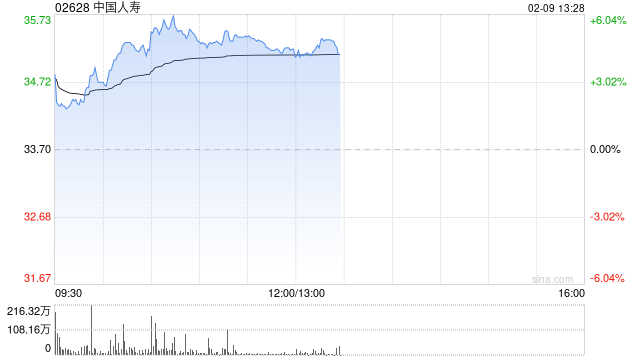
内险股午后集体走高 中国人寿及中国平安均涨逾5%
Xin Lang Cai Jing· 2026-02-09 05:29
Core Viewpoint - Domestic insurance stocks experienced a collective rise in the afternoon trading session, indicating positive market sentiment towards the sector [1][3]. Group 1: Stock Performance - China Life Insurance (02628) increased by 4.93%, reaching HKD 35.36 [1][3]. - Ping An Insurance (02318) rose by 4.67%, trading at HKD 72.85 [1][3]. - China Pacific Insurance (02601) saw a gain of 3.53%, with a price of HKD 39.90 [1][3]. - New China Life Insurance (01336) climbed by 3.31%, priced at HKD 62.45 [1][3].

超4400只股上涨
Di Yi Cai Jing Zi Xun· 2026-02-09 04:01
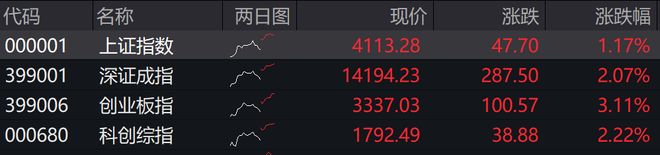
Market Performance - The A-share market showed strong performance with the Shanghai Composite Index up by 1.17%, the Shenzhen Component Index up by 2.07%, the ChiNext Index up by 3.11%, and the Sci-Tech Innovation Index up by 2.22% at midday [1][2]. Sector Highlights - The computing hardware industry chain experienced a surge, with CPO and memory sectors leading the gains. The photovoltaic industry chain also strengthened, particularly in space photovoltaic applications. AI applications, semiconductors, commercial aerospace, and consumer electronics saw significant increases [2][3]. - CPO concept stocks exploded, with Tianfu Communication nearing a 20% limit up, reaching a historical high. Other notable performers included Guangku Technology and Taicheng Light, both rising over 15% [3]. Trading Volume - The total trading volume in the Shanghai and Shenzhen markets reached 1.49 trillion yuan, an increase of 106.8 billion yuan compared to the previous trading day, with over 4,400 stocks rising [3]. Individual Stock Movements - Tianfu Communication's stock price hit a historical high, increasing by over 10% to 281.12 yuan [6]. - The photovoltaic concept stocks continued to perform well, with companies like GCL-Poly Energy achieving four consecutive trading limit ups [5]. - Longyun Co. and Jihua Group both saw their stocks hit the limit up after announcing significant corporate actions [9][10]. Hong Kong Market - The Hong Kong market opened positively, with the Hang Seng Technology Index rising by 1.59% and notable gains in stocks such as Huahong Semiconductor and XPeng Motors, both increasing by over 4% [10][11].




内险股再度走高,1月银保渠道实现开门红,机构看好保险行业估值持续改善
Zhi Tong Cai Jing· 2026-02-09 03:30
Core Viewpoint - The insurance stocks in China have seen a significant rise, driven by strong new premium growth in the insurance sector, particularly through bank insurance channels, indicating a positive outlook for the industry. Group 1: Stock Performance - China Life (02628) increased by 5.4%, reaching HKD 35.52 [1] - Ping An (02318) rose by 4.89%, reaching HKD 73 [1] - China Pacific Insurance (02601) gained 4.77%, reaching HKD 40.38 [1] - New China Life (01336) climbed by 3.39%, reaching HKD 62.5 [1] Group 2: Industry Growth - In January 2026, 79 life insurance companies achieved a total new premium scale of RMB 212.6 billion, marking a year-on-year growth of 27.6% [1] - The pandemic has led to excess savings among residents, with insurance products gaining popularity due to their yield, low volatility, and health protection features [1] Group 3: Market Outlook - Changjiang Securities suggests that the stock market's slow recovery and stable interest rate expectations may lead to improved interest margins, benefiting the industry [2] - If the new premium growth remains strong, it could accelerate the recovery of interest margins, enhancing profitability and driving continuous improvement in industry valuations [2]
盘中线索丨港股中国人寿、中国平安等保险股均涨超4%,机构:上市险企“开门红”表现亮眼
2 1 Shi Ji Jing Ji Bao Dao· 2026-02-09 03:23
南方财经2月9日电,港股保险股普涨,中国人寿、中国平安、中国太平、中国太保均涨超4%。 消息面 上,据国家金融监管总局最新披露数据显示,2025年保险业原保险保费收入约6.12万亿元,同比增长 7.43%。东吴证券指出,上市险企2026年"开门红"表现亮眼,当前"存款搬家"趋势延续,保险产品预定 利率仍高于银行存款,相对吸引力仍然明显,对全年新单保费增长持乐观预期,同时新单中分红险占比 预计进一步提升,利好险企负债成本持续改善。 方正证券:关注大权重、经营边际改善且股息率较高 的中国平安,投资弹性较大、业绩创新高的新华保险,业绩有望超预期的中国太平、中国人寿,业绩稳 健增长中国太保、中国人保,基本面延续改善的中国财险、众安在线等。 ...
内险股再度走高 1月银保渠道实现开门红 机构看好保险行业估值持续改善
Zhi Tong Cai Jing· 2026-02-09 02:58
Core Viewpoint - The insurance stocks in China have seen a significant rise, driven by strong performance in the insurance premium market, particularly through the bancassurance channel, indicating a positive outlook for the industry [1] Group 1: Stock Performance - China Life (601628) increased by 5.4%, reaching HKD 35.52 [1] - Ping An (601318) rose by 4.89%, reaching HKD 73 [1] - China Pacific Insurance (601601) grew by 4.77%, reaching HKD 40.38 [1] - New China Life (601336) saw a 3.39% increase, reaching HKD 62.5 [1] Group 2: Premium Growth - In January 2026, 79 life insurance companies achieved a total new premium scale of CNY 212.6 billion, marking a year-on-year growth of 27.6% [1] Group 3: Market Insights - According to research from Kaiyuan Securities, the advantages of insurance products in terms of yield, low volatility, and health protection have become more prominent due to the concentration of excess savings during the pandemic [1] - Yangtze River Securities noted that the stable stock market and expectations of steady interest rates could lead to improved interest spreads, benefiting the industry [1] - Continued strong growth in new premium income is expected to accelerate the recovery of interest spreads, enhancing profitability and driving ongoing improvements in industry valuations [1]

港股保险股普涨 中国平安、中国人寿涨超5%
Jin Rong Jie· 2026-02-09 02:58
Core Viewpoint - The Hong Kong insurance stocks experienced a collective surge, with significant gains observed across major companies in the sector [1] Group 1: Company Performance - China Life and Ping An Insurance both rose over 5% [1] - China Taiping increased by 4.8% [1] - China Pacific Insurance saw a rise of 4.5% [1] - China Insurance, New China Life, and China Property & Casualty Insurance all gained over 3% [1] - AIA Group experienced an approximate increase of 3% [1]

保险股普涨 中国平安、中国人寿涨超5% 机构指保险板块长期配置价值显著
Ge Long Hui· 2026-02-09 02:56
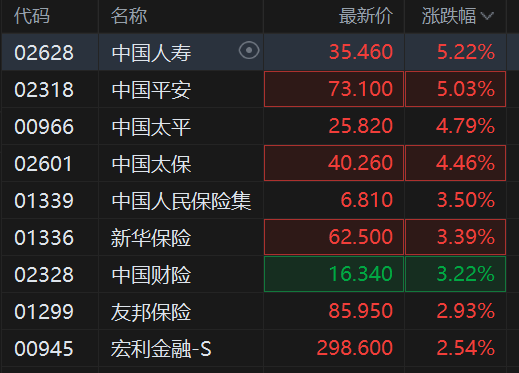
Core Viewpoint - The Hong Kong insurance stocks experienced a collective surge, with major companies like China Life and Ping An rising over 5%, driven by favorable market conditions and strategic positioning in the insurance sector [1] Group 1: Market Performance - China Life's stock price increased by 5.22% to 35.460 [2] - Ping An's stock price rose by 5.03% to 73.100 [2] - China Taiping's stock price went up by 4.79% to 25.820 [2] - China Pacific's stock price increased by 4.46% to 40.260 [2] - Other notable increases include China People's Insurance at 3.50%, New China Life at 3.39%, and China Property & Casualty at 3.22% [2] Group 2: Industry Insights - CITIC Securities' report indicates that with a large number of deposits maturing, savings-type insurance products are expected to meet the demand for stable long-term value growth due to their high returns and long terms [1] - The report anticipates that leading insurance companies will capitalize on improved bancassurance value rates, leading to rapid growth in new policies and new business value (NBV) [1] - The asset side is expected to benefit from a spring rally in the equity market, enhancing profits, while stable interest rates will support long-term returns for insurance funds [1] Group 3: Future Projections - Huaxi Research predicts that listed insurance companies will continue to see rapid growth in net profit attributable to shareholders through 2025, although Q4 may face some pressure from investment impacts [1] - The report highlights a high level of enthusiasm for the insurance sector in Q1 2026, driven by the "opening red" period and the transformation of savings-type insurance products, which will alleviate pressure from interest rate spreads [1] - Recommended stocks include Ping An for its improved fundamentals and high dividend yield, New China Life for its asset flexibility and high dividend yield, and China Life for its asset flexibility [1]