
BANK COMM(03328)

Search documents
超50家银行宣布,停止这一服务
凤凰网财经· 2025-04-06 14:40
来源:21世纪经济报道 你有多久没用过ATM扫码存款了? 日前,招商银行发布公告称, 该行将于4月9日起停止ATM扫码存款服务 ,后续,客户可持银行卡,通过招商银行ATM或前往该行营业网点办理存款业 务。 近年来, 多家银行都在收紧无卡存取款业务 。谈及调整此类业务的原因,多家银行表示,是基于优化金融服务、风险管理以及成本效率等方面的考量。 01 近一年来,超50家银行暂停各类无卡业务 据不完全统计,近一年来已经有超过50家银行机构宣布,停止无卡存款、无卡取款、扫描取款等各类业务。 去年三、四月份 多家国有大行率先作出调整 比如, 工商银行 率先表示,其个人手机银行无卡取现功能已于去年4月17日起暂停服务,客户可通过ATM机手机银行扫码取现功能提取现金,或在ATM机 上插卡提现。 交通银行 随后发布公告称,于2024年5月24日起停止个人手机银行无卡取款功能中的预约取款服务。客户仍可通过交通银行智能机具办理有卡取款、扫码 取款或前往银行营业网点办理取款业务。 去年下半年 多家股份行、头部城商行持续跟进 去年6月4日, 民生银行 发布公告称,将于2024年6月7日起停止个人手机银行"ATM无卡取现"功能,现金机 ...


六大行下一步发展在哪?业绩说明会解读沪市顶流公司背后的“硬核”操作
Zheng Quan Shi Bao Wang· 2025-04-06 09:53
Core Viewpoint - The six major state-owned banks in China are navigating challenges such as narrowing net interest margins while maintaining stable growth and supporting the real economy through strategic financial services [1][2][3]. Group 1: Financial Performance - As of the end of 2024, the total asset scale of the six major banks is approaching 200 trillion yuan, with Industrial and Commercial Bank of China (ICBC) leading at 48.82 trillion yuan [2]. - The non-performing loan (NPL) ratios for the six banks are low, with ICBC, Agricultural Bank of China, and China Bank all at 1.34%, while Postal Savings Bank has the lowest at 0.90% [2]. - The total net profit of the six banks exceeded 1.4 trillion yuan in the previous year, reflecting a year-on-year growth of 1.8% [3]. Group 2: Credit Strategy and Focus Areas - The banks are directing financial resources towards technology, green initiatives, and inclusive finance, with significant loan growth in strategic emerging industries [5]. - Agricultural Bank of China reported a loan balance for private enterprises of 6.53 trillion yuan, with a year-on-year increase exceeding 1 trillion yuan [5]. - The banks are also focusing on rural finance, with Agricultural Bank of China’s rural loans exceeding 9.85 trillion yuan, accounting for over 40% of its domestic loan portfolio [6]. Group 3: Future Development Plans - The banks have outlined their credit growth strategies for 2025, with a focus on increasing total loan amounts while optimizing the structure and maintaining a steady pace [7]. - Postal Savings Bank plans to enhance innovation in serving high-tech enterprises and small businesses, while also increasing support for rural finance [8]. - ICBC aims to expand its global operations by providing services in multiple currencies to support cross-border e-commerce [8].


交易所收紧城投发债,特别国债注资终落地
Ping An Securities· 2025-04-06 09:13
Group 1 - The report highlights that the Shanghai Stock Exchange has tightened the issuance of municipal investment bonds, making it more difficult for weaker quality issuers to finance [2][7][8] - The newly implemented guidelines include increased scrutiny on issuers with high proportions of inventory and receivables, as well as those with low EBITDA relative to interest expenses [12][8] - The special treasury bond injection into four major banks is expected to enhance their core Tier 1 capital adequacy ratios by approximately 1 percentage point, with the Agricultural Bank of China likely to receive additional support due to its lower capital adequacy [9][10] Group 2 - Credit bond yields have generally declined, with notable compressions in credit spreads across various sectors, particularly in the banking sector, which saw a reduction of 8 basis points [3][4][18] - The report indicates that the credit spreads for municipal investment bonds have also compressed, with no overdue non-standard municipal bonds reported in recent weeks [19][22] - The strategy outlook suggests focusing on short-duration opportunities as credit spreads may widen in the future due to lower supply of credit bonds compared to interest rate bonds [6][30]

六大行整体不良率下降,个贷不良悄然攀升
21世纪经济报道· 2025-04-04 09:40
Core Viewpoint - The overall operating conditions of the six major state-owned banks show a steady trend, with a decrease in the overall non-performing loan (NPL) ratio and a maintained provision coverage ratio at a safe level, indicating an improvement in asset quality. However, there are underlying concerns, such as the rising balance of special mention loans and the increasing individual loan NPL ratio, which presents challenges for future asset quality control [1][2][3]. Group 1: Asset Quality Indicators - The NPL ratio of the six major banks is trending downwards and remains below the regulatory red line of 5%. Specific NPL ratios include: Industrial and Commercial Bank of China (ICBC) at 1.34% (down 2 basis points), Agricultural Bank of China (ABC) at 1.30% (down 3 basis points), Bank of China (BOC) at 1.25% (down 2 basis points), China Construction Bank (CCB) at 1.34% (down 3 basis points), and Bank of Communications (BoCom) at 1.31% (down 2 basis points). Postal Savings Bank of China (PSBC) saw a slight increase of 7 basis points to 0.90%, still the lowest among the six banks [2]. - The provision coverage ratio for all six banks significantly exceeds the regulatory red line of 150%, ranging from 200% to 300%. ICBC (214.97%), BOC (200.60%), and BoCom (201.94%) showed increases compared to the previous year, while ABC and CCB experienced slight declines, with PSBC seeing the largest drop of 61.42 percentage points, yet still maintaining a high absolute value [3]. - The balance of special mention loans has increased for five of the six banks, indicating a potential risk of these loans converting into NPLs. The increases in special mention loans are as follows: ICBC up by 91.5 billion yuan, PSBC up by 29.3 billion yuan, ABC up by 27.5 billion yuan, BOC up by 26.2 billion yuan, and BoCom up by 10.7 billion yuan [3][4]. Group 2: Individual Loan NPL Trends - The individual loan NPL ratio has been quietly rising, with the total amount of personal NPLs increasing significantly. In 2024, the personal NPL amounts increased by 109 billion yuan for PSBC, 301 billion yuan for CCB, 421 billion yuan for ICBC, 143 billion yuan for BOC, 320 billion yuan for ABC, and 97 billion yuan for BoCom, totaling nearly 1.4 trillion yuan [6]. - The individual loan NPL ratios have also risen across the board, with ICBC's ratio increasing from 0.70% to 1.15% (up 0.45 percentage points), CCB from 0.66% to 0.98% (up 0.32 percentage points), ABC from 0.73% to 1.03% (up 0.30 percentage points), BoCom from 0.81% to 1.08% (up 0.27 percentage points), and PSBC from 1.12% to 1.28% (up 0.16 percentage points) [6][7]. - Notably, personal operating loans, primarily aimed at small and micro business owners, have seen a significant increase in NPL ratios, with ICBC's ratio rising from 0.86% to 1.27%, ABC from 0.93% to 1.39%, and CCB from 0.95% to 1.59% [7][8]. Group 3: Future Outlook and Strategies - In response to the rising risks in retail loans, banks are implementing various strategies. CCB plans to strengthen risk control throughout the retail loan process, while ABC emphasizes strict entry standards for inclusive retail business and optimizing the risk control system. BOC aims to enhance proactive risk management and post-loan management, and ICBC focuses on optimizing business entry and bad debt disposal processes. BoCom intends to balance business development with risk control to maintain retail loan quality within expected ranges [8][9].


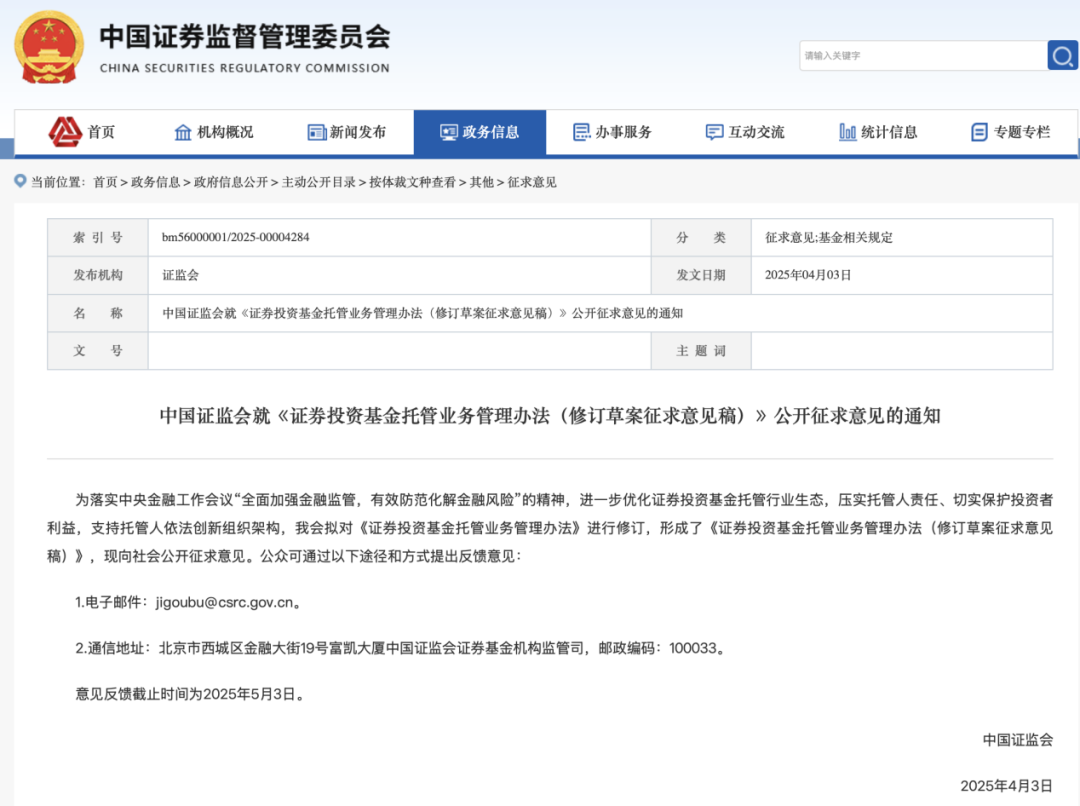
推动托管行业规范化、专业化发展 《证券投资基金托管业务管理办法》即将迎来修订
Zhong Guo Ji Jin Bao· 2025-04-03 15:16
Core Viewpoint - The China Securities Regulatory Commission (CSRC) is revising the "Securities Investment Fund Custody Business Management Measures" to address industry issues and promote the standardized and professional development of the custody industry, thereby supporting the high-quality development of the capital market [1][2]. Group 1: Industry Issues - The current custody industry is highly concentrated, with national commercial banks and a few securities companies holding approximately 80% to 90% of public and private securities investment funds [2]. - Some institutions are engaging in activities outside the core business of "securities investment fund" custody, necessitating a clarification of business boundaries [3]. - Certain custody institutions are failing to fulfill their responsibilities adequately, as evidenced by private fund default incidents, highlighting the need for enhanced regulatory requirements [3]. - The existing market exit mechanism is inadequate, lacking clear standards for "non-business" activities, which leads to risks of unauthorized operations [4]. - The current regulations do not fully align with the needs of industry innovation, indicating a need for specific policies for specialized custody subsidiaries [5]. Group 2: Key Measures for Development - The revised measures will enhance entry thresholds by strengthening requirements for substantial operational capabilities and compliance risk management [6]. - There will be a focus on substantial operations and risk isolation, requiring applicants to commit to core responsibilities and ensuring the separation of fund assets from other custody assets [7]. - Custodians will be held accountable for verifying information provided by fund managers and must disclose risks adequately, with clear responsibilities for reporting and settlement [7]. - The exit mechanism will be improved by adding conditions for license cancellation, ensuring an orderly market mechanism [7]. - High-quality custody institutions will be allowed to establish wholly-owned subsidiaries dedicated to custody business, subject to relevant financial regulatory requirements [8]. Group 3: Industry Context and Growth - As of the end of the first quarter of this year, there are 73 institutions with custody qualifications, and the total assets under custody for public funds exceed 33 trillion yuan [9]. - The Industrial and Commercial Bank of China leads with a custody scale of 4.48 trillion yuan, holding a market share of 13.78% [9]. - The overall principle of the revision is to ensure stringent entry, focus on core business, enforce responsibilities, and promote innovation, aiming to enhance the custody industry's standardization and professionalism [9].

透过大行财报看经济:净息差降幅明显收窄,信贷+债券承接力度不减
Di Yi Cai Jing· 2025-04-03 14:12
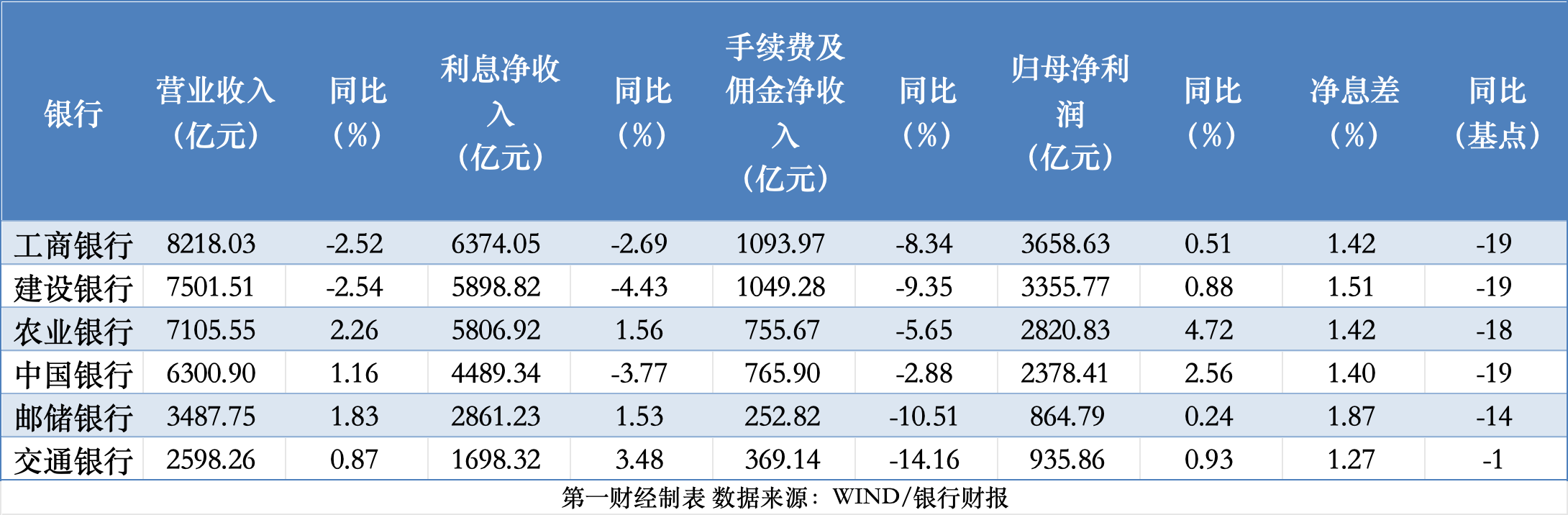
Core Insights - The six major state-owned banks in China have shown steady growth in their financial performance, with total assets nearing 200 trillion yuan and a slight increase in profitability despite challenges such as narrowing interest margins and asset-liability issues [1][2]. Financial Performance - In 2024, the six banks collectively achieved an operating income of approximately 3.52 trillion yuan, a slight decrease of 0.3% year-on-year, with four banks reporting positive growth [2][3]. - The net profit attributable to shareholders for the six banks reached 1.4 trillion yuan, an increase of about 245 billion yuan or 1.8% compared to the previous year [2]. Revenue Breakdown - Interest income for the six banks decreased by 1.58%, with three banks reporting increases and three reporting declines [4]. - Non-interest income saw a significant increase of 34.1% year-on-year, driven by factors such as a favorable bond market [4]. Asset and Loan Growth - Total assets of the six banks reached 199.68 trillion yuan, an increase of approximately 15 trillion yuan or 7.87% from the beginning of the year [7][8]. - The total amount of loans and advances exceeded 118 trillion yuan, with an increase of 9.55 trillion yuan or 8.85% year-on-year [7][8]. Credit Allocation - The banks have maintained strong support for key sectors, with significant loan growth in manufacturing, strategic emerging industries, and green development [9][10]. - Despite a slowdown in new credit issuance, the banks continue to support the real economy, particularly in critical areas [9]. Liability Management - Total liabilities for the six banks were approximately 184 trillion yuan, reflecting an increase of 8.01% from the beginning of the year [10]. - The total deposits reached about 142 trillion yuan, with a growth of 6.66 trillion yuan or 4.91% year-on-year, although there was a noticeable outflow of corporate deposits [10][11]. Asset Quality - The overall asset quality has improved, with most banks reporting a stable or declining non-performing loan (NPL) ratio [13][14]. - However, there is a rising trend in NPLs within retail sectors such as personal housing loans and credit cards [13][15]. Support for Private Enterprises - The banks have committed to supporting private enterprises, with significant loan balances reported, particularly by Agricultural Bank and Construction Bank [16][17]. - The focus on financing for private enterprises is expected to continue, with plans for substantial credit support in the coming years [17].
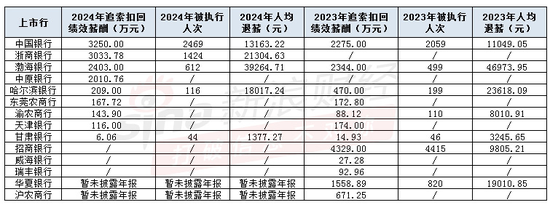
9家上市行“反向追薪”超1.13亿!渤海银行人均退薪3.93万,招商银行未再披露
Xin Lang Cai Jing· 2025-04-03 00:23
Core Viewpoint - The 2024 annual reports of listed banks reveal significant performance salary clawbacks, with a total amount exceeding 113 million yuan across nine banks, indicating a growing trend in enforcing accountability in executive compensation [1][4]. Summary by Category Performance Salary Clawbacks - Nine listed banks have disclosed their performance salary clawback situations in their 2024 annual reports, including major banks like Bank of China, Zhejiang Commercial Bank, and Bohai Bank [1][4]. - The total amount of clawbacks reported by these banks exceeds 113 million yuan, with Bank of China leading at 32.5 million yuan [1][4]. - The average clawback amount per person was highest at Bohai Bank, reaching 39,264.71 yuan, while Bank of China and Harbin Bank also reported significant average clawbacks exceeding 10,000 yuan [2][4]. Year-on-Year Comparison - Compared to 2023, several banks, including China Merchants Bank and Weihai Bank, did not disclose specific clawback amounts for 2024, despite having reported significant figures in the previous year [6]. - In 2023, China Merchants Bank had the highest clawback amount at 43.29 million yuan, affecting 4,415 employees with an average clawback of approximately 9,805 yuan [6]. Disclosure Trends - Zhejiang Commercial Bank and Zhongyuan Bank disclosed specific clawback amounts for the first time in 2024, indicating an improvement in transparency [7]. - Bohai Bank and Dongguan Rural Commercial Bank have consistently disclosed their clawback amounts for three consecutive years, showing a commitment to accountability [5][6]. Regulatory Context - The regulatory framework for performance salary clawbacks has been strengthened over the years, with guidelines established by the former China Banking Regulatory Commission and the China Banking and Insurance Regulatory Commission [10][11]. - As of 2023, over 95% of banking institutions have implemented performance salary clawback mechanisms, reflecting a significant shift towards more robust governance in the banking sector [11].
多维破局银发经济 上市银行养老金融加速跑
Zhong Guo Jing Ying Bao· 2025-04-03 00:18
本报记者 王柯瑾 北京报道 随着上市银行2024年年报密集披露,作为金融"五篇大文章"关键领域的养老金融业务呈现多维突破态 势。《中国经营报》记者梳理发现,多家上市银行个人养老金账户开户数持续攀升、养老产业综合授信 规模不断提升、适老化理财创新产品迭出。 3月28日国家金融监督管理总局发布的《银行业保险业养老金融高质量发展实施方案》(以下简称"《实 施方案》"),构建起涵盖产品供给、服务创新、风险管控的完整政策框架,标志着我国养老金融体系 建设从分散探索转向系统化推进,为银发经济开辟出更广阔的发展空间。 业内分析认为,在国家政策与市场需求的叠加推动下,养老金融正迈入系统性发展新阶段。 养老金金融和养老服务金融破规模 多家上市银行在2024年年报中披露了养老金金融和养老服务金融成效。 养老金融的快速发展离不开政策的推动。2024年12月,人民银行等九部门联合印发《关于金融支持中国 式养老事业 服务银发经济高质量发展的指导意见》,2025年2月证监会印发《关于资本市场做好金 融"五篇大文章"的实施意见》,3月国务院办公厅印发《关于做好金融"五篇大文章"的指导意见》,日 前国家金融监管总局印发《实施方案》……意味着 ...
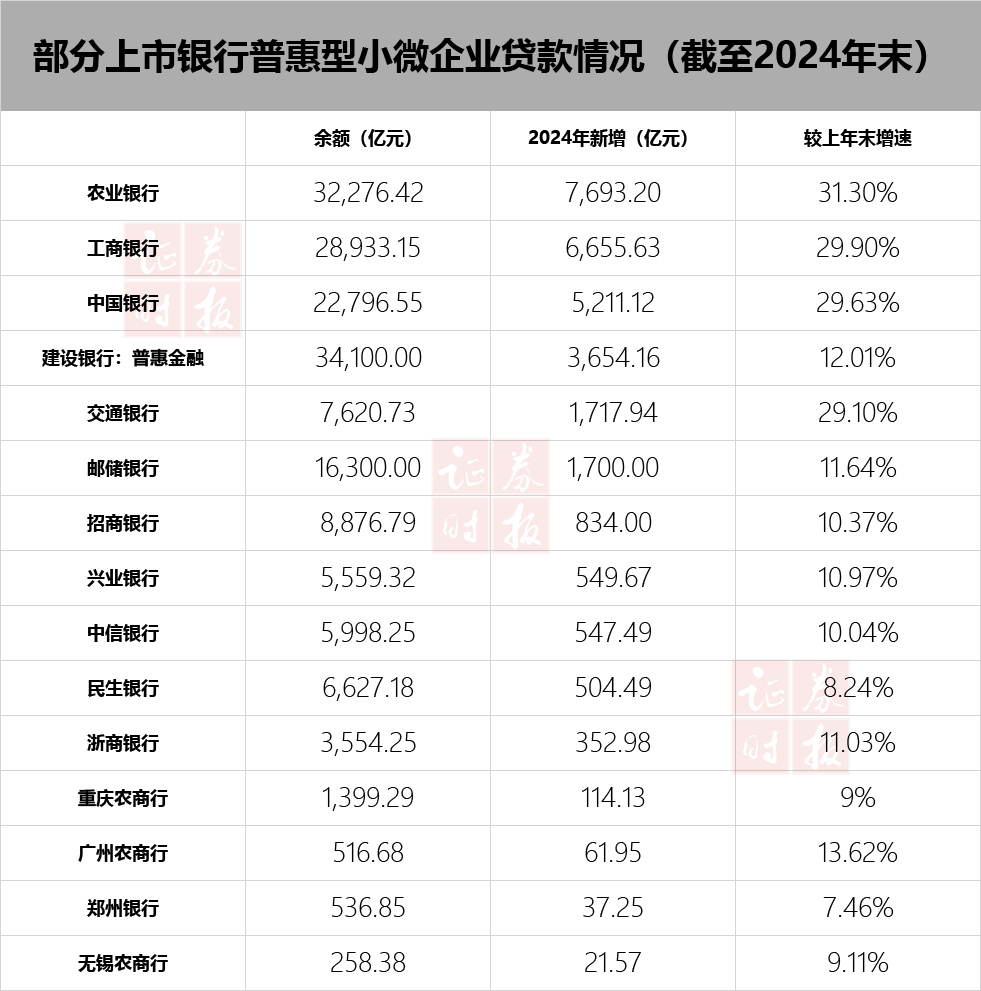
普惠小微贷款延续高增 各地专班精准破解企业融资个性化难题
Zheng Quan Shi Bao· 2025-04-02 14:49
Core Insights - The establishment of a four-level coordination mechanism for financing support to small and micro enterprises aims to enhance the efficiency and quality of financial services provided to these businesses [1][6][9] Group 1: Policy and Mechanism - The financial regulatory authority and the National Development and Reform Commission have initiated a mechanism to improve financing for small and micro enterprises, focusing on information sharing and tailored support [1][6] - Local governments have formed specialized teams to address the unique financing challenges faced by small and micro enterprises, breaking down previous departmental silos [6][7] Group 2: Loan Growth and Performance - Major state-owned banks have reported significant growth in inclusive small and micro enterprise loans, with Agricultural Bank of China, Industrial and Commercial Bank of China, and China Bank showing growth rates exceeding 29% [2][3] - As of February 2025, the total balance of inclusive small and micro enterprise loans in China approached 34 trillion yuan, with a year-on-year growth rate of 12.6%, outpacing other loan categories by 5.7 percentage points [4][6] Group 3: Case Studies and Implementation - Local teams have successfully facilitated financing for specific enterprises by addressing regulatory hurdles and providing necessary documentation to banks, demonstrating the effectiveness of the new coordination mechanism [7][8] - The focus has shifted from merely providing loans to ensuring the quality and suitability of financial products for small and micro enterprises, highlighting the importance of personalized solutions [8][9]


交通银行(601328) - 交通银行2025年第二次临时股东大会、2025年第一次A股类别股东大会、2025年第一次H股类别股东大会资料
2025-04-02 12:46
交通银行股份有限公司 2025 年第二次临时股东大会 2025 年第一次 A 股类别股东大会 2025 年第一次 H 股类别股东大会 资 料 2025 年 4 月 16 日,中国上海 | 1.股东大会议程 3 | | --- | | 2.交通银行股份有限公司2025年第二次临时股东大会议案 7 | | (1)关于本行符合向特定对象发行A股股票条件的议案 7 | | (2)关于本行向特定对象发行A股股票方案的议案 8 | | (3)关于本行向特定对象发行A股股票预案的议案 13 | | (4)关于本行向特定对象发行A股股票方案的论证分析报告的议案 14 | | (5)关于本行向特定对象发行A股股票募集资金使用的可行性分析报告的议 | | 案 15 | | (6)关于本行向特定对象发行A股股票摊薄即期回报及填补措施和相关主体 | | 承诺事项的议案 16 | | (7)关于本行引入中国烟草总公司、中国双维投资有限公司作为战略投资者 | | 的议案 17 | | (8)关于本行与战略投资者签署《附条件生效的战略合作协议》的议案 18 | | (9)关于本行与财政部签署《附条件生效的股份认购协议》的议案 19 | | ...