MEITUAN(03690)

Search documents
强监管信号释放 美团、阿里、京东股价应声大涨:“外卖大战该结束了”
Mei Ri Jing Ji Xin Wen· 2026-03-25 16:26
Core Viewpoint - The ongoing subsidy war among food delivery platforms has significant implications not only for restaurant owners but also for the livelihoods of ordinary people, indicating a broader economic impact [1] Regulatory Actions - On March 25, the National Market Supervision Administration reposted a commentary titled "The Takeaway War Should End," which garnered strong market attention [2] - This marks the second significant regulatory action against "involution-style" competition in a short period, with the Beijing Market Supervision Bureau recently conducting talks with 12 platform companies to address issues identified in their competitive practices [3] Financial Impact - The subsidy war, branded as "hundred billion subsidies," has led to substantial financial losses for major platforms. Alibaba reported an adjusted EBITA of 83.499 billion yuan for the nine months ending December 31, 2025, a 46% year-on-year decline [4] - JD.com disclosed a loss of 46.6 billion yuan in its new business segment, which includes its food delivery service, while Meituan projected a loss of approximately 23.3 billion to 24.3 billion yuan for 2025 [4] Supply Chain Effects - The price war has also affected the supply chain, with 39% of surveyed merchants opting for cheaper suppliers and 30% negotiating harder with suppliers to manage costs [5] Shift in Competition Dynamics - The commentary from the Economic Daily and its reposting by the regulatory body signal a shift towards ending the reliance on capital-intensive competition and promoting healthy competition through technological innovation and service optimization [5][6] - Experts suggest that while the subsidy war may pause, competition will continue in other areas, necessitating a clear distinction between "reasonable market competition" and "involution-style competition" [8] Future Industry Outlook - The food delivery industry is at a critical turning point, with regulatory actions and media positioning indicating a move away from aggressive subsidy strategies towards a focus on efficiency and service quality [10] - Companies will need to balance efficiency and scale while leveraging technological innovations to create differentiated advantages in the market [10]


中国资产深夜大涨 美团ADR狂飙14% 拼多多涨超7% 美股芯片股大幅走强
2 1 Shi Ji Jing Ji Bao Dao· 2026-03-25 16:01
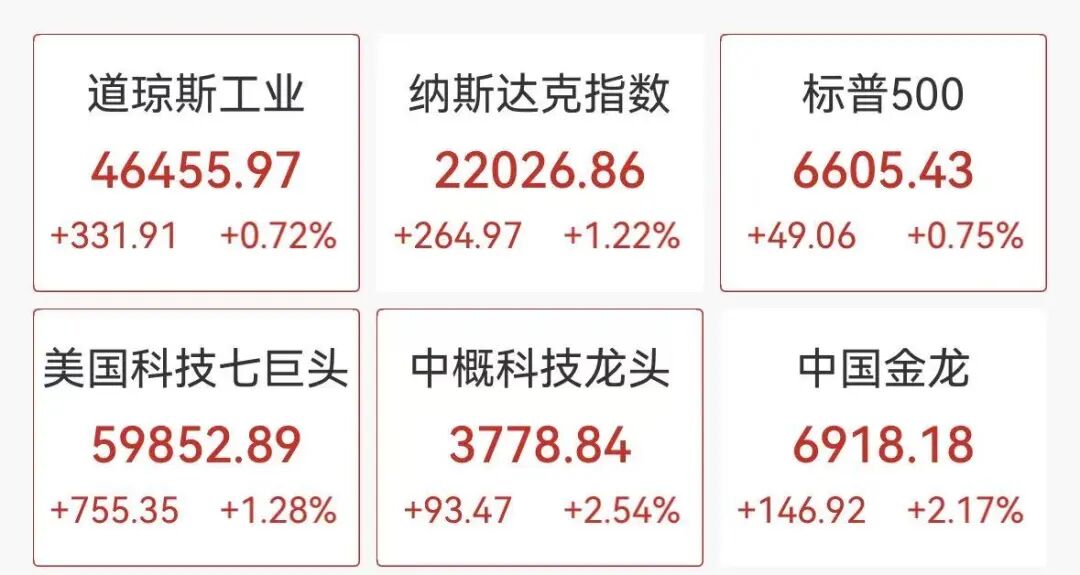
Group 1: Technology Stocks Performance - Major tech stocks experienced a rally, with Nvidia, Tesla, and Amazon each rising over 2% [2] - Semiconductor stocks showed strong performance, with the Philadelphia Semiconductor Index increasing nearly 1.6% and ARM surging over 15% after announcing its self-developed data center CPU, which was adopted by Meta [2] - AMD and Intel both rose over 6%, while Marvell Technology increased by over 4% [2] Group 2: Gold and Silver Market - Gold stocks collectively rose, with companies like IGO Mining, Kinross Gold, and Pan American Silver increasing over 4% [2] - Spot gold prices increased by 1.9%, reaching $4,558 per ounce, while spot silver rose over 2% to $72.8 per ounce [3] Group 3: Oil Market Update - International oil prices saw a slight recovery, with both WTI and Brent crude oil dropping over 3%, after previously declining more than 6%, with Brent crude currently priced at $96 per barrel [4] Group 4: Cryptocurrency Market - The cryptocurrency market saw a collective rise, with Bitcoin increasing over 2% to $71,000 per coin [5]
京东美团奥乐齐加速杀进社区,传统超市的“收租模式”正在被硬折扣肢解
Sou Hu Cai Jing· 2026-03-25 14:38
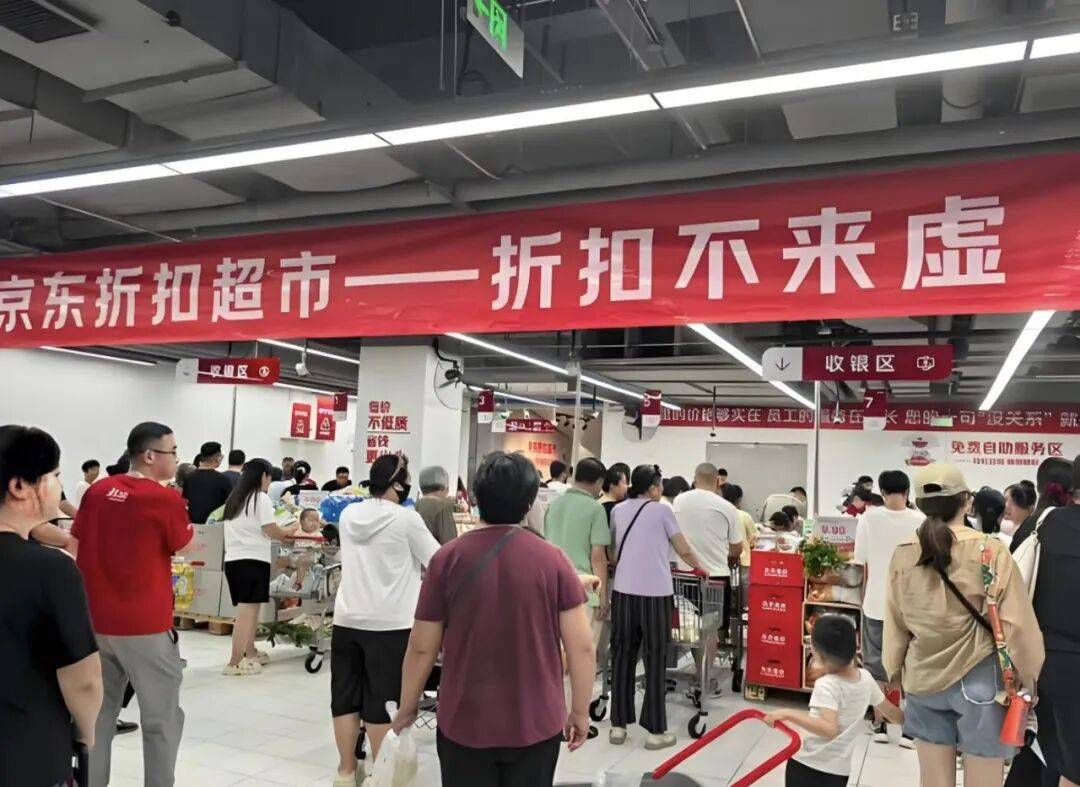
Core Insights - The retail market in China in 2026 is dominated by a single sentiment: price reduction, with hard discount stores emerging as a significant force against traditional supermarkets [2][4][30] Group 1: Market Dynamics - The opening of JD's discount supermarket in Suzhou and Aldi's milestone of 100 stores in China signify a shift from single-store validation to regional replication in the hard discount sector [2][4] - The expansion of hard discount players like JD, Aldi, and Meituan indicates a transition from isolated breakthroughs to a comprehensive encirclement of traditional retail [4][10] Group 2: Competitive Landscape - Traditional supermarkets are increasingly threatened by the rapid expansion of hard discount stores, which have evolved from being seen as a defensive strategy to a necessary project for retail giants [8][11] - Aldi's recent openings in Jiangsu reflect a strategic acceleration in its "out of Shanghai into Suzhou" approach, indicating a broader acceptance of the hard discount model across various city tiers [10][11] Group 3: Operational Efficiency - Hard discount stores are not merely selling cheap goods; they are revolutionizing efficiency in retail by leveraging supply chain advantages and minimizing operational costs [6][12] - Key players like JD, Aldi, and Hema NB focus on operational efficiency, with JD utilizing a large store format and local sourcing to enhance customer engagement [15][19] Group 4: Consumer Behavior - The shift in consumer mindset towards rational spending and quality at lower prices has made hard discount stores appealing to middle-class consumers seeking value without compromising on quality [24][30] - The traditional retail model's reliance on information asymmetry and markups is being challenged as consumers become more aware of pricing structures [26][30] Group 5: Future Outlook - The hard discount model is expected to reshape the offline retail landscape in China over the next 3 to 5 years, potentially leading to a crisis for traditional supermarkets [28][30] - The competition will likely evolve into an "ecological battle," where success will depend on integrating direct supply, digital operations, and instant delivery [28][30]

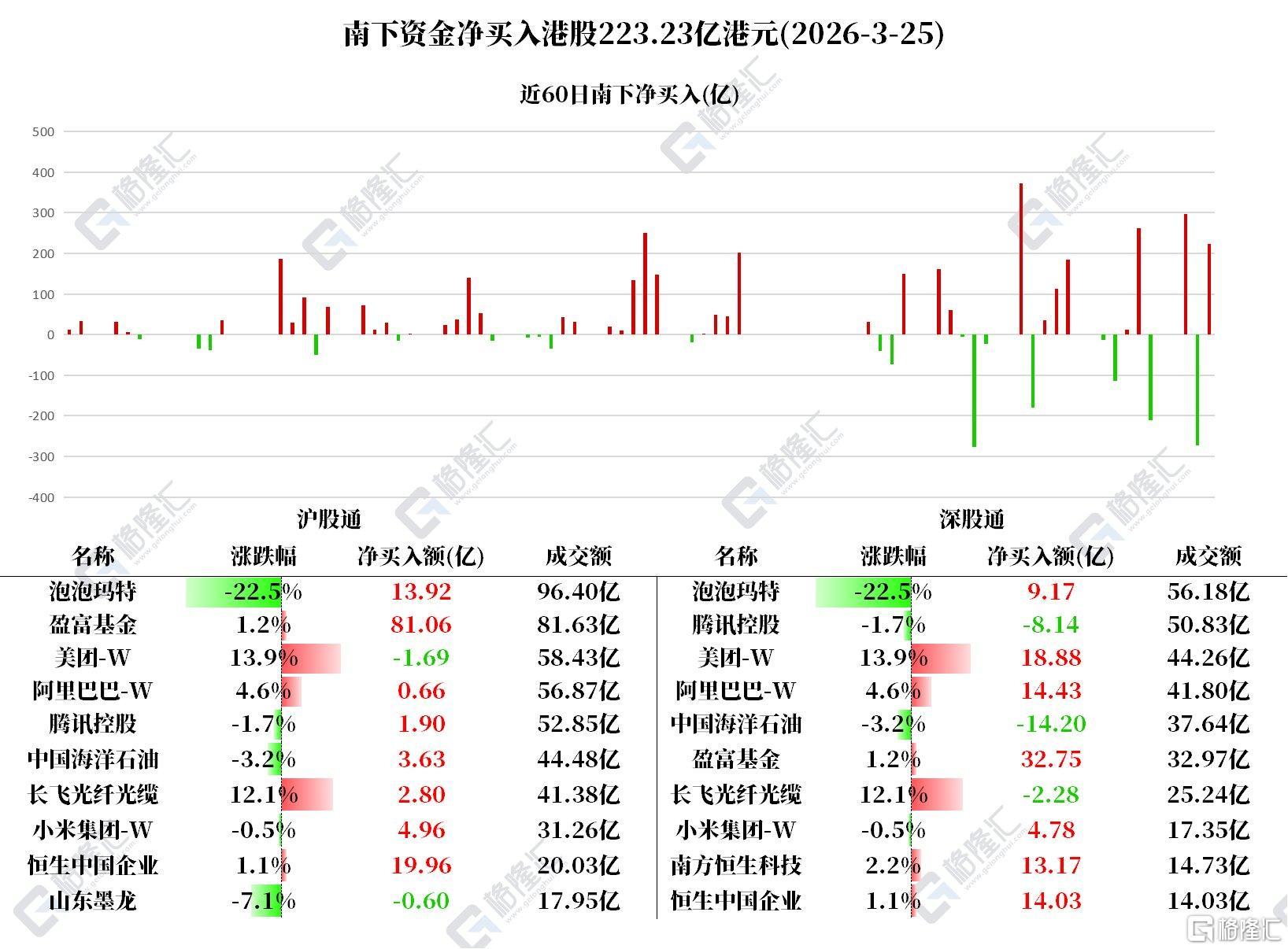
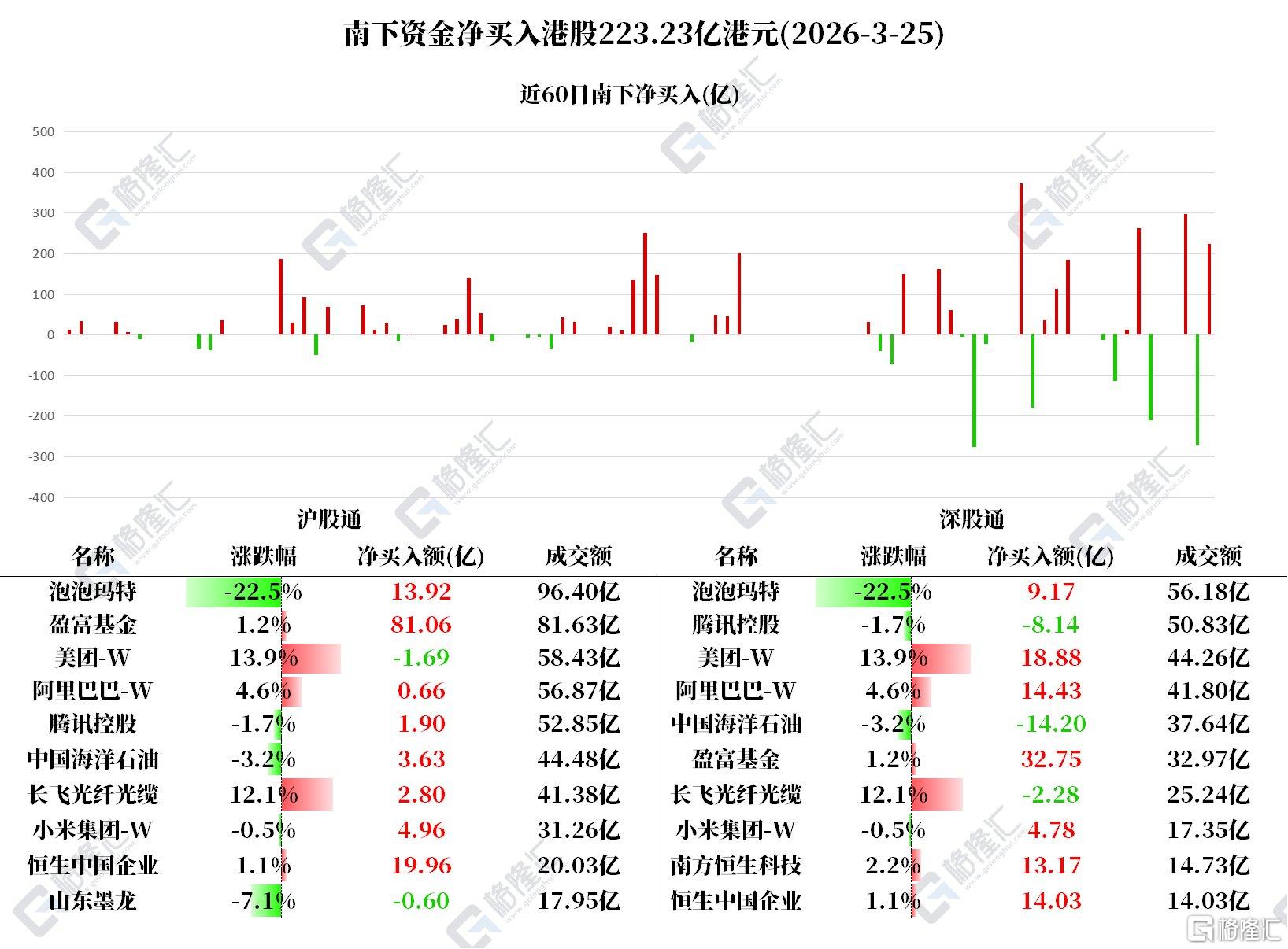
北水净买入港股223亿港元,大手笔加仓泡泡玛特、美团和阿里
Ge Long Hui· 2026-03-25 14:21
Group 1: Market Activity - The net buying amounts for various stocks include: 11.38 billion for Yingfu Fund, 3.399 billion for Hang Seng China Enterprises, 2.309 billion for Pop Mart, 1.719 billion for Meituan-W, 1.508 billion for Alibaba-W, 1.317 billion for Southern Hang Seng Technology, and 0.973 billion for Xiaomi Group-W [1] - The net selling amounts include: 1.057 billion for China National Offshore Oil Corporation and 0.624 billion for Tencent Holdings [1] Group 2: Stock Performance - Pop Mart experienced a decline of 22.5% with a net buying amount of 1.392 billion and a transaction volume of 9.64 billion [4] - Tencent Holdings saw a decrease of 1.7% with a net buying amount of 1.90 billion and a transaction volume of 5.285 billion [4] - Alibaba-W had an increase of 4.6% with a net buying amount of 0.66 billion and a transaction volume of 5.687 billion [4] Group 3: Company Highlights - Pop Mart reported a revenue of 37.12 billion for 2025, a year-on-year increase of 184.7%, with an adjusted net profit of 13.08 billion, up 284.5% [5] - Meituan and Alibaba's stock prices rose following a commentary on the impact of price wars in the food delivery sector, emphasizing the need for healthy competition [5] - Xiaomi Group's new SU7 model achieved 15,000 pre-orders in 34 minutes, with a target of 410,000 deliveries in 2025 and 550,000 in 2026 [6] - Tencent launched a desktop version of its AI-native application Yuanbao, enhancing user interaction and functionality [6]
美团涨超12%
Xin Lang Cai Jing· 2026-03-25 13:12
Group 1 - Meituan's stock price surged by 12.75% to HKD 78.25 per share as of 15:14 on March 25 [1][2] - The National Market Supervision Administration reprinted an article titled "The Takeaway War Should End," advocating for a return to reasonable pricing in the takeaway industry and a shift from price wars to service competition [1][2] - On March 23, the Beijing Municipal Market Supervision Administration, along with other agencies, conducted administrative guidance for twelve platform companies, addressing issues identified in the ongoing "involution" competition rectification [1][2] Group 2 - Meituan's CEO Wang Xing expressed strong confidence in the company's internationalization strategy, emphasizing a focus on core business areas rather than simultaneous international expansion across all sectors [1][2] - Meituan's core local commerce CEO Wang Puzhong noted that the local business faced unprecedented "involution" competition but managed to maintain stability, with instant retail holding over 60% of the Gross Transaction Value (GTV) share due to a focus on user experience and continuous innovation [1][2]
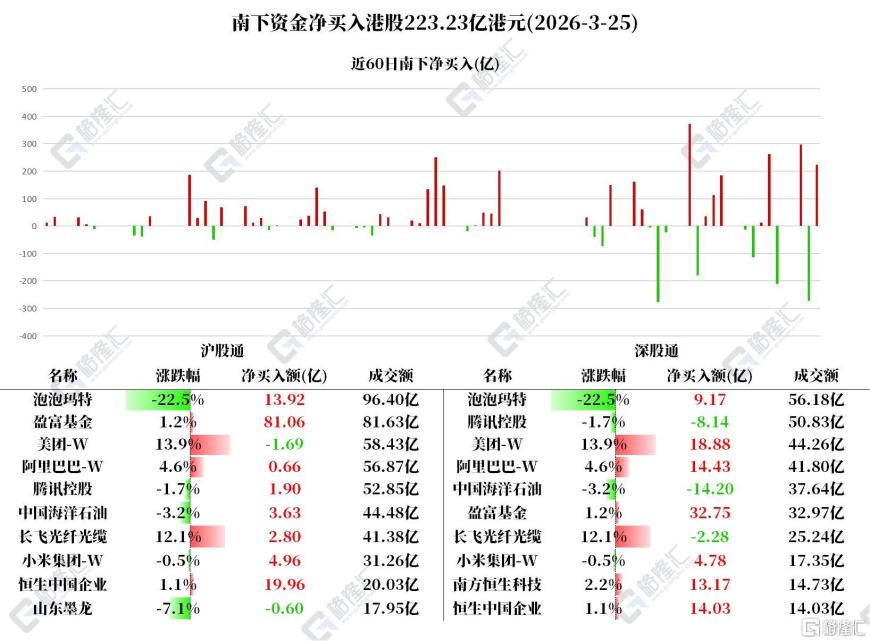
资金动向|北水净买入港股223亿港元,大手笔加仓泡泡玛特、美团和阿里
Ge Long Hui· 2026-03-25 11:59
Group 1 - The net buying amounts for various companies include: 11.38 billion for Yingfu Fund, 3.399 billion for Hang Seng China Enterprises, 2.309 billion for Pop Mart, 1.719 billion for Meituan-W, 1.508 billion for Alibaba-W, 1.317 billion for Southern Hang Seng Technology, and 0.973 billion for Xiaomi Group-W [1] - The net selling amounts include: 1.057 billion for China National Offshore Oil Corporation and 0.624 billion for Tencent Holdings [1] - Southbound funds have continuously net bought Pop Mart for three days, totaling 3.44988 billion Hong Kong dollars [3] Group 2 - Pop Mart International Group reported a revenue of 37.12 billion in 2025, a year-on-year increase of 184.7%, with adjusted net profit of 13.08 billion, up 284.5% [4] - The LABUBU family generated revenue of 14.16 billion, while the Chinese market revenue reached 20.85 billion, growing by 134.6% [4] - Meituan and Alibaba's stock prices surged following a commentary article discussing the negative impact of price wars in the food delivery industry on both restaurant owners and consumers [4] Group 3 - Xiaomi Group's new generation SU7 sold 15,000 units in 34 minutes, with over 30,000 units sold in three days, indicating strong demand [5] - Xiaomi aims to deliver 411,000 vehicles in 2025 and 550,000 in 2026, with plans to invest 60 billion in AI over the next three years [5] - Tencent announced the launch of its AI-native application Yuanbao, which now has a desktop version that supports multi-device message synchronization and file sharing [5]
资金动向 | 北水净买入港股223亿港元,大手笔加仓泡泡玛特、美团和阿里
Ge Long Hui A P P· 2026-03-25 11:00
Core Viewpoint - The news highlights significant net inflows and outflows in the Hong Kong stock market, with particular focus on companies like Bubble Mart, Tencent, Meituan, and Alibaba, as well as the performance of these companies in terms of revenue growth and market dynamics. Group 1: Net Inflows and Outflows - Southbound funds recorded a net inflow of HKD 223.23 billion, with notable net purchases including: - 盈富基金 (HKD 113.8 billion) - 恒生中国企业 (HKD 33.99 billion) - 泡泡玛特 (HKD 23.09 billion) - 美团-W (HKD 17.19 billion) - 阿里巴巴-W (HKD 15.08 billion) - 南方恒生科技 (HKD 13.17 billion) - 小米集团-W (HKD 9.73 billion) - The net sell-offs included: - 中国海洋石油 (HKD 10.57 billion) - 腾讯控股 (HKD 6.24 billion) [6][5] Group 2: Company Performance - Bubble Mart reported a revenue of HKD 371.2 billion for 2025, marking a year-on-year growth of 184.7%, with an adjusted net profit of HKD 130.8 billion, up 284.5% [10] - The LABUBU family generated revenue of HKD 141.6 billion, while the Chinese market contributed HKD 208.5 billion, reflecting a growth of 134.6% [10] - Meituan and Alibaba's stock prices surged following a commentary on the competitive landscape of the food delivery market, emphasizing the need for healthy competition through innovation and efficiency [11] - Xiaomi's new SU7 model saw strong demand, with 15,000 units locked in within 34 minutes and over 30,000 units in three days, indicating robust market interest [11] - Tencent launched the "元宝派" desktop version of its AI-native application, enhancing user interaction capabilities [11]
净买入超223亿港元 回补三大ETF加仓泡泡玛特及美团
Xin Lang Cai Jing· 2026-03-25 10:28
Group 1: Market Overview - Southbound funds traded approximately 165.56 billion HKD today, an increase of 21.8 billion from the previous day, accounting for 47.18% of the total turnover of the Hang Seng Index [1] - The Hong Kong stock market continued its rebound, with a net inflow of southbound funds amounting to 22.32 billion HKD, including a net inflow of about 14.23 billion HKD from the Shanghai-Hong Kong Stock Connect and approximately 8.09 billion HKD from the Shenzhen-Hong Kong Stock Connect [1] Group 2: ETF Activity - After a significant outflow the previous day, funds reversed to buy three major ETFs: the Tracker Fund of Hong Kong (02800.HK) received 11.38 billion HKD, the Southern China Technology ETF (03033.HK) received 3.40 billion HKD, and the Hang Seng China Enterprises Index ETF (02828.HK) received 1.32 billion HKD [1] Group 3: Individual Stock Performance - Pop Mart (09992.HK) saw a net buy of 2.31 billion HKD despite a drop of 22.51% today, with funds increasing their holdings by 3.07 million shares over the past five days [4] - Meituan-W (03690.HK) experienced a net buy of 1.72 billion HKD, with a price increase of 13.92%, although funds reduced their holdings by 1.04 million shares in the last five days [9] - Alibaba-W (09988.HK) had a net buy of 1.51 billion HKD, with a price increase of 4.63% and an increase in holdings by 4.34 million shares over the past five days [9] - Xiaomi Group-W (01810.HK) saw a net buy of 0.97 billion HKD, with a slight decrease of 0.49% today and an increase in holdings by 7.27 million shares over the past five days [5] Group 4: Notable Outflows - China National Offshore Oil Corporation (00883.HK) experienced a significant net outflow of 1.06 billion HKD, with a price drop of 3.19% and a decrease in holdings by 1.78 million shares over the past five days [3][6] - Tencent Holdings (0700.HK) had a net outflow of 0.62 billion HKD, with a price drop of 1.65% and a decrease in holdings by 0.86 million shares over the past five days [3][7]





外卖大战终结?美团、阿里大涨!百亿港股互联网ETF华宝上探逾3%!基金经理:基本面上修,估值是弹性的保障
Xin Lang Cai Jing· 2026-03-25 10:13
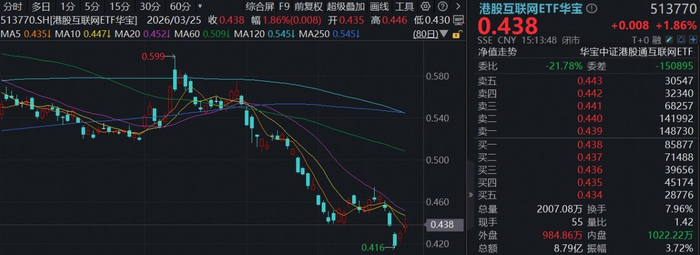
Core Viewpoint - The recent regulatory stance against aggressive competition in the food delivery sector is expected to reduce price wars among major platforms, leading to improved performance expectations for companies in the industry [3]. Group 1: Market Reactions - On March 25, Hang Seng Technology opened high and continued its rebound, later fluctuating before rising again due to news about the food delivery sector [1] - Meituan-W surged nearly 14% at closing, Alibaba-W rose over 4%, while Xiaomi Group-W slightly declined by 0.49% and Tencent Holdings fell over 1% [1] - Southbound funds recorded a net purchase of over 20 billion HKD throughout the day [1]. Group 2: Regulatory Impact - The National Market Regulation Administration has indicated a clear regulatory attitude that the "food delivery war must end," which has prompted on-site investigations of relevant platforms [1][3]. - The recent policies aimed at reducing internal competition are expected to positively impact the performance of major platforms, particularly in the e-commerce sector [3]. Group 3: AI and Market Opportunities - The ongoing commercialization of AI is seen as a significant opportunity for investment in quality internet assets in the Hong Kong market [3]. - The AI narrative is strengthening, with major internet companies being directly involved in AI-related innovations, which could lead to increased demand and pricing power in cloud services and gaming [3]. - The ETF tracking Hong Kong internet stocks, including major players like Alibaba and Tencent, is positioned to benefit from these trends [4]. Group 4: Investment Strategies - The Hong Kong Internet ETF (513770) and its linked funds are designed to track the CSI Hong Kong Internet Index, featuring major tech companies and AI application firms [4]. - For investors looking to reduce volatility while still gaining exposure to technology, the Hong Kong Large Cap 30 ETF (520560) is recommended, combining high-growth tech stocks with stable dividend-paying sectors [4].
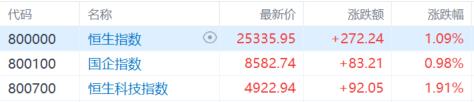
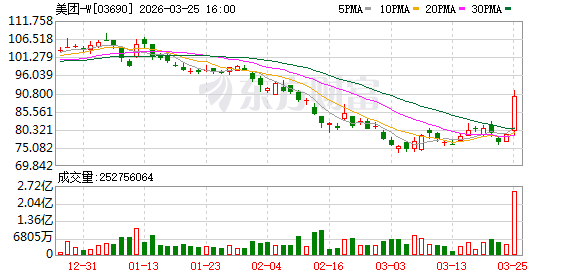
港股收评:连续两日反弹!恒生科技收涨1.91%,美团涨超13%,南下资金净买超200亿港元
Ge Long Hui· 2026-03-25 09:58
Market Overview - The Hong Kong stock market experienced a significant rebound, with the Hang Seng Technology Index rising by 2.6% at one point and closing up by 1.91% [1]. - The Hang Seng Index and the China Enterprises Index increased by 1.09% and 0.98%, respectively, marking the second consecutive day of market recovery [1]. - Southbound funds recorded a net purchase of over 20 billion HKD in Hong Kong stocks [1]. Sector Performance - Technology stocks led the market rally, with Meituan surging nearly 14% [2]. - Other notable performers included nuclear power stocks and optical communication concept stocks, with Changfei Optical Fiber Cable rising over 12% [2][8]. - The airline sector also showed strength, with domestic flight ticket bookings during the Qingming holiday increasing by approximately 20% year-on-year [2][11]. Key Stock Movements - Meituan's stock price reached 90.000 HKD, up by 13.92% [5]. - JD.com and Alibaba saw increases of 4.85% and 4.63%, respectively [5]. - Gold stocks performed well, with Ji Hai Gold and Lingbao Gold rising over 6% [6][7]. Industry Insights - A commentary in the Economic Daily called for an end to the "food delivery war," highlighting its negative impact on the restaurant industry and the broader economy [4]. - The article emphasized that healthy competition should focus on technological innovation, efficiency improvement, and service optimization [4]. Future Outlook - China Galaxy Securities indicated that if a prolonged conflict occurs between the U.S. and Iran, the Hong Kong market may experience a three-phase evolution: short-term emotional shock, mid-term fundamental transmission, and long-term structural differentiation [19]. - The report suggested focusing on cyclical sectors, financial sectors at valuation bottoms, and technology sectors with self-controllable logic [19].