
MEITUAN(03690)

Search documents
美团-W:Bottoming out-20260327
Zhao Yin Guo Ji· 2026-03-27 01:24
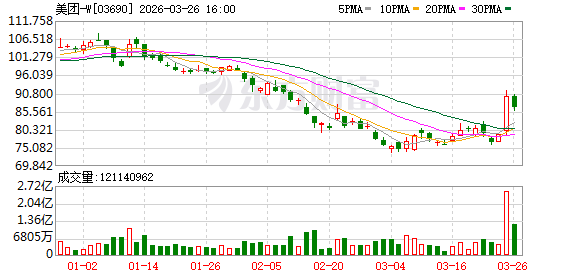
Investment Rating - The report maintains a "BUY" rating for Meituan, with a target price of HK$141.10, reflecting a potential upside of 62.7% from the current price of HK$86.70 [3][10]. Core Insights - Meituan's 4Q25 results showed revenue of RMB92.1 billion, a 4.1% year-over-year increase, aligning with Bloomberg consensus. The adjusted net loss was RMB15.1 billion, at the lower end of the previously guided range [1]. - The Core Local Commerce (CLC) business is believed to be bottoming out, supported by regulatory guidance promoting healthier development in the food delivery sector and a focus on core competencies by in-store players [1]. - The report anticipates a further narrowing of CLC operating losses by 58% quarter-over-quarter in 1Q26 to RMB4.2 billion, following a 29% reduction in 4Q25 [1]. - Revenue from new initiatives reached RMB27.3 billion in 4Q25, up 18.9% year-over-year, indicating an acceleration in growth supported by business expansion [7]. - The forecast for CLC revenue in 1Q26 is RMB64.2 billion, flat year-over-year, with expectations of a 9% increase in in-store and a 25% increase in Instashopping businesses, despite a 9% decline in food delivery [7]. Financial Summary - For FY24A, FY25A, FY26E, FY27E, and FY28E, revenue is projected to be RMB337,592 million, RMB365,982 million, RMB408,564 million, RMB464,754 million, and RMB517,386 million respectively, with year-over-year growth rates of 22.0%, 8.4%, 11.6%, 13.8%, and 11.3% [2]. - The adjusted net profit for FY24A is expected to be RMB43,772.4 million, with losses of RMB18,648.0 million in FY25A and RMB4,703.1 million in FY26E, before recovering to RMB33,682.8 million in FY27E and RMB48,726.3 million in FY28E [2]. - The report revises the revenue forecast for 2026E down by 3% to reflect a strategic shift towards higher-quality growth in the food delivery business, while also reducing operating loss and non-IFRS net loss forecasts by 32% and 51% respectively [9].

美团CEO王兴回应“超级入口”之争 不会盲目追求成为“Token工厂”
Xin Lang Cai Jing· 2026-03-27 01:12
Core Viewpoint - Meituan's CEO Wang Xing stated that the company will not blindly pursue becoming a "Token factory" but will leverage AI as a strategic opportunity to improve and innovate its core local services [1][1]. Financial Performance - In 2025, Meituan achieved a total revenue of 364.9 billion yuan, representing an approximate year-on-year growth of 8% [1][1]. - The company reported a net loss of 23.4 billion yuan for the year, with an operating loss of 17 billion yuan, including a core local business segment operating loss of 6.9 billion yuan [1][1]. International Expansion - In 2025, Meituan's international food delivery brand Keeta accelerated its global expansion [1][1]. - In the fourth quarter of 2025, Keeta achieved positive unit economics (UE) in the Hong Kong market [1][1]. New Business Segment - Due to increased investments in overseas operations, Meituan's new business segment reported an operating loss of 10.1 billion yuan, which is a year-on-year increase [1][1].
全网炸锅!罗技官方广告公然辱骂消费者:「一降价还不是像狗一样跑过来」;Manus的两名联创被告知不要离开中国;小米 MIUI 全面停止更新
雷峰网· 2026-03-27 00:44
Key Points - The article discusses various significant events in the technology and automotive sectors, highlighting the impact of regulatory actions, market dynamics, and company strategies on investment opportunities and risks. Group 1: Regulatory and Market Dynamics - China has reportedly restricted the departure of two executives from AI company Manus amid concerns over its acquisition by Meta, indicating a regulatory scrutiny on cross-border technology transactions [4][5] - Logitech faced backlash for a controversial advertisement that insulted consumers, leading to a potential reputational risk and calls for boycotts [7][8] - Skoda is set to exit the Chinese market by mid-2026, with Volkswagen reaffirming its commitment to the Chinese market and ongoing support for Skoda customers [9][10] Group 2: Company Performance and Financials - Semiconductor manufacturer SMIC reported a revenue of 67.32 billion yuan for 2025, a 16.5% increase year-on-year, with a net profit of 5.04 billion yuan, reflecting strong growth in the semiconductor industry [11] - Leap Motor launched its A10 model, priced between 65,800 to 86,800 yuan, and projected a revenue of 64.73 billion yuan for 2025, marking a 101.3% year-on-year growth [12][13] - Meituan's 2025 financial report showed a revenue of 364.9 billion yuan, an 8% increase, but also a net loss of 23.4 billion yuan, indicating challenges in the competitive landscape [22] Group 3: Technological Developments and Trends - Xiaomi has officially ceased updates for its MIUI system, transitioning to its new operating system, HyperOS, marking a significant shift in its software strategy [16][17] - The automotive industry is witnessing a shift towards electric vehicles, particularly in Southeast Asia, where fuel shortages are driving consumers to consider electric alternatives [40][42] - OpenAI has invested in the startup Isara, which aims to develop a platform for collaborative AI agents, indicating a trend towards more integrated AI solutions [44]





金融界财经早餐:八部门定调长护险三年建成;反垄断剑指“内卷”;纳指跌入调整区;新基金月发行规模破千亿;五大龙头年报发布,券业一哥业绩爆发;美团亏损、SpaceX谋史上最大IPO(3月27日)
Jin Rong Jie· 2026-03-27 00:43
Company Performance - China Ping An reported a total operating profit of 134.415 billion yuan for 2025, a year-on-year increase of 10.3%. The net profit attributable to shareholders, excluding non-recurring items, was 143.773 billion yuan, up 22.5% [7] - CITIC Securities achieved an operating revenue of 74.854 billion yuan in 2025, representing a year-on-year growth of 28.79%. The net profit attributable to shareholders was 30.076 billion yuan, up 38.58% [8] - SMIC reported revenue of 9.327 billion USD in 2025, with a profit of 685 million USD, both reaching historical highs. The monthly production capacity exceeded one million wafers, with a utilization rate of 93.5% [8] - China Mobile's operating revenue for 2025 was 1,050.2 billion yuan, a slight increase of 0.9%. The net profit attributable to shareholders was 137.1 billion yuan, down 0.9% [8] - Muxi Co., Ltd. reported an operating revenue of 1.644 billion yuan in 2025, a significant increase of 121.26%, but incurred a net loss of 789 million yuan [8] - Haier Smart Home achieved an operating revenue of 302.347 billion yuan in 2025, a growth of 5.71%, with a net profit of 19.553 billion yuan, up 4.39% [9] - Haitian Flavoring reported an operating revenue of 28.873 billion yuan in 2025, a year-on-year increase of 7.32%, with a net profit of 7.038 billion yuan, up 10.95% [9] - Shandong Gold reported an operating revenue of 104.287 billion yuan in 2025, a growth of 26.38%, with a net profit of 4.739 billion yuan, up 60.57% [9] Industry Insights - The optical fiber and cable industry is experiencing significant demand growth due to rapid advancements in artificial intelligence, leading to substantial price increases [6] - The solid-state battery sector is strategically positioned in China, with a well-established domestic supply chain and ongoing efforts to capture technological leadership [6] - The first industry standard for embodied intelligence was officially released on March 26, marking a new phase in the evaluation of AI technologies [6] - The National Healthcare Security Administration and other departments issued a plan to establish a long-term care insurance system, aiming for comprehensive coverage and sustainable implementation [6] - The coal industry is expected to see improved demand due to geopolitical tensions affecting oil supply, potentially leading to a resurgence in coal prices [6]
罗技中国就发布鼠标广告侮辱消费者致歉;林俊旸离职后首发长文;月之暗面考虑赴港IPO;拼多多成立新公司“新拼姆”丨邦早报
创业邦· 2026-03-27 00:15
Group 1 - The company "月之暗面" is considering an IPO in Hong Kong and has engaged with China International Capital Corporation and Goldman Sachs for potential listing discussions, with a valuation of approximately $18 billion after a new funding round of up to $1 billion [3] - Pinduoduo has established a new company called "新拼姆" with an initial cash injection of 15 billion yuan, aiming to invest a total of 100 billion yuan over three years to enhance its self-operated brand model and integrate supply chain resources [5] - Lin Junyang, former head of Alibaba's Qianwen technology, published an article discussing the evolution from reasoning to agentic thinking in AI, emphasizing the need for a unified system that combines thinking and instruction modes [6] Group 2 - Xiaomi's automotive division reached a settlement with 山东燕鲁新能源车业有限公司 regarding a patent dispute, marking the first public patent controversy since its market entry [7] - Skoda will continue sales in China until mid-2026, after which it will focus on high-growth markets like India and ASEAN, while still providing after-sales support to existing customers [7] - Xiaomi has officially ceased updates for MIUI, transitioning to the new HyperOS, with only two overseas devices continuing to receive support until 2026 [7] Group 3 - Meta announced a new initiative to support small businesses and promote AI applications, led by its president and product head, with a focus on enhancing business growth through its platform [16] - Liu Qiangdong's company is investing 15 billion yuan in a yacht manufacturing base in Dalian, aiming to develop high-end yacht production and services [16] - Evergrande New Energy Vehicle Investment Holding Group has been subjected to a bankruptcy review initiated by a bank, indicating ongoing financial distress [18][19] Group 4 - Meituan reported a total revenue of 364.9 billion yuan for 2025, with a net loss of 23.4 billion yuan, primarily due to intense competition in the instant retail sector [22] - Apple is planning to open Siri to external AI assistants, enhancing its position as an AI platform, with updates expected in the upcoming iOS 27 [25] - Google has launched a new AI model, Lyria 3 Pro, designed for music creation, allowing users to compose longer and more structured audio pieces [29]



外卖大战周年考:美团贴身肉搏亏了234亿,王兴透露“今年一季度持续减亏”
Sou Hu Cai Jing· 2026-03-26 23:36
Core Insights - The CEO of Meituan, Wang Xing, summarized the year 2025 as one filled with both opportunities and challenges, highlighting unprecedented competition in the industry [1] - Meituan reported a total revenue of 364.9 billion yuan for 2025, an 8% year-on-year increase, but faced a net loss of 23.4 billion yuan, a significant shift from a profit of 35.8 billion yuan in 2024 [1] - The core local commerce segment experienced an operating loss of 6.9 billion yuan, contrasting sharply with a profit of 52.4 billion yuan in the previous year [6] Financial Performance - The operating profit margin for the core local commerce segment plummeted from 20.9% to -2.6% due to declining gross margins and increased user incentives and marketing expenses [6] - Total sales costs reached 253.8 billion yuan, a 22% increase year-on-year, while sales and marketing expenses surged by 60.9% to 102.9 billion yuan [6] Market Competition - The intense competition in the food delivery market, initiated in Q2 2025, has disrupted the previously stable duopoly, with Alibaba and JD.com entering the fray [5] - Despite the competitive pressures, Meituan's fourth-quarter losses narrowed significantly, with a core local commerce operating loss of 10 billion yuan, down from 14.1 billion yuan in Q3 [7] Strategic Adjustments - Meituan is reducing marketing subsidies, with fourth-quarter sales costs decreasing from 70.3 billion yuan to 67.97 billion yuan [7] - The company aims to maintain its market leadership in the mid-to-high price order segment while reducing resources allocated to low-quality orders [9] New Business Ventures - Meituan's new business segment saw a revenue increase of 19.1% to 104.03 billion yuan, although it still recorded an operating loss of 10.1 billion yuan due to increased investments in overseas operations [12] - The international expansion of the Keeta brand is a key focus, with plans to enter new markets such as Qatar, Kuwait, UAE, and Brazil [13] Future Outlook - Wang Xing emphasized a commitment to internationalization, particularly in the instant retail sector, while also indicating that losses from Keeta are expected to remain high in 2026 due to ongoing market cultivation [14][15] - The acquisition of Dingdong Maicai for $717 million is seen as a strategic move to enhance Meituan's fresh retail capabilities and expand its coverage in East China [15]

美团王兴,最新发声
Di Yi Cai Jing· 2026-03-26 23:16
Core Insights - Meituan's CEO Wang Xing highlighted the company's development plans in overseas markets and AI during the earnings call, indicating a focus on growth and innovation [2][4] Group 1: Overseas Expansion - Meituan's Keeta is expected to achieve monthly user engagement (UE) profitability in Saudi Arabia by the end of 2026, potentially faster than in Hong Kong, where it took 29 months to reach profitability [2] - The favorable market characteristics and higher profitability in the food delivery sector in Saudi Arabia are anticipated to contribute to this accelerated timeline [2] Group 2: AI Strategy - Wang emphasized an offensive strategy in the AI revolution, viewing AI as a strategic opportunity rather than merely a technological pursuit [4] - Significant investments have been made in AI talent and capital expenditures since early 2023, positioning Meituan as a leading domestic player in AI investment [4] - The AI assistant "Xiao Tuan" has been integrated into the Meituan app, covering all categories of local services, with ongoing optimization of its capabilities [4] Group 3: Food Delivery Market - Meituan plans to increase its subsidy investments in the restaurant sector for 2025, despite reporting a loss of 6.9 billion yuan in its core local business segment [5] - The company anticipates an improvement in food delivery losses in the first quarter, with expectations for better performance compared to the fourth quarter of the previous year [5] - Meituan continues to maintain its leading position in the mid-to-high price order market in terms of Gross Transaction Value (GTV) [5]

美团2025年收入3649亿元 研发投入同比增长23%
Zheng Quan Ri Bao· 2026-03-26 16:38
Group 1: Company Strategy and Performance - In 2025, Meituan's core local business segment is projected to generate revenue of 260.8 billion yuan, maintaining over 60% market share in GTV despite intense competition in the food delivery sector [1] - Meituan is expanding its "30-minute delivery" model beyond food to include daily necessities and electronics, supported by innovative logistics solutions like brand officer flash warehouses and self-operated front warehouses [1] - The company reported a total revenue of 364.9 billion yuan for 2025, reflecting an 8% year-on-year increase, but faced a net loss of 23.4 billion yuan due to intensified competition in the instant retail sector [4] Group 2: Investment in Technology and AI - Meituan's R&D investment is set to increase by 23% year-on-year to 26 billion yuan in 2025, focusing on logistics and robotics, including drones and autonomous vehicles [2] - The company has launched 70 drone routes in various cities, completing over 780,000 orders, and aims to enhance user experience through AI technology, with over 3.4 million merchants utilizing its AI business assistant [2] - Experts suggest that Meituan's increased AI investment is crucial for building differentiated advantages in a more refined competitive landscape, transitioning from scale expansion to value growth [2]
亏损234亿元!“外卖大战”后,美团公布成绩单
Zhong Guo Zheng Quan Bao· 2026-03-26 15:58
Core Insights - Meituan reported a revenue of 364.9 billion yuan for 2025, reflecting an 8.1% year-on-year growth, but faced a loss of 23.4 billion yuan compared to a profit of 35.8 billion yuan in 2024 [2] Group 1: Financial Performance - The core local business segment of Meituan turned from profit to loss, generating 260.8 billion yuan in revenue, a 4.2% increase, but incurring an operating loss of 6.9 billion yuan [4] - The adjusted EBITDA and adjusted net profit for Meituan fell to -13.8 billion yuan and -18.6 billion yuan, respectively, in 2025 [4] - Sales and marketing expenses surged by 60.9% from 64 billion yuan in 2024 to 102.9 billion yuan in 2025, accounting for 28.2% of revenue, up 9.2 percentage points year-on-year [4] Group 2: Strategic Initiatives - Meituan is actively adjusting its operational strategies, focusing on AI and unmanned delivery technology, product and business model innovation, and enhancing operational efficiency [5] - The company aims to strengthen its core advantages and improve service quality to gain consumer trust while opposing irrational competition [5] Group 3: Business Expansion - Meituan's grocery retail and overseas businesses showed strong growth, with new business segment revenue reaching 104 billion yuan, a 19% increase [7] - The acquisition of Dingdong Maicai's China business for approximately 7.17 billion yuan is part of Meituan's strategy to expand its front warehouse business [7] - Meituan's international business, particularly through Keeta, is expanding in the Middle East and Brazil, with a focus on consolidating market positions rather than broad expansion [8] Group 4: AI Integration - Meituan is committed to embracing AI, launching the independent app "Xiao Mei" and integrating an AI assistant "Xiao Tuan" within its main app [8] - The company plans to develop a comprehensive local life AI assistant by leveraging its extensive data on local businesses and consumer reviews [8]
王兴:美团不会盲目追求成为“Token(词元)工厂”,而是将AI视为战略机遇
Xin Lang Cai Jing· 2026-03-26 15:02
Core Viewpoint - The CEO of Meituan, Wang Xing, emphasizes that the only reasonable strategy in the AI revolution is to be offensive rather than defensive, viewing AI as a strategic opportunity rather than merely a means to become a "Token factory" [1] Group 1: AI Strategy - Meituan aims to leverage AI as a "super entrance" by accurately understanding user needs and efficiently executing tasks, which is more complex than just implementing chatbots [1] - The company intends to enhance its AI search capabilities and execution abilities, striving to upgrade the Meituan app into a leading AI-driven application [1] - The goal is for the Meituan app to become the preferred platform for users to address local life needs, positioning itself as the AI entrance for future local living demands [1]