CM BANK(03968)

Search documents
股份制银行板块8月8日跌0.24%,招商银行领跌,主力资金净流出3.65亿元
Zheng Xing Xing Ye Ri Bao· 2025-08-08 08:35
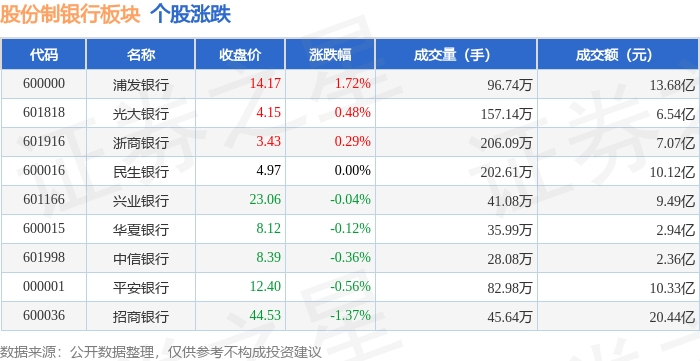
Group 1 - The banking sector experienced a decline of 0.24% on August 8, with China Merchants Bank leading the drop [1] - The Shanghai Composite Index closed at 3635.13, down 0.12%, while the Shenzhen Component Index closed at 11128.67, down 0.26% [1] - Among the listed banks, Shanghai Pudong Development Bank saw the highest increase of 1.72%, while China Merchants Bank had the largest decrease of 1.37% [1] Group 2 - The banking sector faced a net outflow of 365 million yuan from main funds, while retail investors contributed a net inflow of 363 million yuan [1] - Specific banks like Huaxia Bank and China Merchants Bank experienced significant net outflows from main funds, with China Merchants Bank seeing a net outflow of 239 million yuan [1] - Retail investors showed strong interest in several banks, with notable inflows into Huaxia Bank and China Merchants Bank, despite the overall outflow from main funds [1]




多家银行调整高端信用卡权益
Jin Rong Shi Bao· 2025-08-08 07:59
Core Viewpoint - Recent adjustments to high-end credit card benefits by multiple banks indicate a shift towards a more sustainable and long-term operational model in the credit card industry, reflecting the pressures faced by banks in a competitive market [1][4]. Group 1: Bank Adjustments - Several banks, including China Merchants Bank, Everbright Bank, and HSBC China, have announced updates to their high-end credit card products, such as increasing usage thresholds and adjusting applicable ranges [1]. - China Merchants Bank's adjustments include changing the annual fee waiver conditions for its high-end credit cards, moving from "10,000 points for annual fee waiver" to "10,000 points + 180,000 yuan in rigid spending for annual fee waiver" [2]. - Over 10 banks have made similar adjustments to their high-end credit card benefits this year, with notable changes including the removal of airport lounge services and reductions in overseas spending cashback [3]. Group 2: Market Dynamics - The credit card market is entering a phase of stock competition, characterized by declining growth rates in card issuance and rising customer acquisition costs [3]. - Experts suggest that banks are raising thresholds to filter customers, directing resources towards high-spending and high-contribution users, which may enhance overall profitability in the credit card sector [3]. - Since 2025, over 30 credit card centers have been closed, indicating a trend towards consolidation and efficiency within the industry [3]. Group 3: Expert Opinions - Analysts view the current adjustments not merely as a reduction in benefits but as proactive measures by banks to pursue sustainable business models and promote overall industry health [4].
商业银行对公业务场景金融创新的展望
Jin Rong Shi Bao· 2025-08-08 07:55
Challenges in Financial Innovation for Corporate Banking - The scene system is fragmented, making it difficult to leverage brand and scale advantages due to personalized and fragmented demands [1][2] - There is a lack of internal coordination, hindering cross-scenario collaboration, with organizational management needing optimization [3][4] - The benefits of scene construction have not yet become apparent, and the ability to create value needs enhancement [5][6][7][8] Breakthrough Points for Financial Innovation in Corporate Banking - Focus on key scenes to gradually promote systematic and platform-based development, starting with unique scenes like enterprise payment and settlement services [9][10] - Optimize internal organizational management to improve cross-departmental collaboration, including establishing dedicated scene financial teams [11][12] - Enhance technological capabilities by increasing investment in technology and building an open platform for better service efficiency [13] - Improve scene operation capabilities by leveraging data applications to drive value enhancement [14] - Strengthen the integration and interaction between scene resources and branch resources to create significant benefits [15][16][17][18] Future Outlook - Corporate scene finance is a crucial direction for commercial banks to implement a customer-centric approach and digital transformation, addressing personalized and differentiated needs [19]

16万亿盛宴:透视“明星银行”行长的朋友圈与座上宾
Nan Fang Du Shi Bao· 2025-08-08 07:48
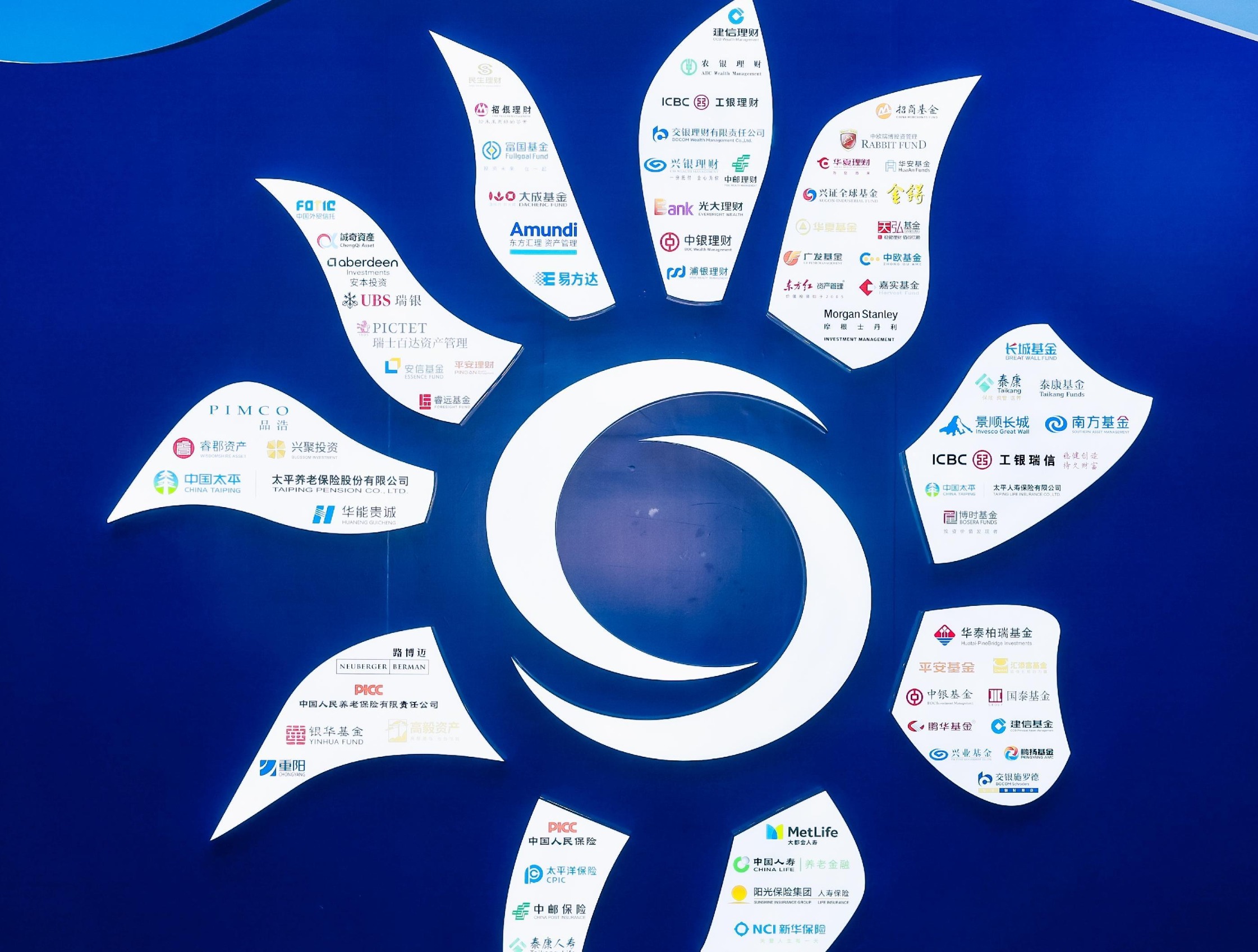
Core Viewpoint - The core message emphasizes the need for collaboration among wealth management institutions to create a sustainable and prosperous wealth management ecosystem, as articulated by Wang Liang, the president of China Merchants Bank, during the "2025 Wealth Partner Forum" [1][2]. Group 1: Wealth Management Ecosystem - The wealth management ecosystem is expanding, with more institutions joining the collaboration, including major players like Fortune Fund, Xinhua Life, and others, totaling over 150 partner institutions [3][6]. - The focus is on high-quality development in wealth management, requiring collective efforts from the entire industry to adapt to structural changes and meet evolving client needs [6][8]. Group 2: Market Dynamics and Challenges - China Merchants Bank reported significant asset management figures, with retail client total assets exceeding 16 trillion yuan and asset management scale nearing 4.5 trillion yuan, indicating a rapid growth trajectory [7]. - The bank faces challenges such as a concentration of wealth among a small percentage of clients, with 2.5% of clients holding over 80% of assets, reflecting a growing wealth disparity [7]. Group 3: Future Outlook and Technology Integration - The financial industry is entering a low-interest-rate era, prompting a shift in wealth management strategies to balance risk, return, and liquidity [8]. - There is a growing demand for comprehensive global asset allocation services, and the integration of AI in financial services is seen as a key trend for future development [10].
超长期特别国债开放个人购买渠道
Zhong Guo Zheng Quan Bao· 2025-08-08 07:31
Core Viewpoint - The issuance of 30-year special government bonds is a significant move to enhance fiscal policy effectiveness and support major projects, while also reducing debt pressure for the government [4][6]. Group 1: Issuance Details - The first issuance of the 30-year special government bonds occurred on May 17, with distribution ending on May 20 and trading starting on May 22 [1]. - The average issuance scale for this year's special government bonds is 455 billion yuan, with a total of 1 trillion yuan planned for issuance over several years [5][6]. - The weighted average bidding rate for the first 30-year bond was 2.57%, which is favorable for reducing interest payment pressure [5]. Group 2: Market Response - Some banks, such as China Merchants Bank and Zheshang Bank, quickly sold out their quotas for the special bonds on the first day of availability [2]. - The demand for these bonds indicates strong interest from individual investors, although some banks have not yet received notifications to sell them [2]. Group 3: Economic Implications - The issuance of long-term bonds is expected to provide ample funding for long-term projects, thereby supporting economic recovery and reducing overall debt costs [4][6]. - Compared to international standards, China's proportion of long-term bonds is relatively low at 16.9%, indicating room for growth [6].
险资持续“扫货”银行股 平安人寿年内三度举牌招商银行H股
Zheng Quan Ri Bao· 2025-08-08 07:25
Core Viewpoint - Insurance capital continues to show strong enthusiasm for acquiring bank stocks, with Ping An Life Insurance Company recently increasing its stake in China Merchants Bank H-shares, surpassing a 15% holding threshold, triggering a regulatory notice [1][3]. Group 1: Insurance Capital Activity - Ping An Life has increased its holdings in China Merchants Bank H-shares by 6.2955 million shares at an average price of HKD 54.19 per share, raising its stake from 14.87% to 15.01%, marking the third time it has triggered a regulatory notice this year [3]. - This year, insurance capital has frequently acquired bank stocks, particularly H-shares, with Ping An Asset Management also increasing its stakes in Agricultural Bank of China and Postal Savings Bank of China [2][3]. Group 2: Characteristics of Insurance Capital Acquisitions - The current trend shows that insurance capital favors large state-owned banks and major national joint-stock banks, primarily focusing on H-shares, and typically purchases from the secondary market using insurance liability reserves [5]. - The decision to frequently buy H-shares of state-owned banks is influenced by factors such as dividend yield, tax advantages, market capitalization, regulatory requirements, and cyclical resilience [5]. Group 3: Financial Analysis and Market Conditions - The H-shares of listed banks generally offer higher dividend yields compared to A-shares, with six major state-owned banks showing H-share dividend yields above 5% as of June 20 [5]. - The preference for H-shares is attributed to their lower price-to-book ratios, which range from 0.4 to 0.7, and tax benefits for long-term holdings through the Hong Kong Stock Connect [5].
中信银行、招商银行拟出资设立金融资产投资公司
Zheng Quan Ri Bao· 2025-08-08 07:24
Core Viewpoint - The establishment of Asset Investment Companies (AICs) by national commercial banks is accelerating, which is expected to enhance banks' participation in technology finance and equity markets, contributing to the high-quality development of the banking industry [1][2]. Group 1: Establishment of AICs - The National Financial Regulatory Administration has approved the establishment of AICs by several national commercial banks, including the first approval for Industrial Bank to set up an AIC [2]. - Following this, CITIC Bank announced a plan to invest 10 billion RMB to establish a wholly-owned subsidiary AIC, while China Merchants Bank plans to invest 15 billion RMB for the same purpose [2]. - The establishment of AICs aligns with the banks' strategies to support technology finance and meet the financing needs of innovative enterprises [3]. Group 2: Impact on Banks - The investments in AICs are seen as key measures for banks to support national strategies and enhance their service capabilities in the real economy [3]. - The establishment of AICs will help banks diversify their operations and improve their integrated business capabilities [3]. Group 3: Benefits and Challenges - The establishment of AICs is expected to bring comprehensive benefits to banks, including enhanced service offerings for technology enterprises and additional revenue streams beyond equity investments [5]. - However, challenges exist, such as the need for strong investment research capabilities and the high risks associated with equity investments, which require banks to develop appropriate long-term assessment mechanisms [6].

股份制银行争锋:兴业、中信离招商银行有多远?
Zhong Guo Jing Ji Wang· 2025-08-08 07:23
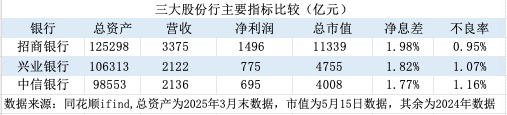
Core Viewpoint - The re-issuance of AIC licenses marks a shift in focus from debt-to-equity swaps to supporting the development of new productive forces in the financial sector [1] Group 1: AIC License and Bank Recognition - The National Financial Regulatory Administration approved the establishment of the Xingyin Financial Asset Investment Company by Industrial Bank, with other banks like China Merchants Bank and CITIC Bank also planning to set up similar companies pending regulatory approval [1] - This indicates regulatory recognition of the strength of these banks, which have carved out their positions in the market through innovation despite lacking the capital strength of state-owned banks [1] Group 2: Financial Performance Comparison - As of March 2025, the total assets of China Merchants Bank, Industrial Bank, and CITIC Bank were 12.5 trillion, 10.6 trillion, and 9.9 trillion yuan respectively, with China Merchants Bank leading in all major financial metrics [2][4] - China Merchants Bank's net profit for 2024 was 149.6 billion yuan, significantly higher than the 77.5 billion yuan of Industrial Bank and 69.5 billion yuan of CITIC Bank [2] Group 3: Retail Business Focus - Retail banking is identified as a cornerstone for future competition among these banks, with Industrial Bank and CITIC Bank actively working to enhance their retail business capabilities [3] - The ability to excel in retail banking and wealth management will likely determine which bank secures the second position among the joint-stock banks [3] Group 4: Asset Growth Trends - Over the past decade, while Industrial Bank and CITIC Bank have pursued aggressive growth strategies, the asset gap with China Merchants Bank has widened, with their total assets at 85% and 79% of China Merchants Bank's respectively by 2024 [4][7] - China Merchants Bank's financial investments grew 2.65 times from 2017 to 2024, indicating a strategic shift towards government bonds amid a challenging lending environment [7] Group 5: Net Interest Margin and Cost of Deposits - In 2024, China Merchants Bank's net interest margin was 1.98%, outperforming Industrial Bank and CITIC Bank by approximately 20 basis points [11][12] - The lower cost of deposits at China Merchants Bank, primarily due to a higher proportion of low-cost personal deposits, contributes to its competitive advantage [11] Group 6: Strategic Directions and Future Outlook - The transition from the old economic cycle to a new one focused on technology, industry, and finance presents opportunities for banks to identify new business avenues [20] - Industrial Bank's strategy of combining commercial and investment banking positions it well to capitalize on emerging trends in the financial landscape [21]

探路数字金融,零售之王“智变”的求索与未来
Zhong Guo Jing Ji Wang· 2025-08-08 07:22
Core Insights - The article emphasizes the critical role of digital finance in the banking sector, highlighting that digitalization is no longer optional but a necessity for all banks in 2023 [1] - China Merchants Bank (CMB) is recognized as a leader in the industry, having made significant investments in digital transformation and technology integration [1][2] Group 1: Digital Finance and Technology Integration - Digital finance is defined as a high-level financial form that combines technology and financial innovation, enhancing the efficiency of financial supply and promoting inclusive financial services [2] - CMB completed a comprehensive cloud migration project by the end of 2022, becoming one of the first major banks in China to fully transition to cloud services, which has significantly upgraded its technological infrastructure [2] - As of June 2024, CMB's "Zhaoqi Loan" has disbursed over 50 billion yuan to 50,000 small and micro enterprises, with 76% of these businesses receiving credit loans for the first time [2][6] Group 2: AI and Risk Management - CMB is focusing on building an intelligent computing platform to leverage large language models, aiming to create specialized models for the financial sector rather than general-purpose models [3] - The bank has developed a comprehensive risk management system that utilizes AI and machine learning to identify and intercept fraudulent transactions, ensuring customer safety [4] - CMB's innovative approach to small and micro enterprise financing has led to the launch of the "Zhaoqi Loan," which offers pure credit, no-collateral loans, streamlining the approval process to seconds [5][6] Group 3: Efficiency and Cost Reduction - The implementation of large language models across various business segments has resulted in significant improvements in efficiency, cost reduction, and enhanced service quality [7] - CMB has integrated over 120 scenarios utilizing large language models, benefiting over 20 million users with intelligent banking services [7] - The bank's fraud detection system processes millions of transactions daily, showcasing the effectiveness of AI in enhancing operational capabilities [7] Group 4: Challenges and Future Directions - Despite the advancements, CMB acknowledges challenges such as high resource consumption, stringent data privacy requirements, and the need for explainability in AI-generated responses [8] - The development of digital finance calls for synchronized efforts between policy and market, including the establishment of a tiered authorization mechanism for data ownership [8]
招银金租违规被罚80万元 为招商银行全资子公司
Zhong Guo Jing Ji Wang· 2025-08-08 07:21
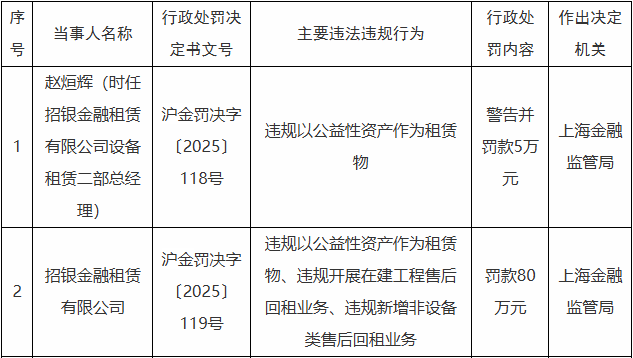
Core Viewpoint - The Shanghai Financial Regulatory Bureau has imposed fines on China Merchants Bank's subsidiary, China Merchants Jinling Leasing Co., Ltd., for multiple regulatory violations, including the improper use of public assets as leasing objects and engaging in unauthorized leasing activities [1][2]. Group 1: Regulatory Violations - China Merchants Jinling Leasing Co., Ltd. was fined 800,000 yuan for violations including using public assets as leasing objects, conducting sale-leaseback transactions on construction projects, and adding non-equipment sale-leaseback businesses [1][2]. - Zhao Xuanhui, the former general manager of the Equipment Leasing Department at China Merchants Jinling Leasing Co., was warned and fined 50,000 yuan for his responsibility in the misuse of public assets [1][2]. Group 2: Company Background - China Merchants Jinling Leasing Co., Ltd. is a wholly-owned subsidiary of China Merchants Bank, established with approval from the former China Banking Regulatory Commission in April 2008 [1].