INTEL(04335)

Search documents
英伟达50亿入股英特尔:联想(00992.HK)迎三重红利 AI PC与服务器业务将加速爆发
Ge Long Hui· 2025-09-20 04:26
Core Insights - Nvidia's strategic investment of $5 billion in Intel positions it as a major shareholder, holding over 4% of Intel's shares, and initiates deep collaboration in AI PC, data centers, and accelerated computing [1] - Lenovo benefits significantly from this partnership, experiencing a 22.77% stock surge, the largest since 1987, and is poised to capitalize on the AI hardware market [1][9] Supply Chain Security - The collaboration between Nvidia and Intel provides Lenovo with prioritized access to AI chip production, ensuring supply chain stability amid ongoing global chip shortages [2][3] - Lenovo's dual partnership with Nvidia and Intel mitigates risks associated with single suppliers and aligns with U.S. domestic chip manufacturing strategies [2] Product Development and Market Position - The integration of Nvidia's NVLink technology with Intel's x86 ecosystem is expected to enhance Lenovo's AI PC and server offerings, driving significant upgrades in product capabilities [4] - Lenovo has already achieved a 30% share in the global AI PC market, with its AI PCs accounting for 27% of total notebook shipments in China [5] Market Opportunities - The combined market potential of Nvidia and Intel's collaboration is estimated at $50 billion, with Lenovo positioned to leverage its global sales network to convert technological advantages into revenue [6] - The demand for AI-optimized servers is projected to double by 2025, with Lenovo set to benefit from this trend through its established partnerships [2][5] Strategic Positioning - Lenovo's role in the Nvidia-Intel partnership allows it to transition from a hardware assembler to a standard setter in the AI era, enhancing its competitive edge [8] - The collaboration is expected to improve Lenovo's revenue structure by increasing the share of high-margin AI products, while also stabilizing supply chains and reducing costs [8][9]



英伟达50亿入股英特尔:联想(00992)迎三重红利 AI PC与服务器业务将加速爆发
智通财经网· 2025-09-20 03:05
Core Viewpoint - The strategic partnership between Nvidia and Intel, involving a $5 billion investment from Nvidia, positions Lenovo to capitalize on the AI and data center markets, enhancing its competitive edge and market share in the AI PC and server sectors [1][9]. Group 1: Strategic Partnership - Nvidia's investment will make it Intel's largest shareholder, holding over 4% of its shares, which is expected to stabilize Intel's operations and enhance its credibility in the market [1][3]. - The collaboration will allow Lenovo to secure priority access to AI chip and x86 processor production, mitigating supply chain risks and aligning with U.S. domestic chip manufacturing strategies [2][3]. Group 2: Market Opportunities - The partnership targets a market size of $50 billion, with Lenovo poised to leverage its global sales network to convert technological advantages into revenue [6]. - Gartner predicts that global AI-optimized server spending will reach $140 billion by 2025, doubling from 2022, with Lenovo expected to benefit significantly from this demand surge [2]. Group 3: Product Development - The integration of Nvidia's NVLink technology with Intel's x86 architecture is set to enhance Lenovo's AI PC and server offerings, leading to a generational leap in product capabilities [4][5]. - Lenovo's AI PC shipments accounted for 30% of its total PC shipments globally, indicating a strong market position and growth potential in the AI segment [5]. Group 4: Competitive Positioning - Lenovo is transitioning from a hardware assembler to a standard setter in the AI era, gaining significant market influence through its collaboration with Nvidia and Intel [8][9]. - The partnership is expected to improve Lenovo's revenue structure by increasing the proportion of high-margin AI products, thereby enhancing profitability [8][9].
美股异动|英特尔股价下跌3.24% 投资者对代工业务困境担忧加剧
Xin Lang Cai Jing· 2025-09-19 23:28
Core Viewpoint - Intel's stock price volatility reflects a combination of market dynamics and internal challenges, despite a strategic investment from Nvidia aimed at enhancing its position in AI data centers [1][2]. Group 1: Strategic Developments - Nvidia announced a $5 billion strategic investment in Intel, intending to strengthen its AI data center capabilities through collaboration [1]. - Intel will customize x86 CPUs for Nvidia, which will integrate these technologies into its AI systems, addressing the demand for more powerful computing [1]. - The retirement of Intel's first chairman for China, Wang Rui, and the appointment of Wang Zhichong marks a significant transition as Intel continues to enhance its strategy in the Chinese market [1]. Group 2: Challenges and Market Position - Intel's foundry business, Intel Foundry Services, is facing significant losses, hindering its growth and raising investor concerns about its future [2]. - Despite Nvidia's investment providing some financial support, it is insufficient to resolve the challenges faced by Intel's foundry business [2]. - Competitors like TSMC maintain a substantial market share in chip manufacturing, prompting suggestions that Intel should consider separating its design and foundry operations to attract more clients [2]. - Intel's role as a chip supplier for the U.S. Department of Defense underscores the national security implications of its foundry business performance [2].
一笔不可思议的投资:英伟达50亿美元入股英特尔
2 1 Shi Ji Jing Ji Bao Dao· 2025-09-19 23:07
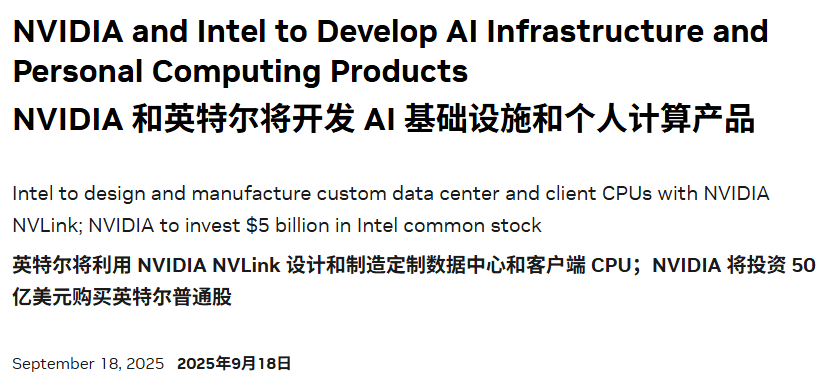
Core Insights - Nvidia and Intel have formed a historic alliance to develop AI infrastructure and personal computing products, with Nvidia investing $5 billion in Intel at a price of $23.28 per share [1][4][5] - The collaboration includes three main areas: integrating Nvidia's NVLink technology with Intel's CPUs, customizing x86 architecture CPUs for Nvidia's AI platform, and launching a new x86 SoC with integrated Nvidia RTX GPU for the PC consumer market [1][4][8] - Following the announcement, Intel's stock surged nearly 30% at market open, closing up 22.77% to $30.57 per share, with a market capitalization reaching $142.7 billion and a year-to-date increase exceeding 50% [1][4] Investment and Market Dynamics - Nvidia's $5 billion investment serves as a crucial financial boost for Intel, which has been facing strategic transformation and financial pressures, particularly in the server CPU market where it has lost market share to AMD [4][5] - The partnership allows Intel to enter the AI market more effectively, as Nvidia's GPUs are essential in AI server markets, providing Intel with a significant opportunity to integrate its CPUs into Nvidia's systems [4][5][8] - The collaboration is expected to reshape the AI computing landscape, as the demand for AI training and inference hardware increases, necessitating deeper cooperation between GPUs and CPUs [7][10] Competitive Landscape - The alliance creates a new competitive dynamic in the semiconductor industry, particularly affecting rivals like AMD and ARM, as the combined strength of Nvidia and Intel may intensify competition in the data center and AI markets [9][10] - Nvidia's CEO Jensen Huang emphasized that the partnership does not diminish their commitment to ARM architecture, indicating that both companies will continue to pursue their respective product lines while collaborating [9][10] - The collaboration is seen as a strategic move to enhance Nvidia's penetration into the PC market while providing Intel with a pathway to leverage Nvidia's AI capabilities [7][8]

英伟达怒花350亿,把英特尔打回了40年前。
Sou Hu Cai Jing· 2025-09-19 16:12
Core Viewpoint - Nvidia has announced a $5 billion investment to acquire a stake in Intel, marking a significant shift in their long-standing rivalry and indicating a potential collaboration between the two companies [1][2][4]. Group 1: Investment Details - Nvidia will invest $5 billion to acquire approximately 4% of Intel's shares, becoming one of its major shareholders [4]. - Intel's stock price surged over 30% following the announcement, closing with a gain of more than 23%, a performance not seen since 1987 [2][4]. Group 2: Strategic Implications - The partnership is expected to enhance collaboration, with Nvidia leveraging Intel's resources to penetrate the home computing market, while Intel aims to develop data center chips alongside Nvidia [2][4]. - Nvidia's CEO expressed confidence in the investment, calling it an "incredible investment," while Intel's new CEO thanked Nvidia for their trust [4]. Group 3: Market Context - This investment follows a previous government acquisition of 10% of Intel's shares, indicating a broader interest in stabilizing Intel's position in the market [6]. - Analysts suggest that Nvidia's investment may only provide short-term relief for Intel, which faces challenges in its chip manufacturing business and lacks significant external clients for its foundry services [8][10]. Group 4: Historical Perspective - The relationship between Nvidia and Intel has evolved from fierce competition to potential collaboration, reminiscent of past industry dynamics where companies shifted roles [12][14]. - Nvidia's investment parallels historical instances, such as Microsoft's investment in Apple in 1997, highlighting the cyclical nature of tech industry partnerships [18].
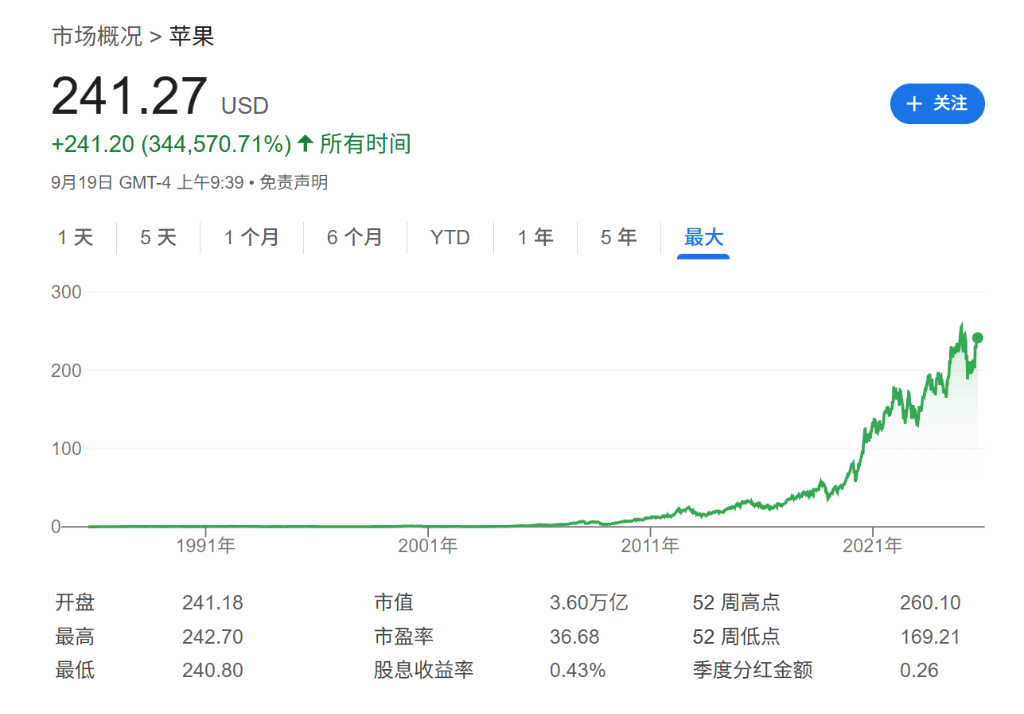
命运的转折点,2025年英伟达入股英特尔=1997年微软入股苹果?
Hua Er Jie Jian Wen· 2025-09-19 13:45
Core Viewpoint - Nvidia's strategic investment of $5 billion in Intel is sparking discussions on Wall Street about a potential turning point for the struggling chip giant, reminiscent of Microsoft's 1997 support for Apple [1][2] Group 1: Nvidia's Investment - Nvidia will become one of Intel's largest shareholders through this investment, with plans to collaborate on chip development in the PC and data center sectors, integrating Nvidia's GPUs with Intel's CPUs and packaging technology [1] - This investment is seen as a strategic move for Nvidia, while providing Intel with much-needed credibility and momentum for its wafer foundry business [1] Group 2: Historical Context - Analysts draw parallels between Intel's current situation and Apple's in 1997, when Microsoft invested $150 million to support a faltering Apple, which later led to Apple's remarkable recovery [2][3] - Intel's market value has plummeted to approximately $140 billion from a peak of over $500 billion, while Nvidia's market cap has surged to nearly $4.2 trillion, making it a key player in the industry [3] Group 3: Strategic Considerations - Nvidia's investment is driven by strategic considerations, including the explosive growth in demand for AI chips and the need for a stable and diversified supply chain amid geopolitical risks [4] - Intel's previously struggling foundry business may see a turnaround due to Nvidia's substantial orders and technological collaboration [4] Group 4: Market Sentiment - Despite the potential for a turnaround, there are skeptics who believe Intel's issues are deeply rooted, and this investment could be a precursor to a breakup or acquisition [5] - Supporters argue that, similar to the late 1990s optimism surrounding Apple, Intel's collaboration with Nvidia could lead to an unexpected resurgence [5]
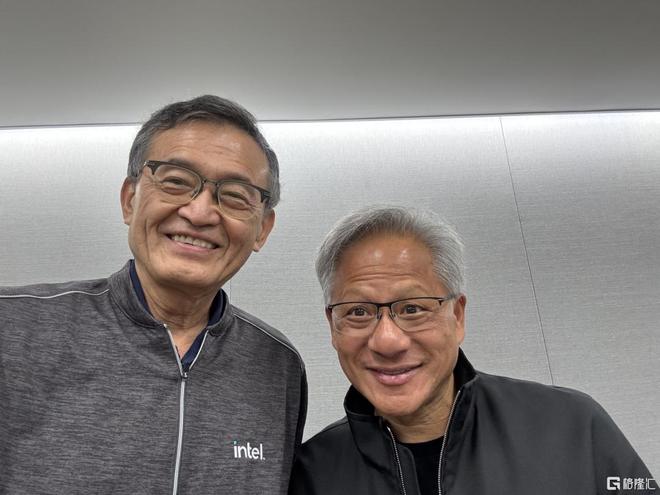
英伟达注资引爆英特尔(INTC.US)股价 花旗却逆势看空:代工落后台积电多年 利好已透支
智通财经网· 2025-09-19 13:41
Core Viewpoint - Citigroup downgraded Intel (INTC.US) from "Neutral" to "Sell," while raising the target price from $24 to $29, indicating skepticism about Intel's performance improvements despite a recent 23% stock price increase following Nvidia's $5 billion investment announcement [1] Group 1: Analyst Insights - Analyst Christopher Danely expects limited performance improvement for Intel, as stronger graphics cards do not enhance Intel's CPU competitiveness against AMD, which is crucial for performance [1] - The potential market size for Intel's AI products is estimated to be between $1 billion and $2 billion, leading to low expectations for these offerings [1] - Danely believes Intel's stock price reflects optimistic expectations regarding its leading foundry business, but the likelihood of success in this area is considered minimal [1] Group 2: Market Context - Intel's stock has risen approximately 50% since early August, suggesting that investors may have already priced in expectations for Intel's wafer foundry deals [1] - Danely notes that Intel's foundry business is significantly behind TSMC, indicating challenges in competing in this sector [1] Group 3: Nvidia's Investment - Nvidia announced a $5 billion investment in Intel to co-develop chips for PCs and data centers, aimed at helping Intel address its current operational challenges [1] - Nvidia plans to acquire Intel common stock at a price of $23.28 per share as part of this investment [1]
白宫“股神”出手!英特尔大涨30%,一夜增值2000亿!
Ge Long Hui· 2025-09-19 13:29
Core Insights - Intel's financial struggles were highlighted by a net loss of $2.92 billion in Q2 2025, a significant increase of 81% compared to the previous year, and a gross margin that fell to 29.7%, down nearly 10 percentage points from 38.7% the previous year [2][3] - Despite these challenges, Intel secured $16 billion in investments from the U.S. government, SoftBank, and NVIDIA within a month, leading to a 30% rebound in stock price and a market capitalization increase of $200 billion [1][6] Group 1: Intel's Financial Struggles - The Q2 2025 financial report revealed a net loss of $2.92 billion, which is an 81% increase from the $1.61 billion loss in the same quarter last year [2] - The adjusted gross margin dropped to 29.7%, significantly below the market expectation of 36.6% and down from 38.7% year-over-year [2] - Core business areas faced severe challenges, particularly in CPU and wafer foundry segments [2][3][4] Group 2: Market Position and Competition - In the CPU market, Intel still holds over 80% market share in the PC segment, but AMD has captured over 40% of the server CPU market, significantly impacting Intel's order volume [3] - Intel's wafer foundry business reported only $820 million in revenue with a loss of $1.25 billion, while its market share remains below 3%, far behind TSMC's 56% [4] - Management instability was exacerbated by public criticism from former President Trump, leading to a drop in stock price and a downgrade in ratings [5] Group 3: Capital Infusion and Strategic Moves - The U.S. government initiated a strategic investment in Intel, acquiring 9.9% of the company for $8.9 billion, making it the largest shareholder [11][12] - SoftBank invested $2 billion for a 2% stake, aiming to leverage Intel's foundry capabilities for its AI infrastructure [10][11] - NVIDIA's $5 billion investment for over 4% equity and a partnership to develop AI-focused chips marked a significant shift for Intel into the AI sector [12][14] Group 4: Underlying Strategic Logic - The government's investment strategy aims to bind Intel to U.S. interests, ensuring priority in producing military-grade chips and limiting collaborations with Chinese firms [16][18] - The collaboration with SoftBank and NVIDIA is designed to stabilize Intel's operations while enabling growth in AI and semiconductor manufacturing [18][20] - This investment model may serve as a template for future government support in other manufacturing sectors, potentially reshaping the U.S. industrial landscape [20]
大摩:英伟达(NVDA.US)联盟英特尔(INTC.US)或对Astera Labs(ALAB.US)造成冲击
智通财经网· 2025-09-19 13:28
此外,英特尔与英伟达的合作项目距离实际落地尚需数年时间。不过摩根士丹利分析师补充称,半导体 行业这一"结构性变革","恰恰凸显了'芯片互联技术'的重要性,以及'机架级计算'模式的优势"。 目前市场存在一种担忧:若NVLink技术延伸至x86领域,可能会取代x86架构CPU与英伟达GPU之间传 统的PCIe接口连接方式——而Astera Labs的产品中包含大量PCIe相关技术及组件,这一变化或将对其业 务造成冲击。不过,现阶段我们尚不宜得出明确结论。" 尽管Astera Labs被列为NVLink Fusion技术的合作方,未来仍有可能在该技术生态中保留业务参与空 间,但具体合作细节目前仍不清晰。 智通财经APP获悉,摩根士丹利表示,英特尔(INTC.US)与英伟达(NVDA.US)达成的PC及数据中心芯片 联合研发协议,可能会对Astera Labs(ALAB.US)产生重大影响,但目前尚无法明确具体影响方向及程 度。 摩根士丹利分析师在致客户的报告中指出:"尽管今年早些时候英伟达发布NVLink Fusion技术的首批公 告中并未提及英特尔,但我们始终认为,这项技术是英伟达为抢占更大规模'服务器x86架构 ...

「寻芯记」英伟达50亿美元“雪中送炭”,英特尔绝地求生?全球芯片格局一夜生变
Hua Xia Shi Bao· 2025-09-19 13:03
Core Viewpoint - Intel and Nvidia have formed a historic partnership, with Nvidia investing $5 billion in Intel to co-develop customized data center and personal computing products, marking a significant shift from competition to collaboration in the semiconductor industry [2][3][4]. Group 1: Partnership Details - Nvidia will utilize its NVLink technology to seamlessly integrate its AI and accelerated computing advantages with Intel's advanced CPU technology, aiming to provide cutting-edge solutions for customers [3]. - Intel will customize x86 processors for Nvidia's AI infrastructure and launch x86 system-on-chip (SoC) products that integrate Nvidia's RTX GPU chiplets for various PC applications [4]. - This partnership is seen as a strategic move for both companies, with Nvidia seeking to enhance its CPU market presence and Intel aiming to revitalize its position in the semiconductor industry [5][6]. Group 2: Market Impact - Following the announcement, Intel's stock surged nearly 30%, closing with a 22.77% increase, while Nvidia's stock rose by 3.49% [6]. - The collaboration is expected to create a new competitive landscape in the semiconductor market, particularly affecting AMD and ARM, which may face increased pressure due to the strengthened position of Intel and Nvidia [9][10]. - The partnership may also challenge TSMC's dominance if Nvidia shifts some of its chip manufacturing to Intel [9]. Group 3: Implications for Chinese Semiconductor Industry - The alliance between Nvidia and Intel could further consolidate the U.S. dominance in high-end computing and data center chips, complicating competition for Chinese manufacturers [11]. - Chinese companies are likely to accelerate their independent innovation efforts, focusing on developing "super nodes" as a key strategy to enhance their competitive edge [11][12]. - Domestic firms are exploring distributed architectures and interconnect innovations to create independent systems that do not rely on Nvidia's ecosystem, which is crucial for China's long-term technological independence [13].