
MICROSOFT(04338)

Search documents
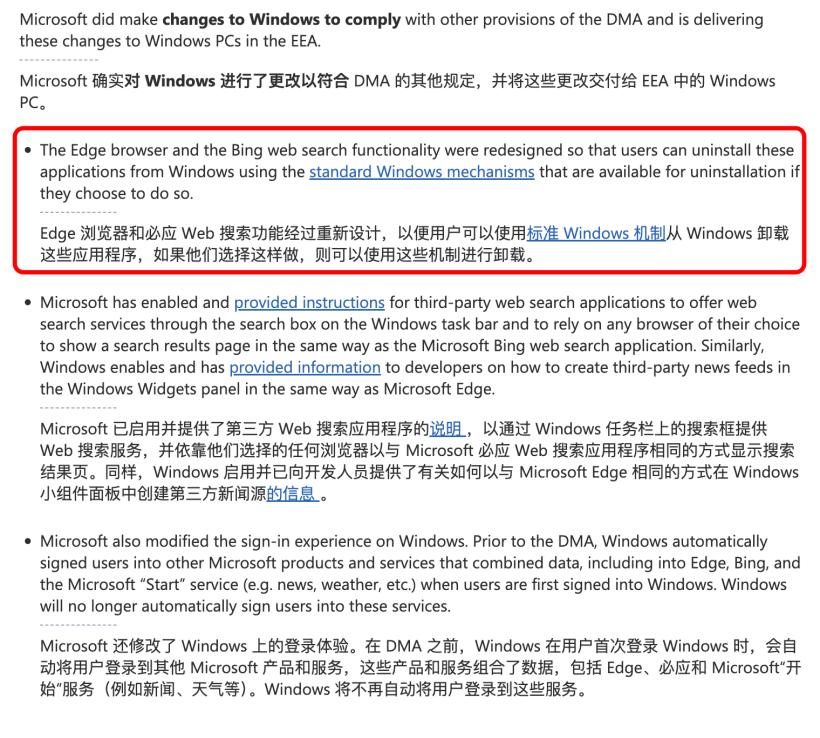
微软疑似暗藏“后门”:用户隐私何存?
3 6 Ke· 2025-09-15 09:38
Core Points - The core issue revolves around Microsoft's UCPD.sys component, which is alleged to contain a backdoor that collects data from users in China while restricting their ability to change default applications [1][2][3] Group 1: UCPD.sys Functionality - UCPD.sys is presented by Microsoft as a "User Choice Protection Driver" aimed at preventing malware from altering default browser settings, but its actual behavior includes writing encrypted data to the system registry and potentially releasing unknown programs [2][3] - The component interferes with user preferences, forcing users to revert to Microsoft’s Edge browser, which can lead to decreased download efficiency and workflow disruptions for professionals [2][5] Group 2: Regional Disparities - UCPD.sys activates data collection mechanisms specifically for users in mainland China, Hong Kong, Macau, and Taiwan, while these mechanisms do not trigger for users in Europe and the US [3][4] - This differential treatment raises concerns about targeted strategies rather than technical limitations, contrasting with Microsoft's compliance with the EU's Digital Markets Act, which promotes user choice [4][5] Group 3: Impact on Chinese Software - The restrictions imposed by UCPD.sys extend to major Chinese software companies, including 360, Tencent, and Lenovo, limiting their functionality and competitive edge within the Windows ecosystem [5][7] - The component acts as a tool for Microsoft to protect its own ecosystem by controlling third-party software interactions, thereby undermining competition [7][10] Group 4: Security Risks - The limitations on Chinese security software due to UCPD.sys could expose users to greater risks, as these tools are hindered from performing their protective functions [10][11] - Historical data indicates that vulnerabilities in Microsoft systems have been exploited for cyberattacks against sensitive sectors in China, raising alarms about the potential misuse of UCPD.sys [8][10] Group 5: User Rights and Transparency - The ongoing situation highlights a broader issue of user rights, with Microsoft’s practices perceived as infringing on user autonomy regarding data collection and software choices [11][12] - Calls for transparency and the restoration of user choice emphasize the need for fair competition and the protection of personal privacy and security in the digital landscape [13][14]


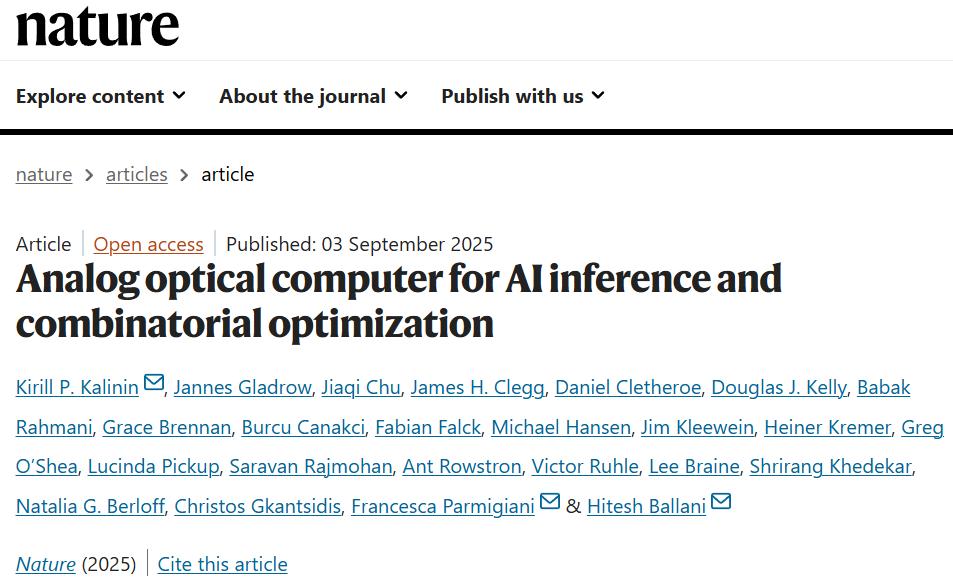
微软用「光」跑AI登上Nature,100倍能效颠覆GPU,华人首席研究员扛鼎
3 6 Ke· 2025-09-15 03:41
Core Insights - Microsoft has developed an Analog Optical Computer (AOC) that redefines computing using light, potentially disrupting the GPU market [1][4][10] Group 1: Technology Overview - The AOC utilizes common components such as Micro LED, optical lenses, and smartphone camera sensors to perform calculations [4][6] - The operation of AOC is based on a fixed-point search mechanism, allowing it to perform matrix-vector multiplication optically while handling non-linear operations electronically [6][8] - AOC can solve optimization problems and perform AI inference on the same platform, showcasing its versatility [9][10] Group 2: Practical Applications - In finance, AOC was tested with Barclays Bank to optimize settlement processes, successfully finding the optimal solution in just 7 iterations for a scaled-down problem [14][16] - In the medical field, AOC demonstrated its capability by reconstructing MRI images, significantly improving efficiency and potentially reducing scan times from 30 minutes to 5 minutes [18][20] Group 3: AI Potential - AOC's fixed-point search mechanism is particularly suited for deep equilibrium networks and modern Hopfield networks, which are computationally intensive on GPUs [21][22] - Initial tests on AI tasks like MNIST classification showed AOC's results aligning closely with traditional methods, indicating its potential for larger-scale applications [22][23] Group 4: Future Prospects - The research team envisions scaling AOC to handle millions of weights, with estimates suggesting it could achieve 500 TOPS/W efficiency, significantly outperforming current GPUs [24][26] - AOC is seen as a potential game-changer in AI infrastructure, offering a more energy-efficient alternative to traditional computing methods [36]
500亿美元!OpenAI拟削减微软分成
Bei Jing Shang Bao· 2025-09-14 17:04
Core Insights - OpenAI is expected to significantly reduce its revenue share payment to Microsoft from nearly 20% to approximately 8% by 2030, allowing it to retain over $50 billion in additional revenue [1] - Ongoing negotiations between OpenAI and Microsoft include discussions on the evolution of their partnership post-AGI and the costs associated with server rentals [1][2] - The restructuring plan aims to transition OpenAI's nonprofit structure while maintaining control over a new public-benefit corporation, which is crucial for future fundraising and potential IPO [3][4] Revenue Sharing and Financial Implications - The new revenue-sharing agreement indicates that OpenAI will share around $56 billion with Microsoft and other partners by 2030, a decrease from the previously estimated $74 billion [1] - The reduction in revenue share is seen as a more aggressive target compared to earlier predictions of around 10% [1] Organizational Structure and Future Plans - OpenAI's complex organizational structure includes a nonprofit parent company and a for-profit subsidiary, which has faced challenges due to profit cap limitations [3] - The restructuring is designed to facilitate a potential IPO, with OpenAI's nonprofit entity expected to control a public-benefit corporation while holding a significant equity stake [3][4][5] Market Context and Investor Sentiment - The AI industry is experiencing rapid growth, leading to heightened interest from capital markets, which could provide OpenAI with substantial funding for further technological advancements [5] - OpenAI's leadership has indicated that the ongoing restructuring is paving the way for a future IPO, contingent on market conditions and the company's readiness [4][5]
微软CEO纳德拉:微软必须重新获取员工的信任
Huan Qiu Wang· 2025-09-14 06:25
来源:环球网 【环球网科技综合报道】9月14日消息,据外媒CNBC报道,微软首席执行官萨蒂亚·纳德拉在一次员工 会议上告诉员工,在宣布几轮裁员和强制部分员工恢复线下办公后,公司需要努力缓和与员工的关系。 在这场线上会议上,一名员工要求高管谈谈公司文化中近期缺乏同理心的问题,以及微软为重新获取员 工信任而采取的措施。 纳德拉对此表示,"我非常感谢这个问题以及它背后的情感,我认为这是对我以及领导团队所有人的反 馈,因为最终,我认为我们可以做得更好,而且我们会做得更好。" 纳德拉发表上述言论之前,微软在7月裁员9000人,此前几个月也进行了小幅裁员。随后,微软表示, 从明年2月开始,居住在雷德蒙德总部附近的员工必须每周上班三天,之后还将在更大范围内推广。 (思瀚) ...
OpenAI据传大砍微软(MSFT.US)商业分成
智通财经网· 2025-09-14 01:05
Core Viewpoint - OpenAI and Microsoft have reached a non-binding memorandum of understanding regarding the next phase of their collaboration, indicating ongoing negotiations on contract terms [1][3] Group 1: Revenue Sharing and Financial Implications - OpenAI has informed some shareholders that the revenue share given to Microsoft will significantly decrease in the coming years, from an initial 20% until 2030 to an expected 8% by the end of the century, potentially allowing OpenAI to retain over $50 billion in additional revenue [3] - It remains unclear whether the non-binding agreement includes modifications to the revenue-sharing plan, with some OpenAI executives seeking to exclude certain unreleased products from the revenue-sharing agreement [3] Group 2: Cloud Services and Competitive Dynamics - OpenAI is currently negotiating the scale of its spending on Microsoft cloud services, with previous estimates suggesting a spending of $135 billion by 2030, while Oracle has reportedly secured a $300 billion order from OpenAI [4] - Microsoft shareholders are questioning why OpenAI is placing larger orders with Oracle compared to Microsoft Azure, despite Microsoft being a key stakeholder in OpenAI [5] Group 3: Ownership Structure and Governance - The terms regarding equity distribution have reportedly been largely determined, with OpenAI's non-profit parent company and Microsoft each expected to hold about one-third of the new company's shares, although Microsoft will not receive a board seat [5]
获微软放行?OpenAI重组,最新进展!
Zheng Quan Shi Bao· 2025-09-13 11:25
Core Viewpoint - The recent non-binding memorandum of understanding between Microsoft and OpenAI marks a significant step in resolving their complex relationship and is seen as crucial for OpenAI's organizational restructuring efforts [1] Group 1: Key Developments - Microsoft and OpenAI have reached a preliminary agreement to revise their partnership, which is viewed as a breakthrough after months of disagreements [2] - The agreement addresses three core points of contention: exclusivity in cloud computing, revenue sharing, and rights related to general artificial intelligence [2][4] Group 2: Cloud Computing Exclusivity - The first major disagreement revolves around cloud computing exclusivity, as OpenAI has expressed dissatisfaction with Microsoft's ability to meet its growing computational needs [3] - OpenAI has begun to diversify its cloud computing sources, partnering with companies like SoftBank and Oracle to build a nationwide AI infrastructure [3] Group 3: Revenue Sharing - The second point of contention is the revenue sharing model, where OpenAI has informed some shareholders that its revenue share to Microsoft will decrease from nearly 20% to approximately 8% by 2030 [4] Group 4: General Artificial Intelligence Terms - The third disagreement concerns the terms related to general artificial intelligence, specifically a clause that allows OpenAI to terminate Microsoft's access to its technology upon proving the capability of achieving AGI [4] Group 5: Organizational Restructuring - OpenAI's restructuring is seen as essential for its future IPO plans and to secure necessary funding, as it aims to transition from a non-profit to a more flexible structure [5][6] - The restructuring plan involves maintaining a non-profit parent company while converting its for-profit subsidiary into a public benefit corporation, with a projected valuation of $500 billion [6] Group 6: IPO Considerations - OpenAI's CFO has indicated that the ongoing restructuring is paving the way for a potential IPO, which could provide the company with substantial funding to enhance its technological development and competitive position [7]
微软与OpenAI达成新协议,OpenAI计划降分成留500亿美元收益
Sou Hu Cai Jing· 2025-09-13 03:12
Core Insights - Microsoft and OpenAI have reached a new agreement that may facilitate OpenAI's restructuring and eventual public listing [1] - OpenAI plans to reduce its revenue share with commercial partners, including Microsoft, from 20% to 8% by 2030, aiming to retain at least $50 billion in revenue [1] - Since 2019, Microsoft has invested at least $13 billion in OpenAI and has been sharing revenue from ChatGPT and its API [1] - Microsoft now views OpenAI as a competitor and is increasing its reliance on its own AI models, with commitments from CEO Satya Nadella and AI chief Mustafa Suleyman for significant investments in self-developed AI chips and models [1]
印度最大互联网券商最快下周提交招股书,微软CEO位列股东
Feng Huang Wang· 2025-09-12 23:49
Core Insights - India's largest investment platform Groww is set to go public, with plans to raise between $650 million to $800 million and a potential valuation of up to $8 billion [1] - If regulatory approval is granted to lower the minimum public shareholding requirement, the IPO size may be adjusted accordingly [1] - Groww currently has 12.07 million active users on the National Stock Exchange of India, representing 26% of the total user base [1] Company Overview - Groww was founded in 2017 by four former employees of e-commerce company Flipkart, aiming to simplify investment for the nearly 200 million Indians with investable income [2] - The platform started with mutual fund distribution and expanded to stock trading in 2020, later adding services like digital gold, intraday trading, and IPOs [2] - Microsoft CEO Satya Nadella is a notable supporter of Groww, serving as an investor and advisor, although specific financial details have not been disclosed [2] Investment Backers - Major investors in Groww include Sequoia Capital (India), Y Combinator, Tiger Global Management, and Ribbit Capital [3]

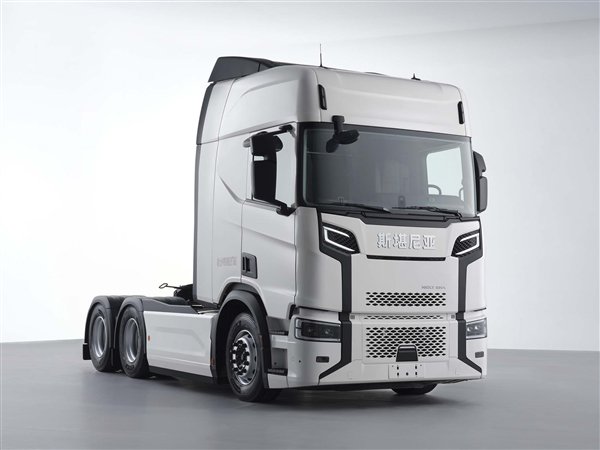
瑞典人整了个大活!中国产斯堪尼亚重卡汉字车标竟用微软雅黑
Xin Lang Cai Jing· 2025-09-12 20:45
Core Viewpoint - Scania, a well-known Swedish heavy truck manufacturer, has submitted a new model of domestically produced semi-trailer truck, SAS4261GGN001, which features a new Chinese logo that has received criticism for its design [1][4]. Group 1: Product Details - The new truck model is equipped with 339kW and 369kW diesel engines and has a maximum allowable towing capacity of 40 tons [4]. - The model is registered by Scania Manufacturing (China) Co., Ltd., which is a wholly-owned subsidiary [4]. Group 2: Design Criticism - The new Chinese logo on the truck is created using the Microsoft YaHei font without artistic design, leading to a mismatch with the overall style of the vehicle [1][4]. - Many netizens have expressed their dissatisfaction with the design, suggesting that the designers have made a common mistake in adapting to the local market [4][5].
美股三大期指齐跌;三大运营商将为iPhone Air提供eSIM支持;OpenAI重组计划获微软“放行”【美股盘前】
Mei Ri Jing Ji Xin Wen· 2025-09-12 11:28
Group 1 - The Dow futures fell by 0.16%, S&P 500 futures dropped by 0.14%, and Nasdaq futures decreased by 0.05% [1] - Cryptocurrency exchange Gemini's IPO has been oversubscribed by more than 20 times, with the company limiting fundraising to $425 million [1] - Microsoft shares rose over 1.5% in pre-market trading after reaching a non-binding agreement with OpenAI to allow the latter to restructure into a for-profit entity [1] - Adobe's shares increased nearly 4.5% in pre-market trading after the company raised its revenue and profit forecasts for fiscal year 2025, indicating strong demand for its design software and enhanced monetization of AI tools [1] Group 2 - Supermicro shares rose nearly 6% in pre-market trading after announcing the delivery of high-capacity NVIDIA Blackwell Ultra systems [2] - Warner Bros Discovery shares increased over 4% in pre-market trading, following a previous trading day gain of over 28%, amid news of Paramount Global's interest in acquiring the company [2] - DA Davidson upgraded NVIDIA's stock rating from "neutral" to "buy," raising the target price from $195 to $210, citing optimism about growing demand for AI computing [2] - Rivian announced a recall of over 24,000 vehicles in the U.S. due to issues with its highway assist software [2] Group 3 - Apple announced that major Chinese carriers will provide eSIM support for the iPhone Air, with activation dependent on regulatory approval [3] Group 4 - The preliminary consumer confidence index from the University of Michigan for September will be released at 22:00 Beijing time [4]


