
BeiGene(06160)

Search documents
百济神州-U(688235):创新药龙头进入新阶段 向全球MNC迈进
Xin Lang Cai Jing· 2025-10-10 02:29
Core Insights - BeiGene is positioned as a leading innovative pharmaceutical company in China, aiming to achieve profitability by 2025, marking a transition from R&D investment to commercialization [1] - The company is expanding its product pipeline into solid tumors and immunology, leveraging new technology platforms such as ADC and PROTAC [1] Global R&D and Commercialization - BeiGene has established a global clinical and commercialization system with a team of approximately 3,700, enabling clinical trials with minimal reliance on CROs [1] - Key products, Baiyueze and Baizean, have been approved in 75 and 47 markets respectively, covering hematological malignancies, solid tumors, and immune diseases, showcasing strong market penetration and product diversity [1] - In the first half of 2025, the company's product revenue reached $2.41 billion, a year-on-year increase of 44.5%, with Q2 revenue of $1.3 billion, up 41.4% [1] Hematological Malignancies - The core product, Zebutinib, saw significant sales growth, reaching $1.74 billion in the first half of 2025, a 55% increase year-on-year [2] - In the U.S., Baiyueze sales in Q2 2025 were $684 million, up 43%, while in Europe, sales were $150 million, reflecting an 85% increase [2] - The company is advancing its pipeline with Sonrotoclax expected to report data in H2 2025 and BTK CDAC (16673) recognized by the FDA for its innovative approach to BTKi resistance [2] Solid Tumors - BeiGene is focusing on next-generation solid tumor drugs based on PD-1 monoclonal antibodies, particularly in breast, lung, and gastric cancers [3] - In breast cancer, the company is developing CDK4 and CDK2 series products, with CDK4i expected to enter Phase 3 trials in 2026 [3] - In lung cancer, the combination of PRMT5i and MATA2i is set to complete patient enrollment in H2 2025, while several other candidates are in early-stage trials [3] Immunology and Inflammation - The IRAK4 CDAC is currently in Phase 2 trials for atopic dermatitis and nodular prurigo, with data expected in H2 2025 [3] - The company reported a GAAP gross margin of 87.4% in Q2 2025, a 2.4 percentage point increase year-on-year, with a net profit of $94 million and adjusted net profit of $253 million, indicating enhanced profitability [3] Revenue Forecast and Investment Recommendations - Revenue projections for Baiyueze from 2025 to 2027 are $27.96 billion, $35.60 billion, and $41.68 billion, with year-on-year growth rates of 49%, 27%, and 17% respectively [4] - Bai Zean's revenue is expected to be $750 million, $880 million, and $1.02 billion for the same period, with growth rates of 20%, 18%, and 16% [4] - The overall revenue forecast for BeiGene from 2025 to 2027 is $37.66 billion, $47.49 billion, and $55.85 billion, with growth rates of 38%, 26%, and 18% [4] - The company is valued at a significantly lower price-to-sales ratio compared to comparable companies, highlighting its investment attractiveness [4]
历时两年多,百济神州打赢泽布替尼美国专利侵权诉讼
Xin Jing Bao· 2025-10-10 02:06
Core Viewpoint - BeiGene has successfully resolved a two-year patent infringement lawsuit regarding its BTK inhibitor, Zebutinib, in the U.S. market, which clears the way for its global expansion [1][5]. Group 1: Product Performance - Zebutinib is BeiGene's best-selling BTK inhibitor, achieving sales of $1.297 billion (approximately 9.138 billion RMB) in 2023, marking its entry into the "billion-dollar molecule" category [2]. - In the first half of 2023, Zebutinib's global sales exceeded 12.527 billion RMB, a year-on-year increase of 56.2%, with the U.S. market contributing 8.958 billion RMB, up 51.7% [2]. - Zebutinib has gained significant market share in the U.S. due to its superior efficacy compared to AbbVie's ibrutinib in head-to-head studies for chronic lymphocytic leukemia (CLL) and small lymphocytic lymphoma (SLL) [2]. Group 2: Legal Developments - The lawsuit initiated by Pharmacyclics, a subsidiary of AbbVie, claimed that BeiGene's Zebutinib infringed on its "803 patent," but the U.S. Patent and Trademark Office declared the patent invalid [4]. - On September 30, 2023, both parties reached a settlement and voluntarily withdrew the lawsuit, concluding the legal dispute [4][5]. - Despite the resolution of this case, AbbVie has ongoing litigation against BeiGene regarding its drug BGB-16673, alleging theft of trade secrets [5]. Group 3: Industry Context - The pharmaceutical industry often faces patent challenges, with companies like BeiGene needing to defend their intellectual property against generic competitors [6][7]. - Patent invalidation is a common strategy used by competitors to challenge the market position of successful drugs, which can significantly impact a company's operations [7][8]. - Companies are encouraged to expand their research pipelines to mitigate risks associated with patent litigation and ensure future growth [8].
百济神州(688235) - 港股公告:授出受限制股份单位及业绩股份单位
2025-10-09 09:15
香港交易及結算所有限公司及香港聯合交易所有限公司對本公告的內容概不負責,對其準確性 或完整性亦不發表任何聲明,並明確表示概不就因本公告全部或任何部分內容而產生或因依賴 該等內容而引致的任何損失承擔任何責任。 BeOne Medicines Ltd. 百濟神州有限公司 (根據瑞士法律註冊成立的公司) (股份代號:06160) 授出受限制股份單位及業績股份單位 本公告乃根據上市規則第17.06A、17.06B以及17.06C條作出。於2025年9月30 日,董事會薪酬委員會根據2016期權及激勵計劃的條款向二百三十七名承授人授 出涉及合共36,234股美國存託股份的受限制股份單位,並向一名承授人授出涉及 合共2,935股美國存託股份的業績股份單位。 2016期權及激勵計劃項下的受限制股份單位及業績股份單位 於2025年9月30日,董事會薪酬委員會根據2016期權及激勵計劃的條款授予二百 三十七名承授人合共36,234股美國存託股份受限制股份單位,並向一名承授人授 出合共2,935股美國存託股份業績股份單位。該等受限制股份單位及業績股份單位 相當於509,197股股份,約佔本公告之日公司發行股份總數的0.03%。 ...
百济神州(688235) - 港股公告:证券变动月报表
2025-10-09 09:15
截至月份: 2025年9月30日 狀態: 新提交 致:香港交易及結算所有限公司 公司名稱: 百濟神州有限公司 (根據瑞士法律註冊成立的公司) 呈交日期: 2025年10月8日 股份發行人及根據《上市規則》第十九B章上市的香港預託證券發行人的證券變動月報表 I. 法定/註冊股本變動 | 1. 股份分類 | 普通股 | 股份類別 | 不適用 | | 於香港聯交所上市 (註1) | | 是 | | | --- | --- | --- | --- | --- | --- | --- | --- | --- | | 證券代號 (如上市) | 06160 | 說明 | 請見備注 | | | | | | | | | 法定/註冊股份數目 | | | 面值 | | 法定/註冊股本 | | | 上月底結存 | | | 2,311,463,847 | USD | | 0.0001 USD | | 231,146.38 | | 增加 / 減少 (-) | | | 0 | | | USD | | 0 | | 本月底結存 | | | 2,311,463,847 | USD | | 0.0001 USD | | 231,146.38 | ...
美股中概股盘前多数下跌,哔哩哔哩涨6%
Xin Lang Cai Jing· 2025-10-09 08:13
Core Viewpoint - The majority of Chinese concept stocks in the US pre-market are experiencing declines, with notable exceptions such as Bilibili which is up by 6% [1] Company Performance - Bilibili is showing a positive performance with a 6% increase [1] - JD.com is slightly down by 0.2% [1] - NIO has decreased by 0.5% [1] - Li Auto and Alibaba both fell by 1% [1] - Xpeng Motors is down by 3% [1] - BeiGene has seen a decline of 4% [1]


港股生物医药股普跌,荣昌生物跌超9%
Xin Lang Cai Jing· 2025-10-09 03:20
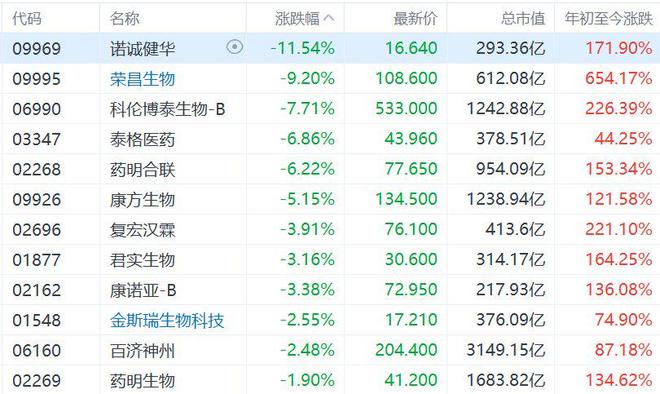
Core Viewpoint - The Hong Kong biopharmaceutical sector experienced a significant decline, with major companies reporting substantial drops in stock prices, indicating a bearish trend in the market [1]. Group 1: Stock Performance - Innovent Biologics (099660) saw a decline of 11.54%, with a latest price of 16.640 and a market capitalization of 293.36 billion, despite a year-to-date increase of 171.90% [2]. - Rongchang Biologics (09995) dropped by 9.20%, priced at 108.600, with a total market value of 612.08 billion, and a remarkable year-to-date increase of 654.17% [2]. - Kelun-Biotech (06990) fell by 7.71%, with a latest price of 533.000 and a market cap of 1,242.88 billion, while still showing a year-to-date increase of 226.39% [2]. - Tigermed (03347) decreased by 6.86%, priced at 43.960, with a market capitalization of 378.51 billion and a year-to-date increase of 44.25% [2]. - WuXi AppTec (02268) experienced a decline of 6.22%, with a latest price of 77.650 and a market cap of 954.09 billion, maintaining a year-to-date increase of 153.34% [2]. - CanSino Biologics (09926) dropped by 5.15%, priced at 134.500, with a market capitalization of 1,238.94 billion, and a year-to-date increase of 121.58% [2]. - Other companies like Junshi Biosciences (01877) and BeiGene (06160) also reported declines, with respective decreases of 3.16% and 2.48% [2].


百济神州专利案结案;*ST赛隆董事长、副总裁等辞职|医药早参
Mei Ri Jing Ji Xin Wen· 2025-10-08 23:12
Group 1 - Norin Pharma and Zenas BioPharma have reached a licensing agreement for the global development and commercialization rights of Obinutuzumab in multiple sclerosis and other non-oncology indications [1] - Zenas also acquired rights to two preclinical molecules, a novel oral IL-17 AA/AF inhibitor and a brain-penetrant oral TYK2 inhibitor [1] - This strategic collaboration aims to accelerate the clinical development of Obinutuzumab and maximize its clinical and commercial value globally, particularly in the field of multiple sclerosis [1] Group 2 - The board of *ST Sailong has received resignation letters from Chairman Chen Ke, Vice President and Secretary Zhang Xu, and Vice President Duan Daifeng [2] - Chen Ke and Zhang Xu will retain their positions as President and Secretary, respectively, while Duan Daifeng's resignation reflects a personal career development decision [2] - This "name resignation but actual retention" adjustment is common but may indicate potential strategic disagreements within the company [2] Group 3 - BeiGene announced that Pharmacyclics LLC has decided not to appeal the final written decision of the U.S. Patent and Trademark Office, leading to the voluntary withdrawal of the lawsuit [3] - The lawsuit was resolved without adverse effects on BeiGene, and the development and sales of Baiyueze® in the U.S. remain unaffected [3] - The resolution of this litigation does not pose significant negative impacts on the company's operations [3] Group 4 - BaiLi Tianheng's first antibody-drug conjugate (ARC) has received clinical trial approval from the National Medical Products Administration [4] - The drug, Lutetium [177Lu]-BL-ARC001 injection, is intended for patients with locally advanced or metastatic solid tumors who have failed standard treatments [4] - This therapy offers new hope for advanced solid tumor patients by precisely targeting and destroying tumor cells, showcasing a differentiated innovation path in the current ADC drug development landscape [4]
百济神州有限公司关于公司涉及诉讼的进展公告
Shang Hai Zheng Quan Bao· 2025-10-08 19:00
Core Viewpoint - The lawsuit involving BeiGene and Pharmacyclics has been voluntarily withdrawn, resulting in no negative impact on the company's operations or product development in the U.S. market [2][5][4]. Group 1: Lawsuit Details - On June 13, 2023, Pharmacyclics LLC filed a lawsuit against BeiGene and its subsidiary BeOne Medicines USA, claiming patent infringement related to the product 百悦泽? [3]. - The patent in question is U.S. Patent No. 11,672,803, which was granted to Pharmacyclics on the same day the lawsuit was filed [3]. - The court has agreed to pause the infringement lawsuit pending the outcome of a Patent Trial and Appeal Board (PTAB) review, which is expected to conclude by November 1, 2023 [3]. Group 2: Impact on the Company - The lawsuit has not adversely affected the research and sales of 百悦泽? in the U.S. market, nor has it significantly impacted the company's overall operations [5]. - The company maintains confidence in its intellectual property related to 百悦泽? and plans to continue developing innovative cancer treatment solutions [2][5].
百济神州授出3.6万股美国存托股份受限制股份单位
Ge Long Hui· 2025-10-08 13:07
Core Points - BeiGene announced the grant of a total of 36,000 restricted stock units to 237 grantees under the 2016 option and incentive plan [1] - Additionally, one grantee was awarded a total of 2,935 performance stock units [1] - The total restricted stock units and performance stock units correspond to 509,197 shares, representing approximately 0.03% of the company's total issued shares as of the announcement date [1]
百济神州授出受限制股份单位及业绩股份单位
Zhi Tong Cai Jing· 2025-10-08 12:29
Core Points - BeiGene (06160) announced that on September 30, 2025, the Board's Compensation Committee granted a total of 36,000 restricted stock units involving American Depositary Shares to 237 grantees under the 2016 Option and Incentive Plan [1] - Additionally, one grantee was awarded 2,935 performance stock units involving American Depositary Shares [1]