NONGFU SPRING(09633)

Search documents
富瑞:微升农夫山泉(09633)目标价至50.5港元 维持“持有”评级
智通财经网· 2026-03-26 07:31
Core Viewpoint - The report from Jefferies indicates that Nongfu Spring (09633) has shown strong financial performance in 2025, with revenue and net profit growth, and maintains a "Hold" rating with a slight increase in target price to HKD 50.5 [1] Financial Performance - Nongfu Spring reported a revenue increase of 22.5% to RMB 52.6 billion in 2025, with a net profit of RMB 15.9 billion, reflecting a year-on-year growth of 32.7% [1] - The second half of 2025 is expected to see revenue and net profit growth of 30% and 42% respectively [1] Future Outlook - Management forecasts double-digit sales growth for 2026, with bottled water sales expected to return to or exceed 2023 levels [1] - Due to fluctuations in commodity prices, particularly PET, no profit margin guidance has been provided [1] - As 2026 marks the 30th anniversary of the company, Nongfu Spring plans to implement more promotional strategies to enhance consumer engagement [1]

农夫山泉:FY25: Strong tea & juice biz; facing challenges to maintain high growth-20260326
Zhao Yin Guo Ji· 2026-03-26 03:24
Investment Rating - The report maintains a BUY rating for Nongfu Spring, with a target price raised by 5% to HK$60.88, reflecting a potential upside of 31.1% from the current price of HK$46.42 [1][3]. Core Insights - Nongfu Spring's FY25 revenue increased by 22.5% YoY to RMB 52.6 billion, exceeding Bloomberg consensus by 4%, while net profit rose by 30.9% YoY to RMB 15.9 billion, beating consensus by 6% [1]. - The company aims for double-digit revenue growth in FY26 but has not provided guidance on gross margin or net profit due to uncertain market conditions [1]. - The forecast for revenue and earnings CAGR from 2026 to 2028 is approximately 11% [1]. Financial Performance Summary - FY25 revenue: RMB 52,553 million, with a YoY growth of 22.5% [2]. - FY25 net profit: RMB 15,868 million, with a YoY growth of 30.9% [2]. - EPS for FY25 reported at RMB 1.41, with a projected EPS of RMB 1.57 for FY26 [2]. - P/E ratio for FY25 is 28.9x, projected to decrease to 26.0x in FY26 [2]. Business Segment Performance - Tea business revenue grew by 29% YoY in FY25, with a notable acceleration in 2H25 [9]. - Water business revenue increased by 17% YoY, with a 25% growth in 2H25 [9]. - Juice business revenue rose by 27% YoY, with 2H25 growth accelerating to 33% [9]. Market and Competitive Landscape - The report highlights intensified competition in the packaged water and beverage sector, which may pose challenges to sustaining high growth rates [1][9]. - Concerns over raw material price volatility due to geopolitical factors are noted, impacting future profitability [1][9]. Valuation Metrics - The target P/E multiple has been cut by 20% to 32x, reflecting market concerns [1]. - The company is positioned as an industry leader, attracting liquidity concentration despite potential sector sentiment challenges [1].
农夫山泉:防御转进攻,“水茅” 强势狂飙
3 6 Ke· 2026-03-26 03:15
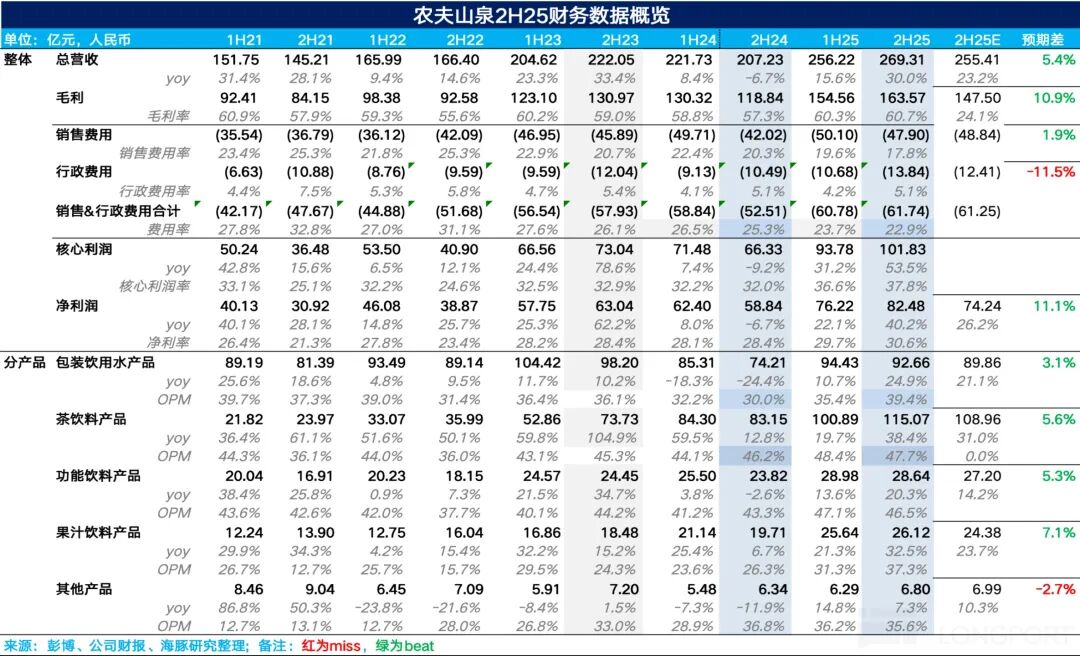
Core Viewpoint - The company delivered a strong performance in H2 2025, exceeding expectations, driven by aggressive channel strategies and growth in both packaged water and tea beverage segments [1][15]. Packaged Water Business - In H2 2025, the packaged water segment achieved revenue of 9.27 billion RMB, a year-on-year increase of 25%, with further acceleration in growth compared to H1 2025 [2][17]. - The company implemented a "ten thousand boxes display" strategy, enhancing control over terminal displays and increasing the proportion of red bottle water in revenue to approximately 82% [3][17]. - The operating profit margin for packaged water reached a record high of 39.4% [3][17]. Tea Beverage Business - The tea beverage segment generated revenue of 11.5 billion RMB in H2 2025, marking a year-on-year growth of 38.4%, officially surpassing packaged water to become the largest growth driver for the company [4][20]. - The company expanded its product offerings by introducing hot drink cabinets nationwide, transforming traditional cold tea products into winter hot beverage options [5][20]. - Despite a slight decrease in operating profit margin to 47.7% due to promotional activities, tea remains the most profitable segment for the company [6][20]. Functional Beverages & Juice - Functional beverages saw a revenue increase of 20% year-on-year, benefiting from accelerated distribution of electrolyte water and product upgrades [6][22]. - Juice revenue grew by 33%, with the introduction of 1L family-sized packaging contributing to the expansion of consumption scenarios [6][22]. Gross Margin Improvement - The company's gross margin increased by 3.4 percentage points to 60.7%, supported by low raw material costs and the growth of high-margin products [6][26]. Operating Leverage and Profitability - The company reduced ineffective advertising expenses, shifting to new media channels, resulting in a sales expense ratio decline to 17.8%, a record low [7][28]. - The net profit margin reached 30.6%, exceeding market expectations [7][28].

饮料市场分化加剧:农夫山泉增长,康师傅下滑丨消费参考
2 1 Shi Ji Jing Ji Bao Dao· 2026-03-26 02:09
Group 1: Beverage Industry Performance - Nongfu Spring reported a revenue increase of 22.5% to 52.553 billion yuan in 2025, with a net profit growth of 30.9% to 15.868 billion yuan [1] - In 2025, Nongfu Spring's packaged water revenue grew by 17.3% to 18.71 billion yuan, while its beverage segment saw a 25.6% increase to 33.84 billion yuan [1] - In contrast, Master Kong's beverage revenue declined by 2.9% to 50.1 billion yuan in 2025, with significant drops in ready-to-drink tea and juice segments [2] - Uni-President China also experienced a similar trend, with a 5.8% decline in beverage revenue in the second half of 2025, totaling 8.68 billion yuan [3] Group 2: Market Dynamics and Competitive Landscape - The decline in Master Kong's beverage sales is attributed to multiple factors, including the impact of aggressive competition in the delivery market [4] - Master Kong's adjustments, such as reducing the number of marketing distributors and increasing prices, have also negatively affected sales [5] - The competition in the sugar tea market is shifting, with Nongfu Spring's Oriental Leaf capturing a significant market share in the unsweetened tea segment [5] Group 3: Other Industry Developments - China Shengmu appointed a new CFO, Li Li, following an internal position adjustment [6] - Mengniu reported a revenue decline of 7.3% to 82.2449 billion yuan in 2025, with a net profit of 1.545 billion yuan [11] - Modern Dairy's revenue decreased by 4.9% to 12.601 billion yuan in 2025, with a net loss of 1.204 billion yuan [13] - Qihai International achieved a revenue increase of 1.1% to 6.613 billion yuan in 2025, with a net profit growth of 13% [14]

饮料市场分化加剧:农夫山泉增长,康师傅下滑
2 1 Shi Ji Jing Ji Bao Dao· 2026-03-26 02:05
Group 1: Beverage Industry Performance - Nongfu Spring reported a revenue increase of 22.5% to 52.553 billion yuan in 2025, with a net profit growth of 30.9% to 15.868 billion yuan [2] - In contrast, Master Kong's beverage revenue declined by 2.9% to 50.1 billion yuan in 2025, with significant drops in ready-to-drink tea and juice segments [3] - Uni-President China also experienced a similar trend, with a 5.8% revenue decline in the second half of 2025, although the annual revenue showed a slight increase of 1.2% [5] Group 2: Market Dynamics and Competitive Landscape - The decline in Master Kong's beverage sales is attributed to multiple factors, including the impact of aggressive competition in the takeaway market [6] - Master Kong's adjustments, such as reducing the number of marketing distributors and increasing prices, have also negatively affected sales [8] - Despite the challenges faced by competitors, Nongfu Spring has managed to withstand the pressures of the takeaway market, indicating a need for Master Kong's management to reassess their strategies [6][8] Group 3: Other Industry Developments - China Shengmu appointed a new CFO, Li Li, following an internal position rotation [9] - Mengniu reported a revenue decline of 7.3% to 82.2449 billion yuan in 2025, with a net profit of 1.545 billion yuan [11] - The average price of pork in China's wholesale markets decreased to 15.80 yuan per kilogram, reflecting broader agricultural market trends [10]

低增长时代,什么生意最扛打?农夫山泉给出了答案
Sou Hu Cai Jing· 2026-03-25 19:14
Core Viewpoint - Nongfu Spring achieved a significant milestone in 2025 with revenue surpassing 52.553 billion yuan and a profit increase of 30.9%, indicating a strong recovery in its drinking water business, which grew by 17.3% compared to 2024 [2][5]. Group 1: Financial Performance - In 2025, Nongfu Spring's revenue reached 52.553 billion yuan, marking its first time exceeding 50 billion yuan [2]. - The company's profit for the year was 15.868 billion yuan, reflecting a growth rate of 30.9% [2]. - The drinking water segment showed a recovery with a growth of 17.3% compared to the previous year [2]. Group 2: Market Context and Competitive Landscape - The beverage industry is facing challenges with new entrants in sugar-free tea and functional drinks, leading to a slowdown in growth for many brands, such as Master Kong and China Resources Beverages [5]. - Despite these challenges, Nongfu Spring managed to recover and grow, attributed to its focus on product, supply chain, and human resources [5][21]. Group 3: Product Strategy and Innovation - Nongfu Spring's strategy emphasizes long-term investment in core products rather than chasing short-lived trends, with successful products like Dongfang Shuye tea becoming stable revenue sources [6][9]. - The company has expanded its tea product line significantly, creating a comprehensive portfolio that includes various types of tea, enhancing its market presence [9][15]. - The introduction of the "Water Source Bottle" and ongoing public engagement activities have reinforced consumer trust in the brand [11][12]. Group 4: Supply Chain and Resource Management - Nongfu Spring has invested heavily in securing high-quality water sources, expanding its national water source map to 16 locations, which enhances supply stability [12][14]. - The company has developed modern tea processing facilities to improve the quality of tea leaves, achieving a quality rate increase from 52% to 90% [15][16]. - By raising purchase prices for tea leaves, Nongfu Spring aims to secure higher quality raw materials, thereby improving overall supply quality [16][20]. Group 5: Management and Organizational Structure - The management team at Nongfu Spring has matured over time, transitioning from founder-driven to team-driven leadership, which has proven effective in navigating market challenges [21][23]. - The internal management team, with extensive experience in the company, has maintained strategic consistency and avoided reactive decisions during market fluctuations [23][24]. - The company's long-term investments in both human resources and physical assets are beginning to yield strategic returns, particularly in a low-growth environment [24][25].

农夫山泉(09633):业绩高增,新品类多点开花,平台型企业优势延续
Hua Yuan Zheng Quan· 2026-03-25 15:31
Investment Rating - The investment rating for the company is "Accumulate" (maintained) [5] Core Views - The company, Nongfu Spring, achieved strong revenue growth in 2025, surpassing market expectations with total revenue of 52.553 billion RMB, a year-on-year increase of 22.51%, and a net profit attributable to shareholders of 15.868 billion RMB, up 30.89% year-on-year, indicating a significant improvement in profitability [5] - The company's gross margin improved by 2.4 percentage points to 60.5% due to a decrease in raw material costs, while the sales expense ratio decreased by 2.8 percentage points to 18.6%, leading to a net profit margin increase of 1.93 percentage points to 30.19% [5] - The dual-engine growth model of "packaged water + tea beverages" is driving the company's growth, with the tea beverage segment becoming the largest revenue source, achieving a revenue of 21.6 billion RMB, a year-on-year increase of 29% [5] Summary by Sections Market Performance - Closing price (HKD): 42.44 - Market capitalization (million HKD): 477,300.03 - Circulating market capitalization (million HKD): 213,671.24 - Debt-to-asset ratio (%): 39.43 [3] Financial Forecasts - Revenue forecast for 2026: 60.219 billion RMB, with a year-on-year growth rate of 14.59% - Net profit forecast for 2026: 17.859 billion RMB, with a year-on-year growth rate of 12.54% - Earnings per share forecast for 2026: 1.59 RMB [7][8] Business Segments - Packaged water revenue in 2025: 18.71 billion RMB, a year-on-year increase of 17.3% - Tea beverage revenue in 2025: 21.6 billion RMB, accounting for 41.1% of total revenue - Juice beverage revenue: 5.18 billion RMB, a year-on-year increase of 26.7% [5][6]
农夫山泉营收破500亿,钟睒睒感谢团队
Guo Ji Jin Rong Bao· 2026-03-25 13:17
Group 1 - The core viewpoint of the article highlights that Nongfu Spring has achieved a revenue milestone of over 50 billion yuan for the first time, marking a significant growth in its financial performance [1] - The company expressed gratitude towards its team for navigating through public relations challenges, indicating a strong internal culture and resilience [1] - The revenue growth reflects a year-on-year increase of 20.5%, showcasing the company's robust market position and effective strategies in the beverage industry [1] Group 2 - Nongfu Spring's success is attributed to its diversified product offerings and strong brand recognition, which have contributed to its competitive edge in the market [1] - The company has also emphasized the importance of maintaining quality and innovation in its products to sustain growth and meet consumer demands [1] - The article notes that the beverage industry is experiencing a shift towards healthier options, which aligns with Nongfu Spring's product strategy [1]
一图读懂农夫山泉(09633.HK)2025全年业绩
Jin Rong Jie· 2026-03-25 11:59
Core Insights - The company achieved significant revenue and profit growth in 2025, with revenue surpassing 50 billion yuan for the first time, marking a year-on-year increase of 22.5% and a net profit growth of 30.9% to 15.868 billion yuan [3][5]. Revenue and Profit Growth - The beverage industry is experiencing a ceiling increase, with the company leveraging both water and beverage segments as dual growth engines [3][4]. - The drinking water business saw a year-on-year growth of 17.3%, supported by new water source developments in Hunan and Sichuan [5][6]. Brand Value and Global Expansion - The company ranked third in the 2025 global soft drink brand value assessment by Brand Finance, with a brand value of 11.09 billion USD, reflecting a 34% year-on-year increase [5]. - The company is expanding its global footprint, with products entering markets like Hong Kong and Singapore in 2025 [5]. Market Position and Product Innovation - The company holds the largest market share in China's packaged drinking water sector, with a strategic focus on building factories at water sources to enhance efficiency [6]. - The beverage segment, including tea and functional drinks, has shown robust growth, with tea beverages increasing by 29% to over 21.596 billion yuan [6][7]. Innovation Strategy - The company adopts a "slow innovation" approach, focusing on early market positioning and product diversification to mitigate volatility [9]. - New product launches include carbonated tea and various juice and soda options, expanding the product matrix to cater to diverse consumer needs [7][8]. Transparency and Trust - The company emphasizes transparency in sourcing and production, enhancing consumer trust through open factory visits and quality assurance initiatives [10]. - The company has engaged over 700,000 people in its sourcing initiatives, reinforcing its commitment to quality and brand value [10]. Team and Corporate Culture - The company has developed a mature team culture, focusing on grassroots growth and business expertise, which supports long-term stability and innovation [12][13]. - The corporate strategy emphasizes long-termism over short-term gains, positioning the company for sustainable growth and future opportunities [15].

农夫山泉营收首破500亿,钟睒睒感谢团队挺过舆情
Guo Ji Jin Rong Bao· 2026-03-25 11:25
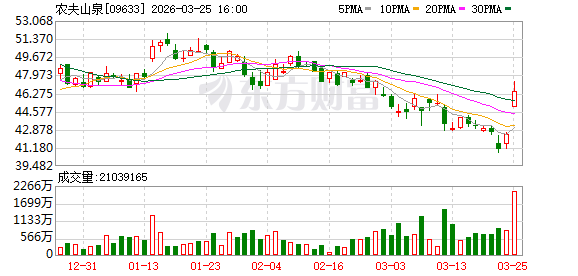
Core Viewpoint - Nongfu Spring has successfully returned to growth after overcoming challenges, achieving a revenue of 52.55 billion yuan in 2025, marking a 22.5% year-on-year increase, and a net profit of 15.87 billion yuan, up 30.9% from the previous year [2][4]. Financial Performance - The company reported a gross margin exceeding 60.5% and a net margin over 30%, the best levels since 2017, benefiting from lower raw material costs and controlled e-commerce channel sales [4]. - On March 25, 2025, following the financial report, Nongfu Spring's stock surged by 11.59%, closing at 46.88 HKD, a 10.27% increase [4]. Business Structure and Growth - Nongfu Spring's business is divided into five segments: packaged water, tea beverages, functional drinks, juice, and other products [6]. - Tea beverages have surpassed bottled water to become the largest business segment, generating 21.60 billion yuan in revenue, a 29% increase, and accounting for 41.1% of total revenue [7][8]. - The company's packaged water segment also returned to growth, with revenue of 18.71 billion yuan, a 17.3% increase, representing 35.6% of total revenue [11]. Market Position and Strategy - The brand "Dongfang Shuye" dominates the unsweetened tea market with a market share of 75%-80%, maintaining its leading position through strategic product launches and promotions [8]. - Despite a slowdown in growth for the unsweetened tea market, Nongfu Spring is expanding into the sweetened tea market with new products like "Ice Tea" [9]. - The company has made significant changes in its bottled water strategy, focusing on promoting red bottle water while phasing out green bottle water promotions [11]. Revenue Contribution - The combined revenue from bottled water and tea beverages accounts for over 76% of Nongfu Spring's total revenue [13]. - Functional drinks and juice segments also showed growth, with revenues of 5.76 billion yuan and 5.18 billion yuan, increasing by 16.8% and 26.7% respectively [13].