
NONGFU SPRING(09633)

Search documents
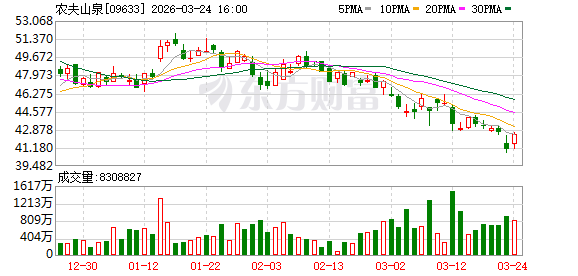
农夫山泉(09633.HK)2025年母公司拥有人应占溢利158.68亿元 同比增加30.9%
Ge Long Hui· 2026-03-24 16:27
Core Viewpoint - Nongfu Spring (09633.HK) reported a total revenue of RMB 52.553 billion for the fiscal year ending December 31, 2025, representing a year-on-year increase of 22.5% [1] - The net profit attributable to shareholders was RMB 15.868 billion, up 30.9% year-on-year, with basic earnings per share of RMB 1.411, also reflecting a 30.9% increase [1] - A final dividend of RMB 0.99 per ordinary share is proposed [1] Group 1 - The drinking water business of the company saw a revenue recovery, generating RMB 18.709 billion in 2025, which is a 17.3% increase compared to 2024 [1] - Since 1996, the company has adhered to the practice of building factories at water source locations for bottling [1] - In 2025, the company added three new water sources: Hunan Badagong Mountain, Sichuan Longmen Mountain, and Tibet Nyainqentanglha Mountain, bringing the total to sixteen premium water sources nationwide [1] Group 2 - The company has opened its factories to consumers, allowing them to experience the high-quality source assurance of Nongfu Spring [1] - The company emphasizes the importance of mineral elements in water for health and believes that the growth of the drinking water business will align with the establishment of consumer health drinking concepts [1] - As the company approaches its 30th anniversary in 2026, it aims to adopt a strategy of "stability, gradualness, and long-term vision" to build trust and foster a future of mutual prosperity with society [1]

饮料行业天花板再抬高!农夫山泉2025年营收首破500亿元,利润飙升30.9%
2 1 Shi Ji Jing Ji Bao Dao· 2026-03-24 14:55
Core Insights - The company reported a revenue of 52.553 billion yuan for the fiscal year 2025, marking a 22.5% increase and surpassing the 50 billion yuan threshold for the first time [2] - Profit reached 15.868 billion yuan, reflecting a growth of 30.9% [2] Group 1: Financial Performance - The financial report indicates that the company has not only quickly resumed growth but has also reached a new scale level [5] - The beverage industry is experiencing stock competition globally, yet the company achieved both revenue and profit growth, positioning itself as a "ceiling-level" entity in profitability [5] Group 2: Business Model and Strategy - The company's unique "water + beverage" dual-engine development model is credited for its success, with packaged water serving as a stabilizing force and beverages acting as a growth driver [5] - The company maintains the largest market share in China's packaged drinking water sector, with a 17.3% growth in its drinking water business compared to the same period in 2024 [5][11] Group 3: Supply Chain and Efficiency - The company has established a stable connection between water sources and consumer markets through a well-developed water supply system and production network [8] - The average transportation radius for single factories reaches 500 kilometers, yet overall efficiency continues to improve due to large-scale layout [8] Group 4: Product Innovation - The tea beverage segment saw a revenue increase of 29%, surpassing 20 billion yuan, while functional and juice beverages recorded double-digit growth rates of 16.8% and 26.7%, respectively [11] - The company's strategy of "slow innovation" focuses on early positioning and waiting for consumer habits to mature, allowing it to cover various demographics and consumption scenarios [12] Group 5: Management and Organizational Development - The new management team, praised for their maturity and ability to withstand public scrutiny, signifies a shift from founder-driven to team-driven leadership [14] - The establishment of a mature talent cultivation system within the company indicates its internal strength and capability to navigate challenges [15]

农夫山泉2025年净利润飙升30.9%,拒绝低价内卷,深耕线下换取高质量增长
Jin Rong Jie· 2026-03-24 14:22
Core Viewpoint - The company achieved significant growth in both revenue and net profit despite challenges in the domestic bottled water industry, indicating a successful differentiation strategy in a competitive market [1][2]. Group 1: Financial Performance - The company reported a revenue of 52.553 billion yuan, representing a year-on-year increase of 22.5% [1]. - The net profit attributable to shareholders was 15.868 billion yuan, reflecting a year-on-year growth of 30.9% [1]. - The net profit growth rate outpaced revenue growth, indicating improved profitability [2]. Group 2: Market Conditions - The bottled water price index has been on a downward trend since January 2024, with significant price pressure observed during the summer peak season [1]. - The industry is facing increased competition, leading to a price war where manufacturers are adopting a "price for volume" strategy [1]. - Average net profit margins in the industry have declined compared to the previous year, signaling weakened growth momentum [1]. Group 3: Strategic Approach - The company has effectively controlled the proportion of e-commerce sales to stabilize pricing within its distribution network, ensuring profitability [1]. - The company maintains a long-term e-commerce sales ratio of around 5%, focusing on offline channels to avoid downward price pressure from online platforms [1]. - The stable channel relationships of the company's distributors are approximately 1.5 to 2 times the industry average, supporting the company's performance growth [2].
农夫山泉发布2025年财报,饮料行业天花板再抬高!
Nan Fang Du Shi Bao· 2026-03-24 13:05
Core Insights - The company reported a revenue of 52.553 billion yuan for the fiscal year 2025, marking its first time surpassing the 50 billion yuan threshold, with a profit of 15.868 billion yuan, reflecting a growth of 30.9% [2] - Despite the global beverage industry entering a phase of stock competition, the company achieved both revenue and profit growth, establishing itself as a "ceiling-level" presence in profitability within the industry [2] Group 1: Water Business - The core capability of the company remains in its water business, which has seen a 17.3% growth compared to the same period in 2024, maintaining its position as the market leader in China's packaged drinking water sector [3] - The company has established 16 premium water sources across the country, with new sources added in Hunan, Sichuan, and Tibet in 2025, and another in Yunnan planned for 2026 [3] - The company's extensive water supply and production network has created a stable connection between water sources and consumer markets, enhancing overall efficiency despite long transportation distances [3][4] Group 2: Beverage Innovation - The beverage segment, which includes tea drinks, functional drinks, and juices, has shown significant growth, with tea beverage revenue increasing by 29% to over 20 billion yuan, and functional drinks and juices growing by 16.8% and 26.7% respectively [5] - The company's strategy of "slow innovation" focuses on early positioning in the market and waiting for consumer habits to mature, allowing it to capitalize on trends such as the shift towards low-sugar beverages [6] - The diverse product portfolio enables the company to meet basic needs while also catering to personalized consumption, enhancing store efficiency and shelf share [6] Group 3: Management and Stability - The company is transitioning from a "founder-driven" model to a "team-driven" approach, with a management team that has grown from the ground up and is well-versed in the company's culture and business logic [7] - This new management team is seen as a sign of the company's mature talent development system and its ability to navigate challenges effectively [7] - The company's operational philosophy emphasizes stability and long-term vision, which is viewed as a key factor in its ability to weather economic cycles and enter a new phase of stability and growth potential [7]
营收突破500亿元,农夫山泉何以再度“翻盘”?
Nan Fang Du Shi Bao· 2026-03-24 13:05
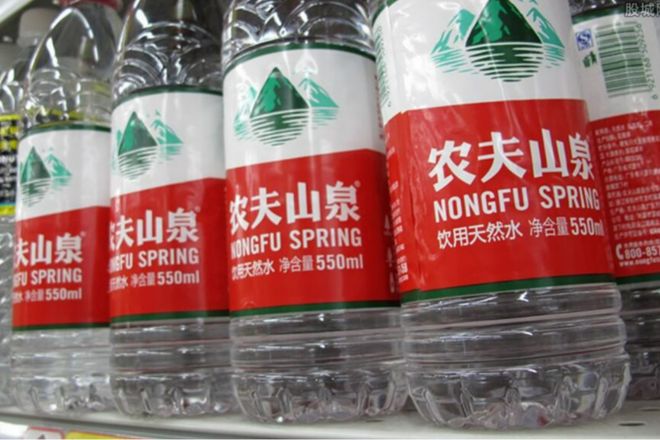
Core Insights - In 2025, the company achieved a revenue exceeding 50 billion yuan for the first time, with a net profit growth of over 30.9% year-on-year, marking a significant recovery from the brand crisis faced in 2024 [2][3] - The company's strategy focuses on product quality and consumer trust, emphasizing the differentiation of its bottled water through a commitment to natural sources rather than industrial standards [3][5] Group 1: Bottled Water Business - The bottled water segment saw a recovery in 2025, driven by a shift in consumer perception rather than price wars or channel subsidies [3] - The company has increased the visibility of its water sources through various marketing strategies, including labeling and public tours, to counteract emotional skepticism [3][4] - The long-term strategy involves significant investment in water source infrastructure, with 16 water sources established nationwide, creating a resource-based competitive advantage [4] Group 2: Tea Beverage Segment - The core brand, Dongfang Shuye, dominated the sugar-free tea market in 2025, benefiting from the rapid growth of this beverage category [6] - The company has successfully positioned itself in the ready-to-drink Longjing tea market, leveraging its industrial capabilities and long-term investments in tea sourcing [8][9] - The company adopts a restrained approach by limiting the production of Longjing tea to specific seasons, ensuring quality and maintaining brand integrity [9] Group 3: Product-Centric Strategy - The company is recognized as a "consumer white horse stock," but operates more like a product-focused company, emphasizing quality over rapid market entry [10] - Its product matrix, including natural water and various tea products, has shown resilience across market cycles, providing stability against external shocks [11] - The recovery in 2025 is seen as a validation of the company's long-term commitment to product quality and operational excellence, rather than a mere reaction to market fluctuations [11]
农夫山泉:2025年度实现营收525.53亿元,同比增长22.51%
Bei Jing Shang Bao· 2026-03-24 12:24
北京商报讯(记者 孔文燮)3月24日,农夫山泉披露的2025年报显示,报告期内实现营收约为525.53亿 元,同比增长22.51%;实现归母净利润约为158.68亿元,同比增长30.89%。其中,茶饮料板块营收增长 近29%,达到215.96亿元;功能饮料与果汁饮料分别录得16.8%与26.7%的双位数高增长。农夫山泉创始 人钟睒睒在业绩公告中表示,"2025年公司饮用水业务已恢复增长,比2024年同期增长17.3%。目前, 农夫山泉继续稳居中国包装饮用水市场占有率第一的位置"。据了解,2025年,农夫山泉新增湖南八大 公山、四川龙门山、西藏念青唐古拉山三个水源地,2026年又再新增云南轿子雪山水源地。目前,农夫 山泉已在全国布局16个优质水源地。 ...
农夫山泉去年净利润158.7亿元,拟分红111亿元
Xin Lang Cai Jing· 2026-03-24 11:56
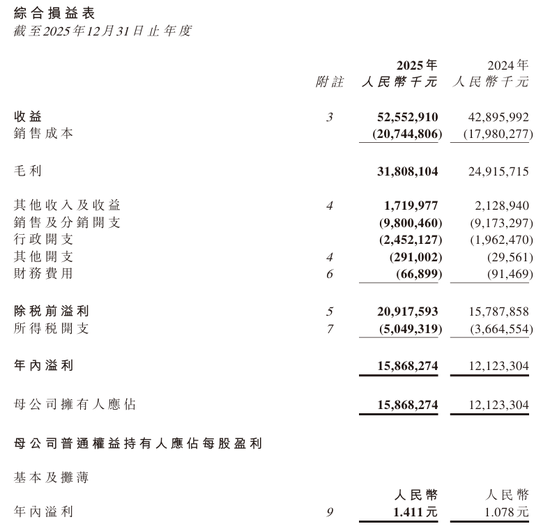
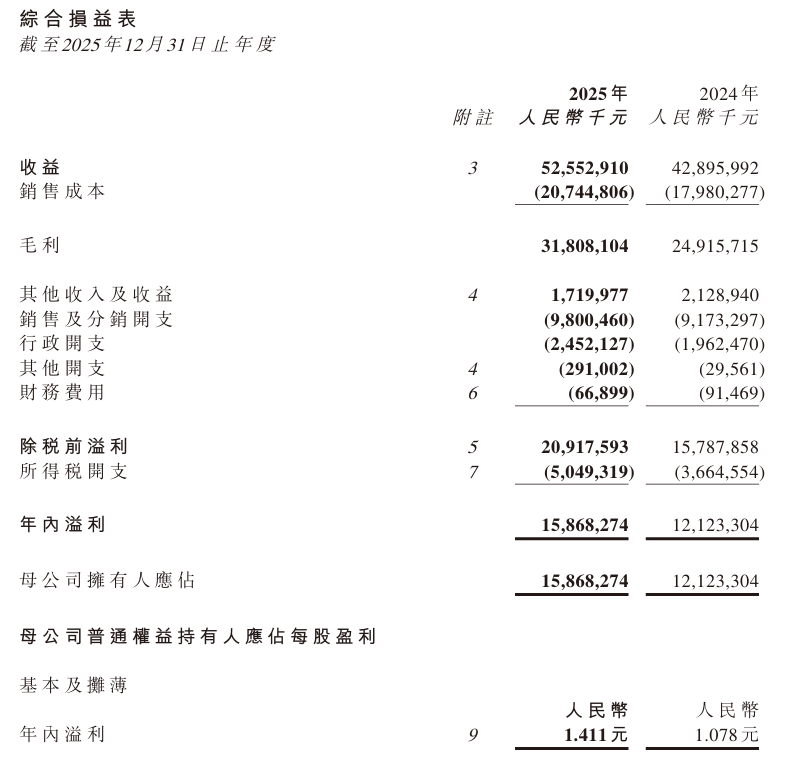
Core Viewpoint - Nongfu Spring (09633.HK) reported a significant increase in revenue and net profit for the year 2025, with revenue reaching RMB 52.55 billion, a year-on-year growth of 22.5%, and net profit at RMB 15.87 billion, growing by 30.9% [1][4]. Financial Performance - The total revenue for 2025 was RMB 52,552.91 million, compared to RMB 42,895.99 million in 2024 [2][5]. - The cost of sales for 2025 was RMB 20,744.81 million, up from RMB 17,980.28 million in 2024 [2][5]. - Gross profit for 2025 was RMB 31,808.10 million, an increase from RMB 24,915.72 million in 2024 [2][5]. - Other income and gains for 2025 were RMB 1,719.98 million, down from RMB 2,128.94 million in 2024 [2][5]. - Selling and distribution expenses were RMB 9,800.46 million in 2025, compared to RMB 9,173.30 million in 2024 [2][5]. - Administrative expenses increased to RMB 2,452.13 million in 2025 from RMB 1,962.47 million in 2024 [2][5]. - Profit before tax was RMB 20,917.59 million for 2025, up from RMB 15,787.86 million in 2024 [2][5]. - Income tax expense for 2025 was RMB 5,049.32 million, compared to RMB 3,664.55 million in 2024 [2][5]. - The net profit attributable to the parent company was RMB 15,868.27 million in 2025, up from RMB 12,123.30 million in 2024 [2][5]. Product Segmentation - In 2025, the revenue from packaged water products accounted for 35.6% of total revenue, while beverage products contributed 63.9% [2][5]. Market Positioning - Nongfu Spring achieved high growth rates that significantly exceeded industry averages, attributed to product premiumization and deeper market penetration despite a slowdown in the packaged water sector and intensified competition in tea and juice segments [3][6].
农夫山泉:2025年净利润158.7亿元 同比增长30.9%
Di Yi Cai Jing· 2026-03-24 11:50
Core Insights - The company reported a total revenue of 52.55 billion yuan for the year 2025, representing a year-on-year growth of 22.5% [1] - The net profit for the year reached 15.87 billion yuan, showing a year-on-year increase of 30.9% [1] - The basic earnings per share were 1.411 yuan, which is a 30.9% increase compared to the previous year [1]
农夫山泉2025年净利润超158亿元!拟现金分红111.34亿元
Sou Hu Cai Jing· 2026-03-24 11:33
Core Viewpoint - Nongfu Spring (09633.HK) reported a significant growth in revenue and net profit for the year 2025, indicating strong performance despite industry challenges [1] Financial Performance - Revenue for 2025 reached RMB 52.55 billion, a year-on-year increase of 22.5% compared to RMB 42.90 billion in 2024 [2] - Net profit for 2025 was RMB 15.87 billion, reflecting a 30.9% increase from RMB 12.12 billion in 2024 [2] - The earnings per share for 2025 was RMB 1.411, up from RMB 1.078 in 2024 [2] Dividend Distribution - The company declared a final dividend of RMB 0.99 per share, totaling approximately RMB 11.13 billion in dividends [1] - The dividend payout ratio is around 70% [1] Market Position and Strategy - Despite a slowdown in the packaged water industry and intensified competition in tea and juice segments, Nongfu Spring achieved performance well above industry averages through product premiumization and deeper market penetration [1] - The net profit growth rate of 30.9% significantly outpaced revenue growth, indicating enhanced economies of scale and cost control capabilities [1]
农夫山泉:2025全年营收525.5亿元 同比增长22.5%
Xin Lang Cai Jing· 2026-03-24 11:20
【农夫山泉:2025全年营收525.5亿元 同比增长22.5%】智通财经3月24日电,农夫山泉2025全年营收 525.5亿元,同比增长22.5%,预估505.3亿元; 全年净利润158.7亿元,同比增长30.9%,预估149.9亿 元;每股基本盈利为1.411元,同比增加30.9%;每股末期股息0.99元。 转自:智通财经 ...