ZAI LAB(09688)

Search documents
医药股表现强势 机构称药品关税对产业链影响有限 后续关注ESMO大会等催化剂
Zhi Tong Cai Jing· 2025-09-30 03:56
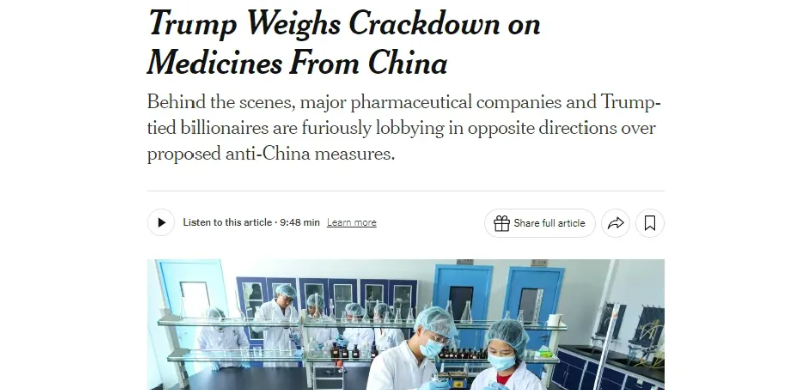
Core Viewpoint - The recent announcement by Trump regarding a 100% tariff on all brand/patent drugs starting in October has led to a strong performance in the pharmaceutical sector, particularly among Chinese innovative drug companies, which are not expected to be significantly impacted by this policy [1][1]. Group 1: Stock Performance - Chinese pharmaceutical stocks have shown strong gains, with Heptares Therapeutics (02142) up 8.2% to HKD 15.71, Zai Lab (09688) up 6.83% to HKD 26.6, Innovent Biologics (09969) up 6.61% to HKD 18.87, and WuXi AppTec (603259) (02359) up 5.37% to HKD 115.7 [1][1]. Group 2: Tariff Impact Analysis - Trump's tariff policy applies only to brand/patent drugs and excludes generic drugs, biosimilars, and active pharmaceutical ingredients (APIs) [1][1]. - According to CMB International, the impact on China's innovative drug industry chain is limited, and there is no need for excessive concern [1][1]. - Most Chinese companies have either established production capacity in the U.S. or outsourced production to local Contract Manufacturing Organizations (CMOs), which mitigates the immediate impact of the tariffs [1][1]. Group 3: Export Dynamics - The majority of Chinese innovative drugs exported are in the form of APIs or raw herbal extracts, which are not affected by the new tariff policy, while the proportion of finished drug exports remains low [1][1]. - The investment timeline for multinational corporations (MNCs) to build factories in the U.S. will take time, leading to limited direct impact on CXO orders in the short term [1][1]. Group 4: Future Catalysts - Upcoming catalysts include the ESMO conference scheduled for mid to late October and the results of the medical insurance negotiations along with the first version of the commercial insurance innovative drug catalog expected to be announced in October to November [1][1].

港股异动 | 医药股表现强势 机构称药品关税对产业链影响有限 后续关注ESMO大会等催化剂
智通财经网· 2025-09-30 03:43
Core Viewpoint - The pharmaceutical sector is experiencing strong performance, with notable stock increases for several companies following Trump's announcement of a 100% tariff on all brand/patent drugs starting in October, which is not applicable to generic drugs, biosimilars, and active pharmaceutical ingredients (APIs) [1] Group 1: Stock Performance - Companies such as HAPO (02142) saw an 8.2% increase, trading at HKD 15.71; Zai Lab (09688) rose by 6.83% to HKD 26.6; Innovent Biologics (09969) increased by 6.61% to HKD 18.87; WuXi AppTec (02359) gained 5.37%, reaching HKD 115.7 [1] Group 2: Tariff Impact Analysis - The new tariff policy is expected to have a limited impact on China's innovative drug industry, as most companies have either established production capacity in the U.S. or outsourced manufacturing to local Contract Manufacturing Organizations (CMOs) [1] - The majority of Chinese innovative drugs exported are in the form of APIs or raw biological extracts, which are not affected by the new tariffs, while the export ratio of finished dosage forms is relatively low [1] Group 3: Future Catalysts - Upcoming catalysts include the ESMO conference scheduled for mid to late October, and the results of medical insurance negotiations along with the first version of the commercial insurance innovative drug catalog expected to be released between October and November [1]

申万宏源:首予再鼎医药“买入”评级 目标价35.2港元
Zhi Tong Cai Jing· 2025-09-24 01:59
Core Viewpoint - The report from Shenwan Hongyuan indicates that Zai Lab (09688) is expected to achieve non-GAAP operating profit by Q4 2025, driven by the commercialization of products and localized production [1] Financial Projections - Revenue projections for Zai Lab from 2025 to 2027 are estimated at $553 million, $802 million, and $1.203 billion respectively, with net profit attributable to the parent company expected to be -$134 million, $15 million, and $173 million for the same years [1] - The target price set at HKD 35.2 implies a 39% upside potential, reflecting confidence in the company's innovative pipeline [1] Product Portfolio and Commercialization - Zai Lab is a global biopharmaceutical company in the commercialization stage, with seven products approved in China, including four oncology products and one immunology product [2] - Since the approval of its first commercial product, Niraparib, in 2019, Zai Lab has seen significant sales growth, with total revenue projected to reach $399 million in 2024, a 50% increase year-on-year [3] New Product Development - The company has submitted applications for new products, including KarXT and TF ADC, to the NMPA, with plans to submit for Bemarituzumab for 1L gastric cancer in the second half of the year [3] - Zai Lab anticipates revenue could reach $2 billion by 2028, supported by the sales of existing products and the approval of new products [3] Expansion of Indications - Efgartigimod, the first FcRn antagonist globally, has received approvals for multiple indications, with sales expected to reach $94 million in 2024, reflecting an 835% year-on-year growth [4] - The company is exploring additional indications for Efgartigimod, which could broaden its market reach across various medical fields [4] Global Pipeline Development - Zai Lab is actively expanding its global pipeline, focusing on ADCs and bispecific antibodies, with several products showing potential for first-in-class (FIC) or best-in-class (BIC) status [5] - The company plans to initiate global pivotal studies for ZL-1310, which has shown promising clinical activity and safety [5]

申万宏源:首予再鼎医药(09688)“买入”评级 目标价35.2港元
智通财经网· 2025-09-24 01:57
Core Viewpoint - Zai Ding Pharma is expected to achieve non-GAAP operating profit by Q4 2025, driven by the commercialization of products and localized production [1] Financial Projections - Revenue projections for Zai Ding Pharma are $553 million, $802 million, and $1.203 billion for 2025, 2026, and 2027 respectively [1] - Net profit projections for the company are -$134 million, $15 million, and $173 million for 2025, 2026, and 2027 respectively [1] - The target price is set at HKD 35.2, indicating a potential upside of 39% [1] Product Portfolio and Pipeline - Zai Ding Pharma has seven products approved for sale in China, including four oncology products, one immunology product, and two infectious disease products [2] - The company has seen a 50% year-on-year revenue growth in 2024, reaching $399 million, primarily due to the sales increase of existing products [3] - New product applications have been submitted to NMPA, with expectations for further approvals in the near future [3] Key Product Developments - Efgartigimod (艾加莫德) is being explored for additional indications beyond its current approvals, with significant sales growth anticipated [4] - The product is expected to generate $94 million in domestic sales in 2024, reflecting an 835% increase [4] Global Pipeline Expansion - The company is actively expanding its global pipeline, focusing on ADCs and bispecific antibodies [5] - ZL-1310 has received Fast Track designation from the FDA, with positive clinical data expected to be presented at the 2025 ASCO annual meeting [5] - The company plans to initiate global pivotal studies for ZL-1310 in the near future [5]
再鼎医药(09688):差异化创新管线布局,有望迎来盈利拐点
Shenwan Hongyuan Securities· 2025-09-23 14:02
Investment Rating - The report initiates coverage with a "Buy" rating for the company [5][11]. Core Insights - The company is positioned to reach a profitability inflection point due to its differentiated innovative pipeline and ongoing commercialization of its products [2][13]. - The company expects significant revenue growth, projecting revenues of $3.99 billion in 2024, $5.53 billion in 2025, $8.02 billion in 2026, and $12.03 billion in 2027, with a potential revenue of $2 billion by 2028 [2][5][11]. Summary by Sections Product Pipeline and Commercialization - The company has seven products approved for sale in China, including four oncology products, one immunology product, and two infectious disease products [2][27]. - The core products are experiencing strong sales growth, with a projected revenue increase of 50% year-over-year in 2024, driven by products like Weiwei Jia and Niu Zai Le [2][30]. - The company has submitted applications for new products, including KarXT and TF ADC, and anticipates further submissions for other products [2][12]. Financial Projections - The company forecasts revenues of $5.53 billion, $8.02 billion, and $12.03 billion for 2025, 2026, and 2027, respectively, with net profits expected to turn positive by 2027 [5][11]. - The report indicates that the company will achieve non-GAAP operating profit by Q4 2025, supported by local production and increasing product sales [41]. Market Position and Valuation - The company's current stock price reflects a valuation of 7 times the 2025 price-to-sales ratio, compared to an average of 18 times for comparable companies, indicating attractive valuation [11]. - The target price is set at HKD 35.2, representing a 39% upside potential from the current price [5][11]. Key Product Highlights - Efgartigimod (艾加莫德) is expected to become a leading product in the autoimmune field, with significant sales growth projected due to new indications and formulations [3][12]. - ZL-1310 (DLL3 ADC) has shown promising clinical data and is expected to enter critical global studies [4][38]. - The company is actively expanding its global pipeline, focusing on ADCs and bispecific antibodies, with multiple products in various stages of clinical development [4][38].
大摩:市场对生物科技股认可度提升 推动股价跑赢大市 看好康方生物等
Zhi Tong Cai Jing· 2025-09-23 02:06
Group 1 - The core point of the article highlights that the total market capitalization of Chinese biotech stocks listed in Hong Kong has increased by 154% year-to-date, significantly outperforming the Hang Seng Index's 34% rise, indicating a major shift in market recognition of local pharmaceutical companies' innovation capabilities [1] - The report anticipates that the Federal Reserve's accelerated interest rate cuts will enhance risk appetite, directing funds towards growth sectors such as Chinese biotechnology [1] - However, the performance of individual stocks is expected to depend on company fundamentals, including commercialization execution and innovation research progress [1] Group 2 - The report expresses optimism for companies with short-term catalysts, specifically naming Kangfang Biotech (09926), Nuo Cheng Jian Hua (09969), and others as potential beneficiaries [1] - Additionally, it assigns an "outperform" rating to Weisheng Pharmaceutical-B (02561) and Zai Lab (09688) [1]

大摩:市场对生物科技股认可度提升 推动股价跑赢大市 看好康方生物(09926)等
智通财经网· 2025-09-23 02:02
Group 1 - The total market capitalization of Chinese biotech stocks listed in Hong Kong has increased by 154% year-to-date, significantly outperforming the Hang Seng Index's 34% rise, indicating a major shift in market recognition of local pharmaceutical companies' innovation capabilities [1] - The expectation of the Federal Reserve accelerating interest rate cuts is anticipated to boost risk appetite, directing funds towards growth sectors such as Chinese biotech [1] - Individual stock performance will still depend on company fundamentals, including commercialization execution and innovation research progress [1] Group 2 - Companies with short-term catalysts that are favored include Kangfang Biotech (09926), Innovent Biologics (09969), Huyou-B (02256), Sinopharm (01801), and Eucure Biopharma-B (09606) [1] - Morgan Stanley has given "outperform" ratings to Weisheng Pharmaceutical-B (02561) and Zai Lab (09688) [1]
港股创新药ETF(159567)涨1.50%,成交额12.63亿元
Xin Lang Cai Jing· 2025-09-22 11:50
Group 1 - The Hong Kong Innovative Drug ETF (159567) closed with a gain of 1.50% on September 22, with a trading volume of 1.263 billion yuan [1] - The fund was established on January 3, 2024, with a management fee of 0.50% and a custody fee of 0.10% [1] - As of September 19, 2024, the fund's latest share count was 8.17 billion shares, with a total size of 7.676 billion yuan, reflecting a year-to-date increase of 1966.38% in shares and 1931.78% in size compared to December 31, 2023 [1] Group 2 - The current fund manager is Ma Jun, who has managed the fund since its inception, achieving a return of 87.92% during the management period [2] - The top holdings of the fund include Innovent Biologics (9.52%), WuXi Biologics (9.47%), BeiGene (8.73%), and others, with their respective market values and share counts detailed [2] - The cumulative trading amount over the last 20 trading days reached 37.235 billion yuan, with an average daily trading amount of 1.862 billion yuan [1][2]

港股创新药ETF(159567)跌1.27%,成交额12.58亿元
Xin Lang Cai Jing· 2025-09-19 12:24
Core Viewpoint - The Hong Kong Innovative Drug ETF (159567) has shown significant growth in both share volume and fund size since its inception, indicating strong investor interest in the innovative drug sector [1][2]. Fund Performance - As of September 18, 2024, the fund's share volume reached 8.17 billion shares, with a total size of 7.839 billion yuan, reflecting an increase of 1966.38% in share volume and 1974.81% in size compared to its initial figures on December 31, 2023 [1]. - The fund manager, Ma Jun, has achieved a return of 90.14% since taking over management on January 3, 2024 [2]. Trading Activity - The ETF recorded a trading volume of 12.58 billion yuan on September 19, 2024, with an average daily trading amount of 18.71 billion yuan over the last 20 trading days [1]. - Year-to-date, the ETF has accumulated a total trading amount of 206.404 billion yuan over 176 trading days, averaging 11.73 billion yuan per day [1]. Top Holdings - The ETF's major holdings include: - Innovent Biologics (9.52% holding, 263 million yuan market value) - WuXi Biologics (9.47% holding, 258 million yuan market value) - BeiGene (8.73% holding, 238 million yuan market value) - CanSino Biologics (7.62% holding, 208 million yuan market value) - China National Pharmaceutical Group (7.17% holding, 196 million yuan market value) [2].
中国创新药企“闯美”,如何预防政策风险?
Hu Xiu· 2025-09-18 06:03
Core Viewpoint - The Trump administration is drafting an executive order that will impose three major restrictions on commercial transactions involving Chinese innovative drug patents or rights, focusing on national security reviews by the Committee on Foreign Investment in the United States (CFIUS) [1][2]. Summary by Sections Executive Order Details - The draft includes three main provisions: 1. Inclusion of Chinese innovative drug BD transactions in the CFIUS mandatory review list, ending the previous "low-risk automatic exemption" practice [2]. 2. FDA will implement "racial sensitivity supplementary reviews" for drugs relying on Chinese clinical data, requiring at least 20% comparative data from non-Asian populations [2]. 3. Establishment of a "key drug domestic production fund" to provide production subsidies for 15 categories of drugs, including antibiotics and acetaminophen, while implementing a "domestic priority" principle in federal procurement [2]. Market Reaction - The market reacted swiftly to the policy risks, with the Hong Kong innovative drug index (HK1105) dropping 3.82% on September 11, 2025, and the A-share innovative drug sector (BK1106) declining 2.17%, with over 80% of stocks in the sector experiencing pullbacks [3]. - The following day, the indices showed signs of recovery, indicating investors' responses to policy uncertainties and rational corrections [3]. Globalization Trends - Despite the geopolitical risks, the trend of Chinese innovative drugs going global remains intact, with total license-out transactions to Europe and the U.S. reaching $9.43 billion as of September 2025 [3]. - Major transactions include a $950 million licensing deal between BeiGene and Royalty Pharma, and a $6 billion global licensing agreement between 3SBio and Pfizer, highlighting a shift towards milestone payments and regional licensing [3]. Industry Challenges - The domestic market faces challenges, with annual growth in medical insurance fund spending (approximately 12%) lagging behind the growth in innovative drug R&D investment (approximately 25%) [4]. - The average reduction in medical negotiations remains high at 54%, and commercial health insurance coverage for innovative drugs is below 15%, creating a supply-demand imbalance that necessitates going global [4]. Risk Resilience Assessment - Goldman Sachs has categorized Chinese innovative drug companies into three risk resilience tiers based on their sensitivity to policy changes and operational capabilities [4][5]. - Companies with mature global layouts exhibit the strongest resilience, while those heavily reliant on domestic markets show the weakest resilience [5][10]. Strategic Defense Framework - A three-dimensional defense system is proposed to address risks associated with the executive order, focusing on transaction review, data compliance, and supply chain security [13]. - Strategies include conducting national security risk pre-assessments for transactions over $50 million and establishing partnerships with U.S. law firms to navigate regulatory challenges [14][15]. Conclusion - The construction of a quantifiable "risk resilience index" is essential for Chinese innovative drugs in the global 2.0 era, emphasizing the need for companies to embed policy hedging clauses in transaction structures and consider racial diversity data in clinical stages [23].