
LEAPMOTOR(09863)

Search documents
港股公告掘金 | 中国软件国际携手深开鸿与奕斯伟计算达成战略合作 共建“开源鸿蒙+RISC-V”双开源数字基础设施新生态
Zhi Tong Cai Jing· 2025-11-17 15:26
Major Events - Shandong Xinhua Pharmaceutical Co., Ltd. received the approval notice for the listing application of fumaric acid vonoprazan chemical raw materials [1] - HeYue Pharmaceutical showcased long-term efficacy and safety data from the clinical III MANEUVER study of pitmiprazole at the CTOS 2025 conference [1] - China Software International partnered with Deep Open Hong and Yiswei Computing to build a new ecosystem for "open-source HarmonyOS + RISC-V" digital infrastructure [1] - China General Nuclear Power Corporation's Zhaoyuan Unit 1 is set to begin full construction [1] - Hengrui Medicine's fumaric acid teglutide injection received approval for clinical trials [1] - China National Nuclear Corporation signed an intention procurement agreement for cobalt-60 irradiation sources with the Brazilian National Nuclear Energy Commission [1] Operating Performance - China Railway Construction Corporation recently won several major projects with a total investment of 49.629 billion yuan [1] - Geely Automobile reported a net profit of 3.82 billion yuan for the third quarter, a year-on-year increase of 59% [1] - China Resources Power's subsidiary power plants achieved a cumulative electricity sales volume of 185 million megawatt-hours in the first ten months, a year-on-year increase of 6.5% [1] - Leap Motor reported a net profit of 150 million yuan for the third quarter, maintaining the top sales position among new force brands in China for eight consecutive months [1] - Huazhu Group's net profit attributable to shareholders for the third quarter was 1.5 billion yuan, a year-on-year growth of 15.4% [1] - Air China saw a year-on-year increase of 8.7% in passenger turnover in October [1] - China Eastern Airlines reported a year-on-year increase of 10.58% in passenger turnover in October [1]


零跑汽车(09863.HK)与杭州珀尔签充电桩等采购协议
Ge Long Hui· 2025-11-17 15:08
Core Viewpoint - Leapmotor (09863.HK) has entered into a framework agreement with Hangzhou Pearl for the procurement of charging equipment, enhancing service convenience and overall user experience [1] Group 1: Agreement Details - The agreement allows Leapmotor to procure various charging products, including AC charging piles and charging guns, from Hangzhou Pearl [1] - The partnership aims to optimize the procurement system and improve service efficiency and market responsiveness [1] Group 2: Supplier Advantages - Hangzhou Pearl is recognized for its stable product quality and reliable supply capabilities, effectively meeting Leapmotor's demand for satisfactory products [1] - The products offered by Hangzhou Pearl are more cost-effective in terms of price and performance compared to other independent third-party suppliers, aiding Leapmotor in controlling procurement costs [1]

零跑汽车(09863) - 持续关连交易 (1)修订新產品购销框架协议之年度上限 (2)配套產品採购...
2025-11-17 14:55
香港交易及結算所有限公司及香港聯合交易所有限公司對本公告的內容概不負責,對其準確性 或完整性亦不發表任何聲明,並明確表示,概不對因本公告全部或任何部分內容而產生或因倚 賴該等內容而引致的任何損失承擔任何責任。 ZHEJIANG LEAPMOTOR TECHNOLOGY CO., LTD. 浙江零跑科技股份有限公司 茲提述本公司日期為2024年12月24日及2025年1月28日之公告,內容有 關本公司與華昱欣科技訂立的新產品購銷框架協議及其項下之持續關連交 易。除另有界定外,本公告所用詞彙與該公告所界定者具有相同涵義。 於2025年11月17日,本公司與華昱欣科技訂立新產品購銷框架協議之補充 協議,以修訂新產品購銷框架協議項下2025年及2026年之年度上限。除修 訂現有年度上限外,新產品購銷框架協議項下的所有其他條款維持不變。 (2) 配套產品採購框架協議 於2025年11月17日,本公司與杭州珀爾訂立配套產品採購框架協議,據 此,本公司不時向杭州珀爾採購車輛配套的充電樁和充電槍等產品,包括 交流充電樁、交流充電槍總成、放電槍╱放電插座等。 (3) 上市規則的涵義 (於中華人民共和國註冊成立的股份有限公司) ...
零跑汽车:提名Davide Mele为非执行董事
Zhi Tong Cai Jing· 2025-11-17 14:35
零跑汽车(09863)发布公告,董事会收到股东Stellantis集团提议,因Douglas Ostermann先生职务变动,建 议免去Douglas Ostermann先生作为第二届董事会非执行董事的职务,同时提名Davide Mele先生为第二 届董事会非执行董事。 ...
零跑汽车(09863.HK):建议提名Davide Mele为非执行董事
Ge Long Hui· 2025-11-17 14:30
格隆汇11月17日丨零跑汽车(09863.HK)宣布,董事会收到股东Stellantis集团提议,因Douglas Ostermann 职务变动,建议免去Douglas Ostermann作为第二届董事会非执行董事的职务,同时提名Davide Mele为 第二届董事会非执行董事。 ...
零跑汽车(09863):提名Davide Mele为非执行董事
智通财经网· 2025-11-17 14:30
Core Viewpoint - Leap Motor (09863) announced that its board received a proposal from shareholder Stellantis Group to remove Douglas Ostermann from his position as a non-executive director of the second board due to a change in his role, and to nominate Davide Mele as a new non-executive director for the second board [1] Group 1 - The board of Leap Motor received a proposal from Stellantis Group regarding a change in directorship [1] - Douglas Ostermann is suggested to be removed from his position as a non-executive director [1] - Davide Mele is proposed as the new non-executive director for the second board [1]
零跑汽车(09863) - 建议更换非执行董事;及建议修订公司章程
2025-11-17 14:17
香港交易及結算所有限公司及香港聯合交易所有限公司對本公告的內容概不負責,對其準確性 或完整性亦不發表任何聲明,並明確表示,概不對因本公告全部或任何部分內容而產生或因倚 賴該等內容而引致的任何損失承擔任何責任。 ZHEJIANG LEAPMOTOR TECHNOLOGY CO., LTD. Davide Mele先生之履歷詳情載列如下: 浙江零跑科技股份有限公司 (於中華人民共和國註冊成立的股份有限公司) (股份代號:9863) 建議更換非執行董事; 及 建議修訂公司章程 建議更換非執行董事 浙江零跑科技股份有限公司(「本公司」)董事(「董事」)會(「董事會」)宣佈,董事 會收到股東Stellantis集團提議,因Douglas Ostermann先生職務變動,建議免去 Douglas Ostermann先生作為第二屆董事會非執行董事的職務,同時提名Davide Mele先生為第二屆董事會非執行董事。 於本公告日期,董事會決議建議免去Douglas Ostermann先生作為第二屆董事會非 執行董事的職務,同時提名Davide Mele先生為第二屆董事會非執行董事候選人, 惟需待本公司股東於股東大會上批准後方可 ...
连续季度盈利销量翻倍增长 零跑汽车三季度交出高质量发展答卷
Zheng Quan Ri Bao Wang· 2025-11-17 13:57
Core Insights - Zhejiang Leapmotor Technology Co., Ltd. (Leapmotor) reported a net profit of 150 million yuan for Q3 2025, marking continuous quarterly profitability [1] - The company delivered 173,852 new vehicles, achieving a 101.8% increase compared to the same period in 2024, and generated revenue of 19.45 billion yuan, up 97.3% year-on-year [1] - Leapmotor's gross margin improved significantly to 14.5%, and the company has a strong cash position of 33.92 billion yuan, maintaining positive operating and free cash flow [1] Product Development - Leapmotor has launched multiple new models to enhance its product matrix, including the C11, B01, Lafa5, and D19, catering to diverse consumer needs [2][3] - The C11 has sold approximately 300,000 units since its launch in 2021, while the B01 has consistently sold over 10,000 units monthly since its release [2] - The D19, positioned as a flagship model, aims to redefine the value standards for full-size SUVs priced around 300,000 yuan [2] Global Expansion - In Q3 2025, Leapmotor exported 17,397 vehicles, leading the new energy vehicle sector in overseas sales, with a total of 37,772 units exported from January to September [4] - The company has established over 700 sales and service points across approximately 30 international markets, with significant presence in Europe and the Asia-Pacific region [4] - Leapmotor's B10 model debuted in Europe, with over 1,000 orders received in October, and the company is expanding into the South American market with new launches in Brazil [4][5] Service Network and Customer Experience - As of September 30, 2025, Leapmotor's sales and service network covers 292 cities with 866 sales outlets and 493 service centers [6] - The company has implemented a "fast response" service model, improving repair efficiency and parts delivery, with a 30.26% increase in single-store efficiency [6] - Leapmotor has launched a circular manufacturing center to promote resource reuse and reduce carbon emissions, aligning with national carbon neutrality goals [7]
零跑汽车三季度交付17.39万台,连续8月居新势力榜首
Xin Lang Ke Ji· 2025-11-17 13:32
Core Insights - Leapmotor delivered 173,852 vehicles in Q3 2025, leading the sales among new energy vehicle brands in China, representing a 101.8% increase compared to the same period in 2024 [1] - The company has maintained its position as the monthly sales champion among new energy brands in China for eight consecutive months, with October's deliveries surpassing 70,289 units [1][7] Financial Performance - The net profit for Q3 2025 was RMB 150 million, with a total net profit of RMB 180 million for the first three quarters of 2025 [7] - The gross profit margin for Q3 2025 was 14.5%, an increase of 0.9 percentage points from Q2 2025 [7]

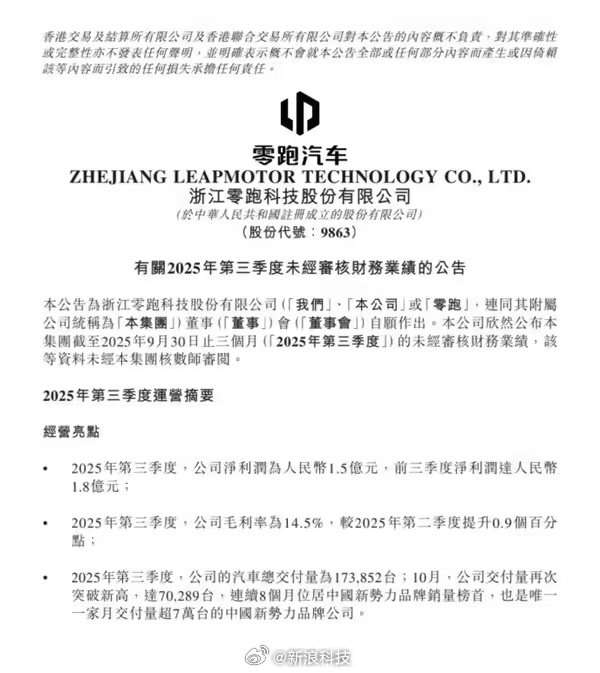
零跑汽车2025年Q3营收194.5亿元 A系列首款车型A10即将亮相
Feng Huang Wang· 2025-11-17 11:58
Core Viewpoint - Leap Motor reported a strong financial performance for Q3 2025, with significant growth in revenue and net profit, indicating a robust market position and operational efficiency [1] Financial Performance - The net profit for Q3 reached 150 million yuan, maintaining positive growth [1] - Revenue for the quarter was 19.45 billion yuan, representing a year-on-year increase of 97.3% [1] - Gross margin improved to 14.5%, up by 6.4 percentage points compared to the same period last year [1] Delivery and Sales - Total delivery volume for Q3 was 173,852 units, marking a year-on-year growth of 101.8% [1] - In October, Leap Motor's monthly sales surpassed 70,000 units for the first time [1] Cash Flow and Reserves - As of the end of Q3, the company had cash reserves of 33.92 billion yuan [1] - The net cash generated from operating activities was 4.88 billion yuan [1] - Free cash flow amounted to 3.84 billion yuan [1] Product Development - Leap Motor has completed the layout of its four major product series: A, B, C, and D [1] - The Lafa5 sports sedan began pre-sales on November 7, with plans for domestic launch on November 27 [1] - The D19 luxury SUV made its global debut in Shanghai in October [1] - The A10, the first model in the A series, is set to be showcased at the Guangzhou Auto Show in November [1] - The company launched its new flagship D platform, which includes six major technologies such as range extension, high-voltage pure electric, and intelligent driving [1]