LEAPMOTOR(09863)

Search documents
自主品牌座次洗牌 新势力环比普降
Zhong Guo Zheng Quan Bao· 2026-02-02 20:45
截至2月2日,国内主流车企2026年1月产销数据陆续披露。整体市场呈现"传统自主强势领跑、新势力普 遍承压"的鲜明格局:上汽、吉利、奇瑞等头部车企销量同比多实现20%以上增长,自主品牌座次因新 能源与出口表现差异出现重构。 与此同时,9家主流造车新势力则遭遇集体环比下滑。业内分析指出,短期政策切换、淡季效应等因素 扰动终端,但自主车企核心竞争力持续提升,新势力"马太效应"加剧,行业高质量发展的长期逻辑未 变。 ● 本报记者 龚梦泽 自主品牌座次重构 奇瑞集团凭借出口优势跃居前列,1月销售汽车20.03万辆,其中出口11.96万辆,同比增长48.1%,连续 9个月出口突破10万辆。新能源板块同样稳步推进,1月销量5.21万辆,形成"出口+新能源"双轮驱动格 局。旗下主要品牌中,奇瑞品牌销量13.56万辆,捷途品牌4.27万辆,星途、iCAR、智界品牌分别销售 5276辆、3419辆、4506辆,产品矩阵覆盖从主流到高端的全细分市场。 广汽集团自主板块爆发式增长,推动整体销量达11.66万辆,同比增长18.47%。这是昊铂埃安BU和传祺 BU完成组建后首次披露月度销量,成效立竿见影:昊铂埃安BU销量超2.16万辆 ...





汽车图谱|1月车市调整:上汽销量居首 吉利逆势增长
Xin Jing Bao· 2026-02-02 13:58
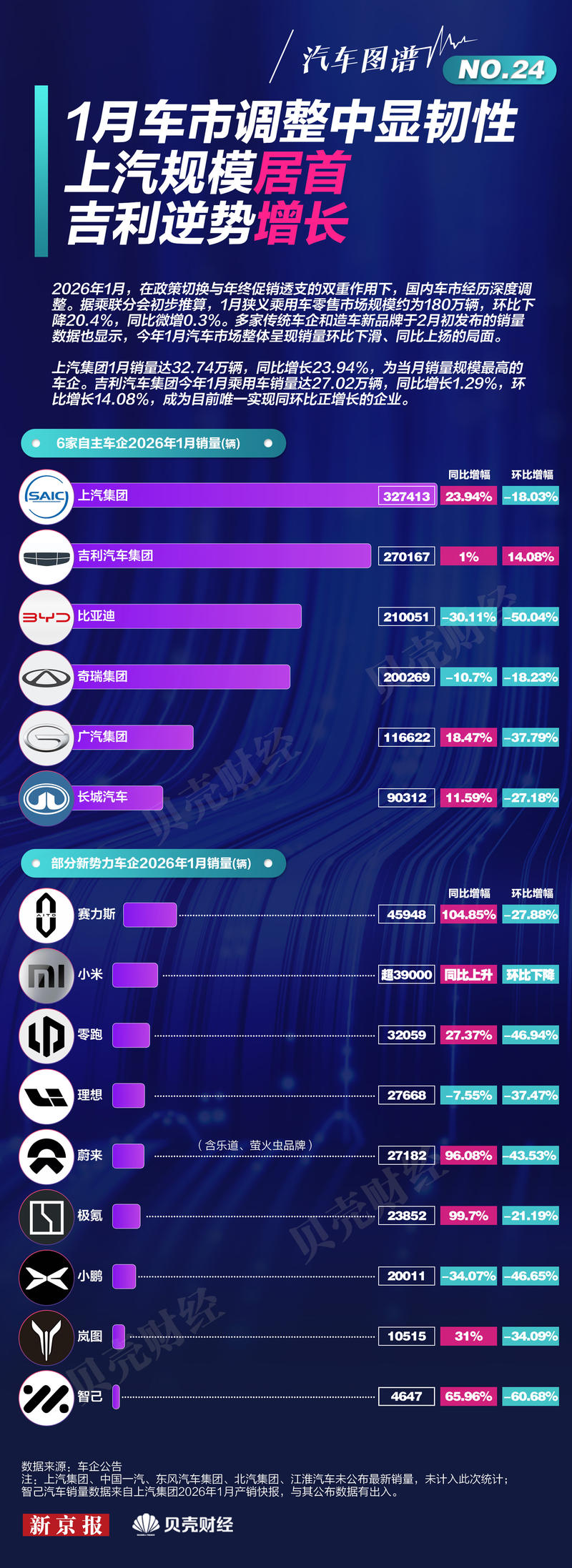
2026年1月,在政策切换与年终促销透支的双重作用下,国内车市经历深度调整。 据乘联分会初步推算,1月狭义乘用车零售市场规模约为180万辆,环比下降20.4%,同比微增0.3%。多家传统车 企和造车新品牌发布的销量数据也显示,今年1月汽车市场整体呈现销量环比下滑、同比上扬的局面。 上汽集团1月销量达32.74万辆,同比增长23.94%,为当月销量规模最高的车企。 吉利汽车集团1月乘用车销量达27.02万辆,同比增长1.29%,环比增长14.08%,成为目前唯一实现同环比正增长的 企业。 比亚迪1月销量国内下滑、海外增长。当月总销量约21万辆,其中海外市场销量超10万辆,同比增长51.47%。海 外市场的快速拓展正成为比亚迪重要的增长引擎。比亚迪品牌及公关部门总经理李云飞年初透露,公司计划在 2026年向中国以外地区销售130万辆汽车。 (文章来源:新京报) 新势力车企中,小米汽车1月交付量超3.9万辆,首次超越零跑汽车。赛力斯、极氪、蔚来1月销量同比分别增长 104.85%、99.7%和96.08%,成为当月表现亮眼的高增长梯队。 吉利汽车集团 14.08% 270167 1% 比亚迪 210051 -30. ...


开年就迎“大逆转”:小米反超零跑,蔚来快追平理想,新造车1月环比暴跌
3 6 Ke· 2026-02-02 13:02
Core Insights - The automotive industry faced a significant downturn at the beginning of 2026, with many companies reporting disappointing sales figures compared to December 2025, despite some year-on-year growth due to low bases from the previous year [1][4][6] - The market is experiencing a reshuffling, with new entrants like AITO and Xiaomi gaining traction while established players like Li Auto and Xpeng are struggling [3][12][20] Group 1: Market Performance - January 2026 saw a 28% year-on-year decline in retail sales of passenger vehicles, with a 37% drop compared to December 2025 [6] - The new energy vehicle (NEV) market specifically experienced a 16% year-on-year decline and a 52% month-on-month decline [6] - AITO led the new energy vehicle segment with a delivery of 40,016 units, marking a significant year-on-year increase of 83% [13] Group 2: Company-Specific Performance - Xiaomi and AITO both reported over 39,000 units delivered in January, while Li Auto and Xpeng fell below the 30,000 mark [3][15] - Li Auto's deliveries were 27,668 units, showing a 37% month-on-month decline and an 8% year-on-year decline due to battery supply issues [20][22] - NIO delivered 27,182 units, a 96.1% year-on-year increase but a 43% month-on-month decline, with the new ES8 model being a key contributor [22][23] Group 3: Competitive Strategies - Companies are responding to market pressures by adjusting pricing strategies, with BMW reducing prices on 31 models and some brands offering zero-interest loans [6][7] - AITO and Xiaomi are launching new financial purchase plans to stimulate sales, including low-interest financing options [11][23] - The competitive landscape is intensifying, with companies like Geely and BYD also adjusting their strategies to maintain market share [26][28] Group 4: Traditional Automakers - Geely emerged as the top-selling automaker in January 2026 with 270,000 units sold, surpassing BYD's 210,000 units [26][28] - BYD's sales dropped by 30.11% year-on-year, with a significant 50.04% decline from December 2025 [28][30] - Chery and Great Wall Motors also reported declines, with Chery's sales at 200,269 units and Great Wall's at 90,312 units, reflecting broader market challenges [33][35]




汽车股股价悉数受挫 小鹏汽车-W(09868)跌9.21% 机构指1月新能源车销量承压
Xin Lang Cai Jing· 2026-02-02 11:01
消息面上,开源证券发布研报称,2026年1月,国内乘用车市场同比持平但环比下滑,其中新能源汽车 销量承压明显,渗透率降至约44.4%。市场呈现结构性分化:问界、小米等凭借爆款车型实现高增长; 燃油车为部分品牌提供短期支撑;比亚迪股份等纯新能源品牌销量承压。展望2026年,行业重点看好高 端化发展与海外市场拓展两大方向。 该机构表示,1月为春节前最后一个完整销售月,工作日数量明显多于2025年同期,但受购置税减免退 坡产生透支效应、以旧换新政策退坡各省逐步落实等影响,乘用车零售销量有望实现180万辆、日均5.8 万辆,同比基本持平、环比下滑明显。具体来看,根据乘联会数据,1月首周车市疲软,日均零售3.0万 辆;第2周需求略有恢复,日均零售5.0万辆;1月第3周,随着以旧换新补贴陆续落地,车市热度缓慢回 升,日均零售有望达5.7万辆;1月第4周,在补贴政策基本落实与年前首购需求增强的双重推动下,车 市日均零售量有望有望冲高至12.0万辆。分能源形式看,1月燃油车销量预计相对有支撑,主要系冬季 为传统燃油车销售旺季、购置税减免退坡缩小油电价差;反观新能源车,受政策及季节性因素影响明 显,预计1月零售销量约80万辆, ...
零跑汽车1月交付新车32,059台,同比增长27%
Ju Chao Zi Xun· 2026-02-02 03:18
Core Insights - Leap Motor reported a total delivery of 32,059 vehicles in January 2026, marking a year-on-year increase of 27% [2] - The company received an ESG "AA" rating in January, indicating strong performance in environmental, social, and governance aspects [2] - Leap Motor expanded its retail network by adding 85 new stores, bringing the total number of stores to 1,068 as of January 5, enhancing customer accessibility to its products and services [2] Group 1: Brand and Product Development - The Leap A10 smart long-range SUV was showcased at the Brussels Motor Show, featuring a classic and flexible design that aligns with European urban mobility needs, garnering significant attention from media and consumers [2] - The company launched the "Leap A10 Co-Creation Contest" on January 24, inviting users to contribute creative ideas for the A10 urban skin modification challenge, promoting user engagement in product design [2] Group 2: Strategic Outlook - Leap Motor is focused on comprehensive development across brand building, channel expansion, product internationalization, market engagement, and social responsibility [2] - The company expressed confidence in its future growth, emphasizing a user-centric approach and technology-driven strategy in the context of global market trends [2]
1月车企销量排行
数说新能源· 2026-02-02 02:37
根据2026年2月1-2日各大车企发布的最新数据,2026年1月中国汽车市场销量排行如下: 车企集团销量排行(TOP 5) | 排名 | 车企集团 | 1月销量 | 同比变化 | 主要亮点 | | --- | --- | --- | --- | --- | | 1 | 吉利汽车集团 | 270,167辆 | +1% | 海外出口60,506辆,同比翻倍;新能源124,252辆 | | 2 | 比亚迪 | 210,051辆 | -30.11% | 出口100,482辆,同比+51.47%,蝉联新能源冠军 | | 3 | 奇瑞集团 | 200,269辆 | -10.72% | 出口11.96万辆,同比+48.1%,出口占比近60% | | 4 | 广汽集团 | 116,622辆 | +18.47% | 自主品牌超4.9万辆,同比+87.58% | | 5 | 长城汽车 | 90,312辆 | +11.59% | 海外销量40,278辆,同比+43.77% | | | 🚀 造车新势力销量排行(TOP 10) | | | | 排名 品牌 1月销量 同比变化 备注 1 问界(AITO) 40,016辆 +83% 鸿蒙智 ...


新能源汽车股集体大跌
Di Yi Cai Jing Zi Xun· 2026-02-02 02:21
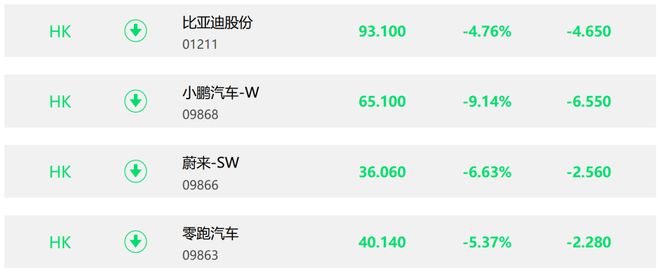
2月1日,多家新能源车企公布1月销量。比亚迪销量21.01万辆,同比下降30.11%;小鹏交付了20011 辆,同比下降34.07%;理想交付27668辆,同比下降7.55%。 | HK | (+) | 比亚迪股份 | 93.100 | -4.76% | -4.650 | | --- | --- | --- | --- | --- | --- | | | | 01211 | | | | | HK | (+) | 小鹏汽车-W | 65.100 | -9.14% | -6.550 | | | | 09868 | | | | | HK | (4) | 蔚来-SW | 36.060 | -6.63% | -2.560 | | | | 09866 | | | | | HK | ( | 零跑汽车 | 40.140 | -5.37% | -2.280 | | | | 09863 | | | | 其中,比亚迪股份(1211.HK)跌4.86%,新势力头部"蔚小理零"中,小鹏汽车(09868.HK)跌9%,蔚 来-W(09866.HK)跌6.73%,零跑汽车(09853.HK)跌5%。 2月2日早盘,港股新能源汽车股集体大跌 ...
新能源汽车股集体大跌
第一财经· 2026-02-02 02:14
2月1日,多家新能源车企公布1月销量。比亚迪销量21.01万辆,同比下降30.11%;小鹏交付了 20011辆,同比下降34.07%;理想交付27668辆,同比下降7.55%。 | HK | ਦ | 比亚迪股份 | 93.100 | -4.76% | -4.650 | | --- | --- | --- | --- | --- | --- | | | | 01211 | | | | | HK | ਦ | 小鹏汽车-W | 65.100 | -9.14% | -6.550 | | | | 09868 | | | | | HK | + | 副来-SW | 36.060 | -6.63% | -2.560 | | | | 09866 | | | | | HK | + | 零跑汽车 | 40.140 | -5.37% | -2.280 | | | | 09863 | | | | 2月2日早盘,港股新能源汽车股集体大跌。 其中,比亚迪股份(1211.HK)跌4.86%,新势力头部"蔚小理零"中,小鹏汽车(09868.HK)跌 9%,蔚来-W(09866.HK)跌6.73%,零跑汽车(09853.HK)跌5%。 ...

零跑汽车“领跑”势头遇挫,连续两个月环比下滑
Shen Zhen Shang Bao· 2026-02-02 02:12
Core Viewpoint - Leap Motor's January vehicle deliveries reached 32,059 units, marking a year-on-year increase of 27.37% but a month-on-month decline of 46.94% [1] Group 1: Delivery Performance - Leap Motor's delivery volume has been declining for the past two months, with December's deliveries down 16.4% compared to November [1] - The company aims to stabilize the market by accelerating channel development, having added 85 new stores recently, bringing the total to 1,068 nationwide as of January 5 [1] Group 2: Future Projections - 2025 is anticipated to be a "breakout year" for Leap Motor, with expectations to lead the new energy vehicle sales rankings for ten consecutive months starting from March [1] - Monthly deliveries are projected to exceed 50,000 units from July to August, surpassing 60,000 in September, and reaching over 70,000 in October and November, despite a drop to 60,000 in December [1] - For the full year of 2025, Leap Motor aims to deliver nearly 600,000 vehicles, representing a 103% year-on-year growth, solidifying its position as the sales leader among new energy vehicle manufacturers [1] - The company also plans to export over 67,000 vehicles, leading in exports among new energy vehicle manufacturers [1] Group 3: Upcoming Models - In 2026, Leap Motor is set to launch four significant new models, including the compact SUV Leap A10, the large SUV Leap D19, the mid-to-large MPV Leap D99, and a sports sedan, the Leap Lafa 5 Ultra [1]
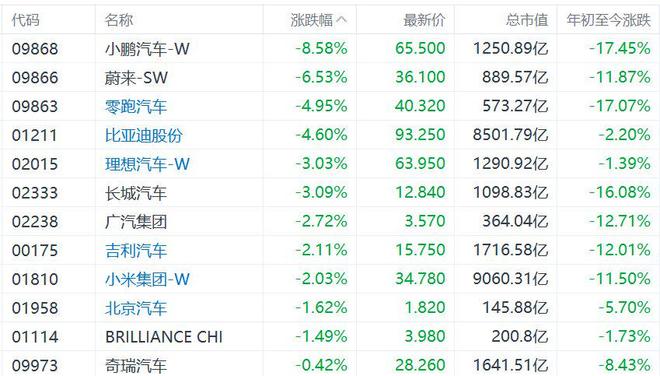
港股异动丨汽车股集体下挫,蔚来跌超6%
Ge Long Hui· 2026-02-02 02:07
Group 1 - The Hong Kong stock market saw a collective decline in automotive stocks, with Xpeng Motors dropping over 8%, NIO down over 6%, and Li Auto, Great Wall Motors, and others also experiencing declines [1] - Major Chinese automakers reported January vehicle delivery data, with BYD's January new energy vehicle sales at 210,051 units, a year-on-year decrease of 30.11%, while Li Auto delivered 27,668 units, down 7.55%, and Xpeng delivered 20,011 units, a decline of 34.07% [1] Group 2 - Specific stock performance included Xpeng Motors at -8.58% with a latest price of 65.500 and a market cap of 125.09 billion, NIO at -6.53% with a price of 36.100 and a market cap of 88.96 billion, and BYD at -4.60% with a price of 93.250 and a market cap of 850.18 billion [2] - Other notable declines included Li Auto at -3.03%, Great Wall Motors at -3.09%, and Geely Auto at -2.11%, with respective market caps of 129.09 billion, 109.88 billion, and 171.66 billion [2]