
BABA(09988)

Search documents
21评论|为AI撒钱,很考验技术
2 1 Shi Ji Jing Ji Bao Dao· 2026-02-10 11:37
Core Insights - The article discusses the recent "red envelope war" among major tech companies in China, highlighting their strategies to attract users and establish AI as a key component in their ecosystems [3][10][12] Group 1: User Growth and Engagement - Tencent's Yuanshao saw a daily active user (DAU) of 23.99 million on the first day of its cash red envelope campaign, a 2.1 times increase from the previous day [1] - Baidu's Qianwen achieved a DAU of 58.48 million on the first day of its "30 billion free order" campaign, marking a 7.3 times increase from the prior day [2] - The rapid user growth indicates a significant impact of these promotional activities on user engagement [7] Group 2: Strategic Approaches - Tencent aims to leverage its WeChat ecosystem to quickly expand its user base and capture the AI application entry point [4][5] - Alibaba's Qianwen focuses on essential consumer scenarios, with its "one-sentence order" feature becoming a phenomenon, indicating high user interaction with AI [5] - Baidu adopts an "embedded AI" strategy, integrating its AI capabilities into the red envelope activities to enhance user experience [6] Group 3: Competitive Landscape - The competition is not merely about cash giveaways but reflects deeper strategic moves by each company to solidify their positions in the AI landscape [3][10] - The red envelope war is seen as a pivotal moment in the transition from technical validation of AI to large-scale user acquisition [10][11] - Companies are not limiting themselves to single AI assistants but are building comprehensive ecosystems to meet user needs [13] Group 4: Future Implications - The red envelope campaigns are viewed as tools to cultivate a mindset among users to seek AI assistance in various situations [14][15] - The outcomes of these campaigns could significantly influence the AI landscape over the next decade [15]



为AI撒钱,很考验技术
2 1 Shi Ji Jing Ji Bao Dao· 2026-02-10 11:29
21世纪经济报道记者孔海丽 北京报道 豆包红包姗姗来迟,路透是10万份"科技好礼"。 各有看家本领 各家的打法,都是对自身生态基因的极致放大。 腾讯元宝试图复刻2014年微信红包通过社交裂变逆袭支付宝的成功路径。 腾讯的逻辑则是,利用微信生态的社交关系链实现快速破圈,抢占AI应用入口。 阿里千问的"请客计划"直接切入最刚需的生活消费场景,活动上线后,"一句话点奶茶"成为现象级活 动。 其实,过去10天,腾讯元宝、百度文心助手、阿里千问的红包,已经撒出了效果,撒出了互联网史上最 疯狂的用户增长。 QuestMobile数据显示,元宝启动新春现金红包活动首日, DAU为2399万,较前一日增长2.1倍,后几日 仍保持在高位。 千问"春节30亿免单"活动首日,DAU为5848万,较前一日增长7.3倍。 2月10日,豆包官宣2026年春晚将送出10万份"科技好礼",除了机器人、机器狗,还有奥迪、奔驰电车 的使用权,这些科技实物全都接入了豆包大模型。 这场红包大战,根本不是简单的"撒钱"。 腾讯大方送现金,意在拉新;百度搞AI互动,想建立用户黏性;阿里打通AI购物链,豆包送AI实物, 最终全都指向"下一代AI入口"。 ...
千问免单活动导致宕机,关注算力基础设施投资机遇
Changjiang Securities· 2026-02-10 11:25
Investment Rating - The industry investment rating is "Positive" and maintained [6] Core Insights - The "Spring Festival 30 Billion Free Order" event launched by Qianwen App led to a surge in orders, causing system crashes and highlighting the current shortage of computing power resources among major AI companies like Alibaba. This event indicates a growing demand for computing power, which is expected to increase as companies compete for AI application traffic during the Spring Festival [2][4][8] - Major companies, including Tencent, ByteDance, and Baidu, are expected to engage in a "traffic war" during the Spring Festival, collectively investing approximately 4.5 billion to secure AI entry points, further driving the demand for computing power [8] - The report suggests focusing on domestic computing power chip manufacturers, particularly industry leaders like Cambricon and Haiguang Information, as well as companies involved in computing power leasing and IDC [2][8] Summary by Sections Event Description - On February 6, Qianwen App launched a promotional event that resulted in a significant increase in orders, with over 1 million orders placed within 9 hours, setting a new record for the beverage industry. The system faced a peak request processing rate 30 times higher than normal, leading to a complete server crash [2][4][8] Market Dynamics - The report notes that the computing power demand is expected to continue to grow, especially with the increased capital expenditures (CapEx) from major overseas cloud service providers (CSPs) like Amazon, Google, Meta, and Microsoft, which are projected to exceed 600 billion USD in total for 2026 [8]


China's Alibaba launches AI model to power robots as tech giants talk up 'physical AI'
CNBC· 2026-02-10 11:05
Group 1 - Alibaba has launched an artificial intelligence model named RynnBrain, aimed at enhancing robotics capabilities, as the tech industry increasingly focuses on this fast-growing sector [2][3] - The RynnBrain model allows robots to understand and identify objects in their environment, showcasing complex AI functionalities [2] - Alibaba's entry into the robotics market aligns with the broader trend of tech giants, including Nvidia and Google, developing their own AI models for robotics [3][4] Group 2 - The robotics sector is viewed as a multitrillion-dollar growth opportunity, with significant investments and advancements being made by various companies [3] - China is leading in the development of humanoid robots, with plans to increase production in the coming year, positioning itself ahead of the U.S. in this area [5] - Alibaba is adopting an open-source strategy for RynnBrain, allowing global developers to utilize the model for free, which is crucial for expanding its reach [5]

智通港股通活跃成交|2月10日
智通财经网· 2026-02-10 11:01
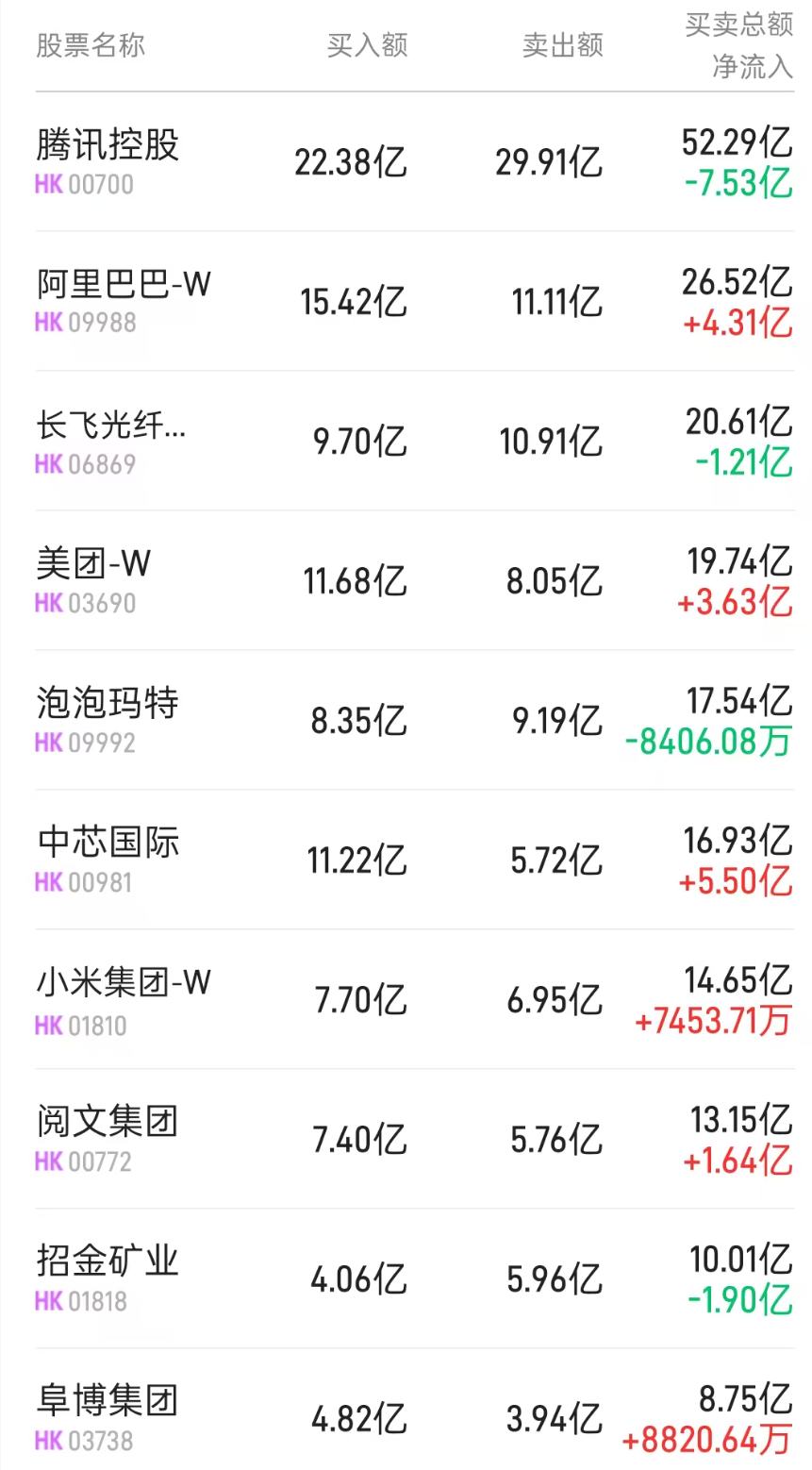
沪港通(南向)十大活跃成交公司 智通财经APP获悉,2026年2月10日当天,腾讯控股(00700)、阿里巴巴-W(09988)、长飞光纤光缆 (06869)位居沪港通(南向)成交额前3位,成交额分别为52.29 亿元、26.52 亿元、20.61 亿元;腾讯控 股(00700)、阿里巴巴-W(09988)、长飞光纤光缆(06869) 位居深港通(南向)成交额前3位,成交额分别 为42.37 亿元、21.69 亿元、12.08 亿元。 | 公司名称 | 成交金额 | 净买入额 | | --- | --- | --- | | 腾讯控股(00700) | 42.37 亿元 | -6.49 亿元 | | 阿里巴巴-W(09988) | 21.69 亿元 | -2.70 亿元 | | 长飞光纤光缆(06869) | 12.08 亿元 | +4.08 亿元 | | 中芯国际(00981) | 11.61 亿元 | -1.74 亿元 | | 泡泡玛特(09992) | 11.07 亿元 | -1.51 亿元 | | 美团-W(03690) | 10.28 亿元 | +1.83 亿元 | | 快手-W(01024) | 9 ...

春节大厂羊毛薅到没?他们到底在争什么?
Sou Hu Cai Jing· 2026-02-10 10:18
Group 1 - Alibaba's Qianwen launched a 30 billion yuan free drink campaign on February 6, inviting the public to enjoy milk tea, showcasing its AI lifestyle integration [1] - Tencent's Yuanbao initiated a 10 billion yuan cash red envelope campaign at the end of January, leveraging the Spring Festival for user growth in AI tools [1][5] - Both Alibaba and Tencent's founders, Jack Ma and Pony Ma, respectively, participated in their companies' Spring Festival activities, highlighting the importance of AI strategies for both giants [3][5] Group 2 - The competition between Alibaba and Tencent during the Spring Festival represents a shift from traditional "Internet+" to "AI+" marketing strategies [5] - The Qianwen app achieved over 10 million downloads in its first week of public testing, positioning itself as an "AI lifestyle entry" that supports various services [7] - The rivalry over milk tea and red envelopes signifies a broader battle for user engagement and experience in the AI sector [7] Group 3 - Hangzhou aims to become the leading city in artificial intelligence, while Shenzhen focuses on building an internationally competitive industrial cluster, creating a dual-engine for the AI industry [10] - The two cities have different government support strategies: Hangzhou emphasizes computing power and talent subsidies, while Shenzhen concentrates on AI applications in industrial scenarios [11] - Talent acquisition is a critical factor, with Hangzhou offering up to 500,000 yuan in subsidies for local researchers, and Shenzhen launching initiatives to attract talent from Hong Kong and Macau [10][11]

千问紧急提醒:30亿免单卡快抢完了,最后供应3天
21世纪经济报道· 2026-02-10 10:09
Group 1 - The core idea of the article revolves around the launch of the "Spring Festival 30 Billion Free Order" campaign by Qianwen, which aims to stimulate consumer spending through free vouchers for tea drinks and other purchases [3]. - The campaign started on February 6 and is set to run until February 12, offering users a 25 yuan no-threshold free order card upon updating the Qianwen app [3]. - The campaign has led to a significant increase in daily active users (DAU), with a 7.3 times growth on the first day, reaching 58.48 million DAU, surpassing competitors like Doubao [3]. Group 2 - The article mentions that participating tea brands experienced a surge in online orders, with some reporting order volumes increasing nearly tenfold compared to the previous day [3]. - Users can earn additional free order cards by inviting friends to download the app, with a maximum of 21 cards per person, and a chance to win a valuable AI lifestyle card [3]. - The second phase of the campaign will begin on February 13, where users can receive cash red envelopes, with the highest amount being 2888 yuan [3].

北水动向|北水成交净买入0.85亿 中芯国际盘后发业绩 北水绩前抢跑加仓超3亿港元
Zhi Tong Cai Jing· 2026-02-10 09:59
Group 1: Market Overview - Northbound trading recorded a net buy of 0.85 billion HKD, with Shanghai Stock Connect contributing a net buy of 11.03 billion HKD and Shenzhen Stock Connect showing a net sell of 1.19 billion HKD [1] - The most bought stocks by northbound investors included Meituan-W (03690), CNOOC (00883), and SMIC (00981), while Tencent (00700) faced the highest net sell [1] Group 2: Individual Stock Performance - Meituan-W (03690) saw a net buy of 5.45 billion HKD, driven by its acquisition of Dingdong Maicai's China business for approximately 7.17 billion USD, indicating a significant shift in the domestic fresh food instant retail landscape [4][5] - CNOOC (00883) received a net buy of 4.2 billion HKD, supported by a report indicating a 3.5% week-on-week decline in US crude oil production due to cold weather, which is expected to influence oil prices [5] - SMIC (00981) had a net buy of 3.76 billion HKD, with a projected sales revenue of 2.489 billion USD for Q4 2025, reflecting a 4.5% quarter-on-quarter increase and a 16.2% year-on-year growth for the full year [5] - Longi Green Energy (06869) attracted a net buy of 2.87 billion HKD, as the bidding for a special optical cable procurement project by China Mobile has been completed, indicating a rising trend in optical fiber prices [5] - Xiaomi Group-W (01810) and Alibaba-W (09988) received net buys of 2.03 billion HKD and 1.6 billion HKD, respectively [8] - Tencent (00700) experienced a significant net sell of 14.02 billion HKD, indicating a bearish sentiment among investors [8] Group 3: Other Notable Stocks - Yueda Group (00772) gained a net buy of 1.63 billion HKD, with the CEO highlighting the increasing value of original content in the context of rapid AI development [6] - Fubo Group (03738) saw a net buy of 882 million HKD, benefiting from the global surge in AI video applications and copyright protection investments [7]



2026年企业选型指南:阿里云邮箱服务商推荐哪家更安全高效?
Sou Hu Cai Jing· 2026-02-10 09:14
数字化转型浪潮下,企业邮箱已从单一通信工具演变为承载数据安全、流程协同与品牌形象的数字化基础设施。面对2026年日益复杂的网络威胁与降本增效 需求,企业如何选择既安全又高效的邮箱服务商?本文以阿里云企业邮箱为例,拆解其技术架构与用户价值。 一、安全架构:金融级防护体系的底层逻辑 传统邮箱的明文传输模式存在中间人攻击风险,阿里邮箱采用SSL/TLS加密协议,实现邮件从发送到接收的全链路加密。合兴集团反馈显示,其财务部门通 过加密通道传输合同文件后,未再发生邮件内容泄露事件。 3. 合规性认证的行业标杆 阿里邮箱通过ISO27001信息安全管理体系认证、等保三级认证等权威标准,符合金融、政务等高敏感行业的合规要求。其审计日志功能可完整记录邮件收 发、登录、删除等操作,满足《网络安全法》对数据留存的要求。 阿里企业邮箱联系电话:400-8959-335 二、协同效率:钉钉生态融合的降本增效 1. 单点登录与账号统一的价值释放 中国铁塔等企业通过阿里邮箱的SSO功能,将邮箱账号与OA、ERP等系统打通,员工无需记忆多套密码。据统计,该功能可减少30%的密码重置工单,提升 IT支持效率。 账号统一管理支持多域绑定,聚光 ...
阿里达摩院开源具身大脑基模RynnBrain,首次让机器人拥有时空记忆
Feng Huang Wang· 2026-02-10 08:41
Core Insights - Alibaba's Damo Academy has released the RynnBrain foundational model for embodied intelligence, which includes seven models, such as the 30B MoE, and has been fully open-sourced [1] - The RynnBrain model introduces temporal memory and physical space reasoning capabilities to robots, allowing them to record and recall historical states during task execution [1] - In 16 open-source evaluations of embodied intelligence, RynnBrain outperformed existing models like Google's Gemini Robotics ER1.5 and NVIDIA's Cosmos Reason2 in various tasks [1] Group 1 - The RynnBrain model enables robots to remember the time and spatial state of a task when interrupted, allowing them to resume previous tasks seamlessly [1] - Damo Academy's embodied intelligence lab head, Zhao Deli, stated that RynnBrain represents a significant step towards the development of general embodied intelligence [1] - Damo Academy has previously open-sourced related models such as WorldVLA and RynnEC, and has introduced the RynnRCP protocol to advance AI applications in real-world physical scenarios [1]

