
Cambricon(688256)

Search documents
300308,成交额A股第一
Shang Hai Zheng Quan Bao· 2025-10-20 05:03
Market Overview - On October 20, A-shares saw all three major indices rise collectively, with the ChiNext Index increasing by over 3% during intraday trading. The Shanghai Composite Index closed at 3866.09 points, up 0.69%, while the Shenzhen Component Index and ChiNext Index rose by 1.38% and 2.49%, respectively. The total trading volume in the Shanghai and Shenzhen markets reached 11,709 billion yuan [2][4]. Sector Performance - Over 4,200 stocks in the market experienced gains, with strong performance in the hard technology sector. The CPO (optical module) concept rebounded significantly, with Yuanjie Technology hitting a 20% limit up, and Cambridge Technology also reaching its limit. The commercial aerospace concept saw strong activity, with Longcheng Electric and Xingwang Yuda hitting their limits. The ice and snow concept was also active, with Dalian Shengya reaching its limit [4][8]. Notable Stocks - Agricultural Bank of China achieved a 12-day consecutive rise in its stock price, reaching a historical high of 7.68 yuan per share, with a total market capitalization exceeding 2.45 trillion yuan [4]. - Yuanjie Technology's stock hit a 20% limit up during intraday trading, reflecting the strong rebound in computing hardware stocks [7][8]. - Faraday Holdings experienced significant volatility, initially hitting a limit up before dropping to a limit down, and then rebounding to close at 10.74 yuan per share with a trading volume of 9.38 billion yuan [5][6]. CPO Market Insights - Recent reports indicate that overseas major clients have raised their procurement plans for 1.6T optical modules for 2026, increasing from 10 million to 20 million units, driven by the rapid growth in AI training and inference network bandwidth demand [12]. - The optical module market is experiencing rapid growth and technological iteration, with price changes reflecting the industry's healthy development [12]. Solid-State Battery Sector - The solid-state battery and lithium battery sectors also saw gains, with Haike New Source hitting a 20% limit up, and other companies like Zhuhai Guanyu and Huasheng Lithium Energy rising over 10% [14]. - Chery Automobile announced a breakthrough in solid-state battery technology, showcasing a module that could enhance electric vehicle range to 1200-1300 kilometers [16]. - Haike New Source is actively conducting research and process optimization for solid-state electrolyte materials, with some products in pilot testing and others in laboratory performance testing [14][16].





000917,直线涨停!
中国基金报· 2025-10-20 05:02
Market Overview - On October 20, the A-share market showed a strong rebound, with the ChiNext Index rising over 3% at one point. The Shanghai Composite Index closed at 3866.09 points, up 0.69%, while the Shenzhen Component Index rose 1.38% and the ChiNext Index increased by 2.49% [1][2]. Trading Volume and Stock Performance - The total trading volume exceeded 1.1 trillion yuan, slightly down from the previous trading day. A total of 4237 stocks rose, with 75 hitting the daily limit, while 1056 stocks declined [2]. Sector Performance - Most sectors were in the green, with the top-performing sectors including optical modules (CPO), lithium battery electrolyte, optical communication, and optical chip concepts, which saw gains of 5.70%, 4.71%, 4.05%, and 3.99% respectively. Conversely, the precious metals sector led the decline, with rare earths and banking sectors also experiencing pullbacks [2][3]. CPO Sector Highlights - The optical module (CPO) sector experienced a strong rebound, with related indices rising over 7%. Notable stocks included: - Zhongji Xuchuang, up 8.31%, with a market cap of 449.6 billion yuan [5]. - New Yisheng, up 4.86%, with a market cap of 329.7 billion yuan [6]. - Tianfu Communication, up 8.94%, with a market cap of 124.2 billion yuan [7]. - Source Jie Technology surged 14.84%, with a market cap of 35.7 billion yuan [10]. Semiconductor Sector Developments - The semiconductor chip sector also showed strength, with companies like Silan Microelectronics hitting the daily limit, reporting a market cap of 54.8 billion yuan. The company announced plans to invest 20 billion yuan in a new 12-inch high-end analog chip manufacturing line [11][13]. Financial Sector Performance - The financial sector exhibited mixed results, with Agricultural Bank of China reaching a new high, up over 1% and achieving a market cap of 2.61 trillion yuan. Insurance stocks saw a comprehensive rise, with China Life Insurance increasing nearly 4% [15][21]. Precious Metals Sector Decline - The precious metals sector faced significant declines, with stocks like Hunan Silver hitting the daily limit down, and West Gold dropping over 8%. The international gold price remained volatile, reported at 4265.61 USD per ounce, up 0.35% [24][25][27].



半导体龙头ETF(159665)开盘涨1.25%,重仓股中芯国际涨1.74%,海光信息涨2.96%
Xin Lang Cai Jing· 2025-10-20 04:46
Group 1 - The semiconductor leader ETF (159665) opened with a gain of 1.25%, priced at 1.775 yuan [1] - Key holdings in the ETF include: - SMIC up 1.74% - Haiguang Information up 2.96% - Cambrian up 2.04% - North Huachuang up 1.64% - OmniVision up 1.41% - Lattice Semiconductor up 2.88% - Zhongwei Company up 2.33% - Zhaoyi Innovation up 3.24% - Changdian Technology up 1.90% - Unisoc up 1.71% [1] - The ETF's performance benchmark is the National Securities Semiconductor Chip Index return, managed by ICBC Credit Suisse Asset Management Company, with a return of 75.25% since its establishment on December 22, 2022, and a return of 0.36% over the past month [1]




A股半导体股集体上涨,源杰科技涨超14%,长光华芯涨超11%,士兰微触及涨停,寒武纪涨4%!牛散章建平增持寒武纪
Ge Long Hui· 2025-10-20 04:25
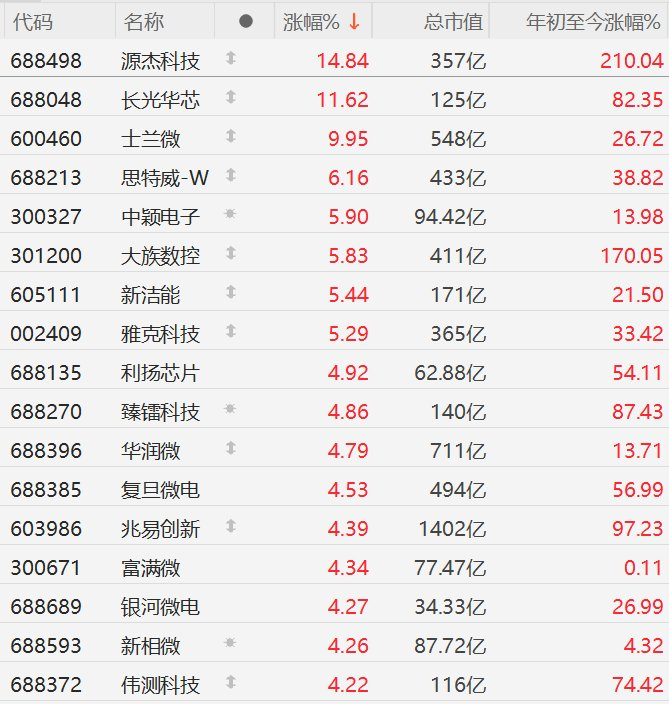
Core Viewpoint - The semiconductor sector in the A-share market is experiencing a strong rally, with several stocks showing significant gains, indicating positive market sentiment and potential investment opportunities in this industry [1][2]. Group 1: Stock Performance - Yuanjie Technology (源杰科技) saw a rise of 14.84%, with a total market capitalization of 35.7 billion and a year-to-date increase of 210.04% [2]. - Changguang Huaxin (长光华芯) increased by 11.62%, with a market cap of 12.5 billion and a year-to-date rise of 82.35% [2]. - Silan Microelectronics (士兰微) hit the daily limit with a 9.95% increase, having a market cap of 54.8 billion and a year-to-date growth of 26.72% [2]. - Other notable performers include Zhongying Electronics (中颖电子) up 5.90%, Dazhu CNC (大族数控) up 5.83%, and Yake Technology (雅克科技) up 5.29% [1][2]. Group 2: Financial Highlights - Cambrian (寒武纪) reported a revenue of 1.727 billion for Q3 2025, marking a year-on-year growth of 1,332.52%, with a net profit of 567 million [2]. - For the first three quarters, Cambrian's revenue reached 4.607 billion, reflecting a year-on-year increase of 2,386.38%, and a net profit of 1.605 billion [2]. - The latest shareholder data shows that prominent investor Zhang Jianping increased his stake from 1.46% to 1.53%, acquiring an additional 320,000 shares [2]. Group 3: Investment Projects - Silan Microelectronics announced plans to invest 20 billion in the construction of a 12-inch high-end analog integrated circuit chip manufacturing line [3].


科创芯片ETF(588200)半日收涨1.69%,盘中最高涨超3%!机构:半导体设备行业2026年或迎来拐点
Sou Hu Cai Jing· 2025-10-20 04:16
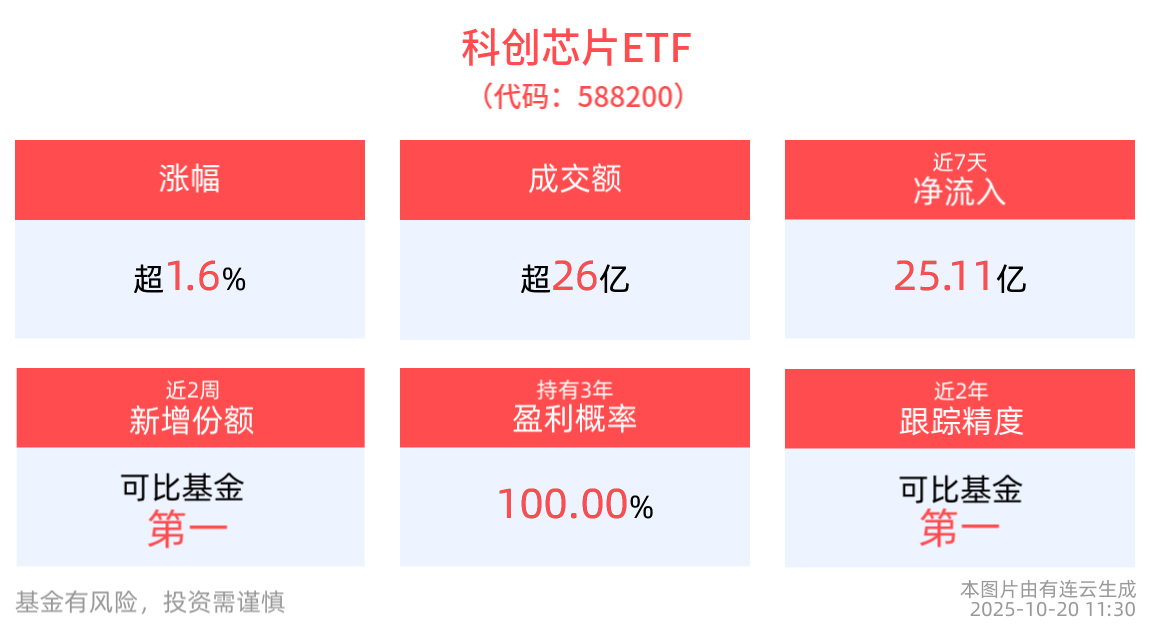
Group 1: ETF Performance - The Sci-Tech Chip ETF has a turnover rate of 6.63% and a transaction volume of 2.604 billion yuan [3] - The latest scale of the Sci-Tech Chip ETF reached 38.493 billion yuan, ranking first among comparable funds [3] - In the past two weeks, the ETF's shares increased by 966 million, marking significant growth and leading among comparable funds [3] - Over the past seven trading days, the ETF recorded net inflows on five days, totaling 2.511 billion yuan [3] - As of October 17, the ETF's net value has risen by 130.66% over the past three years, ranking 16th out of 1890 index equity funds, placing it in the top 0.85% [3] - The highest monthly return since inception was 35.07%, with the longest consecutive monthly increase being four months and a maximum increase of 74.17% [3] - The average return during rising months is 9.90% [3] Group 2: Semiconductor Industry Insights - Nvidia's CEO stated that due to U.S. export controls, Nvidia's market share in China has dropped from 95% to 0%, indicating a complete exit from the Chinese market [4] - The global semiconductor industry is projected to grow from $631 billion in 2024 to over $1 trillion by 2030, with a CAGR of approximately 8% [4] - AI and High-Performance Computing (HPC) are expected to be the core drivers of this growth, with their share rising from 35% in 2025 to 48% in 2030 [4] - SEMI forecasts a 10% year-on-year increase in global wafer fabrication equipment (WFE) capital expenditure in 2026, reflecting strong growth in advanced process logic and memory capital expenditures driven by AI [4] - The semiconductor equipment industry may see a turning point in 2026, with advanced packaging equipment expected to reach a scale of $6.3 billion [4] Group 3: Top Weight Stocks - The top ten weighted stocks in the Shanghai Stock Exchange Sci-Tech Chip Index include: - Haiguang Information (10.22% weight, +1.77%) - Langqi Technology (10.15% weight, +1.80%) - SMIC (9.59% weight, +4.07%) - Cambricon (8.01% weight, -0.54%) - Zhongwei Company (6.80% weight, +1.59%) - Chipone (2.89% weight, +3.15%) - Hu Silicon Industry (2.63% weight, +0.65%) - Hengxuan Technology (2.50% weight, +1.21%) - Sitaiwei (2.46% weight, +6.16%) - Shenghai Qingke (2.39% weight, +1.20%) [6]


A股午评:创业板指涨2.49%,煤炭、算力硬件股集体走强
2 1 Shi Ji Jing Ji Bao Dao· 2025-10-20 03:56
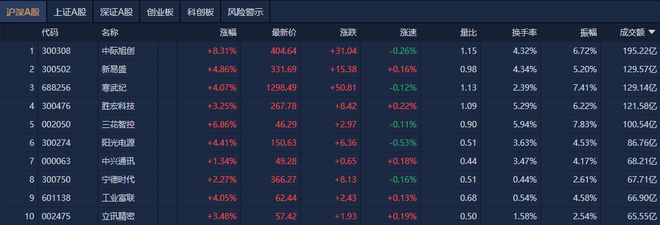
Market Performance - The market experienced high volatility in the morning session, with the ChiNext Index leading the gains, up 2.49% [1] - The Shanghai Composite Index rose by 0.69%, while the Shenzhen Component Index increased by 1.38% [1] - The total trading volume in the Shanghai and Shenzhen markets reached 1.16 trillion yuan, a decrease of 16.5 billion yuan compared to the previous trading day [3] Sector Highlights - The computing hardware sector showed strong performance, with leading companies in optical modules, such as Cambridge Technology, hitting the daily limit [1] - The robotics sector was active, with Sanlian Forging achieving two consecutive trading limits, and other companies like Dayang Electric and Jingxing Paper also hitting the limit [1] - The chip industry chain strengthened again, with Sanfu Co. achieving three trading limits in four days, and Ruineng Technology hitting three consecutive limits [1] - The coal sector continued its strong performance, with Dayou Energy achieving six trading limits in seven days [1] Individual Stock Performance - Zhongji Xuchuang had the highest trading volume, exceeding 19.5 billion yuan [4] - Other notable stocks by trading volume included Xinyi Sheng (12.957 billion yuan), Hanwujing (12.914 billion yuan), and Shenghong Technology (12.158 billion yuan) [4] - Specific stock performances included Zhongji Xuchuang up 8.31%, Xinyi Sheng up 4.86%, and Hanwujing up 4.07% [5]


超4200股飘红
Di Yi Cai Jing Zi Xun· 2025-10-20 03:56
Core Viewpoint - The A-share market experienced a significant rebound, particularly in technology stocks, with the Shanghai Composite Index rising by 0.69%, the Shenzhen Component Index by 1.38%, and the ChiNext Index by 2.49% [2]. Market Performance - The total trading volume in the Shanghai and Shenzhen markets reached 1.16 trillion yuan, a decrease of 16.5 billion yuan compared to the previous trading day, with over 4,200 stocks showing gains [4]. - The A-share market's total market capitalization surpassed 24.5 trillion yuan [4]. Sector Highlights - Technology stocks, particularly in CPO, computing power, and 6G concepts, saw significant gains, with companies like Cambrian Technology reporting a revenue increase of 2386.38% year-on-year [4][6]. - Solid-state battery concepts gained traction, with companies like Hekang New Energy and Zhuhai Guanyu rising over 10% following announcements of technological breakthroughs in solid-state battery production [6][8]. - Precious metals experienced a notable decline, with the precious metals sector down by 6.09% [3]. Notable Stocks - Agricultural Bank of China saw its stock price rise over 1%, continuing a streak of 12 consecutive days of gains [4]. - Companies in the CPO sector, such as Huijie Ecology and Cambridge Technology, reached their daily limit up [8]. - The stock of Cambrian Technology expanded its gains to over 5%, trading at 1318.97 yuan [4].




A股异动丨半导体股集体上涨,士兰微触及涨停,寒武纪涨4%
Ge Long Hui A P P· 2025-10-20 03:54
Group 1 - The A-share semiconductor stocks showed strong performance, with significant gains for several companies, including Yuanjie Technology up over 14% and Changguang Huaxin up over 11% [1] - The latest earnings report from Cambrian revealed a revenue of 1.727 billion yuan for Q3 2025, a year-on-year increase of 1,332.52%, and a net profit of 567 million yuan [1] - For the first three quarters, Cambrian reported a revenue of 4.607 billion yuan, a year-on-year increase of 2,386.38%, and a net profit of 1.605 billion yuan [1] Group 2 - Silan Micro announced plans to invest 20 billion yuan in a new 12-inch high-end analog integrated circuit chip manufacturing project [1] - The top ten circulating shareholders of Cambrian show that prominent investor Zhang Jianping increased his stake from 1.46% to 1.53%, acquiring an additional 320,000 shares [1] - A detailed table of semiconductor stocks indicates significant year-to-date gains, with Yuanjie Technology showing a 210.04% increase and Silan Micro at 26.72% [2]
000917,直线涨停
Shang Hai Zheng Quan Bao· 2025-10-20 03:15
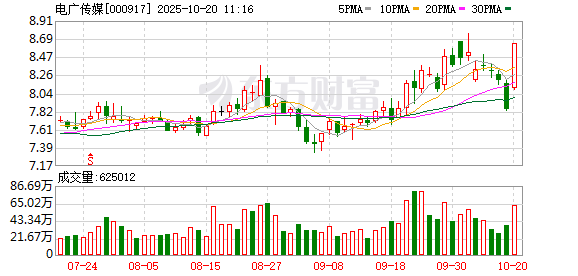
Group 1 - The stock of Dianguang Media (000917) opened high and surged, reaching the daily limit with a latest price of 8.64 yuan per share as of the report [2] - PCB concept stocks are active, with companies like Jingwang Electronics, Yidao Information, and Chenfeng Technology hitting the daily limit, while Weiergao and Hudian shares also saw increases [2] Group 2 - Cambrian's stock rose over 6% following the release of its Q3 financial report, which showed a revenue of 1.727 billion yuan, a year-on-year increase of 1332.52%, and a net profit of 567 million yuan [5] - For the first three quarters, Cambrian reported a revenue of 4.607 billion yuan, up 2386.38%, and a net profit of 1.605 billion yuan [5] Group 3 - Agricultural Bank's stock experienced a rebound, rising over 1% and reaching a historical high with a latest price of 7.71 yuan per share, and a total market capitalization exceeding 2.7 trillion yuan [8] - As of the report, the Shanghai Composite Index rose by 0.9% to 3874.41 points, the Shenzhen Component Index increased by 1.72% to 12907.70 points, and the ChiNext Index climbed by 3.06% to 3025.31 points, with over 4200 stocks in the three markets rising [10]


寒武纪股价涨5.08%,同泰基金旗下1只基金重仓,持有1.42万股浮盈赚取89.9万元
Xin Lang Cai Jing· 2025-10-20 03:09
Group 1 - The core viewpoint of the news is that Cambrian Technology Co., Ltd. has seen a significant increase in its stock price, rising by 5.08% to 1311.00 CNY per share, with a total market capitalization of 5484.57 billion CNY [1] - Cambrian's main business involves the research, design, and sales of artificial intelligence core chips for various cloud servers, edge computing devices, and terminal equipment, with 99.62% of its revenue coming from cloud products [1] - The company was founded on March 15, 2016, and went public on July 20, 2020, indicating a relatively recent entry into the public market [1] Group 2 - From the perspective of fund holdings, the Tongtai Digital Economy Stock A fund has increased its holdings in Cambrian by 2213 shares, making it the fourth largest holding in the fund, which has a net asset value proportion of 7.69% [2] - The fund has achieved a year-to-date return of 62.63%, ranking 137 out of 4218 in its category, and a one-year return of 78.13%, ranking 57 out of 3865 [2] - The fund manager, Chen Zongchao, has been in position for 4 years and 87 days, with the best fund return during his tenure being 25.84% [3]