SMIC(688981)

Search documents
芯片ETF天弘(159310)开盘涨1.82%,重仓股中芯国际涨1.47%,寒武纪涨2.18%
Xin Lang Cai Jing· 2025-11-20 01:41
Core Viewpoint - The chip ETF Tianhong (159310) opened with a gain of 1.82%, indicating positive market sentiment towards semiconductor stocks [1] Group 1: ETF Performance - The Tianhong chip ETF (159310) opened at 2.018 yuan, reflecting a 1.82% increase [1] - Since its establishment on April 18, 2024, the fund has achieved a return of 98.22% [1] - The fund's performance over the past month has seen a decline of 1.40% [1] Group 2: Major Holdings - Key stocks in the Tianhong chip ETF include: - SMIC (中芯国际) up 1.47% - Cambricon (寒武纪) up 2.18% - Haiguang Information (海光信息) up 2.47% - Northern Huachuang (北方华创) up 1.12% - Lattice Semiconductor (澜起科技) up 2.48% - Zhaoyi Innovation (兆易创新) up 2.46% - Zhongwei Company (中微公司) up 1.28% - OmniVision (豪威集团) up 0.83% - Chipone (芯原股份) up 2.68% - Changdian Technology (长电科技) up 1.09% [1]




半导体ETF南方(159325)开盘涨1.61%,重仓股中芯国际涨1.47%,寒武纪涨2.18%
Xin Lang Cai Jing· 2025-11-20 01:41
Group 1 - The semiconductor ETF from Southern (159325) opened with a gain of 1.61%, priced at 1.448 yuan [1] - Key holdings in the semiconductor ETF include companies like SMIC, which rose by 1.47%, and Cambrian, which increased by 2.18% [1] - The ETF's performance benchmark is the CSI Semiconductor Industry Select Index return, managed by Southern Fund Management Co., Ltd. [1] Group 2 - Since its establishment on October 31, 2024, the ETF has achieved a return of 42.44%, while the return over the past month has been -2.04% [1]

弱势盘整,恒生科技跌幅居前,消费、医疗、银行等紧随其后
Ge Long Hui· 2025-11-19 20:35
Group 1 - The Hang Seng Index experienced a slight decline of 0.38% after a narrow consolidation period, with the Hang Seng Technology sector leading the drop [1] - The Hang Seng Technology Index opened high but fell throughout the day, closing down 0.66%. Notable declines included Xiaomi Group down 4.81%, Kuaishou down 1.78%, and SMIC down 1.35% [3] - The banking sector also saw a decline, closing down 0.44%, with HSBC Holdings down 1.64%, Standard Chartered down 1.43%, and Dah Sing Bank down 1.33% [3] Group 2 - The Hang Seng Internet sector showed relative resilience, closing flat after opening high and then declining. Notable movements included Horizon Robotics down 1.83%, while Alibaba managed to rise 1.16% [3] - Other companies like JD Group and Meituan also experienced slight declines, with their stock prices falling by over 1% [3]




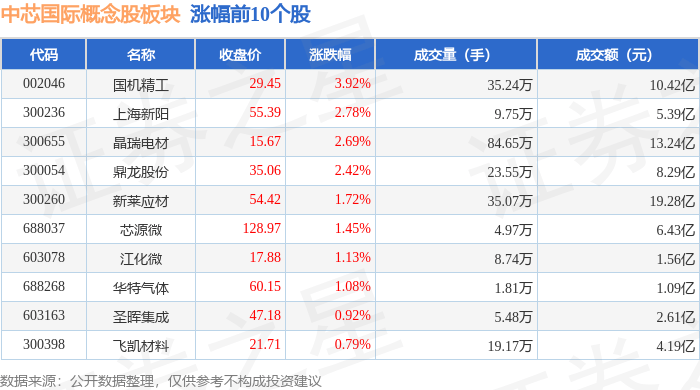
中芯国际概念股板块11月19日跌0.87%,汉钟精机领跌,主力资金净流出13.46亿元
Sou Hu Cai Jing· 2025-11-19 10:43
Market Overview - On November 19, the SMIC concept stock sector declined by 0.87%, with Hanbell Precise Machinery leading the drop [1] - The Shanghai Composite Index closed at 3946.74, up 0.18%, while the Shenzhen Component Index closed at 13080.09, unchanged [1] Stock Performance - Notable gainers in the SMIC concept stock sector included: - Guoji Precision Engineering (002046) with a closing price of 29.45, up 3.92% [1] - Shanghai Xinyang (300236) at 55.39, up 2.78% [1] - Jingrui Electric Materials (300655) at 15.67, up 2.69% with a trading volume of 846,500 shares and a transaction value of 1.324 billion [1] - Conversely, Hanbell Precise Machinery (002158) saw a significant decline of 6.39%, closing at 22.55 [2] - Other notable decliners included: - Taiji Industry (600667) down 5.27% [2] - Beijing Junzheng (300223) down 3.55% [2] Capital Flow - The SMIC concept stock sector experienced a net outflow of 1.346 billion from institutional investors, while retail investors saw a net inflow of 1.097 billion [2][3] - Key stocks with significant capital flow included: - Jingrui Electric Materials (300655) with a net inflow of 111 million from institutional investors [3] - New Lai Materials (300260) with a net inflow of 85.44 million [3] - Guoji Precision Engineering (002046) with a net inflow of 85.25 million [3]


科创板资金动向:5股主力资金净流入超亿元
Sou Hu Cai Jing· 2025-11-19 09:33
Market Overview - The net outflow of main funds in the Shanghai and Shenzhen markets reached 40.955 billion yuan, with the Sci-Tech Innovation Board experiencing a net outflow of 5.791 billion yuan [1] - A total of 178 stocks saw net inflows, while 415 stocks experienced net outflows [1] Sci-Tech Innovation Board Performance - On the Sci-Tech Innovation Board, 93 stocks rose, while 496 stocks fell, with one stock, He Xin Instrument, hitting the daily limit down [1] - C Hengkun, listed for 5 days, had a significant drop of 2.44% [1] Fund Flow Analysis - Among the 178 stocks with net inflows, five stocks had inflows exceeding 100 million yuan, led by Yuanjie Technology with a net inflow of 316 million yuan [2] - Other notable inflows included Changguang Huaxin and Yingshi Innovation, with net inflows of 144 million yuan and 113 million yuan, respectively [2] Continuous Fund Flow - 46 stocks showed continuous net inflows for more than three trading days, with Weigao Orthopedics leading at 10 consecutive days of inflow [2] - Conversely, 202 stocks experienced continuous net outflows, with Zhixiang Jintai leading at 17 consecutive days of outflow [2] Top Fund Inflows - The top stocks by net inflow included: - Yuanjie Technology: 315.73 million yuan, 10.22% inflow rate, 3.56% increase [2] - Changguang Huaxin: 144.31 million yuan, 11.14% inflow rate, 2.00% increase [2] - Yingshi Innovation: 113.72 million yuan, 21.35% inflow rate, 4.26% increase [2] Notable Outflows - The stocks with the highest net outflows included: - SMIC: 800.2 million yuan, 1.42% decrease [1] - Baiwei Storage: 344 million yuan outflow [1] - Guodun Quantum: 263 million yuan outflow [1]


电子行业资金流出榜:中芯国际、佰维存储等净流出资金居前
Zheng Quan Shi Bao Wang· 2025-11-19 09:28
Market Overview - The Shanghai Composite Index rose by 0.18% on November 19, with 10 industries experiencing gains, led by non-ferrous metals and petroleum & petrochemicals, which increased by 2.39% and 1.67% respectively. Conversely, the comprehensive and real estate sectors saw declines of 3.08% and 2.09% respectively [1] - The net outflow of capital from the two markets reached 40.955 billion yuan, with 7 industries seeing net inflows. The defense and military industry led with a net inflow of 3.610 billion yuan and a daily increase of 1.11%, followed by the banking sector with a 0.92% increase and a net inflow of 1.265 billion yuan [1] Electronic Industry Performance - The electronic industry fell by 0.90%, with a total net capital outflow of 7.580 billion yuan. Out of 471 stocks in this sector, 81 rose, 3 hit the daily limit up, while 388 fell, with 1 hitting the daily limit down [2] - Within the electronic sector, 127 stocks experienced net capital inflows, with 12 stocks seeing inflows exceeding 100 million yuan. The top inflow was for Nanda Optoelectronics, which had a net inflow of 338 million yuan, followed by Founder Technology and Yuanjie Technology with inflows of 319 million yuan and 316 million yuan respectively [2] Electronic Industry Capital Outflow - The stocks with the highest capital outflows in the electronic industry included SMIC, with a net outflow of 802 million yuan, followed by Baiwei Storage and Lanke Technology with outflows of 344 million yuan and 255 million yuan respectively [3] - Other notable stocks with significant outflows included Shengyi Electronics, Dongxin Co., and Lens Technology, with outflows of 253 million yuan, 251 million yuan, and 219 million yuan respectively [3]



主力动向:11月19日特大单净流出207.83亿元
Zheng Quan Shi Bao Wang· 2025-11-19 09:26
Market Overview - The net outflow of large orders in the two markets reached 20.783 billion yuan, with 36 stocks seeing net inflows exceeding 200 million yuan, led by Hailu Heavy Industry with a net inflow of 890 million yuan [1] - The Shanghai Composite Index closed up 0.18%, while a total of 1,526 stocks experienced net inflows and 3,248 stocks saw net outflows [1] Industry Performance - Among the 7 industries with net inflows, the defense and military industry topped the list with a net inflow of 2.929 billion yuan and an index increase of 1.11%, followed by non-ferrous metals with a 2.39% increase and a net inflow of 1.207 billion yuan [1] - A total of 24 industries experienced net outflows, with the electronics sector seeing the highest outflow of 4.716 billion yuan, followed by the computer sector with 4.620 billion yuan [1] Individual Stock Performance - 36 stocks had net inflows exceeding 200 million yuan, with Hailu Heavy Industry leading at 890 million yuan, followed by Zhongji Xuchuang at 817 million yuan [2] - Stocks with significant net outflows included Liou Co., with an outflow of 1.006 billion yuan, and Huasheng Tiancheng with 950 million yuan [2] - Stocks with net inflows of over 200 million yuan saw an average increase of 7.66%, outperforming the Shanghai Composite Index [2] Top Stocks by Net Inflow - Hailu Heavy Industry (002255) had a closing price of 13.92 yuan and a rise of 10.04% with a net inflow of 890 million yuan [3] - Zhongji Xuchuang (300308) closed at 488.60 yuan, up 3.32%, with a net inflow of 817 million yuan [3] - Other notable stocks include Yaguang Technology and Ganfeng Lithium, with net inflows of 690 million yuan and 532 million yuan, respectively [2] Top Stocks by Net Outflow - Liou Co. (002131) experienced the highest net outflow of 1.006 billion yuan, closing at 5.20 yuan with a decline of 5.11% [4] - Huasheng Tiancheng (600410) had a net outflow of 950 million yuan, closing at 21.67 yuan, up 1.45% [4] - Other significant outflows were seen in Zhongxin International and Dongfang Fortune, with outflows of 764 million yuan and 524 million yuan, respectively [4]


中芯国际(00981):供应链国产替代需求增长强劲,消费电子市场需求回暖
First Shanghai Securities· 2025-11-19 08:46
Investment Rating - The report assigns a "Buy" rating to the company with a target price of HKD 90.00, representing a potential upside of 21.63% from the current stock price of HKD 74.00 [3][6]. Core Insights - The semiconductor industry is experiencing strong domestic substitution demand, and the consumer electronics market is showing signs of recovery. The company is expected to benefit from these trends, with projected revenue growth driven by increased capacity utilization and demand from domestic clients [6][7]. - The company’s revenue for the fiscal year ending December 31, 2023, is reported at USD 6.32 billion, with a year-on-year decline of 13.09%. However, a significant recovery is anticipated in the following years, with a projected revenue CAGR of 38.6% over the next three years [5][6]. - The company’s net profit for 2023 is reported at USD 492.75 million, a decrease of 50.35% from the previous year, but is expected to rebound significantly in subsequent years, with a CAGR of 90.6% [5][6]. Financial Summary - For the fiscal year 2023, the company reported total revenue of USD 6.32 billion, with a projected increase to USD 8.03 billion in 2024 and further growth to USD 9.40 billion in 2025 [5][6]. - The gross profit margin for 2023 is reported at 18.0%, with expectations of improvement to 21.0% in 2024 and 24.5% in 2025 [7]. - The company’s capital expenditure for Q3 2025 increased by 27.0% to USD 2.39 billion, driven by the recovery of equipment shipments previously affected by geopolitical issues [6][7]. - The company’s cash flow from operations is projected to improve significantly, with operating cash flow expected to reach USD 4.71 billion by 2025 [8].
雷军吐槽涨价实在太多了!中芯国际赵海军:存储芯片产能紧张逼得手机厂商不敢下单
Qian Zhan Wang· 2025-11-19 07:38
Core Insights - The global storage chip market is expected to experience a price surge starting in the second half of 2025, driven by increased demand for AI computing power, creating a challenging situation for the smartphone industry [2] - Major smartphone manufacturers like Xiaomi, OPPO, and vivo are facing supply chain pressures, with upstream suppliers (Micron, Samsung, SK Hynix) raising prices by nearly 50%, forcing manufacturers to make difficult choices between accepting price hikes or risking supply shortages [2][3] - The storage chip industry is characterized by high technical and financial barriers, with significant requirements for R&D capabilities and capital investment, leading to a market dominated by a few key players [3][6] Industry Dynamics - Xiaomi has already begun to feel the impact of rising costs, with the price of its Redmi K90 standard version increasing by 300 yuan to 2599 yuan compared to the previous generation K80 [3] - The storage chip market is highly concentrated, with Samsung holding a 43.03% share in the DRAM segment and 34% in the NAND segment, followed by SK Hynix and Micron [6] - Morgan Stanley has indicated that upstream manufacturers like SK Hynix and Samsung will benefit from increased profit margins due to their strong pricing power, while downstream sectors such as PCs and smartphones will face significant cost pressures [7]


超4100只个股下跌
第一财经· 2025-11-19 07:37
Market Overview - The A-share market experienced a fluctuating trend, with the Shanghai Composite Index rising by 0.18% to close at 3946.74, while the Shenzhen Component Index remained flat and the ChiNext Index increased by 0.25% to 3076.85 [3][4]. Sector Performance - The gold sector showed strength, and the aquaculture sector surged in the afternoon, with stocks like Guolian Aquatic and Zangzi Island hitting the daily limit [4][5]. - The banking sector also performed well, with China Bank rising over 3% to reach a historical high, alongside significant gains in other banks like Everbright Bank and Ping An Bank [6]. Trading Volume and Market Sentiment - The total trading volume in the Shanghai and Shenzhen markets was 1.73 trillion, a decrease of 200.2 billion from the previous trading day, with over 4100 stocks declining [7]. - Main funds saw a net inflow into sectors such as telecommunications, banking, and precious metals, while there was a net outflow from computer, media, and pharmaceutical sectors [9]. Institutional Insights - Shenwan Hongyuan predicts a comprehensive market rally may start in the second half of 2026, marking the beginning of "Bull Market 2.0" [10]. - Zhongyuan Securities notes that the current A-share market is in a phase of consolidation around the 4000-point mark, with a likely continuation of style rebalancing between cyclical and technology sectors [11]. - CITIC Securities observes that the Shanghai Composite Index is fluctuating around 4000 points, with total market turnover decreasing to around 2 trillion, indicating active investment in thematic and growth sectors [12].