
SPD BANK(600000)

Search documents
四大证券报精华摘要:1月23日
Zhong Guo Jin Rong Xin Xi Wang· 2026-01-23 00:17
Group 1: Commercial Aerospace - The Chinese commercial aerospace sector is entering a new phase aimed at large-scale launches and commercial closed-loop systems, with significant breakthroughs expected in rocket capacity over the next 3 to 5 years [1] - By 2025, China's commercial aerospace is projected to complete 50 launches, accounting for 54% of total space launches, with 25 commercial rockets launched and 311 commercial satellites in orbit, representing 84% of total satellites [1] - The capital market for commercial aerospace companies is accelerating, with several leading firms preparing for IPOs, including Blue Arrow Aerospace and Zhongke Aerospace [1] Group 2: Public Fund Performance - The latest public fund reports reveal that the top ten holdings include companies like Zhongji Xuchuang, Ningde Times, and Tencent, with notable increases in holdings for companies like Zhongji Xuchuang, which saw an increase of 22.602 billion yuan [2] - The automotive industry is facing cost pressures due to rising prices of memory chips and metals, impacting supply chain dynamics and competition [2] Group 3: Biopharmaceutical Industry - Over 50 biopharmaceutical companies have disclosed their 2025 performance forecasts, with nearly 50% showing positive expectations, particularly in the CXO sector, where WuXi AppTec anticipates a revenue increase of approximately 15.84% [3] - The biopharmaceutical industry is expected to enter a new phase of high-quality development as structural reforms and supportive policies continue to evolve [3] Group 4: Fundraising and Market Trends - The public fund market has seen a resurgence, with several equity funds raising over 7 billion yuan, indicating a positive trend in active equity fund performance [4] - The Shanghai Suiruan Technology Co., Ltd. has received approval for its IPO, aiming to raise 6 billion yuan for product development and business expansion [5] Group 5: Aluminum Market - The aluminum market has shown strong performance, with prices rising over 12% since mid-December 2025, supported by favorable macroeconomic conditions and demand for aluminum in various applications [6] - The copper-aluminum price ratio exceeding 4 suggests a potential shift towards aluminum in sectors like air conditioning, indicating new demand growth [6] Group 6: Banking Sector - Five listed banks have reported a year-on-year increase in net profit for 2025, with improvements in non-performing loan ratios for three banks [9] - The banking sector is expected to maintain stable performance, supported by improved funding costs and a potential stabilization of net interest margins [9] Group 7: Chemical Industry - The chemical industry is experiencing positive performance, with over 60% of companies reporting improved earnings, driven by rising prices of certain chemical products [10] - The DOP market is expected to maintain upward momentum due to strong raw material prices and limited supply, indicating a stable support for pricing [10]





银行探路“航天+”: 一本成本账 一盘生态棋
Zhong Guo Zheng Quan Bao· 2026-01-22 21:51
Core Insights - The article discusses the increasing involvement of commercial banks in the "finance + aerospace" integration, highlighting the significant financial investments required for satellite development, launch, and operation [1] Group 1: Satellite Launches and Applications - Several banks, including China Merchants Bank and Pudong Development Bank, successfully launched satellites, namely "Zhaoyin Jinkui" and "Puyin Shuzhi," which are part of China's first low-orbit satellite IoT constellation, "Tianqi Constellation" [1] - Pudong Development Bank aims to leverage its communication service expertise to innovate applications in financial asset lifecycle management and cross-border asset and trade supervision using the satellite data capabilities [1] Group 2: Technological Integration in Banking - China Merchants Bank has integrated remote sensing satellite technology into its financial risk control system, enhancing efficiency in post-loan monitoring of real estate projects across the country [3] - The bank has initiated the application verification of low-orbit satellite communication technology in its financial disaster recovery systems, establishing a technical foundation for a comprehensive financial emergency communication network [3] Group 3: Value Proposition and Investment Returns - The technology is expected to address three core pain points in traditional banking risk control: remote monitoring of collateral and project progress, application in agricultural finance to reduce data collection costs and loan default risks, and obtaining independent data from space to mitigate information asymmetry [4] - Investment returns from satellite systems are characterized by low initial returns, stable mid-term returns, and increasing long-term value as applications expand into green finance, cross-border finance, and disaster recovery [4] - Differentiated strategies are emerging, with large banks building their satellite systems to control data and create technological barriers, while smaller banks are opting for data service procurement or third-party platform integration for practical participation [4]


银行探路“航天+”:一本成本账 一盘生态棋
Zhong Guo Zheng Quan Bao· 2026-01-22 20:56
Core Insights - The banking sector is actively exploring the integration of finance and aerospace, particularly in the context of commercial space ventures, while facing challenges related to the significant funding required for satellite development, launch, and operation [1] Group 1: Satellite Launches and Applications - Several banks, including China Merchants Bank and Shanghai Pudong Development Bank, successfully launched satellites, namely "Zhaoyin Jinkui" and "Puyin Shuzhi," which are part of China's first low-orbit satellite IoT constellation, "Tianqi Constellation" [1] - Shanghai Pudong Development Bank aims to leverage its communication service capabilities to innovate applications in financial asset lifecycle management and cross-border asset and trade supervision, supporting the large-scale development of the satellite IoT industry [1] Group 2: Technological Integration and Risk Management - China Merchants Bank has integrated remote sensing satellite technology into its financial risk control system, enhancing the efficiency of post-loan inspections through high-precision monitoring of construction progress across the country [2] - The bank has initiated the application verification of low-orbit satellite communication technology in its financial disaster recovery systems, establishing a technical foundation for a comprehensive financial emergency communication network [2] Group 3: Strategic Importance and Value Realization - Banks have been pursuing satellite-related strategies for years, driven by needs for risk control and business upgrades, with technologies like big data and satellite remote sensing becoming crucial for rural revitalization efforts [3] - The investment return from satellite systems is characterized by low initial returns, stable mid-term returns, and increasing long-term value as applications expand into green finance, cross-border finance, and disaster recovery systems [3] Group 4: Implementation Strategies - There is a consensus in the industry regarding differentiated implementation strategies, where large banks build their satellite systems to control data and create technological barriers, while smaller banks opt for purchasing data services or accessing third-party platforms to participate effectively [4]
5家上市银行披露业绩快报 归母净利润均实现同比增长
Zheng Quan Ri Bao Zhi Sheng· 2026-01-22 16:38
Group 1 - As of January 22, 2025, five listed banks in A-shares have reported their preliminary performance for the year, showing an overall increase in net profit attributable to shareholders compared to 2024 [1] - Among these banks, three have reported a decrease in non-performing loan (NPL) ratios compared to the end of 2024 [1] - Shanghai Pudong Development Bank (SPDB) reported a revenue of 173.96 billion yuan, a year-on-year increase of 1.88%, and a net profit of 50.02 billion yuan, up 10.52% [1] - CITIC Bank and Industrial Bank reported revenues of 212.48 billion yuan and 212.74 billion yuan, with net profits of 70.62 billion yuan and 77.47 billion yuan, reflecting year-on-year growth of 2.98% and 0.34% respectively [1] - Ningbo Bank and Su Nong Bank also reported positive growth, with Ningbo Bank's revenue at 71.97 billion yuan (up 8.01%) and net profit at 29.33 billion yuan (up 8.13%), while Su Nong Bank's revenue was 4.19 billion yuan (up 0.41%) and net profit was 204.3 million yuan (up 5.04%) [1] Group 2 - Ningbo Bank disclosed its revenue structure, reporting net interest income of 53.16 billion yuan (up 10.77%) and net fee and commission income of 6.09 billion yuan (up 30.72%) [2] - All five listed banks have shown steady growth in total assets, with SPDB and CITIC Bank both surpassing 1 trillion yuan in total assets, reaching 1.008 trillion yuan and 1.013 trillion yuan respectively, marking increases of 6.55% and 6.28% from 2024 [2] - Industrial Bank's total assets reached 1.109 trillion yuan, up 5.57%, while Ningbo Bank's total assets grew by 16.11% to 363 billion yuan, and Su Nong Bank's total assets increased by 8% to 231.1 billion yuan [2] - In terms of asset quality, SPDB, CITIC Bank, and Su Nong Bank reported declines in NPL ratios, with ratios of 1.26%, 1.15%, and 0.88% respectively, while Ningbo Bank's NPL ratio remained stable and Industrial Bank's increased by 0.01 percentage points [2] Group 3 - The banking industry is expected to maintain stable performance in 2025, supported by significant improvements in funding costs, which are likely to stabilize net interest margins and boost interest income [3] - Analysts predict that the growth rates of revenue and net profit for listed banks in 2025 will improve compared to the first three quarters of 2025, driven by stable net interest margins and declining credit costs [3] - SPDB noted a significant decrease in interest costs, leading to a stabilization of net interest margins, while Ningbo Bank benefited from a 33 basis point drop in deposit interest rates, resulting in substantial growth in interest income [3] - The effects of previous reductions in deposit rates are expected to continue into 2026, helping to improve funding costs and reduce pressure on net interest margins, indicating a potential recovery phase [3]




浦发银行 x 同花顺:APP焕新升级,不止于金融工具
Xin Lang Cai Jing· 2026-01-22 10:09
Group 1 - The core viewpoint of the article emphasizes the comprehensive upgrade of wealth services, aiming to make investments smarter and more professional [14][12] - The company is focusing on creating a multi-dimensional wealth ecosystem that includes interactive community features to help users navigate market fluctuations and make informed investment decisions [15][4] - The introduction of over 20 specialized product sections provides a diverse range of investment options, including real-time market insights and selected institutional strategies [16][5] Group 2 - The company is enhancing its pension financial services, offering a holistic approach that integrates various types of pension assets and elder-friendly services to improve the quality of retirement life [18][17] - The pension ecosystem includes features such as health management and community services, aimed at ensuring long-term care and peace of mind for users [20][19] - The updated app is designed to be more than just a financial tool, aspiring to be a partner that understands users' needs in their daily lives [12][21]



多家银行发文明确信用卡账单分期贴息细节,开启补申请通道
Bei Jing Shang Bao· 2026-01-22 09:37
Core Viewpoint - The Chinese government has introduced a new personal consumption loan interest subsidy policy, which aims to enhance consumer spending and stimulate the economy by providing financial incentives through interest subsidies on personal loans and credit card installments [1][3]. Group 1: Policy Implementation - The new subsidy policy will be effective from September 1, 2025, to December 31, 2026, for personal consumption loans, while the credit card installment subsidy period will be from January 1, 2026, to December 31, 2026 [3]. - The policy expands the support scope by including credit card installment payments for the first time, with a subsidy rate of 1% per annum, and removes previous restrictions on consumption areas [3][4]. Group 2: Bank Responses - Major banks such as ICBC, ABC, BOC, CCB, and others have quickly responded by issuing operational guidelines and clarifications regarding the implementation of the subsidy policy [2][3]. - Banks have confirmed that customers who have already signed consumption loan subsidy agreements will automatically benefit from the new policy without needing to re-sign agreements [4][5]. Group 3: Customer Guidance - Customers are required to sign a supplementary agreement for credit card installment subsidies, with each card needing a separate agreement to benefit from the subsidy during the policy period [5][6]. - Banks are advised to streamline the process for customers to access the subsidy, including online application portals and clear communication of interest rates and subsidy limits [6][7]. Group 4: Market Impact - The minimum execution interest rate for consumption loans remains at 3%, but with the subsidy, the effective interest rate for eligible borrowers could potentially drop to the "2% range" [7].





银行行业资金流出榜:招商银行、华夏银行等净流出资金居前
Zheng Quan Shi Bao Wang· 2026-01-22 09:25
Market Overview - The Shanghai Composite Index rose by 0.14% on January 22, with 22 out of the 28 sectors experiencing gains. The top-performing sectors were building materials and defense, with increases of 4.09% and 3.23% respectively. The banking sector was among the top decliners, down by 0.43% [1] Capital Flow Analysis - The main capital flow showed a net outflow of 21.612 billion yuan across the two markets. However, 12 sectors saw net inflows, with the telecommunications sector leading at a net inflow of 8.019 billion yuan and a daily increase of 2.83%. The defense sector also performed well, with a net inflow of 5.713 billion yuan and a daily increase of 3.23% [1] - Conversely, 19 sectors experienced net outflows, with the electronics sector leading at a net outflow of 13.206 billion yuan, followed by the power equipment sector with a net outflow of 7.206 billion yuan. Other sectors with significant outflows included non-ferrous metals, automobiles, and pharmaceuticals [1] Banking Sector Performance - The banking sector saw a decline of 0.43% with a net outflow of 545 million yuan. Out of 42 stocks in this sector, 26 rose while 14 fell. Notably, 25 stocks had net inflows, with Jiangsu Bank leading at a net inflow of 224 million yuan, followed by Bank of Communications and Minsheng Bank with inflows of 152 million yuan and 98.929 million yuan respectively [2] - The stocks with the highest net outflows included China Merchants Bank, Huaxia Bank, and Shanghai Pudong Development Bank, with outflows of 743 million yuan, 184 million yuan, and 156 million yuan respectively [2] Individual Stock Performance - The following table summarizes the performance of key banking stocks based on their net capital flow and daily change: | Stock Code | Stock Name | Daily Change (%) | Turnover Rate (%) | Net Capital Flow (10,000 yuan) | | --- | --- | --- | --- | --- | | 600036 | China Merchants Bank | -1.02 | 0.91 | -7426.622 | | 600015 | Huaxia Bank | -0.92 | 0.82 | -1836.242 | | 600000 | Shanghai Pudong Development Bank | -1.02 | 0.46 | -1555.792 | | 601939 | China Construction Bank | -1.92 | 1.44 | -1473.762 | | 601988 | Bank of China | -0.56 | 0.12 | -1247.776 | | 601288 | Agricultural Bank of China | -2.16 | 0.15 | -504.228 | | 601166 | Industrial Bank | -1.33 | 0.69 | -398.051 | | 601998 | CITIC Bank | -1.58 | 0.17 | -213.897 | | 002936 | Zhengzhou Bank | 0.53 | 1.30 | -147.699 | | 601665 | Qilu Bank | 1.65 | 0.89 | -144.610 | | 601577 | Changsha Bank | 0.75 | 0.32 | -122.400 | | 601187 | Xiamen Bank | -1.40 | 0.49 | -100.037 | | 603323 | Suning Bank | 1.01 | 1.52 | -89.489 | | 002839 | Zhangjiagang Bank | 0.90 | 1.07 | -67.650 | | 002958 | Qingnong Commercial Bank | 0.97 | 0.86 | -54.434 | | 601963 | Chongqing Bank | 0.10 | 0.48 | -44.601 | | 601997 | Guiyang Bank | 0.35 | 0.71 | -9.478 | | 600928 | Xi'an Bank | 0.82 | 0.49 | 47.776 | | 601860 | Zijin Bank | 0.73 | 1.18 | 49.415 | [2][3]




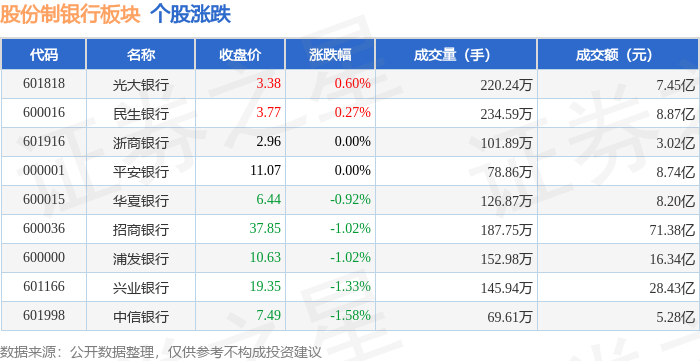
股份制银行板块1月22日跌0.86%,中信银行领跌,主力资金净流出9.6亿元
Zheng Xing Xing Ye Ri Bao· 2026-01-22 09:01
从资金流向上来看,当日股份制银行板块主力资金净流出9.6亿元,游资资金净流出2.76亿元,散户资金 净流入12.36亿元。股份制银行板块个股资金流向见下表: | 代码 | 名称 | 收盘价 | 涨跌幅 | 成交量(手) | 成交额(元) | | --- | --- | --- | --- | --- | --- | | 601818 | 光大银行 | 3.38 | 0.60% | 220.24万 | 7.45 Z | | 600016 | 民生银行 | 3.77 | 0.27% | 234.59万 | 8.87亿 | | 601916 | 浙商银行 | 2.96 | 0.00% | 101.89万 | 3.02亿 | | 000001 | 平安银行 | 11.07 | 0.00% | 78.86万 | 8.74亿 | | 600015 | 华夏银行 | 6.44 | -0.92% | 126.87万 | 8.20亿 | | 600036 | 招商银行 | 37.85 | -1.02% | 187.75万 | 71.38亿 | | 600000 | 浦发银行 | 10.63 | -1.02% | 152.98万 ...


商业航天热已经传到银行了!招行浦发放卫星,放贷已经卷到外太空了?
Sou Hu Cai Jing· 2026-01-22 08:53
Group 1 - The core idea of the articles highlights the unexpected collaboration between commercial banks and the aerospace industry, where banks like China Merchants Bank and Shanghai Pudong Development Bank are launching their own satellites for financial risk management [1][2] - The satellites, named "Zhaoyin Jinkui" and "Pudong Shuzhi," are designed to enhance banks' ability to monitor collateral and project progress, providing a technological upgrade to traditional methods of oversight [1] - With the integration of AI, these satellites can analyze construction activities and logistics in real-time, achieving a monitoring accuracy of over 95%, thus preventing potential financial losses from project mismanagement [1] Group 2 - The trend indicates a shift in the banking industry, where competition is extending beyond traditional financial metrics like interest rates to include technological capabilities such as satellite surveillance [2] - This development suggests that in the near future, banks may need to invest in space technology to remain competitive, indicating a new frontier in the financial services sector [2]
数字人民币2.0:从M0到M1的质变
GF SECURITIES· 2026-01-22 05:07
Investment Rating - The report provides a "Buy" rating for all major banks analyzed, indicating a positive outlook for the banking sector [7]. Core Insights - The digital renminbi has entered its 2.0 era, transitioning from a central bank liability (M0) to a commercial bank liability (M1), allowing it to earn interest and be included in deposit insurance and reserve requirements [6][14]. - This transformation positions China as the first economy to offer interest on its central bank digital currency (CBDC), fundamentally altering its monetary attributes and creating a new financial paradigm in the digital economy [27]. - The digital renminbi's interest-bearing feature enhances user motivation to hold it, shifting its perception from a mere payment tool to a viable store of value, thus promoting its integration into everyday financial activities [27][28]. Summary by Sections 1. Digital Renminbi 2.0 Era - The digital renminbi (e-CNY) is now classified as a digital deposit currency, which can earn interest and is managed under a new regulatory framework [14]. - Major state-owned banks have begun offering interest on digital renminbi wallet balances, marking a significant shift in its utility and appeal [14][27]. 2. Development Progress and Application Status - The development of the digital renminbi began in 2014, with significant milestones including pilot tests in various cities and the establishment of a comprehensive operational framework by 2025 [32][33]. - As of November 2025, the digital renminbi has processed 34.8 billion transactions amounting to 16.7 trillion yuan, with extensive coverage across multiple provinces and cities [37]. 3. Global CBDC Development Trends - The report identifies three main trends in global CBDC development: active retail CBDC initiatives, innovation in payment systems, and cautious approaches in some countries like the U.S. [6]. - China's proactive stance in developing its CBDC positions it favorably in the global digital economy landscape, particularly in cross-border trade applications [30].
